
Lecture
Introduction Music in video games is not just background. It is a powerful tool that shapes the atmosphere, guides the player's emotions and even influences gameplay. Unlike films, where music is linear, in games it has to be dynamic and interactive.
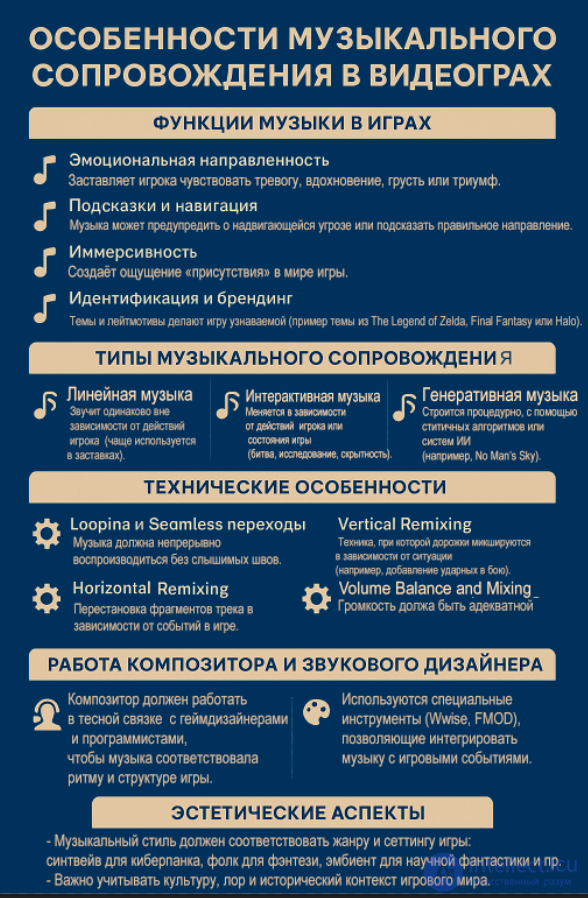
Emotional guidance: Makes the player feel anxiety, inspiration, sadness or triumph.
Cues and navigation: Music can warn of an impending threat or point the player in the right direction.
Immersion: Creates a sense of «presence» in the game world.
Identity and branding: Themes and leitmotifs make a game recognizable (think of the themes from The Legend of Zelda, Final Fantasy or Halo).
Music in video games plays an invaluably important role, performing a multitude of functions, each of which contributes to deepening the gaming experience and the emotional connection with the player. One of the key functions of music is emotional guidance. It is music that is able to evoke in the player feelings of anxiety in the face of danger, inspiration during an epic feat, sadness at the loss of a character or exultation in the moment of victory. The audio accompaniment is an invisible director of emotions: it prompts you when to relax and when to be on your guard, shaping the emotional landscape of a scene. For example, in horror games the tense sound of violins or a muffled bass can create a feeling of constant threat, even if nothing is happening on screen yet.
The next function is cues and navigation. Here music works as a tool of interactive information. A change in tempo, key or the appearance of a distinctive motif can signal an approaching enemy, the solution to a puzzle or the correct direction to move. Such audio cues are especially important in open-world games or in quests, where visual hints may be minimal. Music becomes part of the game mechanics, helping the player make decisions even if they are not aware of it.
No less important is immersion, that is, music's ability to draw the player into the virtual world. Music shapes the atmosphere and makes the world alive and convincing. Depending on the genre and setting of the game, this may be a minimalist ambient accompaniment underscoring the loneliness of the protagonist in a post-apocalypse, or a rich orchestral score enhancing the scale of fantasy battles. Without a sound environment, even the most detailed graphics lose part of their persuasiveness — the player stops feeling like a part of the world.
And finally, we must not forget the function of identity and branding. Musical themes and leitmotifs make a game recognizable and form its audiovisual image, which stays in memory for years. Classic examples are the main theme of The Legend of Zelda, the melodies from Final Fantasy or the iconic intro from Halo. These melodies become a kind of logo that instantly evokes in the mind images, emotions and memories associated with the game. This is especially important from the standpoint of marketing and building a long-term connection between the player and the brand.
Thus, music in games is not just a background accompaniment, but a full-fledged tool of storytelling, interaction and identity. It controls our emotions, points the way, immerses us in the world and makes games unforgettable.
There are several sources of sounds and tracks — generation by artificial intelligence systems, creating it yourself, hiring musicians, buying paid works or using free musical compositions. Let us examine where and how any musical work comes into being.
Creating a musical composition is a creative process that includes both artistic and technical aspects.
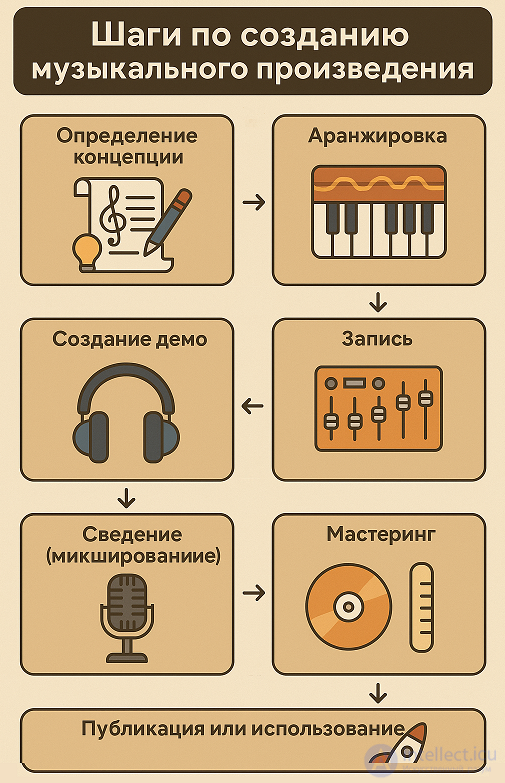
Below are the universal steps suitable for creating any musical composition — from a song to an instrumental piece:
Genre: pop, rock, electronic music, classical, etc.
Mood: sadness, joy, anxiety, solemnity.
Purpose: personal self-expression, musical accompaniment, commercial release, soundtrack.
Melody: created on an instrument, by voice or in digital form.
Harmony: chords that support the melody.
Rhythm: choice of time signature, tempo and rhythmic pulse.
Lyrics (if any): writing the words, choosing the rhymes, the logic of verses and choruses.
Instruments: which sounds will be used (guitar, synthesizer, violin, drums).
Structure: intro, verse, chorus, bridge, coda.
Dynamics: where there will be a build-up and where a decline.
A simple recording to «hear» how it sounds.
It can be done in a home studio or on a computer in a DAW (for example, FL Studio, Logic Pro, Ableton).
Live instruments or virtual ones (VST).
Vocals (if any): recorded with the necessary takes.
Microphones, an audio interface and a sequencer (DAW) are used.
Balancing the volume of all tracks.
Panning (distributing across the stereo field).
Processing: equalizer, compressor, reverb and other effects.
Final polishing of the sound.
Adding realistic distortions and noise.
Adjusting the volume to standards (Spotify, radio, etc.).
Preparing for release (formats, loudness, export).
Release on platforms (Spotify, YouTube, SoundCloud, etc.).
Use in films, games, advertising, etc.
Copyright protection (optional).
Working as a team (lyricist, composer, producer).
Inspiration from other genres and cultures.
Using artificial intelligence or sound generators.
Linear music: Plays the same regardless of the player's actions (more often used in cutscenes).
Interactive music: Changes depending on the player's actions or the state of the game (battle, exploration, stealth).
Generative music: Built procedurally, using algorithms (for example, No Man’s Sky).
Musical accompaniment in video games can take different forms depending on the tasks, the genre and the degree of interaction with the player. The main types of musical accompaniment include linear, interactive and generative music, each of which has its own features and areas of application.
Linear music is the most traditional form of soundtrack, which sounds the same on every playback and does not depend on the player's actions. Most often it is used in cutscenes, intros, closing videos or other pre-staged episodes. Such music allows the composer to precisely control the emotional rhythm and dynamics of a scene, enhancing the drama and helping to convey the story. Linear music is especially appropriate where cinematic quality and a predetermined pace of narration are important, as, for example, in story-driven RPGs or visual novels.
Interactive music is a more complex and flexible type that responds to the player's actions or the state of the game. This can be a change of musical theme when transitioning from exploration to combat, an increase in tension when approaching an enemy, or the complete fading of the music in moments of stealth. In an interactive system the music is arranged modularly: various layers (drums, strings, effects) can be turned on or off depending on the situation. This approach makes gameplay more alive and personalized, reinforcing the feeling that the music is «following» the player's actions. Good examples of interactive music are the soundtracks to The Witcher 3, DOOM (2016) or Red Dead Redemption 2, where the transition between states happens smoothly and imperceptibly, yet creates a powerful emotional effect.
Generative music is a form of musical accompaniment created not from pre-recorded tracks, but with the help of algorithms in real time. Such music can be unique on every playthrough and practically endless. The algorithms take into account certain rules and conditions on the basis of which they generate musical elements: rhythms, melodies, tempos. The generative approach is especially appropriate in open-world games, procedural generation or abstract gameplay. A striking example is No Man’s Sky, where the music adapts to the environment, the planets and the player's actions, creating a unique audio experience that is not exactly repeated for any user.
Thus, the choice of the type of musical accompaniment depends on what role the music is meant to play in the gameplay — whether it is emphasizing the drama, accompanying dynamic interaction with the world, or creating a unique soundscape. All these approaches do not exclude one another, and modern games often combine them to achieve maximum immersion and expressiveness.
Looping and Seamless transitions: The music must play continuously without audible seams.
Vertical Remixing: A technique in which tracks are mixed depending on the situation (for example, adding drums in combat).
Horizontal Re-sequencing: Rearranging fragments of a track depending on events in the game.
The volume must be appropriate — neither quieter nor louder than all the other sounds and music.
The technical features of musical accompaniment in games play a key role in creating a smooth, realistic and expressive audio experience. Unlike films, where music plays according to a rigid script, in video games it must be flexible, adaptive and continuous in order to match the unpredictability of the player's actions and the specifics of the game world.
One of the most important tasks is looping — the cyclical playback of music. Musical fragments must loop in such a way that the player does not notice the beginning and end — this is especially important for tracks that play for a long time, for example during moments of exploration. To achieve this, composers and sound engineers use special techniques for writing and processing tracks, achieving seamless transitions — ones in which the moment of repetition sounds natural and imperceptible. This is especially critical in open-world games or when staying in one place for a long time, where even the slightest audio "seam" can break the immersion.
The next technology is vertical remixing. This is a method in which a musical track consists of several layers or tracks (for example, bass, drums, melody, atmospheric sounds), and depending on the situation in the game some layers can be added or turned off. For example, when transitioning from calm exploration to a combat scene, a layer of rhythmic drums or reinforced orchestration can be added to the composition. At the same time the main melody remains the same, which makes it possible to preserve musical integrity while varying the mood and intensity. This approach gives the composer and game designer a flexible tool for managing emotional dynamics without having to start a new composition.
Another important technique is horizontal re-sequencing. Unlike the vertical approach, here we are talking about rearranging musical fragments horizontally, that is, in time. A musical track is broken up into separate parts, and depending on game events they can be played in different sequences. This can be useful, for example, when alternating calm moments and tense ones — the game can jump to the needed fragment without restarting the track, thereby preserving a sense of continuity. Horizontal re-sequencing is especially effective in interactive scenes, when it is necessary to react instantly to the player's actions.
Finally, the volume of the musical accompaniment must be carefully balanced relative to the other sounds of the game. The music must not drown out important interface sounds, character voices or environmental sounds, but neither should it be too quiet and lost in the background. This balance is achieved through mixing and dynamic volume adjustment. In some games the volume of the music also changes automatically depending on the gameplay — for example, it intensifies at climactic moments and weakens during pauses, which helps to additionally focus the player's attention.
Thus, the technical features of musical accompaniment are not just implementation details, but full-fledged tools of artistic expression. They ensure the smoothness, expressiveness and interactivity of the music, making it an integral part of the gaming experience.
The composer must work in close collaboration with game designers and programmers so that the music matches the rhythm and structure of the game.
Special tools (Wwise, FMOD) are used, allowing music to be integrated with game events.
The work of a composer and sound designer in the gaming industry requires not only musical talent, but also a deep understanding of game design, the logic of gameplay and the technical side of development. Unlike cinema, where music is created to fit already edited footage, in games the sound must be flexible and adaptive, which means the composer is obliged to work in close collaboration with game designers and programmers. Joint work makes it possible to ensure that the music fits organically into the gameplay, matches the rhythm of events and the logic of scenes, enhances the necessary emotions and does not interfere with the perception of what is happening.
It is important for the composer to understand which game states require musical accompaniment, which transitions between them are possible, and how long the player may stay in one scene or another. Programmers, in turn, help to integrate the music into the game engine and control it in real time. Such cooperation is especially necessary when working with interactive or adaptive music, where melodies must respond to the player's actions, change their sound depending on the situation and smoothly transition from one theme to another.
To implement complex musical logic, special tools are used, such as Wwise and FMOD. These are powerful audio environments that make it possible not just to play back tracks, but to build entire sound scenarios, set playback conditions, configure mixing, track switching, looping and much more. With the help of these tools the composer and sound designer can literally "program" the behavior of the music depending on what is happening in the game. For example, it is possible to set it up so that as the player's health decreases an anxious motif intensifies, and upon victory a triumphant choir kicks in. All of this is created not manually in code, but with the help of visual interfaces and logic diagrams, which makes the process more convenient and creative.
Thus, a composer in games is not only a creator of melodies, but an active participant in development, who, together with the rest of the team, builds a living, interactive sound environment. And the sound designer helps to embed these ideas into the technological foundation of the project, ensuring their correct and expressive implementation. The result of such teamwork is music that not only sounds, but lives together with the game and the player.
The musical style must correspond to the genre and setting of the game: synthwave for cyberpunk, folk for fantasy, ambient for science fiction, and so on.
It is important to take into account the culture, lore and historical context of the game world.
The aesthetic aspects of musical accompaniment in video games play a key role in shaping a unique atmosphere and the artistic appearance of the game world. Here music is not just a background element, but a full-fledged expressive component that helps the player feel the spirit of the era, the genre, the cultural context and the mood of the space. One of the most important principles is the correspondence of the musical style to the genre and setting of the game. So, for example, synthwave fits organically into cyberpunk projects — synthetic sounds, electronic rhythms and a retro atmosphere emphasize the technogenic aesthetic and the city of the future. In fantasy games, elements of folk, ethnic instruments and archaic intonations are often used, creating a feeling of an ancient world, magic and fairy tale. In science fiction, ambient is appropriate — abstract soundscapes, drawn-out textures and minimalism that convey the boundlessness of space, loneliness or the grandeur of technology.
The musical aesthetic should not be accidental, but a well-considered part of the artistic concept. That is precisely why it is important to take into account the culture, lore and historical context of the game world. If a game is inspired by a particular era, region or mythology, this should be reflected in the soundtrack as well. For example, a game set in a loosely Slavic world may use motifs of Old Russian or Balkan music, while in a game based on Japanese mythology instruments such as the shamisen, koto and taiko drums are appropriate. Even in fantastical or entirely fictional worlds, the music must follow the logic of the internal style — be an organic part of the «universe», rather than an external decoration.
Thus, the aesthetic design of music in a video game is the result of a subtle artistic choice that supports the integrity of the project. Music helps the visuals «come to sound», enhances the narrative, and makes the game world alive, convincing and memorable. A well-chosen musical style becomes an integral part of the gameplay and the player's emotional experience.
1. Orchestral music / Epic (Epic Orchestral) Used in role-playing games, strategy games and games with a high level of pathos or drama (e.g. The Elder Scrolls, Final Fantasy).
Features: rich timbre, live strings, brass, choir.
Effect: loftiness, epicness, emotional involvement.
2. Electronic / EDM / Synthwave Often heard in science-fiction and futuristic projects (Cyberpunk 2077, Hotline Miami).
Features: synthesizers, a powerful beat, repetitive rhythms.
Effect: a neon atmosphere, dynamism, rhythm.
3. Ambient (Ambient) Ideal for atmospheric or meditative games (Journey, Abzû, Inside).
Features: soundscapes, the absence of a pronounced rhythm.
Effect: calm, concentration, deep immersion.
4. Rock / Metal Used in action games, especially in shooters and horrors (DOOM, Metal: Hellsinger).
Features: guitars, a powerful rhythm section, drive.
Effect: aggression, tension, energy.
5. Jazz, blues, swing Excellent for noir games and retro stylistics (L.A. Noire, Cuphead).
Features: improvisation, saxophone, double bass.
Effect: a vintage atmosphere, sophistication, intrigue.
6. Folk / Ethnic Popular in fantasy and historical settings (The Witcher 3, Kingdom Come: Deliverance).
Features: ethnic instruments (lute, duduk, balalaika), rhythms inspired by tradition.
Effect: cultural immersion, authenticity, a connection with myths and legends.
7. Horror atonality / Sound design Actively used in horror games (Silent Hill, Resident Evil).
Features: dissonance, noise, sharp contrasts.
Effect: anxiety, fear, disorientation.
8. Hip-hop / Lo-fi / Trap Often found in urban and youth-oriented games (Spider-Man: Miles Morales, NBA 2K).
Features: rhythm, sampling, urban motifs.
Effect: contemporary feel, style, dynamism.
9. Chiptune (Chiptune) / 8-bit / Retro Used in pixel and indie games (Undertale, Shovel Knight).
Features: the synthetic sounds of old game consoles.
Effect: nostalgia, lightness, playfulness.
1. The role of SFX in the gaming experience
Physical responsiveness: confirmation of the player's actions — footsteps, blows, gunshots, jumps.
Informational function: signaling events outside the field of view (for example, an enemy approaching from behind by the sound of footsteps).
Emotional resonance: they create tension, fright, triumph or relief (a splash of water, the sound of shattered glass, the roar of a monster).
Immersion: a realistic sound environment draws the player into the world — wind, raindrops, the rust of an old mechanism.
2. Types of sound effects
Foley: specially recorded live sounds (footsteps, the movement of clothing, creaks).
Ambience: natural backgrounds, crowd sounds, industrial noises, the ecosystem of a level.
Interface sounds (UI SFX): clicks, menu selections, pop-up notifications.
Fantastical and synthetic SFX: magic, portals, science fiction, powers and the like, created with the help of synthesizers.
3. Technical features
3D sound and positioning: allows the player to «hear» the direction of a sound source (for example, an opponent behind on the left). Spatial audio technologies are used: HRTF, binaural, Dolby Atmos.
Audio shaders and reactivity: SFX can change depending on the material (footsteps on wood, stone, water) or the intensity of the action (a light blow vs a heavy blow).
Layering of sounds: a single effect can consist of several layers — for example, the sound of a sword: a metallic swing, a dull impact and sparks.
4. Management and optimization
Memory budget: sound takes up space in RAM and must be optimized, especially on consoles or mobile devices.
Priority-based playback: in scenes with many sounds, the most important ones are played (for example, the sound of a gunshot is more important than the sound of a mouse's footsteps).
Integration via middleware: tools such as Wwise and FMOD make it possible to finely tune the behavior of sounds depending on events and the state of the game.
5. Audio as game design
Sound cues can replace visual ones, especially in intuitive or minimalist interfaces.
1. Copyright and licensing
Any music created for a game is automatically protected by copyright. This applies to both original music and licensed music.
When using already existing musical tracks, the acquisition of licenses is required:
A synchronization license (sync license) — permission to use a composition in a game context.
Master license — permission to use a specific recording of a track.
Without all the necessary licenses, a game may be removed from platforms or even lead to lawsuits.
2. Work for Hire and rights to the music
If a composer works under contract, it is important to determine who owns the rights to the music. Often the client company receives all the exclusive rights (so-called Work for Hire).
It is important to document the terms: the right to use, distribute, modify and publish.
3. Performance rights and streaming
When publishing a game on streaming platforms (Twitch, YouTube, etc.), additional licenses for the public performance of the music may be needed.
Composers and publishers can monetize such uses through Content ID and similar systems.
4. Use of libraries and royalty-free music
Many developers use audio libraries (for example, AudioJungle, Epidemic Sound). However, even royalty-free music has its own terms: a limited number of copies, the impossibility of resale, and so on.
It is important to carefully read the user agreement of each library.
5. International differences
Intellectual property laws differ from country to country. This especially concerns the duration of copyright, licensing rules and the concept of «fair use».
Musical accompaniment is not just a decoration, but a full-fledged element of game design. Well-executed music can stay with the player long after the closing credits, evoking memories, emotions and the desire to return to the world of the game.

Comments