
Lecture
Game splash screens are visual introductions that precede the main gameplay or accompany the transition between stages of a game. They may be an intro video, a logo animation, an opening scene, or a stylized screen. Despite their brevity, they play an important role: they create the first impression, set the mood, and help immerse the player in the game world.
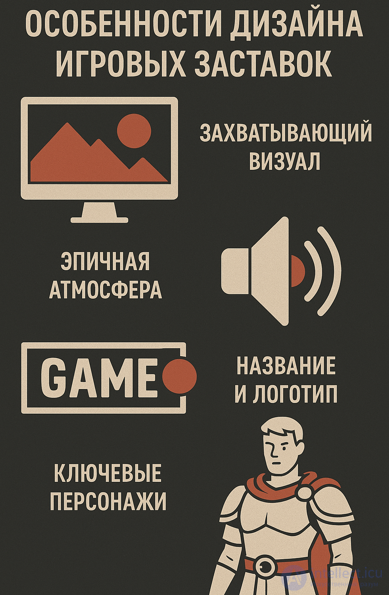
Creating atmosphere: The splash screen is the player's first visual and auditory contact with the game. The music, color palette, and pace of the animation — everything should harmonize with the genre.
Immersion in the story: Many splash screens introduce the player to the story or hint at key events and characters.
Brand showcase: Splash screens often include the developer's or publisher's logo, rendered in their signature style.
Loading and technical transitions: A splash screen can mask scene loading time or the streaming of resources.
Styling to match the game's genre:
In horror games — dark tones, distorted animation, sound with unsettling notes.
In arcade games — bright colors, fast dynamics, cartoonish elements.
In fantasy — epic music, symbolism, textures resembling metal, stone, and magic.
In science fiction — neon, abstraction, interfaces, and digital effects.
Dynamics and rhythm:
The animation should be lively but not overloaded. It is especially important to strike a balance between attention to detail and overall conciseness.
Interactivity:
Some modern splash screens include interactive elements — for example, the player can control the camera, choose an action, or simply "skip" the splash screen after a certain amount of time.
Sound is an integral part of the design. A well-chosen composition enhances the emotional effect, emphasizes the style, and sets the mood. This can be either a signature musical theme or sound effects: creaks, breathing, a narrator's voice, the hum of energy, and so on.
A game splash screen should be short enough not to tire the player, yet expressive enough to capture interest.
Optimal length: from 5 to 15 seconds.
For story introductions, longer formats are acceptable — up to 1–2 minutes.
Optimization: The splash screen should not cause lag or slow down loading.
Adaptation to the platform: On mobile devices, splash screens are shorter and lighter, while on PC and consoles they are more elaborate.
Skip support: This is especially important for scenes that are replayed. Respecting the player's time is a sign of good UX.
What modern trends in game splash screen design exist right now?
Modern game splash screens (or intro scenes, title screens) have become true works of art, and here are the trends that particularly stand out right now:
The use of cinematic camera angles, depth of field, and dynamic lighting.
The splash screen often resembles a trailer: tense music, edited scenes, an emotional hook.
Example: The Last of Us Part II — a grim, meditative splash screen with a guitar theme.
A move away from cluttered screens toward clean, concise compositions.
Often a single strong visual symbol is used (a logo, a silhouette, an artifact).
Example: Inside — simply the silhouette of a boy against a backdrop of fog.
The player can interact with elements of the splash screen: move, choose, influence the music or visuals.
This creates a bridge between gameplay and narrative.
Example: Firewatch — an intro with a choice that influences how the story is perceived.
The splash screen can flow smoothly into gameplay without loading screens.
Dynamic scenes, camera transitions, and changes in the time of day are used.
Example: God of War (2018) — the camera never cuts away; the splash screen is part of the storytelling.
A revival of 8-bit and 16-bit styles, but with modern effects.
Glitch art, CRT emulation, and a chiptune-style soundtrack are often used.
Example: Katana ZERO — a stylish splash screen with VHS effects.
The splash screen can change depending on the player's progress, the time of day, or even the weather.
Parametric graphics, reactive shaders, and AI animation are used.
Example: Returnal — the splash screen reflects the current state of the cycle.
Symbols and patterns: a leaning toward symbolic design can serve as an excellent foundation for a splash screen.
Interactivity: even a simple cursor movement or a reaction to sound can boost engagement.
Scientific motifs: if the game is related to science or abstraction — you can use visualizations of molecules, energy, or neural networks.
A splash screen is not just a «pretty picture before the game» but a full-fledged design element that works on perception and atmosphere. From thoughtful visuals and sound to technical implementation — everything should be cohesive and appropriate. A well-made splash screen is a smooth, stylish entry into the game world that stays in the player's memory for a long time.

Comments