
Lecture
Balance, rewards and punishments, and progression are key elements in game design that determine how engaging and fair a game will be for players. In this lecture we will look at how these systems work and how they can be used effectively to create an exciting gaming experience.
In games (sports, board, computer and others), balance is a subjective «equilibrium» between characters, teams, game tactics and other game objects. Game balance is one of the requirements for the «fairness» of the rules. Balance is especially important for multiplayer games.
From Adams and Rollings’ book «Game Design» (2003): «A balanced game is one where the main determining factor of a player’s success is their skill. This does not mean that random events do not happen, but a strong player should, as a rule, be more successful than a weak one, unless they hit an unusually long streak of bad luck». In that same chapter they state that game theory is poorly suited to studying balance: a real game has too many variables, and game theory teaches you how to play correctly, not how to design games correctly.
Jeannie Novak, author of the book «Game Development Essentials: An Introduction», also believes that the main determining factor is the player’s skill. But she identifies five components of a balanced game: consistent difficulty, subjective fairness, absence of stagnation, absence of trivial solutions, and difficulty levels.
Keith Burgun, author of the indie game 100 Rogues, states that an unbalanced game has many irrelevant elements. Gameplay is always about choice, and in an unbalanced game a great many of those choices are meaningless because they are dominated by others.
Dan Felder, a Hearthstone developer, defines balance by negation: a game is balanced if it is not «broken», that is, if it gives the player exactly the experience that was intended — by analogy with a printer: if it has cracked but keeps printing at acceptable quality, it is not broken. As if arguing with Burgun, Felder writes: if a game has choice, then a suboptimal option will also be found.
The most varied parts of a game are subject to balancing.
This type of balance lies on the surface: back in the Dendy days we would say that such-and-such a fighting-game character was too strong (too weak). Adams, Rollings and Novak call this component of balance static balance.
Burgun mentions a common Counter-Strike house rule: to play without the AWP. This means that a rifle that kills with a single hit to any part of the figure is perceived by many as too strong, whatever the authorities may say.
Adams and Rollings mention WarCraft I: orc magic was clearly stronger than that of humans, and if the players reached the spellcasters, the orc usually won.
Keith Burgun talks about maps in RTS: even if you make a map fully symmetrical, there is still room for balancing. Expanding bases, hunting neutral creatures, attacks on the enemy, secret raids — all these tactics should have meaning.
Lennart Nacke, a game design lecturer, states that randomness is needed in games:
Here are a few symptoms of an imbalance between chance and skill.
Imbalance in games is not always a flaw; sometimes game designers use it deliberately to make the gameplay more exciting and varied. This approach makes it possible to create vivid moments that stay with players for a long time, especially if they manage to overcome apparent unfairness or win under conditions of unequal forces. Such situations become a source of strong emotions, which makes them especially appealing to streamers and reviewers.
Leveling the odds:
For games where the player has to fight against a stronger artificial intelligence, imbalance can compensate for the difference in experience and adaptability. For example, the player is given power-ups so they can defeat a more difficult opponent.
An advantage for weaker players:
Beginners or knowingly weak players can receive bonuses at the start, which allows them to remain competitive. This is often used in multiplayer games to retain newcomers.
Gameplay variety:
In strategy games, intentional imbalance can add complexity and motivation to experiment. Changing unit characteristics or mechanics after release forces players to look for new strategies, thereby maintaining interest in the game.
The term describes situations where certain game elements become either excessively powerful (hyper-usefulness) or completely useless. Example: if in a card game one card is so strong that using it becomes the only optimal choice, or if another game element turns out to be so weak that it is ignored. Such distortions, if not controlled, can undermine players’ interest, but their deliberate use sometimes helps to emphasize the uniqueness of certain mechanics.
Using imbalance requires fine tuning and a deep understanding of the target audience. Applied correctly, it makes a game engaging and emotionally rich, but under the wrong conditions it can ruin the gaming experience.
The game development school «XYZ» (Yulia Chernyshevskaya, Nikita Zhuravel) says: if it is too easy, the player will quickly get through all the content and the game will bore them. If it is hard, they will not be able to break through the wall of difficulty and will quit the game before they come to love it.
Many modern games rely on monetization — selling paid elements. Andrei Popovich, a game designer at Immo Games, says in a 2012 talk:
Positive feedback helps the leader win by even more. Negative feedback helps the loser catch up (an example is the blue shell in Mario Kart).
Sergey Abdulmanov, founder of the company «Mosigra» (selling other people’s board games and developing its own), gives several cases of imbalance.
Adams, Rollings and Novak identify dynamic balance, when during the course of play the balance of forces is disrupted, preserved or maintained.
Paradoxically, collecting, reading texts and other activities unrelated to the player’s main goal of winning also affect balance.
In the children’s cooperative board game «Hoot Owl Hoot!» beginners either dragged their favorite owl to the nest (they are all identical) or made the farthest move without thinking about what would happen next. Since jumps over other owls bring the whole group much closer to the finish, the designer came up with an idea: after each jump, hoot like an owl. It worked: children deliberately set up such situations for their parents[10].
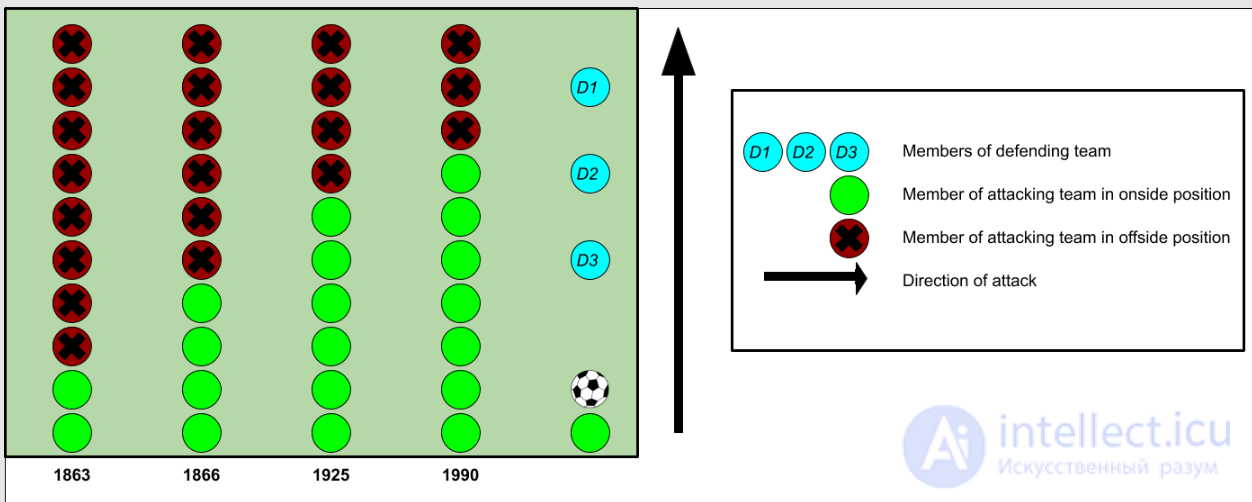
The evolution of the offside rules: from «you may not pass forward» (1863) to «you may not pass to a player who is behind the second player of the defending team» (1990)
Although the concept of «game balance» is applied mainly to board and computer games, in sports games too the rules have to be balanced.
Effective use of the systems of balance, rewards and punishments, and progression makes it possible to create engaging and fair gameplay. Game designers must carefully think through these elements in order to ensure a harmonious and captivating gaming experience for all players.

Comments