
Lecture
A video game with nonlinear gameplay presents players with challenges that can be solved in various sequences. Each player can choose (or even encounter) only some of the possible challenges, and the same challenges can be completed in different orders. In a video game with linear gameplay, by contrast, the player faces a fixed sequence of challenges: every player encounters all the challenges and must solve them in the same order.
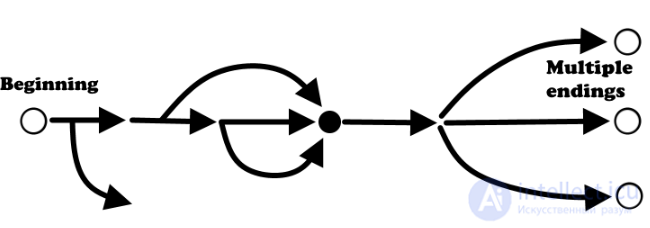
A diagram of the routes from the beginning to one of the game's three endings
A nonlinear game gives the player more freedom than a linear one. For example, a nonlinear game may allow several ways to complete the game, a choice between paths to victory, different types of victory, or optional side quests and subplots. Some games contain both linear and nonlinear elements, and some feature a «sandbox» mode that lets players explore an open game world independently of the game's main objectives, if any are provided at all.
A game that is substantially nonlinear is sometimes described as open-ended or a «sandbox», and is characterized by allowing players to gauge their progress through self-defined goals, independent of the game's programmed elements.
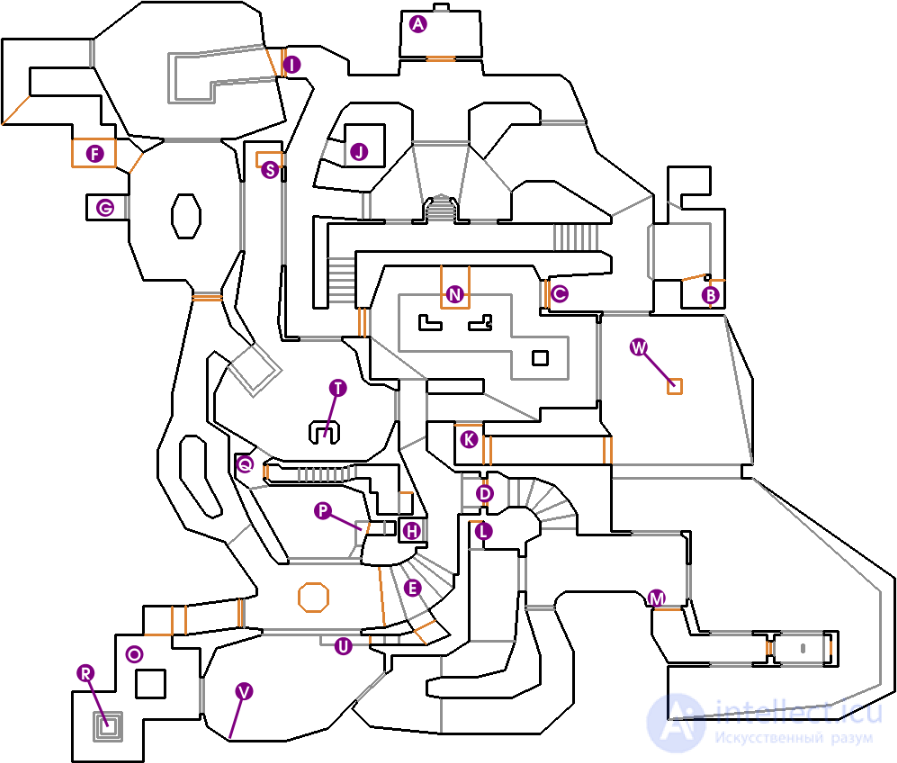
A reconstruction of the map «E1M7: Computer Station» from the shooter Doom.
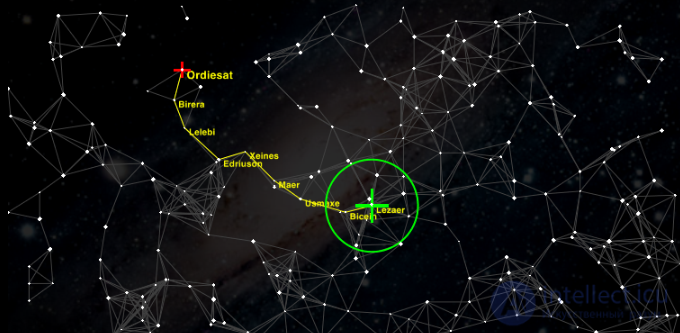
The galactic trade map of the space trading and combat simulator, Oolite
A game's level or world can be linear, nonlinear, or both. In a linear game the player can traverse a level by only one path, but in games with nonlinear gameplay players may need to revisit locations or choose among several paths to complete a level.
As with other game elements, linear level design is not absolute. Although a nonlinear level may offer the freedom to explore or backtrack, the player may still be given a sequence of trials to complete it. If the player has to face challenges in a fixed order, nonlinear games often offer several approaches to achieving those goals.
In a more linear game, to win the player must progress through levels in a specific sequence. The ability to skip levels, replay them, or choose among them makes such games less linear. Super Mario Bros. — one of the earliest examples of this approach, where the player was given access to warp zones that allowed many of the game's levels to be skipped.
In some games, levels can shift from a linear design to free movement depending on the stage's objective. Super Mario 64 — an example in which the main stages consist of free movement, while the levels where Bowser is encountered follow a straight path to the end.
When a game is large and open enough, it can be described as an open-world game or a sandbox game. Open-world games in one form or another have existed since the 1980s, such as the space trading game Elite, and often use procedurally generated environments.
In a game with a sandbox mode, the player can disable or ignore the game's objectives and have unlimited access to items. This can open up possibilities that were not intended by the game's developer. A sandbox mode is an option in goal-oriented games, and it differs from open-ended games, which have no goals, such as SimCity and Garry's Mod.
Games with linear stories are those in which the player cannot change the storyline or the ending of the story. Many video games use a linear structure, making them more akin to other works of fiction, but such games are marked by interactive storytelling, in which the player has to interact with something before the plot begins to unfold, or by nonlinear narratives, in which events are depicted out of chronological order. Many games offer premature endings in case the player fails to reach a goal, but these are usually just interruptions in the player's progress rather than actual endings. Even in games with a linear story, players interact with the game world by performing various actions as the game progresses.
More recently, some games have begun to offer multiple endings in order to heighten the dramatic effect of moral choices within the game, though early examples exist as well. Nevertheless, some games have gone beyond small choices or special endings, offering a branching storyline (also known, outside the video game context, as interactive storytelling) that players can control at critical moments in the game. Sometimes the player is given a choice of which branch of the plot to follow, while sometimes the path will be based on the player's success or failure in a particular trial. For example, the Fallout series of role-playing video games from Black Isle Studios includes numerous quests where the player's actions dictate the outcome of the story behind the objectives. Players can permanently remove game characters from the virtual world if they wish to do so, and in doing so can actually change the number and type of quests that become available to them as the game progresses. The effect of such decisions may not be immediate. Plot branches can merge or split at different points in the game, but rarely allow a return to previous ones. In some games you can even choose different starting points, and one way to do this is through the character selection screen.
Developing linear stories is cheaper and requires less time and money, since there is only one fixed sequence of events and no need to make important decisions. For example, several games in the Wing Commander series offered a branching storyline, but it was ultimately abandoned because the cost was too high. Nonlinear stories increase the likelihood of bugs or absurdities if they are not tested properly, although they do give players greater freedom. Some players have also reacted negatively to branching stories, because they find it difficult and tedious to experience the «full value» of all the game's content. As a compromise between linear and branching stories, there are also games in which the stories branch and then fold back together into a single storyline. In such stories the plot branches but then converges toward some inevitable event, creating the impression of nonlinear gameplay through the use of nonlinear narrative without the use of interactive storytelling. This is commonly used in many graphic adventure games.
A truly nonlinear story would be written solely by the player's actions and thus remains a difficult design challenge. As a result, video games with truly nonlinear gameplay often have little or no story. ] Facade, a video game often classified as interactive drama, includes numerous branching paths dictated by user-entered text based on the current situation, but there is still a fixed number of outcomes due to the inherent limitations of programming, and as such it is nonlinear, but not entirely.
Branching storylines are a common trend in visual novels, a subgenre of interactive narrative and adventure games. Visual novels often use several branching storylines to achieve multiple different endings, providing nonlinear freedom of choice along the way. The decision points in a visual novel often give players the opportunity to change the course of events during play, leading to many different possible outcomes. Visual novels are popular in East Asia, especially in Japan, where they make up nearly 70% of the personal computer games released there. A recent well-known example is 999: Nine Hours, Nine Persons, Nine Doors, where almost every action and dialogue choice can lead to entirely new branching paths and endings. Each path reveals only certain aspects of the overall storyline, and only after all the various possible paths and outcomes have been uncovered over the course of several playthroughs does everything come together to form a coherent, well-written story.
It is not uncommon for visual novels to feature a morality system. A notable example is the animated visual novel School Days, released in 2005, which Kotaku describes as going far beyond the usual «black-and-white choice systems» (referring to video games such as Mass Effect, Fallout 3, and BioShock), where players «pick a side and stick with it», leaving «the vast middle ground between them unexplored». School Days, by contrast, encourages players to explore the gray, neutral middle in order to see the more interesting, «bad» endings. [ 14 ]
It is also not uncommon for visual novels to feature multiple protagonists who offer different perspectives on the story. EVE Burst Error (1995) by C's Ware introduced a unique twist on the system, allowing the player to switch between two protagonists at any point in the game, rather than finishing one protagonist's scenario before playing as the other. EVE Burst Error often requires the player to have both protagonists cooperate with each other at various points in the game, with choices in one scenario affecting the other. Fate/stay night — another example that presents multiple perspectives. Chunsoft's sound novels, such as Machi (1998) and 428: Shibuya Scramble (2008), develop this concept further, allowing the player to switch between the perspectives of several or more different characters, making choices for one character that have consequences for the others. 428 in particular has up to 85 different possible endings. [ 18 ]
Another approach to nonlinear storytelling can be seen in Cosmology of Kyoto. The game lacks an overarching plot but instead presents fragmented narratives and situations in a nonlinear manner, as the player's character encounters various non-player characters while wandering the city. These narratives are cross-referenced with an encyclopedia that provides background information as the narrative unfolds and as the player encounters various characters and locations, with different stories, situations, and their associated information appearing in different places. This gives the player enough freedom to allow them to experiment with the game, for example using it as a resource for their own role-playing campaign. [ 20 ]
Branching storylines are also frequently used, to some degree, in role-playing video games (RPGs). An early example, published in 1999, is the fantasy role-playing game Might and Magic VII: For Blood and Honor, where players must choose between Light and Dark. While the dark side wants to destroy the world of Enroth, the light side tries to save it. The choice determines which grandmaster levels the player's characters can obtain and the quests they will have to complete in this part of the game. Earlier in the game the player already had to choose a side in a border conflict between elves and humans or remain neutral. This affects the flag in their Harmondale castle and several quests, but not the outcome.
A second example is Fallout: New Vegas by Obsidian Entertainment, where the player's decisions affect which of three different factions gains control of the territory surrounding post-apocalyptic Las Vegas. These factions include Caesar's Legion, a Roman-style group of slavers; the New California Republic (NCR), an expansionist military government; and Mr. House, the mysterious de facto ruler of New Vegas, who commands an army of robots patrolling the city. Each of the three sides seeks to control Hoover Dam, which still functions and supplies the American Southwest with electricity and clean, unirradiated water; thus, control of the dam means effective control of the region. A fourth option, siding with a robot named Yes-Man and either overpowering or eliminating the leaders of the other factions, lets the player go it alone and seize Hoover Dam.
Another RPG example is the Star Ocean series by tri-Ace, where the storyline does not depend on moral orientations as in other role-playing games, but is inspired by dating simulators, friendship, and relationship points between each of the characters. Star Ocean: The Second Story in particular offers as many as 86 different endings with hundreds of permutations, setting a standard for the number of possible outcomes in a video game. Another unique variant of this system is the Sakura Wars series, which features a real-time branching-choice system where, during an event or conversation, the player must select an action or dialogue option within a limited time or not respond at all during that time; the player's choice or lack of one affects the player character's relationships with other characters and, in turn, the direction and outcome of the storyline. Later games in the series added several variations, including an action gauge that can be raised or lowered depending on the situation, and a gauge that the player can manipulate with the analog stick depending on the situation. A similar type of conversation system later appeared in a later action role-playing game, also published by Sega, Alpha Protocol.
Another unique approach to the concept is combining nonlinear branching storytelling with the concepts of time travel and parallel universes. Early attempts at this approach included Squaresoft's Chrono series of role-playing games (1995–1999) and the ELF visual novel YU-NO: A girl who chants love at the border of this world (1996). Radiant Historia goes further, giving players the freedom to travel forward and backward along the timeline to alter the course of history, with each of their choices and actions significantly affecting the timeline. The player can return to certain points in the story and relive certain events again in order to make a different choice and see the various possible outcomes on the timeline. The player can also travel forward and backward between two parallel timelines, and can obtain many possible parallel endings. The PSP version of Tactics Ogre introduced a «World» system that allowed players to return to key plot moments and make a different choice to see how the story would unfold differently. [ 31 ] Final Fantasy XIII-2 also features a nonlinear time-travel system similar to Radiant Historia's.

Comments