
Lecture
Character clothing and costumes are not merely a decorative element. In game design they serve some of the most important functions: they help reveal the hero's personality, emphasize the atmosphere of the world, and create a visual and emotional identity. The player reads information about a character primarily through their appearance, and it is precisely the costume that becomes the key to understanding their role in the story.
Costumes in video games and in the real world can be visually similar, but they differ in function, context, and the way they are created. Game clothing is an artistic tool, whereas real clothing is a practical necessity.
Inspiration from real fashion: designers often draw on historical, ethnic, and contemporary styles. For example, in Assassin’s Creed the costumes are based on real historical eras.
Materials and textures: modern games use realistic fabrics—leather, metal, wool—with imitated seams, folds, and wear.
Functions and roles: as in life, clothing in games can denote status, profession, culture, or membership in a group.
Fashion and brands: characters in The Sims wore Diesel and Balenciaga, while Final Fantasy heroes took part in advertising campaigns for Prada.
| Category | Video games | Real world |
|---|---|---|
| Function | Narrative, style, gameplay | Protection, comfort, social norm |
| Physics | Simulation: fabric reacts to wind and movement | Real laws of physics, weight, temperature |
| Creation | Digital modeling, texturing, rigging | Sewing, tailoring, materials, manufacturing |
| Wear | Artistic effect (scratches, dirt) | A real process that requires upkeep |
| Adaptation | To gameplay and readability (for example, bright colors) | To climate, culture, personal preferences |
| Experimentation |
Fantastical shapes and impossible fabrics are possible violating the laws of physics, biology, economics, time no restrictions—everything in the creator's imagination is available |
Limited by the laws of physics and anatomy and by other constraints |
They can be impossible in reality: for example, glowing elements, levitating details, transforming parts.
They are subordinate to gameplay logic: for example, armor that does not hinder movement, or a cloak that does not get stuck in the textures.
They are created with the camera and lighting in mind: so that they look striking in different scenes.
Game costumes are a synthesis of fashion, narrative, and technology. They are inspired by reality but serve artistic goals. While clothing in the real world is limited by physics and practicality, costumes in games are a field for experimentation and visual storytelling.
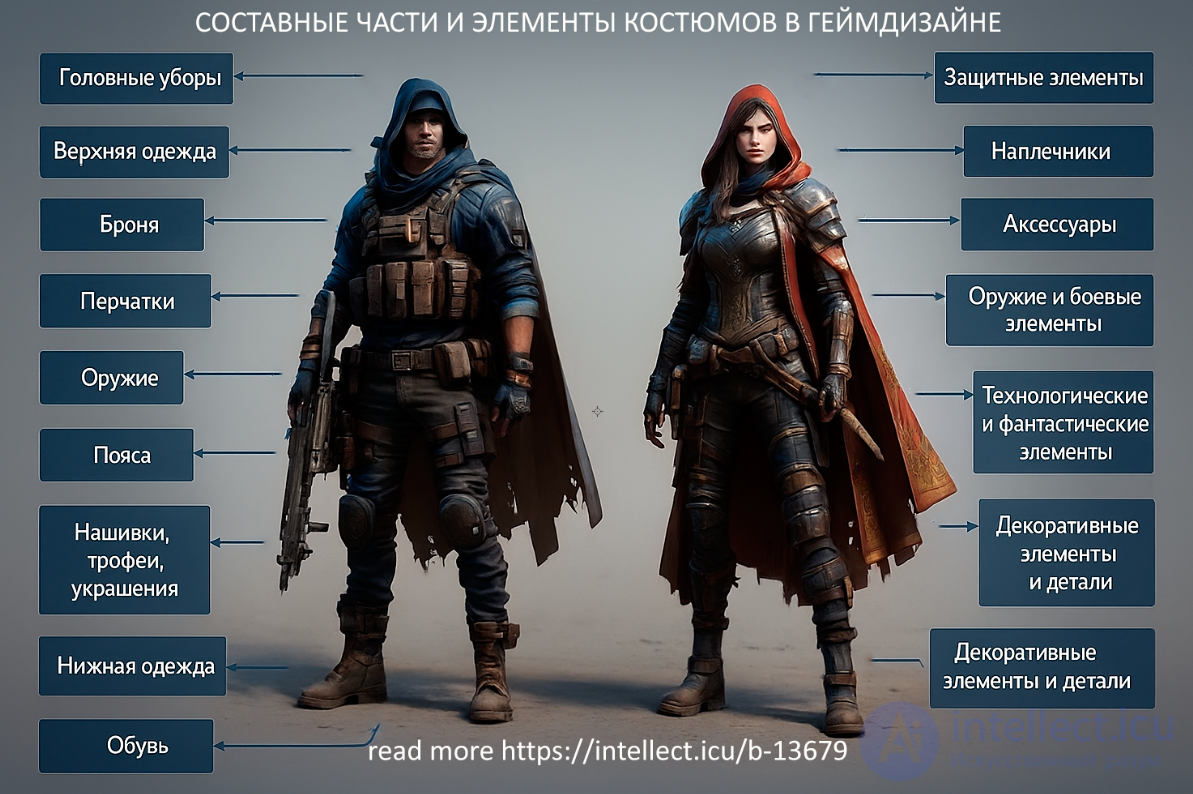
In game design, character costumes consist of many component parts and elements, each of which serves a functional, aesthetic, or narrative role. Below is a classification of the main elements with examples and purposes.
Purpose: they form the character's basic silhouette and reflect the era, culture, and social status.
Examples and classification:
Outerwear: cloaks, jackets, robes, vests.
Example: A wizard's robe in an RPG emphasizes magical status.
Lower garments: trousers, skirts, shorts, leg armor.
Example: A soldier's tactical trousers in a shooter enhance the sense of realism and mobility.
Footwear: boots, shoes, sneakers, armored boots.
Purpose: the visual finishing touch to the look and an emphasis on the character's style.
Headgear: hats, helmets, crowns, hoods.
Example: A helmet in a military strategy game symbolizes the character's combat role.
Purpose: they reflect the character's combat or social function and can be gameplay-relevant (increasing defense).
Examples and classification:
Armor: cuirasses, pauldrons, breastplates, plates.
Example: A knight's armor in an RPG reinforces the sense of strength and protection.
Helmets and masks: protection for the head and face; they can conceal identity.
Example: An assassin's mask in «Assassin’s Creed» hides the face and emphasizes an air of mystery.
Gloves and elbow guards: protection for the arms during combat, and a visual detail.
Purpose: they refine the character's personality, social status, style, or role.
Examples:
Belts and straps: hold equipment in place and visually divide the costume.
Bags, backpacks: functional elements that can hold items and weapons.
Jewelry: rings, necklaces, earrings. They emphasize wealth and cultural affiliation.
Emblems and badges: they symbolize a faction, ranks, or achievements.
Purpose: integration of the costume with gameplay and visual identification of the combat role.
Examples:
Swords, daggers, bows, firearms.
Magazines, sheaths, holsters—they secure the weapon to the costume.
Shields and energy barriers—they enhance protection both visually and functionally.
Purpose: they create individuality and a unique style for the character and support the narrative.
Examples:
Embroidery, ornaments, patterns on fabrics.
Patches, trophies, medals.
Fabric elements with effects (tears, scuffs, stains).
Purpose: they emphasize the genre and the character's functional capabilities.
Examples:
Exosuits, cybernetic inserts, interfaces on the clothing.
Jetpacks, magical auras, plasma elements.
Glowing lines and holograms—often used in cyberpunk and sci-fi.
Purpose: they reinforce personality and emotion and help to visually classify characters.
Examples:
Metals—armor, weapons.
Fabrics—robes, cloaks, NPC clothing.
Leather, fur—for savages or animal characters.
Colors: red—aggression, blue—calm, gold—status.
| Hero archetype | Key clothing elements | Visual accents | Effect on perception |
|---|---|---|---|
| Warrior / leader | Armor, cloaks, boots, belts | Symmetry, massive shoulders | Strength, determination, protection |
| Sage / mage | Robes, long sleeves, hood | Flowing fabrics, ornaments | Mystery, knowledge, spirituality |
| Rebel / adventurer | Jackets, leather elements, asymmetry | Worn fabrics, accessories (gloves, goggles) | Freedom, risk, independence |
| Princess / aristocrat | Dresses, corsets, jewelry | Bright colors, gemstones | Status, refinement, power |
| Trickster / comedic hero | Bright patterns, unusual combinations | Contrasting colors, eccentric details | Playfulness, chaos, humor |
| Dark antagonist | Dark cloaks, sharp silhouettes | Metal, leather, minimalism | Threat, coldness, control |
|
Mixed—this is about the contrast and balance of different styles.
|
|
|
|
|
Tangled—this is about complexity, an overload of details and a sense of chaos, or, depending on the hero's mood, can display different traits, archetypes, personality |
|
|
|
| Personality | Shape of the clothing | Color palette | Visual effect |
|---|---|---|---|
| Evil | Sharp lines, asymmetry, hard materials (leather, metal) | Dark shades: black, burgundy, gray, sometimes venomous green | Threat, coldness, aggression |
| Good | Soft shapes, rounded silhouettes, light fabrics | Light and warm tones: white, pastels, golden | Trust, warmth, openness |
| Dreamy | Loose, flowing silhouettes, long sleeves, capes | Blue, lavender, silvery, soft transitions | Airiness, fantasy, detachment |
| Bold | Clear lines, open shapes (vests, short cloaks) | Bright contrasting colors: red, orange, saturated blue | Energy, determination, dynamism |
| Cunning | Narrow silhouettes, hidden pockets, layering | Dark green, brown, gray with accents | Mystery, agility, stealth |
| Cheerful | Asymmetrical, playful shapes, unusual accessories | Bright, contrasting colors: yellow, pink, turquoise | Joy, chaos, humor |
| Tragic | Long, heavy shapes, draping | Dark blue, purple, gray | Drama, sorrow, depth |
Shape reflects the inner structure of the personality: sharp angles → aggression, soft lines → kindness, fluidity → dreaminess.
Color reinforces the emotion: warm shades → positivity, cool ones → detachment, dark ones → danger.
Material adds nuance: leather and metal → strength and toughness, light fabrics → softness and spirituality.
You happen to love systematic thinking, so you can break the costume down into modules, each of which reflects a trait of the personality:
Silhouette → strict (discipline), loose (freedom), asymmetrical (rebellion).
Fabric → heavy (strength, power), light (spirituality, dreaminess).
Color → bright (emotion), dark (restraint), neutral (rationality).
Accessories → weapons, books, amulets, jewelry—direct markers of personality.
Decor → ornaments (tradition), minimalism (pragmatism), chaotic details (eccentricity).
A warrior hero with a kind heart → massive armor, but with soft fabric inserts and light colors.
A scholar mage → a long robe with many pockets, neutral tones, glasses.
A rebel antagonist → a leather jacket, an asymmetrical cut, dark shades with a bright accent.
Evil → a silhouette with sharp shoulders, a dark cloak.
Good → a soft tunic in light tones.
Dreamy → a long robe with smooth lines.
Bold → a short cloak, bright contrasting colors.
Cheerful → a colorful jacket with patterns.
Cunning → a narrow suit with many pockets.
Tragic → heavy draped clothing.
| Level | Name | Description | Examples of genres and games |
|---|---|---|---|
| 1 |
Abstract shapes
|
Minimal detail, simplified silhouettes, often without textures. Color and shape are the main expressive means. | Platformers (Thomas Was Alone), minimalist indie games |
| 2 |
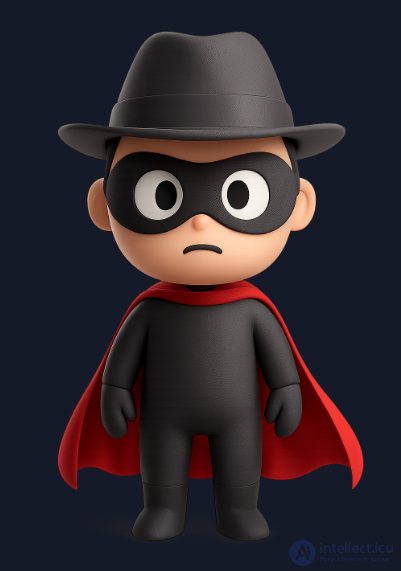
Symbolic costumes
|
Simple shapes with recognizable elements: cloak, hat, mask. Often stylized as a cartoon or pixel art. | Early RPGs (Undertale), retro games |
| 3 |
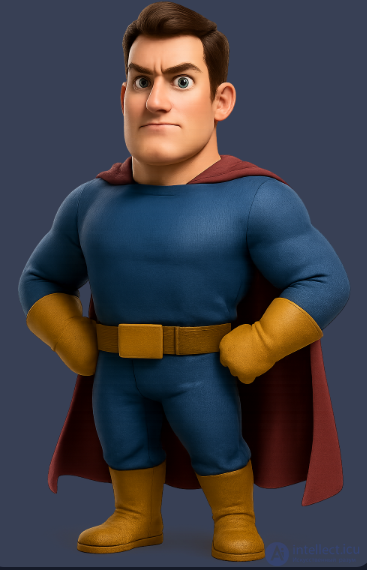
Stylized realism
|
Costumes have textures and materials, but the proportions and colors are exaggerated. Often used in cartoonish or fantasy worlds. | Fortnite, Zelda: Breath of the Wild |
| 4 |
Gameplay realism
|
Costumes look plausible but are adapted to the gameplay: simplified for readability, movement, and optimization. | Assassin’s Creed, Mass Effect, Skyrim |
| 5 |
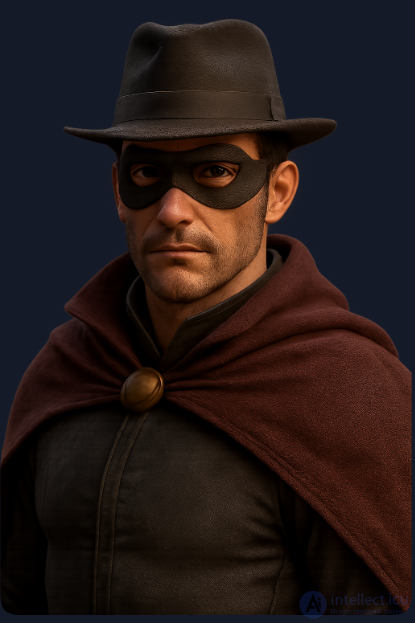
Cinematic realism
|
Highly detailed 3D models with realistic fabrics, seams, folds, and wear. Often used in story-driven AAA games. | The Last of Us, Red Dead Redemption 2 |
| 6 |
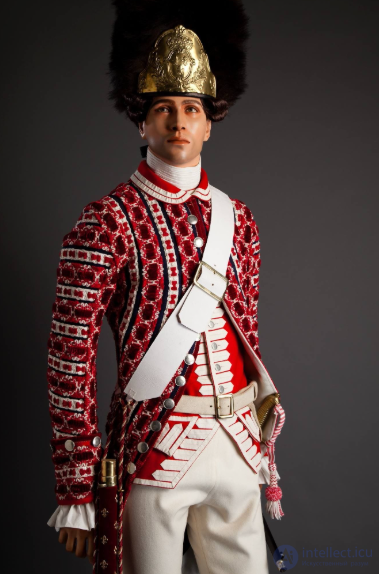
Photorealism and scanning
|
Costumes created from real scans of clothing, with accurate physics and lighting. Used in simulators and VR. | Death Stranding, Detroit: Become Human, Flight Simulator |
Genre affects realism: platformers and indie games are more often stylized, AAA action games are more realistic.
Technical limitations: mobile games and older consoles limit the level of detail.
Design goal: sometimes simplification is a deliberate choice for the sake of readability and style.
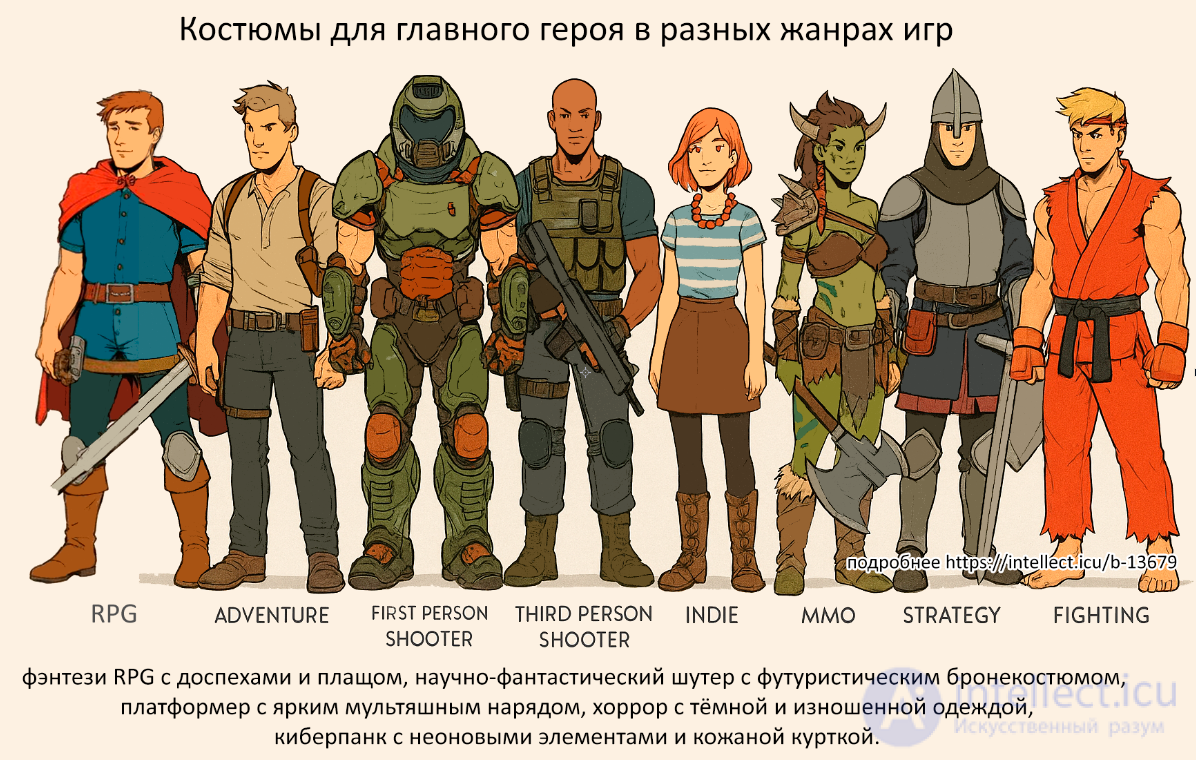
Identity and style: the protagonist's costume must be easily recognizable and distinct from the other characters. For example, the iconic looks of Lara Croft or Geralt from «The Witcher» have become symbols of their franchises.
Functionality: the clothing must match the game's mechanics—armor for RPGs, comfortable gear for shooters, bright outfits for platformers.
Evolution of the look: the costume can change as the story progresses, reflecting the character's growth or their inner changes.
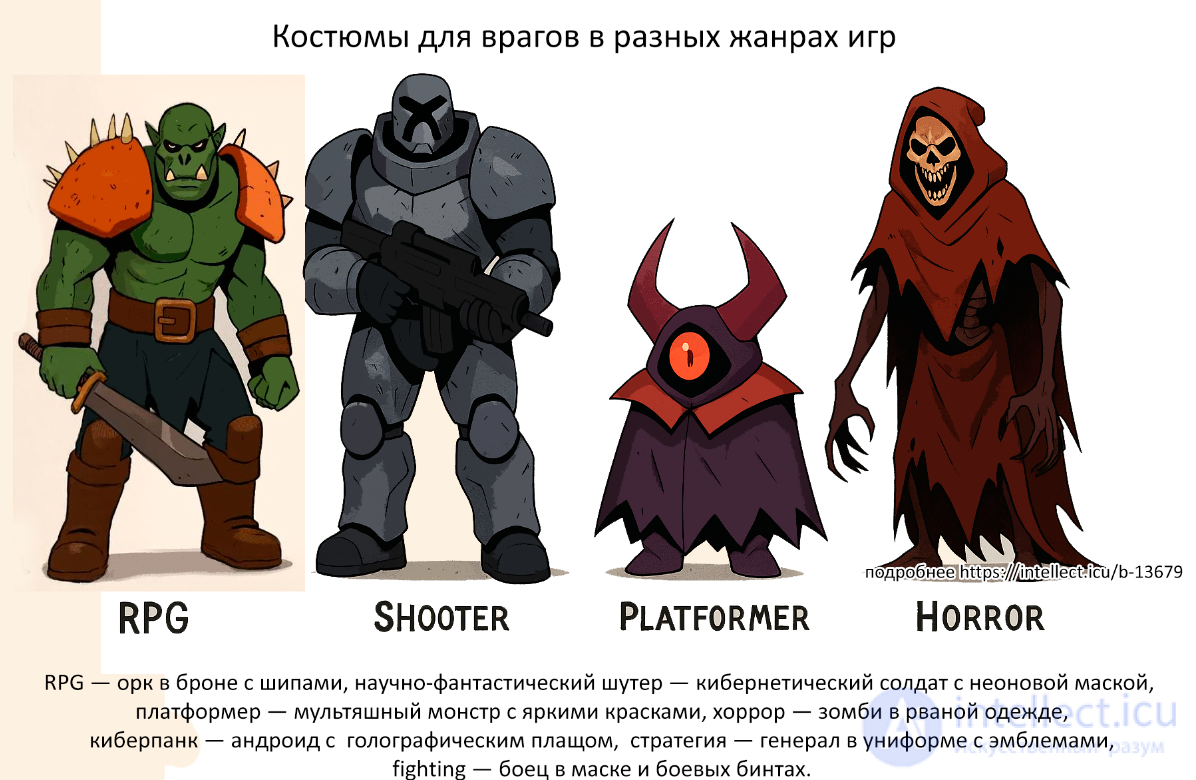
Signals of danger: enemy design often uses aggressive shapes, dark colors, and menacing details (spikes, masks, distorted proportions).
Variety: costumes help distinguish types of enemies—weak opponents may be dressed more simply, while bosses have complex and detailed looks.
Symbolism: the clothing of enemies can reflect their affiliation with a faction or cult, reinforcing the narrative.
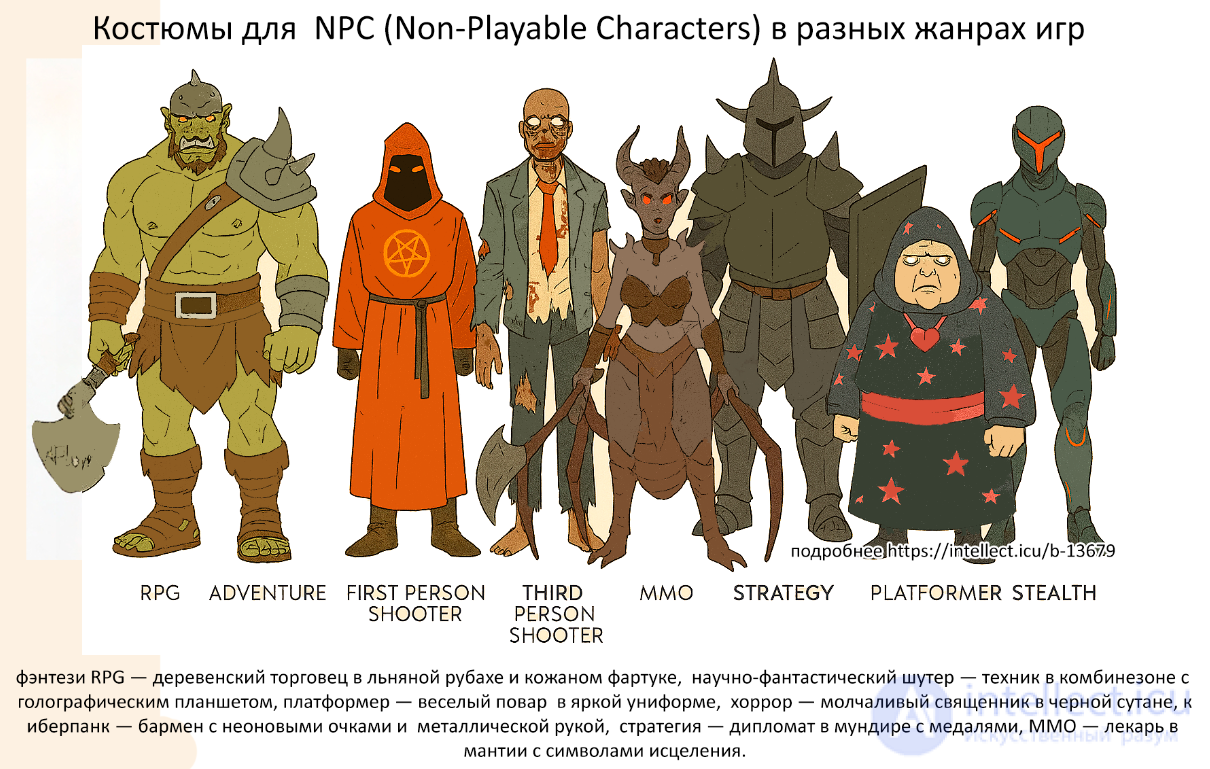
Background and atmosphere: NPC costumes create the sense of a living world. Merchants, guards, villagers—their clothing must be logical and consistent with the culture and era.
Functional differentiation: the player should quickly understand an NPC's role from their appearance—healer, blacksmith, mage.
Detail and realism: even secondary characters enhance immersion if their costumes are well thought out.
Fantasy elements: for magical creatures or aliens, the costume can be entirely abstract, based on unusual materials and shapes.
Cultural references: the design can draw inspiration from mythology, history, or ethnography, creating unique visual solutions.
Hierarchy and status: the clothing indicates the level of power or the importance of a character—the higher the status, the richer and more elaborate the costume.
Silhouette: a recognizable outline is more important than small details—the player should be able to distinguish the character even from a distance.
Color palette: colors emphasize personality (heroes—bright, enemies—dark).
Materials and textures: leather, metal, fabric—everything must be convincing and appropriate to the setting.
Narrativity: the costume tells the character's story without words.
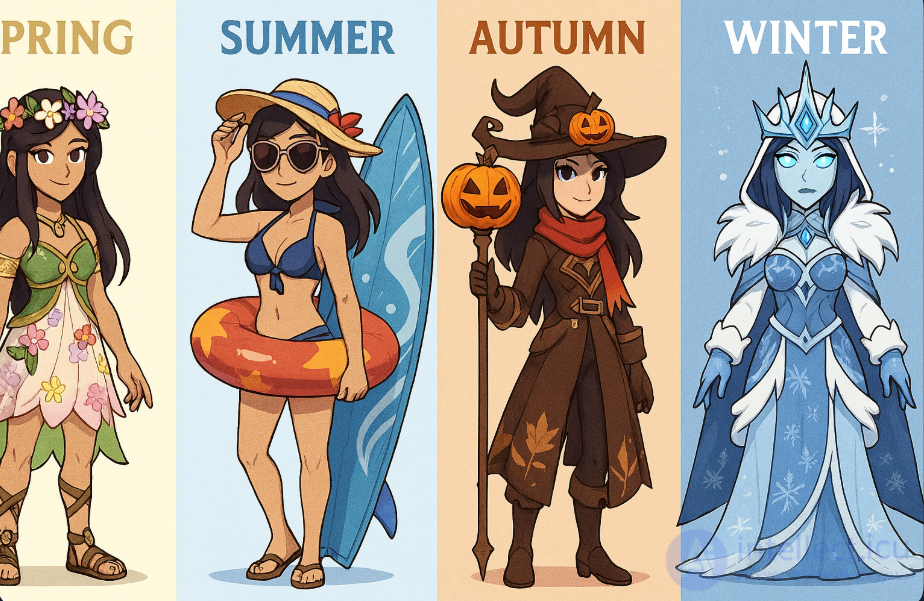
characters get skins that depend on the time of year
Here is how it usually works:
Light, bright costumes with floral patterns
Accessories such as wreaths, petals, and pastel tones are often added
In Japanese games—cherry-blossom motifs
Swimwear, beach outfits, light fabrics
Sunglasses, hats, surfboards, marine motifs
In fantasy games—light armor with golden elements
Warm cloaks, coats, scarves
Colors: orange, brown, burgundy
Motifs of harvest, pumpkins, and Halloween are often added
Down jackets, fur capes, New Year costumes
Snowflakes, ice effects, Christmas accessories
In fantasy games—ice armor or magical winter robes
In games this is done for:
Visual variety and atmosphere
Ties to events (for example, New Year promotions)
Motivating players to collect collections
The design of character costumes in video games is not only a visual component but also a powerful tool for conveying cultural context, the character's personality, and the atmosphere of the game world. It is especially interesting to examine how game designers use national or regional features in characters' clothing.
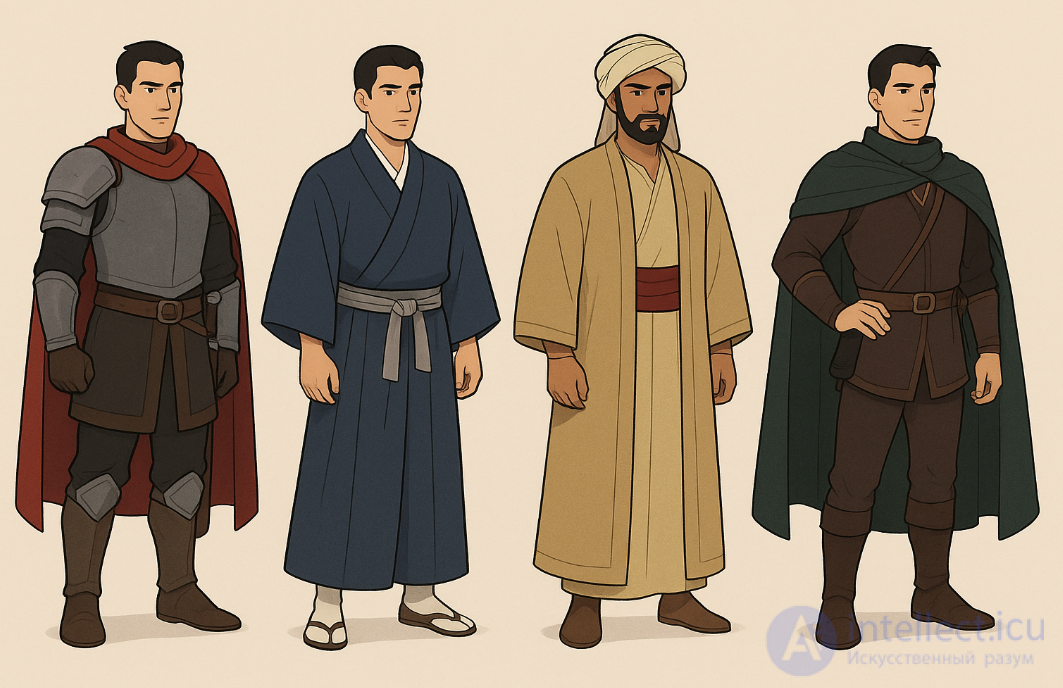
A character's costume often reflects the culture or historical period on which the game world is based. For example:
Japanese culture: kimonos, haori, and traditional samurai armor. In Japanese RPGs or visual novels, they emphasize a connection with the country's history or mythology.
European Middle Ages: knights' armor, dresses with crinolines, cloaks, and hoods. Often used in fantasy games with knights, mages, and nobility.
The Middle East and North Africa: robes, turbans, amulets, and characteristic patterns. These elements help create the atmosphere of a desert region or an Eastern fairy tale.
The use of such elements makes characters recognizable and culturally authentic, and it also helps players immerse themselves in the local color of the world.
Modern games rarely use exact copies of historical or national costumes. More often, designers create adapted versions that suit the game's setting, mechanics, and aesthetics:
Fantastical elements are added: magical symbols, unusual materials, bright colors.
Changes are made for the sake of animation: costumes may be simplified or modified so that the character can move freely.
Sometimes a costume combines elements of different cultures, creating a hybrid design that looks unique but references the real world.
A character's costume is a narrative tool: it can show origin, social status, profession, or the hero's personality. For example:
In many JRPGs, a hero in a kimono or sandals is associated with traditional values or spiritual strength.
Characters in fantasy games with northern armor or fur capes immediately make it clear that they are from a cold region and accustomed to harsh conditions.
In modern shooters or RPGs, elements of national clothing can be used as camouflage or as a symbol of belonging to a particular faction.
Using national clothing requires care:
Stereotyping: excessive simplification or a caricatured depiction of national clothing can provoke criticism and offend players.
Historical accuracy vs. creative freedom in the game: sometimes an exact reproduction of costumes limits creativity or game mechanics.
Cross-cultural understanding: designers must take into account that players from different countries may interpret costumes in different ways.
Assassin’s Creed: each game carefully develops the costumes in accordance with the historical and regional context.
Final Fantasy XIV: a combination of elements from various cultures, but with a fantastical adaptation, which creates a unique world.
Ghost of Tsushima: traditional Japanese costumes and armor convey the atmosphere of the samurai era while preserving authenticity and drama.
Character costumes in games are more than aesthetics. They reflect cultural and regional features, help the player understand the world, create the uniqueness of a character, and enhance emotional immersion. The skillful use of national and traditional elements can make the gaming experience more meaningful and memorable, while it is important to balance accuracy, creativity, and respect for the culture.
1. Introductory lecture. The concept of composition. The goals and objectives of the course. The place of the course on the fundamentals of composition among the specialized disciplines.
In the creative process of designing modern clothing, composition plays the decisive role. Composition, which reflects an inner harmonious order in its outward manifestation, is an organizing concept, one that has the power to join parts together, forming from them a single whole. Working on composition is a process of the designer's individual imaginative thinking, of their conceptions realized in a specific work of art. This kind of activity presupposes that the specialist possesses talent and intuition grounded in diligence and rich visual experience. At the same time, the fundamentals of composition are a rather strict discipline that rests on knowledge of specific rules and laws and on the use of expressive means and techniques. Thus, the process of working on composition is a unity of the intuitive and the logical.
In art, composition is understood as the structure of a work of art, the arrangement of its main elements and parts within a certain system and sequence; that is, composition is the unity and integrity of the form of a work of art, conditioned by its content. Composition is considered in two interrelated manifestations: as the living process of artistic creation, i.e. the solving of a design problem, and as its realization.
The goal of this course is to acquaint students with the main principles governing the compositional organization of the structure of form in design, to instill professional skills in working with flat and three-dimensional form, to develop a sense of measure in the search for the artistic expressiveness of the product being designed, and to develop individual creative capabilities.
The main objectives of the course are to develop in students the ability to competently use the laws of composition in the design of design objects, as well as the ability to independently turn theoretical knowledge into a method of professional creativity in costume design.
Experience in teaching the discipline shows that, among the disciplines students begin to master from the very start of their studies («Color Studies and Coloristics», «Drawing», «Painting»), this course is the most fundamental. Becoming familiar with the content of the discipline should contribute not only to broadening one's understanding of the main principles and laws of compositional mastery but, above all, should prompt the student toward independent and continuous acquisition of knowledge as the key to successful study and further creative activity.
The laws of composition act as objectively operating conditions that are reflected in the character of our perception of form. Regardless of whether the perceiving subject is a professional or an inexperienced person, the violation of the most important laws of composition provokes a certain reaction in them—a signal that integrity has been broken. In the modern theory of visual perception, great importance is attached to the visual structure of the perceived object with its most characteristic features, by which are understood the following structural properties: directions, angles, distances between elements, and pronounced plastic and rhythmic features. The main qualities of the composition of form that affect perception are balance, integrity, and expressiveness.
Balance helps the composition be perceived easily. A balanced composition evokes a sense of wholeness, simplicity, and clarity. An essential means of composition is the division of the perceived object into elementary parts. This realizes one of the main principles of composition—the law of the subordination of the parts to the whole. As a system of a series of subordinations, composition arises only when there are special connections between the parts of the whole. Especially great is the role of the laws connected with proportions. It is well known how significant a clear system of law-governed relationships is for the harmony of form—the system placed at the basis of the dimensions of the main elements and of the ornamental elements of the folk costume. Every design object must possess specific expressive means. This is a property of the visual model that is grasped through such visually perceived qualities as speed, shape, and color.
In the law of the unity and integrity of composition, the natural principles of the organization of the objects of the surrounding world have found reflection and embodiment. The analysis of nature's creations, like that of truly beautiful creations made by human hands, constantly confirms the presence of certain objective laws. After all, humans have always seen before their eyes examples of the close connection and mutual coordination of all elements of form: the proportionality of the shape of a tree leaf, its crown, and its trunk; the purposeful coordination of the body parts of all animals; the harmony of natural landscapes. All the parts are arranged in a strict order, grouping and uniting into a whole through balance, equilibrium, symmetry, repetition, rhythm, proportionality, and proportional relationships. These compositional principles, inherent in natural forms, were aesthetically assimilated and became fixed in the experience of art and in the course of social and historical practice.
The artistic image is the expression of the author's sensation, of a personal vision of an object, a phenomenon, the surrounding world. It is a form of reflecting objective reality from the standpoint of a certain aesthetic ideal in art and culture. The artistic image represents an inseparable, mutually penetrating unity of the objective and the subjective, the logical and the sensory, the rational and the emotional, the abstract and the concrete, the general and the individual, the necessary and the accidental, the part and the whole, the essence and the phenomenon, content and form. It is with the artistic image that art's ability to give a person deep aesthetic pleasure is connected. To think in images means to concretely reproduce the content of objects, concepts, and thoughts with the liveliness and vividness characteristic of a mental representation that has arisen as a result of associations drawing on accumulated life experience, accumulated graphic experience, and the creative gift of the artist.
The principal means of expressing the artistic image is form. The totality of particular forms enriches the artistic image, gives it a many-sided emotional character, and complicates its associative structure. The artistic image rests on the expressiveness of form. Stylization is one of the techniques of the visual organization of imaginative expression, in which the most characteristic features of an object are brought out and unnecessary details are discarded. Transformation is the change of an object's form in the required direction: rounding, elongation, enlarging or reducing the size of individual parts, emphasizing angularity, and so on. Proportions are of particular importance for giving expressiveness to the artistic image. The proportional relationship of the parts to the whole yields various variations in its interpretation.
Color, together with form, yields works that are rich in content. Form is expressed through color, texture, and light. When using color as a means of expressing the artistic image, one should take into account the character of the physiological effect of color on a person and the physical and emotional associations evoked by color. Colors have subjective and objective properties of perception.
Texture has physical characteristics and possesses aesthetic expressiveness. Texture interacts with form in different ways and influences the subjective assessment in the perception of form. Factors in the perception of texture connected with lighting are taken into account.
4. The basic elements of pictorial language. The expressive means of graphics. Line, spot, stroke, dot. Linear and spot images.
The dot, the line, and the spot are elements for organizing a flat composition. Of the elements of graphics, the line is perceived most actively. Through line are conveyed both the qualities of objects—curvature, angularity, waviness—and the qualities of movement—tense and sluggish, fast and slow. Depending on their configuration, line and spot affect the viewer differently. The process occurs on the associative, intuitive, and physical levels of perception, and on the level of memory. Color and linear images of the qualities of natural and artificial objects are the material from which the spatial images of the objects of creative work are built. The richer the spiritual world of the viewer, the more varied the palette of empathy with the artist.
The line serves as the boundary separating the depicted form from the space surrounding it. Its versatility lies in the fact that it simultaneously belongs only to a given plane and serves as the boundary of the intersection of several planes. Hence its flexibility in transitions from a flat image to a three-dimensional one, and its clarity in expressing spatial forms. A number of historians consider that the line lies at the foundation of the development of art in many countries. An understanding of the culture of the graphic line and its theoretical grounding came about at the turn of the 19th and 20th centuries, together with the recognition of graphics as a distinct kind of art. The emotional coloring of a linear image is considered depending on the shape of the line, the material on which the image is made, and the instrument used.
In a spot image, form is determined by a combination of spots that differ in configuration. A spot is understood as a part of a plane singled out by some color and formed by a group of dots, lines, or strokes. A distinction is made between the plasticity of two-dimensional and three-dimensional spot images. Spots that vary in lightness and color tone enhance the depth of relief in textile ornaments.
The aesthetics of the stroke in the art of graphics is connected with the culture of making images by hand. A number of varieties of stroke drawing are distinguished. The stroke is used simultaneously with the line, conveying the texture and movement of form.
The dot image is the most labor-intensive. Modern printing is based on combining, in various arrangements, the tiniest dots of the primary colors. Given a highly precise technology, this method makes it possible to obtain quality reproductions even of paintings.
At the basis of the perception of three-dimensional forms lie properties inherent in all surrounding natural and artificial systems. These properties are objective. The main properties of three-dimensional forms are: geometric type, position in space, size, and mass. Additional properties include texture, light, and color. Each of these properties can change within certain limits and have an infinite number of states.
The geometric type of a form is determined by the outline of its surface (the silhouette shape of clothing) and by the ratio of the form's dimensions along three coordinates. Position in space is determined in relation to the coordinate axes, to the viewer, and to other forms. The size of a form is considered as the ratio of the form's extents along three coordinates, as the ratio of two or more forms to each other, and in relation to the human being. In physics, mass is defined by the quantity of substance of which a body consists. In the artistic-compositional sense, mass is considered on the basis of associative subjective perception as massiveness, and it depends on the dimensionality of the volume, the density with which it is filled by material, and on color and texture.
Texture is understood as the character of a surface at various scales—from roughness (the character of the weave and the fibrous composition of a fabric) to various degrees of dividedness of the surface. The expressive possibilities of texture are revealed by light.
Staticity is the emphasized expression of a state of rest, immovability, and stability of a form throughout its entire structure, in its very geometric foundation. Static objects are those that have a clear center and in which the axis of symmetry serves as the main means of organizing the form. If a form vividly expresses an active one-sided directionality, it is called dynamic. The dynamic state of a form is connected with proportions.
6. Means of harmonization in composition. Rhythmic organization of form. Metric repetition. Rhythm. Types of rhythm in costume.
One of the main conditions for the emergence of the artistic qualities of clothing is the unity of all the elements of its form—that is, proportionality, coordination, and subordination, which ensure the holistic perception of the form. The means of uniting the elements of form into a harmonious whole are rhythm, proportions, scale, contrast, nuance, identity, and symmetry.
Harmonization on the basis of meter and rhythm presupposes the establishment of a law-governed order in the arrangement of the elements of the composition. For order to be achieved, no fewer than three elements are required. Meter is the simplest order, based on the repetition of equal elements at equal intervals. The monotony of a metric series is eliminated by certain techniques. Rhythm is a more complex alternation, based on the continuous change of the properties of elements. The organization of increasing and decreasing series is based on changing the size of elements. A gradual increase characterizes the staticity of a series, an abrupt one—its dynamism. The organization of rhythmic series is based on a multitude of techniques: changing the intervals, narrowing and widening, parallel and opposing movement, changing color, plasticity, chiaroscuro, and others. A means of analyzing complex series is the rhythmic score.
Rhythm in costume is a decrease or increase in the alternation of volumes, structural details, and the concentration of color, tone, and texture. An example of a metric series is pleats laid in one direction, loops and buttons of a fastening, and ornamental stripes of a fabric pattern. In a costume built on the rhythm of curved lines, order is established with respect not only to the sizes of the form but also to the increase and decrease of the curvature of the lines and the inclinations of these lines toward the common axis and toward each other. The alternation of contrasting color spots creates an active chromatic composition and ensures an expressive, imaginative resonance for the costume.
Proportioning as a method of the quantitative coordination of the parts and the whole has at its basis a geometric or numerical regularity, which contributes to achieving the aesthetic integrity and harmony of a three-dimensional form by uniting its dimensions into some system. The features of proportional systems are closely connected with the methods of construction and measurement that were used by masters of one era or another. Proportional systems based on numerical, arithmetic techniques of coordinating the parts and the whole are called modular systems. Such a system presupposes the existence of a module—a conventional unit of measurement. Since ancient times, geometric systems have been used in construction, carried out with the help of a measuring cord and stakes through relatively simple geometric constructions based on the triangle, the square, the rectangle, and the circle.
The golden-ratio relationship is a widespread law of the organization of living nature, which, behind the unity of additivity and multiplicativity, conceals a global principle of the construction of the universe. The concept of additivity attests to the fact that the whole is structural. The concept of multiplicativity means that one and the same law of growth extends to all the parts of a structurally organized whole. In nature, the golden ratio is the numerical characteristic of the division of plant stems, their arrangement on the stalk, the twisting of the spirals of a sunflower, the description of the proportions of the human body, the structure of a shell, and of an apple. The laws of harmony have been discovered in musical series, in the periodic table, in the distances between the planets, and in the micro- and macrocosm. Sculpture, architecture, astronomy, biology, engineering, psychology—the golden proportion manifests itself everywhere.
O. Bodnar developed the principles of the form-generation of the plant world, which is characterized by spiral symmetry, a strict structural order, and a connection with the golden ratio and the Fibonacci sequence. Drawing on V. Vernadsky's hypothesis of the «non-Euclidean character of the geometry of living matter» and on the tenets of dynamic symmetry, O. Bodnar constructed the characteristic geometry of the hyperbola of the genetic spiral, which is applicable to objects of architecture and design as well. In this way a unified geometric basis was established for the development of science and art in the field of spatial conceptions.
8. Proportions of the human figure. The concept of the canonical figure. Proportional relationships in costume.
A person has the ability, through proportions, to grasp the regularity of the structure of a form. It has been established that the geometric similarity of segments and figures has a particularly attractive, organizing power. The search for regularities in costume design is made easier by the fact that the human figure is itself proportional and has whole series of elements of similarity. The structure of the figure is examined, its divisions based on a modular value equal to the length of the head vertically. A harmoniously built human figure, taken by clothing designers as an ideal, has proportional relationships of the parts and the whole that manifest themselves in its measurements along the vertical, horizontal, and diagonal.
Harmonic principles were selected over generations of people and coalesced into canonical and modular systems. These systems dictated harmonic norms to architects, sculptors, painters, and artists of the applied arts. The three best-known canons are: the Indo-Tibetan, which is more than 3,000 years old; the Egyptian; and the «squaring of the circle» canon (European), based on the proportions of the golden ratio. In the 20th century, Le Corbusier's modular system became widespread, created for use both in flat graphic compositions and in the creation of three-dimensional and spatial compositions. The essence of Le Corbusier's invention is extremely simple: the «Modulor» is a means of measurement whose basis is human height and mathematics.
The use of the module as a primary unit of measure in costume design is based on visual estimation and a sense of proportionality. Herein lies the dialectic of the formation of harmonic proportions, which is perfected with the development of experience and knowledge. This sense is especially important in the direct construction of clothing, but instead of developing the sense of measure, a so-called «conversion coefficient» has been introduced, which not only fails to help in determining the parameters of a costume on the drawing but, on the contrary, distorts the artist's idea.
The mathematical nature of proportions, objectively existing in the structure of the human body, is not dogmatized in the designer's creative work; rather, it is taken as a norm to build upon. The main divisions of the form of the body are determined by the structural zones, which also establish the places of the compositional development of the forms of clothing. The main element is the torso part, and the secondary ones are the elements of the costume that cover the limbs and frame the neck and head. In each element one can observe its own hierarchy of the principle of the golden ratio, the division of the element into unequal, irrational parts that form the basis of the artistic arrangement of the costume's mass.
To simplify the graphic language and to facilitate communication among designers in the process of creative work, they resort to geometry, giving a geometric appearance to forms made of fabric. This is carried out in graphics, in drawing the form of a costume, from the preliminary sketches all the way to the finished works. In analyzing a costume, geometry makes it possible to investigate the laws of the construction of forms. One can make use of tracing the silhouettes of clothing in the form of analogues in the process of purely abstract searches for a compositional solution of the costume, in order to determine rhythmic tasks, tasks of plastic relationship, and the proportional structure. This is the basis of the combinatorics of the elements of costume forms. Recourse to geometry is also used in calculating the construction, where geometric concepts serve as a means of building a technical drawing.
As a means of composition, scale works strategically. It is enough to compare a graphic work and a monumental-decorative work to understand how scale affects the form of a composition. The formal aspect of a graphic work is the fineness of all its elements, since it is viewed up close. A monumental composition invariably has greater generalization, a certain rigidity of form, and a simplification of detail. As scale increases, the demands on the balance and integrity of the composition grow. Within a composition, the relationships between elements are regulated by proportion. Not every relationship of dimensions harmonizes with another, and so internal scale and proportion are a very subtle means of composition, based on intuition.
The objective environment created by humans, and each of its objects—be it a building, a car, or an item of clothing—must be in scale with the human being. Thus, in architectural design, the human figure serves as the measure in accordance with which the divisions of buildings, their proportional structure, and all their elements are set. In the design of technical objects, for example machine tools, one likewise tries to find a correspondence of the entire structure, its divisions, and its elements to the human figure. This correspondence is both purely external—a correlation of perception—and ergonomic. Moreover, a direct influence on an object's scale relative to the human being is exerted by all those dimensional magnitudes which, in a machine tool, an instrument, or a vehicle, determine the convenience of human use.
The unity of scale and the overall level of organization play a great role in a complex, densely packed objective environment, where the human factor is connected with ensuring the reliability of the entire system—for example, in the cockpit of a modern aircraft, a disparity in the scale of instruments and other elements is entirely inadmissible. The same applies to operator stations, where unity of scale is one of the necessary conditions without which it is difficult to achieve the integrity that is so important here.
In pictorial works of art, and in the designs of living spaces, scale and proportions are the main means of conveying perspective—the reduction of elements into the depth of the picture creates a sense of space. Achieving proportionality is connected with proportioning. Of two buildings equal in size, the one that has more divisions will seem taller, and conversely, the fewer and larger the divisions, the lower the building seems relatively, but the more significant in scale.
The scale of clothing manifests itself differently than in architecture and engineering. The human being is inside the costume, and if it is an everyday costume rather than a theatrical one, then all the means of composition are directed at making both its overall mass and its divisions and details work toward correspondence with the human figure, toward convenience of use in both the utilitarian and the aesthetic sense. In theatrical art, in various performances and shows, characters often appear in a costume that is out of scale. As a whole, or in individual elements, such scale is a carrier of the character's imaginative characterization. A number of examples of historical costume are examined, demonstrating various scale relationships of the elements of form.
Examples of the influence of the disproportionality of costume elements on the perception of a person's appearance are examined. The character of the proportional relationships in a costume depends on many factors: on the plasticity and texture of the fabric, on the scale and character of the pattern, on the color of the fabric, and on the fashionable proportions of the given period.
10. Contrast, nuance, and identity as a means of creating a stable, subordinated system in composition.
Each means of harmonization is assigned a specific role in the organization of a composition, and each author determines the degree of its significance in the creation of a work independently, in accordance with their creative tasks. Not only individual preferences but also the kind of activity influence the choice of these means. Thus, in works that require an instantaneous, active visual effect on the viewer (for example, an advertising poster), contrast will mainly be used—a contrast of forms, color, and texture, expressed by the means of graphics. It is precisely contrast that makes possible the quick reading of the theme, the information, the subject. At the same time, contrast can interfere with the main compositional task and even destroy it. Thus, in creating a rich textile surface, such a means as nuance—expressed through form-generation, coloring, and texture—is more likely to be applied.
If contrast is the maximum change in the qualities of the pictorial means, and nuance is the minimum, then identity is the repetition of these qualities. In order for nuance or contrast to work as a means of harmonization, it must be given a counterpart—then the possibility for comparison appears. For example, the contrast of a large and a small element, of round and square, of black and white, of green and red, of smooth and rough. As soon as this comparison appears, so does the relationship of the quantity of white and black, of green and red, of small and large. That is why, in creating a harmonious composition, the moment of relationship is very important. In characterizing one work, we say that in it the main compositional task was fulfilled by a contrast of tone, while in another the artistic image may be resolved through the richness of the coloring, through its nuanced elaboration.
Contrast, nuance, and identity are compositional means that help to organize a balanced, unified, and subordinated composition. These are the means that give the artist the ability to create the artistic images that move them. Depending on the dominance of one means over another, various associations and artistic images arise, and the emotional mood of the whole work is created. Contrast and nuance are complementary means that cannot exist separately from each other. Harmony is a combination of opposites, their equilibrium.
At the basis of the perception of a form and its emotional assessment lies the comparison of its objective properties with the same properties of another form. The criteria of such an assessment are identity, nuance, and contrast. The initial state in reckoning the difference of properties is the state of complete likeness, coincidence, sameness—that is, identity. A relationship between compared objects in which difference clearly predominates is considered contrasting; one in which likeness clearly predominates, with only slight difference, is considered nuanced. The categories of identity, nuance, and contrast are quantitative-qualitative, since they express the complex process of the accumulation of quantitative changes in the difference of forms and their transition into a new quality.
Contrast is directed at sharpening the perception of a form. The expressiveness of a dull geometric form can be increased by using contrasting interactions of its inner lines, color, and texture. Contrast activates any form, but to achieve harmony it must be supplemented with those necessary nuanced relationships without which it may seem too abrupt. Nuance creates additional connections between elements and ensures soft, painterly effects in the composition of a form. Identity and similarity in the structure of a form introduce a unifying principle into the relationships of the elements of a composition, setting off the more complex nuanced-contrasting dependencies.
The human figure, as the basis of the composition of a costume, is a carrier of contrast. Contrasting with the vertical of the body's structure are the horizontals of the shoulders, the lines of the waist, the arms, and other structural zones. The most active zone for obtaining contrast in a composition is always the arms and shoulders. It is here that the form of a costume can manifest itself in the most varied ways. Examples of the relationship of contrasting forms in the composition of a costume are examined.
A contrast of forms, by giving sharpness to the silhouette, evokes a heightened perception, organizes the three-dimensional form of the costume in different ways, and speaks to the functional purpose of the costume. Significant compositional expressiveness is achieved through an unequal quantitative relationship of the contrasting color tones.
Nuancing is used not only to bring the composition of a costume to a final coordination of form and color, but also to obtain a modification of the form. This occurs in modeling each time a new form appears that becomes fashionable. Its life span in fashion is determined by how many silhouette modifications and features of inner content it can yield.
11. Symmetry and asymmetry. Axes of symmetry. The expression of symmetry in costume.
The concept of symmetry reflects a fundamental property of the material world and is currently used by many sciences that study the laws of the construction and organization of inanimate and living nature. Symmetry characterizes the constancy of certain properties of an object or phenomenon with respect to some changes. To consider the types of symmetry, it is expedient to make use of the data of crystallography—the science that possesses the most developed knowledge about symmetry in three-dimensional space.
Symmetry is the law-governed arrangement of equal parts of a three-dimensional form relative to one another; here, by equal parts are meant both congruently and mirror-equal parts. The main symmetric transformations are reflection, rotation, and parallel translation. The auxiliary geometric elements (points, lines, and planes) with the help of which symmetric transformations are carried out are called elements of symmetry. In mirror symmetry, the reflected figures are divided by a line or plane of symmetry. A line about which, in one full rotation, a form coincides with itself several times is called an axis of symmetry, and the number of such coincidences is the order of the axis of symmetry.
Asymmetric systems have no elements other than axes of the first order. These systems cannot be brought into self-coincidence by any symmetric transformations other than rotation by an angle of 360° about any straight line. Asymmetric forms obey their own laws, in accordance with which the axes and planes of symmetry are deformed, transforming the original form entirely. These transformations are equivalent to a number of geometric transformations of the classical, affine, and curvilinear groups of motions.
The form of a costume, in terms of the theory of symmetry, appears not as a frozen phenomenon of right and left, but as a process of the spatial movement of elements in a given direction, as a property of certain laws of motion. In the course of such motion, the elements of the form are arranged both in relationships of equality and identity and in relationships of difference. Motions as a result of which the elements are arranged in a relationship of identity generate symmetric formations; motions as a result of which the elements of the form are arranged in relationships of difference generate an asymmetric organization. The center of gravity is transferred from the flat treatment of the form to its volume, to the identification of the character of the geometric motions and displacements as a result of which the form itself and its plastic characteristics change.
In the theory of costume, the following types of symmetry are considered: classical, affine, symmetry of similarity, and curvilinear symmetry. Classical symmetry is observed in the form of crystals and plants, of living organisms, including the human figure, in ornamental art, and in sculpture. In advertising images, rotation in a plane is most frequently employed, since such motions characterize the plastic possibilities of silhouettes and their dynamics, and heighten the emotional perception of the costume. The affine transformations of stretching and compression are identical to the lengthening and shortening of parts of clothing—the bodice and the skirt. The transformation of shear manifests itself in the possibility of obtaining dynamic silhouettes and forms by changing the angle of shear. All forms that develop in a costume along a spiral satisfy the logical content of the transformation of similarity: the lines of the cut, flounces, draperies. To define a complex plastic bend of curvilinear symmetry, a vertical axis of the original form is constructed and given a complex rightward or leftward motion. This transformation characterizes both the sagittal and the frontal silhouettes of the form. The extreme manifestations of such motions in the history of fashion were the costumes of the Gothic and Art Nouveau periods.
Frontal compositions on a plane are represented by works executed in various techniques and materials. These include computer graphics, holography, and works of a decorative-applied nature, where the texture of the material often gives the composition relief (textiles, tapestry, stained glass, and so on). Compositions that project out of the plane—that is, that have relief—are also classed as frontal, since they do not require viewing from the side. The relief of such works makes it possible to reveal their form and compositional structure through light and shadow. Frontal compositions are created by authors as self-contained works. This excludes the influence of the environment and its individual properties. The self-sufficiency of the works is emphasized by a frame, a border, a line, and other compositional devices that solve the problem of extracting the work from space and closing off the composition. At the same time, a frontal composition can become an element of a deep spatial composition in the design of both an interior and an exterior. By its form, plasticity, and color, it can become the compositional center.
The difficulty of constructing a formal composition of this kind lies not only in the requirement of extreme refinement in the element-field relationship, but also in the fact that the composition must fully possess activity, artistic expressiveness, and integrity.
Unlike law-governed repeating ornamental compositions, frontal compositions are called monocompositions. The principles of building a monocomposition have their own clearly expressed features and their own laws, conditioned by the singularity of the item. The features of building monocompositions are examined using the example of contemporary graphics, prints, tapestries, and shawls. A monocomposition may involve not only the simplest solutions; more often it consists of a significant number of different motifs that must be grouped and arranged in a certain way, so as to focus attention on the central part of the plane through certain movements of the elements. One should take into account the laws of the perception of a plane by the human eye, according to which the plane is divided into an active and a passive part.
The expressive means of resolving a monocomposition include: the arrangement of elements, the division of the plane into parts, rhythmic organization, and the creation of a dominant.
Among the range of products of the textile industry there is a large group of individual items of various purposes that are part of the ensemble of women's, men's, and children's costumes. These include handkerchiefs, headscarves, and neckerchiefs, shawls, scarves, ties, and textile emblems. All the designs of the items in this group are built on the principle of monocomposition—that is, an ornamental motif is organized within a closed plane of a given size and shape and is subject to common laws.
The distribution of all the elements of the composition of a textile design within a plane, regardless of its complexity, must be balanced, taking into account the shape and scale of the item, the interrelation of the individual elements of the ornament, and the relationship of the background and the ornamental motif as a whole. Balance can be static or dynamic. In the case where all the elements of the motif are arranged symmetrically relative to one or several axes of the plane, the balance is called static. This can be achieved not only through the arrangement of the elements of the motif but also through the division of the plane into 2, 4, 6, 8, and so on equal parts and their symmetric organization.
A more complex type of balance is dynamic, in which the elements of the motif are arranged asymmetrically relative to the vertical and horizontal axes of the plane and are shifted to the right or left, up or down. Balance is achieved by redistributing the elements of the motif, by identifying the main and the secondary ones, and by orienting the former toward the visual center of the composition. The shape, size, and color of the elements of the motif, and the ornamental plane of the design, are taken into account. The dynamism of the construction of the composition is also achieved through the division of the plane into unequal parts by straight and curved lines. Examples of the organization of static and dynamic compositions of 19th-century shawls and 20th-century scarves are examined.
The organization of balance in a monocomposition is carried out by singling out the compositional center—the dominant. The dominant of a composition can be the largest element of the motif or a group of elements that ensure a stable visual balance, primarily through the shape, size, color, or density of the ornament. The dominant can be oriented toward the geometric center of the given plane, or it can be shifted and balanced by other means.
In a monocomposition, the following requirements for the construction of a design are taken into account: the closedness of the composition of the design with regard to the interrelation of all the elements of the motif and the background, the character of the balance, and the dominant of the composition.
The main functions of modern clothing are the following:
The functions of costume took shape historically. At the early stages of the development of human society, clothing served above all the functions of protection against the unfavorable effects of nature and climate. The remaining functions appeared later.
In modeling clothing on the human figure, one distinguishes the so-called structural zones, which are connected with certain points of the figure (fig. 1.1).
The head zone (1) is the basis for creating headgear, as well as parts of clothing that cover the head (a hood).
The neck zone (2) marks the base of the neck and is taken into account when designing collars and the neckline of clothing.
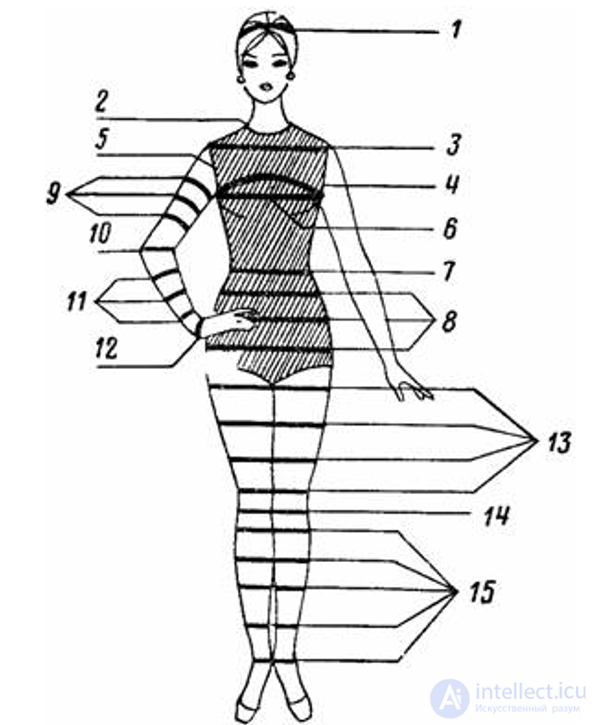
Figure 4. The structural zones of the figure
The shoulder zone (3) determines the width and shape of the clothing with regard to the shape of the shoulders, and it is also of great importance in determining the equilibrium (balance) of the clothing.
The armpit zone (4) is located at the level of the armpits. In front it passes above the swell of the chest, and at the back—in the area of the shoulder blades.
The armpit-shoulder zone (5) connects the armpit with the shoulder joint and determines the outline of the armhole.
The chest zone (6) passes in front through the most protruding points of the chest and determines the placement of the ends of the upper darts.
The waistline zone (7) passes through the most indented points of the torso and determines the degree of volume and the width of the item along the waistline.
The main hip zone (8) marks the widest part of the female torso. The volume of the clothing must be no less than the size of this zone. Two other hip zones are located between the waistline zone and the main hip zone.
The zones of the arm are located parallel to one another from the armpit to the wrist:
The zones of the leg are located parallel to one another from the pubic junction to the joint of the shin with the foot:
Costume sketches in video games are a key stage of visual design, where the character's personality, function, and atmosphere are laid down. They must be expressive, logical, and adapted to the game world.
A costume sketch is not just a drawing but a synthesis of artistic vision, technical requirements, and narrative. It lays the visual foundation of the character and influences the perception of the entire game.
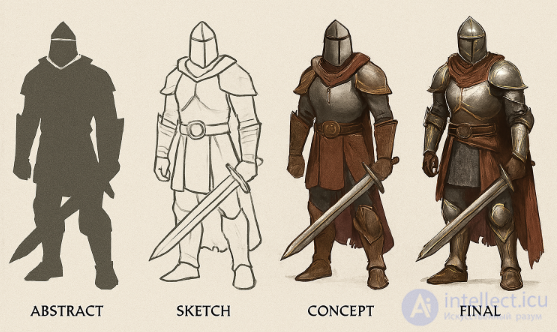
Figure. Examples of the stages of drawing character costumes from video games: 1. Abstract shapes, sketches—a character in a minimalist costume consisting of simple geometric figures and solid colors. 2. Symbolic costumes, sketches—a character with recognizable elements such as a cloak, a mask, and a hat, executed in pixel art. 3. Stylized realism—a character in a bright cartoonish costume with exaggerated proportions and textures. 4. Gameplay realism—a character in plausible clothing adapted to the gameplay, with moderate detailing. 5. Cinematic realism—a character in a highly detailed costume with realistic fabrics, seams, and wear. 6. Photorealism—a character in a costume created on the basis of a real scan, with accurate physics and lighting.
Here are the main features and principles that determine the creation of costume sketches in game design:
The silhouette is the primary marker: the player must recognize the character by their outline even at a distance.
Contrast and uniqueness: the sketch must stand out from the others, especially in multiplayer or dynamic games.
A minimum of unnecessary details: excessive complexity hinders perception, especially in combat scenes.
The clothing must match the mechanics: for example, light armor for a fast character, heavy armor—for a tank.
Animation and interaction: the designer takes into account how the costume will move, deform, and interact with the environment.
Technical limitations: sketches are adapted to the engine, polygons, textures, and lighting.
Story through clothing: the costume tells about the character's past, status, and culture.
Color palette and symbolism: red—aggression, blue—intellect, green—nature or magic.
Age, profession, race, faction—all of this must be reflected in the sketch.
Realism or stylization: depending on the genre—from realistic leather and metal to cartoonish fabrics.
Combining materials: metal + fabric, leather + fur—these create visual interest and depth.
Wear and damage: especially important in post-apocalyptic or combat games.
Sketches go through many revisions: from a rough draft to the final concept.
Feedback from writers, animators, and 3D artists—affects the final look.
Modifications for different levels, seasons, and DLC—the costume can evolve.
In The Sims, clothing became part of the fashion industry—characters wore Diesel and Prada.
In Final Fantasy, heroes were used in the advertising campaigns of real brands.
Even a simple denim outfit requires an understanding of the script, the environment, and its interaction with the gameplay.
The quality of the manufacture of clothing depends in large part on the professional abilities and skills of the workers of garment enterprises and on their artistic culture. The ability to embody one's artistic idea and thought in a drawing or sketch, to make it clear, convincing, readable, and professionally competent, is of great importance for workers dealing with individual clothing customers. In their creative work, they must use drawing as a means of demonstrating and explaining their creative idea. Such concepts as line, silhouette, form, harmony, proportions, and so on must be part of the garment workers' vocabulary and find correct graphic expression in the technical drawing of a model.
A technical drawing of a model is a graphic drawing with front, back, and side views. The item is drawn on the human figure without distortions, in proportions correlated with the structure of a specific or standard figure. The technical drawing is built on analytical data about the structure of the figure and the characteristics of the form-generating means of the model (volume, massiveness, harmoniousness, proportionality). In building the figure and the costume on it, one takes into account its volume as a whole and of its individual parts, creating massiveness—that is, volumes that are visually light or heavy in form. Heaviness in a costume can be achieved by filling the form with decorative and decorative-structural elements or by various ways of arranging the pattern. A soft, plastic resolution of the form with smooth transitions makes the costume lighter, while a hard, graphic resolution increases its mass.
The color, texture, and properties of the materials of a costume make it either heavier or lighter. Fabrics that are textured, rough, or with a fleecy surface increase the volume of a costume, and conversely a smooth, shiny, or glossy surface reduces its volume. Dark, heavy tones make it heavy by reducing the volume, and light tones, on the contrary, make it lighter by increasing the volume. The volumetric forms of a costume depend on the degree of its closeness to the human body. In creating a costume sketch, the position of the points and areas of contact between the body and the costume at the level of the shoulder, waist, or hip zones is taken into account. The creation of a volumetric form leads to harmony or to contrast between the costume and the proportions of the human body.
Harmony is expressed in the proportionality and subordination of all the elements of a costume and of its form as a whole to the sizes, proportions, and appearance of the human figure.
Contrast is expressed in violations of the proportions of the figure—within permissible limits—by the designed form of the costume and its elements. The outline of the surface and the smooth transition of the elements of the form, as if gliding, make the form plastic.
Soft, plastic forms in a costume emphasize the lightness and grace of the human figure. Hard, angular forms make a costume more stable and static.
Proportionality between the forms of a costume and the human figure is a proportionate interdependence, a relationship of the parts of the costume and the corresponding areas of the figure. The precise mutual placement and relationship of the parts of the costume and the areas of the human body make the costume constructive—that is, one that more fully and convincingly helps to reveal the true intent of the costume artist.
A cutter-designer needs to be able, with the help of a schema, to quickly reproduce the drawing of a human figure in a costume, taking into account all the features of its structure. To do this, one should know the rules and order of the schematic construction of a figure by proportions and draw the schemas almost automatically.
On a proportional figure, the features of the structure of the specific figure should always be drawn in. Figure 3.1 shows a variant of the proportional schema of a female figure.
One should begin drawing a model of clothing after first sketching out the schematic outline of the body. Then one builds up the outlines of the model in proportional relationships with reality, and then finishes it. A model of clothing can be built most accurately on the figure by schema if each line and each fold is laid along the form of the body in accordance with its plasticity. To do this, the axial line is drawn first.
. 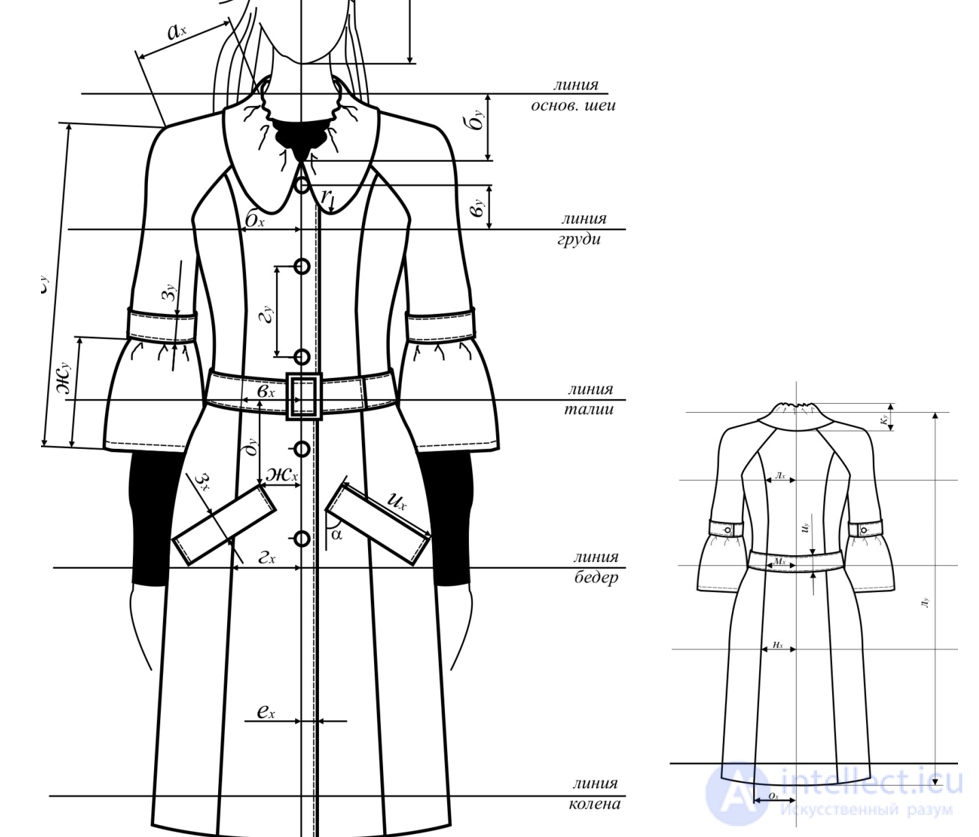
At the end, on the technical drawing of the model, the finishing details are drawn in (pockets, flaps, a belt, and so on), along with stitching, piping, trim, and so on; their type, configuration, parameters, and placement are refined. Last of all, the creases, folds, pleats, and the like are marked out. With stroke and spot, the volume of the model and the texture of its materials are emphasized.
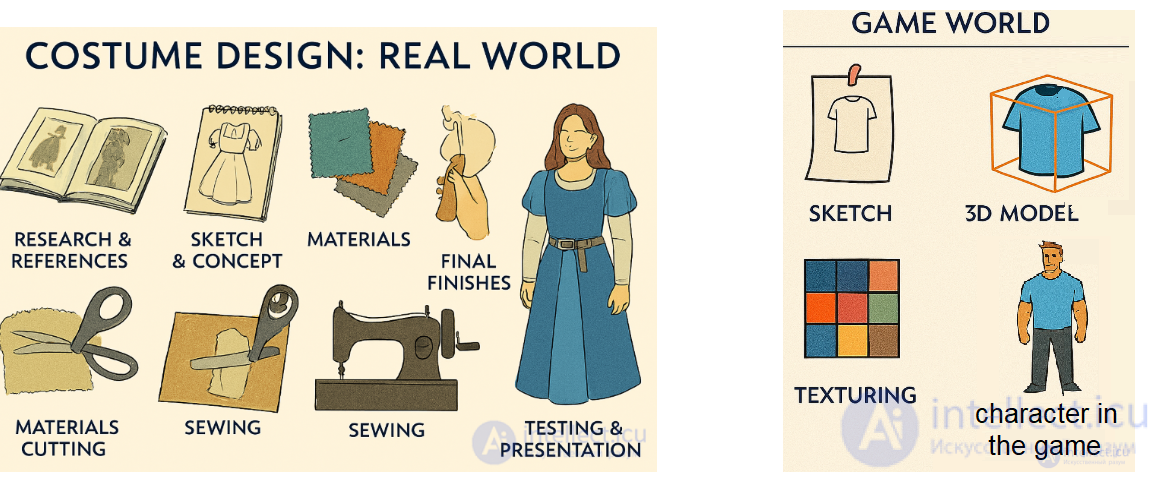
. Despite the shared design principles, the processes differ greatly in tools, goals, and constraints.
Table. The stages of creating costumes: reality vs. video games
| Stage | Real world | Video games |
|---|---|---|
| 1. Research and references |
Studying historical, cultural, and fashion sources. Fabric, cut, traditions. Communicating with the client, ascertaining the need, or conducting surveys |
Analysis of the game's setting, genre, factions, and mechanics. Inspiration—films, art, other games. Communicating with the client, ascertaining the need, or conducting surveys |
| 2. Sketch and concept | Hand-drawn or digital sketches of the silhouette, details, and accessories. |
Concept art: stylized images of the character in the costume, often in different poses and from different angles. |
| 3. Choice of materials | Selection of fabric, leather, metal, and fittings. Consideration of weight, durability, and comfort. |
Defining textures: metal, fabric, leather, glowing elements. Creating a UV map. |
| 4. Sewing or modeling |
Cutting, sewing, fitting, adjustment. Often by hand or with machines. |
3D modeling of the costume: creating the mesh, applying textures, adjusting shaders. |
| 5. Adaptation to movement | Checking comfort, stability, and the response to movement. |
Rigging and skinning: the costume must deform correctly during animation. |
| 6. Final finishing | Decor, patination, aging, embroidery, dyeing. |
Adding effects: dirt, scratches, light, reflections, fabric physics. |
| 7. Testing and presentation | Fitting on a model, a photo shoot, a show. |
Implementation in the game engine, testing in scenes, adjusting the lighting and the camera. |
They can be impossible in reality: levitation, transformation, glowing elements.
They are created faster: there is no physical production, but there is complex optimization.
They are subordinate to gameplay logic: readability, recognizability, correspondence to the mechanics.
Physical limitations: weight, warmth, stability.
Tactility and comfort: important for actors, models, and users.
Material costs: fabric, labor, logistics.
In the production of game or animation costumes, a whole set of procedures is usually used so that the model is convenient for animation, optimized, and visually expressive.
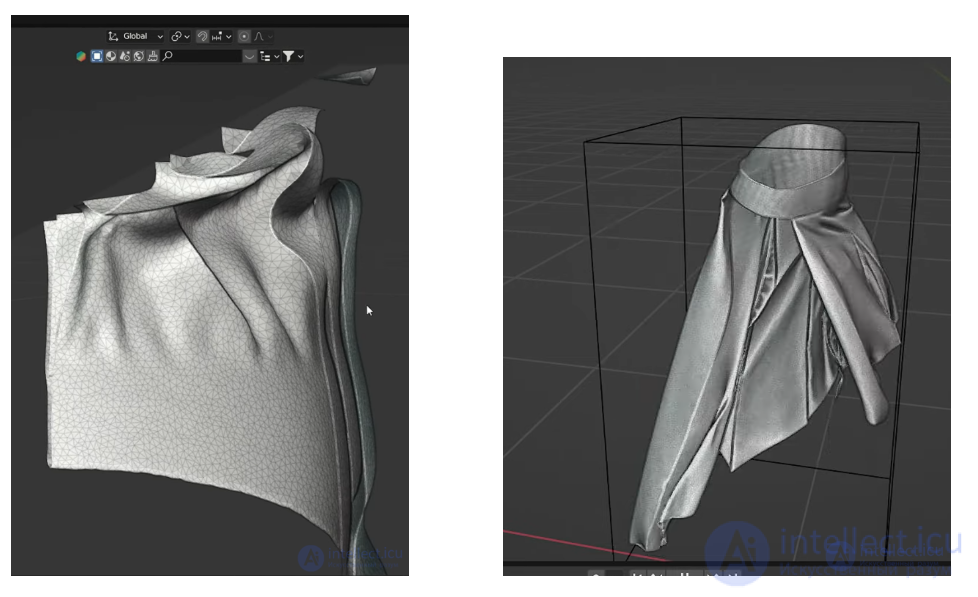
Retopology—Rebuilding the mesh to optimize the polygon count, simplify animation, and improve the deformation of the fabric.
UV unwrapping—Creating a flat map of the surface for applying textures (patterns, fabrics, prints).
Baking maps
Normal map (details of folds and seams without extra polygons).
Ambient occlusion (shadows in the folds).
Roughness/metalness (properties of the fabric).
Cloth simulation—Adjusting the physical properties: softness, elasticity, weight, so that the clothing moves realistically.
Skinning / weight painting—Binding the clothing to the character's skeleton, distributing the influence of the bones on the deformation of the fabric.
Sculpting details—Adding small elements: folds, seams, scuffs.
Texturing and shading—Rendering the materials: cotton, leather, metal, velvet. Adjusting reflections, sheen, and transparency.
LOD (Levels of Detail)—Creating several versions of the model with different numbers of polygons for optimization in the game.
Topology optimization—Removing extra vertices, fixing artifacts, simplifying the mesh for performance.
Rigging the clothing separately—Sometimes clothing is made with its own bones (for example, for cloaks or skirts).
Creating Alembic animation—The clothing looks alive and physically plausible. It simplifies the transfer of simulations between programs. It makes it possible to create cinematic scenes with detailed fabric movement. Alembic (.abc) is a format for caching geometry and animation. It stores the result of a simulation (for example, the movement of fabric) frame by frame, so that it can then be used in other software or engines without recalculating the physics.
Morph targets (blend shapes) → for animating folds or transforming the costume.
Damage simulation → torn fabric, scuffs, dynamic rips.
Materialization in the engine → setting up PBR materials (Physically Based Rendering).
Thus, retopology is only the first step. Next comes a whole «pipeline» of processing: from the mesh → UV → textures → simulation → optimization.
The design of clothing and costumes in game design is a synthesis of art, psychology, and functionality. It shapes the visual language of the game, helps the player navigate the world, and enhances emotional perception. A well-thought-out costume turns a character into an icon, and a game into a unique work of art. The design of the clothing and costumes of characters in game design is a multilayered creative process that unites artistic vision, a knowledge of visual codes, an understanding of technical limitations, and the ability to work with narrative. It is a synthesis of art and functionality that allows characters to come alive and become part of a memorable, profound game world.


Comments