In multiplayer games there are various ways of transmitting data, which depend on the type of game, the synchronization requirements, and the presence of network constraints. The main task of data transmission in multiplayer is to ensure synchronization of player actions and the state of the game world, while minimizing latency and the amount of data transmitted.
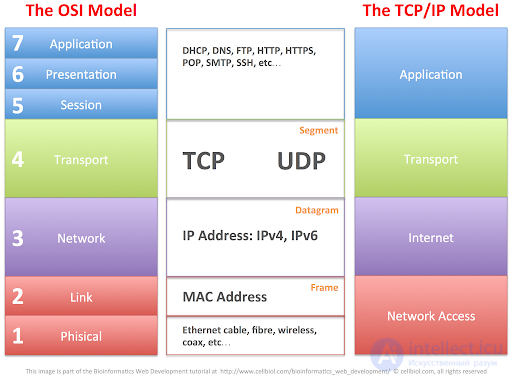
There are several key approaches and technologies for data transmission in multiplayer games, which are used depending on the requirements for performance and reliability:
1. UDP (User Datagram Protocol)
UDP is one of the main network protocols used for real-time data transmission in games.
Features:
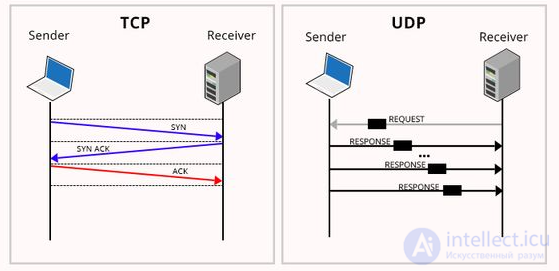
- High speed: UDP transmits data without establishing a connection, which makes it fast and efficient for real-time games.
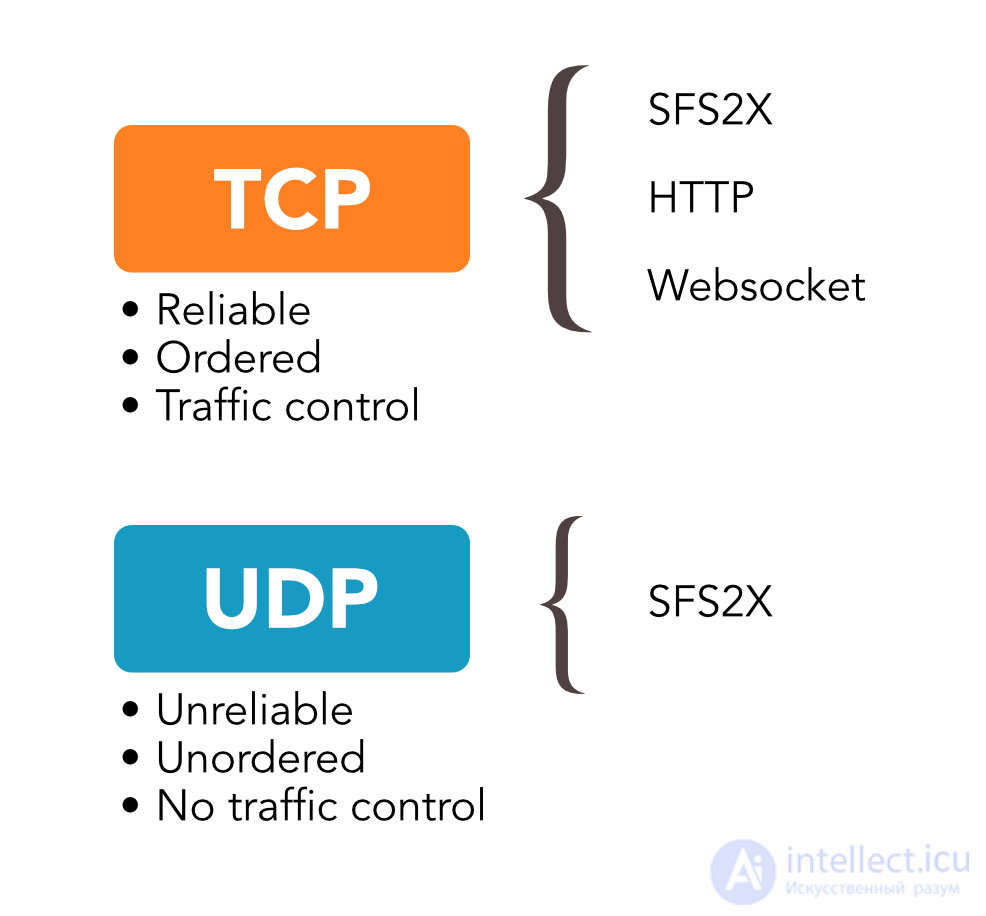
- No guaranteed delivery: UDP does not guarantee packet delivery or the order in which they are received, which can lead to data loss, but in games this is sometimes acceptable (for example, for transmitting movement coordinates).
- Used for critical real-time data: such as player movement, position updates, shooting, and other actions where minor packet loss is not critical.
Application:
- First-person shooters (for example, Call of Duty, Counter-Strike), where it is important to transmit player actions as quickly as possible, even if some packets are lost.
Advantages:
- Low latency.
- Lower load on the server.
Disadvantages:
- No guarantee of data delivery (packet loss can lead to desynchronization).
- It is necessary to handle lost or duplicated packets yourself at the application level.
2. TCP (Transmission Control Protocol)
TCP is a protocol that guarantees the delivery of data in the correct order, but it is slower than UDP.
Features:
- Guaranteed delivery: TCP ensures the delivery of all packets and their correct order, which makes it reliable.
- Slower than UDP: since TCP requires establishing a connection and confirming the receipt of data, this can increase latency.
- Used for less critical data: such as transmitting chat data, inventory, game state, and quests, where accuracy matters more than speed.
Application:
- In MMO games (World of Warcraft), where it is important to transmit data about quests, inventory, and other events that require accuracy.
Advantages:
- Reliable delivery and correct order of data.
Disadvantages:
- Higher latency compared to UDP.
- The loss of a single packet can cause a delay of all subsequent packets (due to the retransmission mechanism).
3. WebSocket
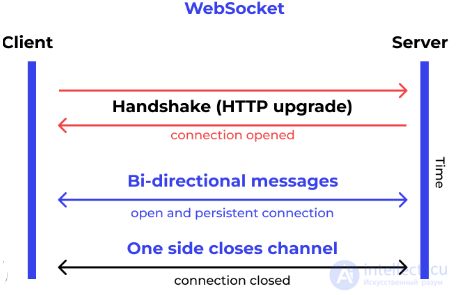
WebSocket is a protocol that provides a persistent two-way connection between the server and the client, and is often used for browser games and games that require support over the Internet.
Features:
- Persistent connection: allows the server and client to exchange data in real time without the need to establish a new connection for each message.
- Used in browser and mobile games: for example, for multiplayer HTML5 games, where support over the Internet and browser technologies is important.
- Based on TCP: which ensures reliable data transmission.
Application:
- Simple multiplayer games in the browser, such as real-time online games (Agar.io, Slither.io).
Advantages:
- Supports a persistent connection with low overhead for data transmission.
Disadvantages:
- May have higher latency compared to UDP.
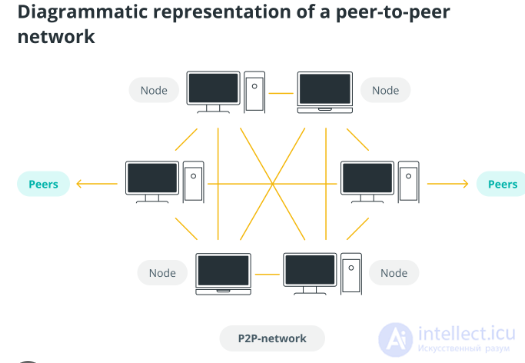
4. P2P (Peer-to-Peer)
In some cases, especially in games with a peer-to-peer architecture (P2P), data is transmitted directly between clients without using a central server.
Features:
- Direct connection between players: clients transmit data directly to each other, which reduces the load on the central server.
- NAT traversal requirements: because of the presence of NAT, it can be difficult to establish a direct connection between clients, and STUN/ICE/TURN servers are often used for this.
- Used in cooperative games: such as Age of Empires, Minecraft (in local server mode).
Advantages:
- Lower latency when a P2P connection is successful.
- Savings on server resources.
Disadvantages:
- Difficulties with NAT traversal.
- The possibility of desynchronization if the connection with one of the participants is lost.
5. Multicast and Broadcast
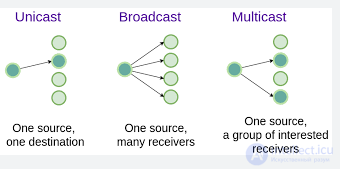
Multicast and Broadcast are ways of sending data to several clients at once, which can be used in local networks.
Features:
- Broadcast: sending data to all devices in the local network (used extremely rarely in games).
- Multicast: allows data to be sent to a specific group of clients at once, which can reduce network load.
- Used in LAN games: when it is necessary to transmit data to several participants in the local network at the same time.
Advantages:
- Reduced load on the server when sending data to a group of clients.
Disadvantages:
- Practically not supported over an Internet connection (limited to local networks).
- Desynchronization can occur if packets are lost.
6. Authoritative server architecture (Client-Server Model)
This is the most common way of transmitting data in modern multiplayer games, in which the server makes all decisions and synchronizes states between clients.
How it works:
- Clients send commands to the server (for example, movement, shooting).
- The server processes these commands, decides how they affect the gameplay, and then sends updates to the clients.
- The server is the source of "truth," and any action of a client is verified and confirmed by the server.
Application:
- Used in games with a high level of gameplay fairness, such as Counter-Strike, Fortnite, and other competitive games.
Advantages:
- Full control over the gameplay.
- Protection against cheating.
Disadvantages:
- Higher load on the server.
- Large delays can occur if the server is far from the players.
7. Hybrid (Hybrid method)
Many modern games use a hybrid model, combining various data transmission protocols depending on the type of information being transmitted.
How it works:
- UDP is used for real-time-critical data (player positions, shots).
- TCP is used for important but non-urgent data (chat, inventory, quest events).
- WebSocket or P2P can be used for certain types of interactions or depending on the players' network.
Advantages:
- Optimization of data transmission for different types of information.
Disadvantages:
- Complexity of implementation and configuration.
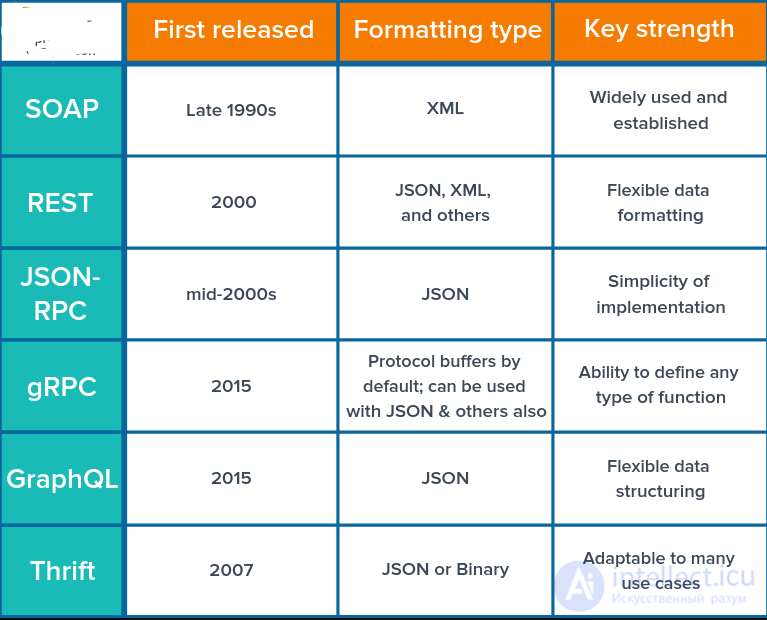
The difference between data transmission methods such as REST, RPC, and others
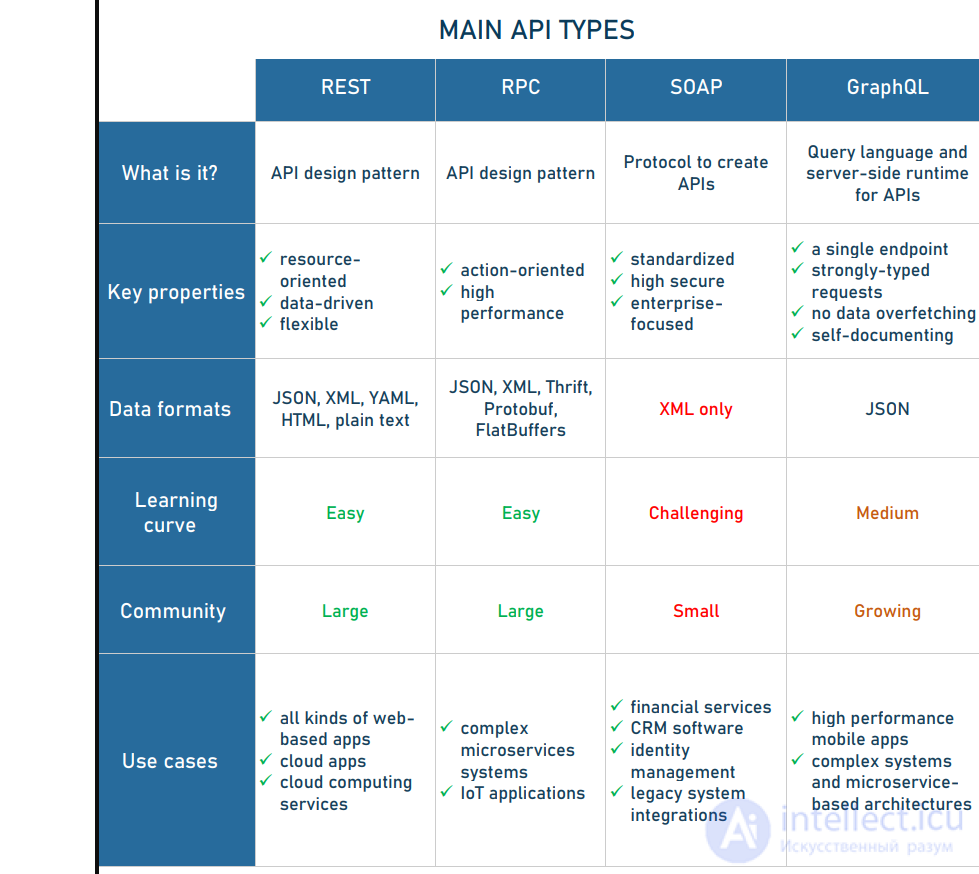
Data transmission in networked applications can be implemented using various approaches and protocols. The most popular methods are REST and RPC, as well as their various variants and other methods. The difference between them lies in the way the interaction between the client and the server is organized, the format of data transmission, and the way requests are processed.
1. REST (Representational State Transfer)
REST is an architectural style for building distributed systems and web services, based on HTTP. In REST, clients interact with resources using standard HTTP methods, such as GET, POST, PUT, DELETE.
Main features:
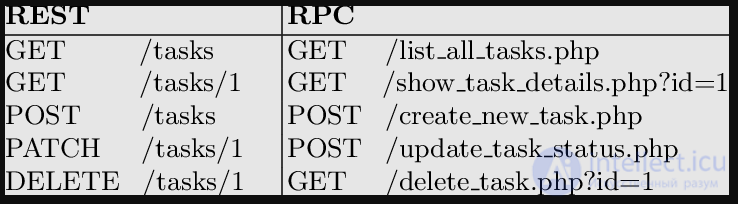
- Use of standard HTTP methods: each method corresponds to a specific action on resources (for example, GET is retrieving a resource, POST is creating a new resource, PUT is updating, DELETE is deleting).
- Resources are identified via a URI (Uniform Resource Identifier). For example, the "user" resource may be accessible at the URL /users/1.
- State is stored on the client side: the server does not store information about the client's previous requests (sessions). Each request contains all the necessary information for its processing.
- Data transmission in JSON or XML format: to simplify processing and integration, data is often transmitted in JSON (JavaScript Object Notation) or XML format.
Advantages:
- Simplicity and standardization (all HTTP requests and methods are well known).
- Platform independence (REST can be used in any programming language and on any devices).
- Ease of scaling and maintenance (standard methods make it easy to manage resources).
Disadvantages:
- Most often REST is used in synchronous systems, where the client has to wait for a response from the server, which can cause delays.
- Redundancy of data in requests, especially with a large amount of information (for example, transmitting large JSON objects).
- Limited capabilities for building complex operations that require more flexible approaches to data transmission.
2. RPC (Remote Procedure Call)
RPC is a protocol that allows a program to call functions (procedures) on a remote server as if they were executed locally. The main idea of RPC is to call remote functions, passing arguments and receiving a result.
Main features:
- Calling procedures: the client calls a remote function as if it were local. For example, the server may have a function createUser(username, password), and the client simply sends a call to this function with arguments.
- Data transmission: the data transmission format can be anything, depending on the implementation (JSON-RPC, XML-RPC, gRPC, etc.).
- Synchronous and asynchronous calls: depending on the implementation, RPC can support both synchronous calls (the client waits for a response) and asynchronous ones (the client does not wait for a response).
- Tight coupling with the server: unlike REST, where requests are resource-oriented, RPC is oriented toward calling methods, which can lead to a strong dependence of the client on the server's structure.
Advantages:
- Procedural model: the approach is close to programming and allows remote functions to be called directly, which simplifies development.
- Less redundancy: when transmitting data, the client sends only the arguments needed to call the function.
- Flexibility in implementation: you can configure the data format, session management, and error handling.
Disadvantages:
- More complex integration: especially if support for different programming languages or platforms is required.
- Dependence on the server: changes in the server interface may require changes on the client side.
- Less standardized approach: unlike REST, there is no single standard for RPC, which can complicate integration with external systems.
3. gRPC (Google Remote Procedure Call)
gRPC is an extension of the RPC concept developed by Google. It supports calling procedures on a remote server using the HTTP/2 protocol and the binary data format Protocol Buffers (Protobuf).
Main features:
- High performance: thanks to HTTP/2 and binary serialization, gRPC can transmit data faster than REST, which uses the text formats JSON or XML.
- Stream support: gRPC supports data streaming between the client and server, which makes it suitable for real-time applications.
- Interface for multiple languages: gRPC supports the automatic generation of client and server code in various languages (C++, Java, Go, Python, etc.).
- HTTP/2 protocol: support for multi-channel data transmission (Multiplexing), which allows sending several requests at once and processing them faster.
Advantages:
- High performance and network optimization.
- Support for streams and bidirectional data transmission.
- Support for multiple programming languages.
Disadvantages:
- More complex configuration and infrastructure (unlike REST, it requires compiling schemas and using Protobuf).
- Less convenient for simple requests, such as working with a browser.
4. SOAP (Simple Object Access Protocol)
SOAP is a protocol for transmitting messages between systems that was widely used before the emergence of REST and other modern methods. SOAP is based on XML for the message format and includes strict standards, such as WSDL for describing web services.
Main features:
- XML format: all messages are transmitted in XML format.
- Strict standards: SOAP has rigid standards and specifications for interaction, including WSDL (Web Services Description Language), which allows code to be automatically generated for working with the service.
- Support for transactions and security: SOAP supports complex features, such as message-level security, session management, and transactions.
Advantages:
- Reliability and security.
- Clear specifications and standards.
- Suitable for integration with enterprise systems.
Disadvantages:
- Redundancy and complexity (XML messages take up more space and require more time to process).
- Complexity of configuration and maintenance.
5. GraphQL
GraphQL is a query language for APIs developed by Facebook, which allows the client to request only the data it needs.
Main features:
- Requesting only the necessary data: the client requests only the fields it needs, which can reduce the size of the data transmitted.
- Support for complex queries: the client can request related data in a single query, which reduces the number of requests needed to the server.
- Single access point: all API requests go through a single endpoint, which simplifies management.
Advantages:
- Optimization of data transmission (only the needed fields).
- Universality and flexibility of queries.
Disadvantages:
- More complex server architecture.
- Possible performance issues if complex queries are configured incorrectly.
Comparison of REST and RPC:
- REST focuses on resources and actions on them using standard HTTP methods, while RPC is oriented toward calling remote procedures and functions, which is closer to method calls in programming.
- REST is more standardized and easy to integrate with various systems, especially with web applications. RPC, in turn, provides more flexibility but creates a dependency between the client and the server.
- gRPC, as an extension of RPC, provides high performance and support for data streams, which makes it a good choice for high-load systems.
- GraphQL gives clients the ability to flexibly request the data they need, which can reduce request redundancy, but requires a complex server architecture.
The "Tribes" networking model
The "Tribes" networking model (or the "Tribes networking model") was developed by Bungie for the game Halo 2, but its concept and approaches have general applicability for the development of multiplayer games. This model was named after the game Starsiege: Tribes, which also used a network architecture optimized for games with a large number of players and dynamic movement of objects.
The main task of the "Tribes" model is to minimize network latency and optimize data transmission between clients and the server in multiplayer games. This model emphasizes distributed processing and efficient use of the network, which is important for dynamic multiplayer shooters and other games.
The use of an unreliable protocol can lead to problems when it is necessary to transmit data that is critical for all players in the game. To avoid this, the engineers had to develop a mechanism that sorts data by its importance. As a result, the developers of the game «Tribes» implemented a system that divides data into four categories:
- Non-guaranteed data: data that is not important for the gameplay and can be skipped when network bandwidth decreases. This is information that does not greatly affect the gameplay. When network bandwidth decreases, the game's algorithm may decide to temporarily stop transmitting this data without harm to the game.
- Guaranteed data: important information that must be delivered accurately and in a specific order, for example, data about shots. This information is important for the gameplay, and its delivery to the recipient is ensured in the correct order. An example is data about a weapon shot, which absolutely must reach all participants of the game.
- "Most recent state" data: information that requires being up to date, such as the number of times a player has been wounded. This is information for which being current is important. For example, the number of hits on a player. If a player receives a new wound, the old data loses its meaning and needs to be updated.
- Guaranteed fast data: priority information that must be transmitted quickly, for example, data about player movement. This data has the highest priority and requires fast transmission with a guarantee of delivery. An example would be information about a player's movement, which must be transmitted as fast as possible to reflect changes in real time.
Here are the main types of data transmitted in the "Tribes" networking model:
1. Entity State Data
The model assumes constant synchronization of the state of game objects between clients and the server. This is key information for maintaining the integrity of the game world on all participants' devices.
- Position and movement of objects: current coordinates, speed, acceleration, direction of movement, etc. For example, in a shooter this could be the movement of a player, the flight of a rocket, or a vehicle.
- State of objects: health of characters, state of combat units, energy level, etc.
- Animations and behavior: active animations (for example, shooting, jumping, running) and state related to the gameplay.
Example:
A player moves around the map, and their coordinates, speed, and direction are updated on the server and transmitted to other players so that they see the exact location of this player in their own client.
2. Game Event Data
This data includes events that happen in the game and require synchronization between all clients. They include, for example, interaction with objects or the performance of actions that require a response from other players or changes in the game world.
- Shots and hits: information about where and when a shot was made, who hit or took damage.
- Interaction with objects: activating buttons, capturing points, picking up items, etc.
- Use of abilities: activation of special abilities or skills (for example, in MOBA games this could be the activation of an ultimate ability).
Example:
A player shoots at another player, and the server sends information about the hit or miss to the other players.
3. Player Input Data
To minimize latency (lag), it is not the full states of players that are transmitted, but their actions and commands. This makes it possible to reduce the load on the network and speed up the response to the player's commands.
- Key presses and control commands: for example, data that the player pressed a key to jump, move, or shoot. This allows the server or other players to simulate movements and actions in real time.
Example:
A player pressed a key to shoot — this command is sent to the server, which then decides whether the shot was successful and transmits this to the other players.
4. Authentication and Sync Data
Since players connect to the server over the Internet, it is important to maintain the session and synchronize their data. This includes:
- Identifying players: confirming that a player is indeed authorized on the network and can participate in the gameplay.
- Time synchronization: especially important for asynchronous actions, such as changing the states of objects in the game environment.
- Latency control and action prediction: the "Tribes" model actively uses client-side prediction to reduce visual lag. For example, a character's movement can be partially predicted on the client and then refined by the server.
5. Network State Data
This data concerns the state of the connection and the performance of the networked game:
- Pings and delays: constant exchange of data about the state of the connection with the server, in order to optimize data transmission and adjust actions taking latency into account.
- Packet loss: data about lost packets or delays that can cause desynchronization between the client and the server. The "Tribes" model uses strategies to correct such losses, minimizing visible artifacts for the players.
6. Data Replication
Replication is a data transmission mechanism that ensures that all clients see the same state of game objects. In the "Tribes" model, this replication can be event-based or continuous.
- Event-based replication: used for transmitting rare events (for example, explosions or the opening of doors).
- Continuous replication: used for objects whose state changes frequently (for example, players who are constantly moving).
Features of the "Tribes" model:
- Minimizing network load: the "Tribes" model tries to reduce the amount of data transmitted, sending only the most necessary updates (for example, changes in the position of objects rather than the full state data).
- Prediction and interpolation: if data is lost or arrives with a delay, clients use prediction and interpolation methods to fill in the gaps based on previous data.
- Sending data only when necessary: the server sends updates only for those objects that are in the immediate vicinity of the player (an object visibility system), which reduces the amount of data.
- Synchronizing state with the server: all clients ultimately receive accurate data from the server, even if at some point the data was predicted incorrectly on the client.
These mechanisms ensure high performance in dynamic multiplayer games, minimizing network latency and providing smooth gameplay.
Server options for multiplayer
When developing multiplayer games, it is important to choose the right architecture and infrastructure for the servers, since this directly affects the performance, scalability, and reliability of the game. There are several server options for organizing multiplayer, each of which has its own advantages and disadvantages. Here are the main options:
1. Your own server (on-premise or self-hosted)
This is a server that you manage yourself, deploying it in your own data centers or on your own hardware.
Features:
- Full control: you fully manage the server, its configuration, security, performance, and updates.
- High initial costs: deploying your own hardware requires significant capital investments.
- Lack of flexibility in scaling: scaling such a system is difficult and costly, especially if the number of players is inconsistent.
- Responsibility for maintenance: all technical problems and support are your task.
Advantages:
- Full control over the hardware, network, and data.
- Maximum flexibility in configuring it to your needs.
Disadvantages:
- High cost of deployment and maintenance.
- Complexity in managing the infrastructure, especially when the load changes.
- Technical staff is required for management and support.
Application:
- Suitable for small studios with limited resources or for internal tests.
2. Cloud server (Cloud Hosting)
Cloud servers are provided by major providers (for example, AWS, Google Cloud, Microsoft Azure) and offer high flexibility, scalability, and availability.
Features:
- Scalability: cloud services make it easy to increase or decrease the number of servers depending on the load (autoscaling).
- You pay for usage: instead of large initial investments, payment is made as resources are used.
- High availability: cloud providers usually offer global data centers, which makes it possible to reduce latency for players from different regions.
- Managed solutions: many providers offer ready-made solutions for games, which simplifies deployment (for example, AWS GameLift).
Advantages:
- Ease of scaling and adapting to the current load.
- High availability and reliability.
- No need to manage physical hardware.
Disadvantages:
- Dependence on a third-party provider (limited flexibility in configuration compared to your own server).
- In the long run it may be more expensive than your own servers, if a lot of resources are constantly required.
Application:
- Suitable for projects of any scale, especially when the ability to dynamically increase or decrease the number of servers is important.
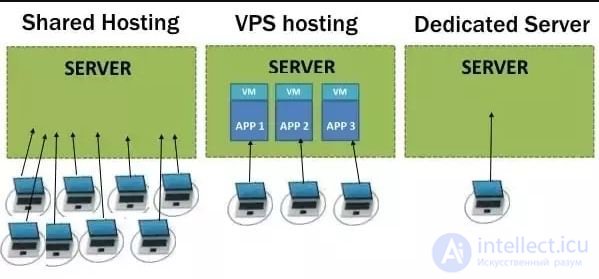
3. Dedicated server
A dedicated server is a physical server that is rented from a hosting provider but is entirely dedicated to your project.
Features:
- Full control: you get full access to the server and can configure it to your needs (for example, the operating system, server applications, etc.).
- High performance: since the server is not shared with other users, all of the hardware's power is available only to your project.
- Fixed payment: dedicated servers are usually rented for a fixed monthly fee.
Advantages:
- High performance and reliability.
- Full control over the server, the ability to configure it for specific needs.
Disadvantages:
- Higher cost than VPS or cloud solutions.
- Limited scalability: to increase capacity, you will need to rent additional servers.
- Technical staff is required to manage the server.
Application:
- Suitable for large games where high performance is important and the number of players is stable.
4. VPS (Virtual Private Server)
A VPS is a virtual machine that runs on a physical server together with other VPSs, but at the same time has its own operating system and resources (dedicated CPU, memory, and storage).
Features:
- Flexibility and control: it provides practically the same control as a dedicated server, but at a lower cost.
- Fewer resources: a VPS has fewer resources compared to a dedicated server, since it operates within virtualization on a single physical server with other users.
- Suitable for small and medium scale: using a VPS makes it possible to run games with a limited number of players, with the possibility of scaling.
Advantages:
- Cost lower than that of a dedicated server.
- The ability to flexibly configure and manage it.
- Resources can be increased as needed.
Disadvantages:
- Limited resources compared to a dedicated server.
- Difficulties with scaling under heavy loads.
- Possible influence of neighboring users on the same physical server.
Application:
- Suitable for small and medium projects, test servers, or games with a limited number of players.
5. VDS (Virtual Dedicated Server)
A VDS is a more advanced version of a VPS, providing more resources and isolation, practically like a dedicated server, but at a lower cost.
Features:
- Dedicated resources: unlike an ordinary VPS, where resources are shared with other users, in a VDS the resources are more isolated, which ensures better performance.
- Management: full access to the server settings is provided.
- Less influence from neighbors: a VDS has higher isolation from other users on the same physical server.
Advantages:
- Better performance compared to a VPS.
- Lower cost than a dedicated server.
- Full control and flexibility.
Disadvantages:
- Fewer resources than a dedicated server.
- Dependence on virtualization.
Application:
- Suitable for medium-scale games or projects that require stability and resource isolation.
6. Colocation
Colocation is placing your own hardware in a data center, where you rent space to install servers and connect to the network.
Features:
- You use your own hardware: you buy and install the servers, but they are physically located in the provider's data center.
- The data center provides the infrastructure: ensuring the network, power, cooling systems, and security.
- Lower operating cost: since the servers belong to you, payment is made only for the use of the data center's resources (renting space, electricity, network connection).
Advantages:
- Full control over the hardware.
- Reliable data center infrastructure with a high level of security and availability.
- Savings in the long run at large scales.
Disadvantages:
- High initial costs for purchasing and installing the hardware.
- Difficulties with scaling: to increase capacity you need to buy new servers.
- Technical support is required to maintain the hardware.
Application:
- Suitable for large game studios with a large budget, where it is important to have full control over the hardware and data, but they do not want to handle the infrastructure themselves.
Comparison table of the options:
| Option |
Management |
Cost |
Scalability |
Performance |
Suitable for |
| Your own server |
Full |
High |
Low |
High |
Small studios |
| Cloud |
Limited |
Pay for usage |
High |
Varies |
Projects of any scale |
| Dedicated |
Full |
Medium/high |
Medium |
High |
Large games |
| VPS |
Full |
Low/medium |
Medium |
Medium |
Small/medium projects |
| VDS |
Full |
Medium |
Medium |
High |
Medium projects |
| Colocation |
Full |
High |
Low |
High |
Large studios |
Conclusion
The choice of a data transmission method in multiplayer games depends on many factors, including the genre of the game, the requirements for reaction speed, security, network capabilities, and the application architecture. In real games, various protocols and methods are often combined to achieve the best performance and connection quality, using the appropriate method for each type of data.
The choice of a data transmission approach (REST, RPC, SOAP, gRPC, GraphQL) depends on the specific requirements of the project: REST and GraphQL are more suitable for simple web applications, RPC and gRPC are for high-performance systems, SOAP is for large enterprise integrations, and GraphQL is for query flexibility and data optimization.
The choice of a server for a multiplayer game depends on your technical and financial capabilities, the scale of the project, and the performance requirements. Cloud solutions offer flexibility and scalability, dedicated servers provide high performance, and colocation and your own servers
See also


Comments