
Lecture
Level creation is one of the most challenging and creative tasks in game design. Every game requires unique solutions based on the specifics of its genre, mechanics, and audience preferences. Levels shape the key moments of gameplay that determine how interesting, engaging, and challenging the game will be for the player.
The purpose of this lecture is to examine the specifics of level design for various game genres, such as shooters, platformers, strategy games, and RPGs. We will discuss which principles should be taken into account when creating levels and how to adapt the design depending on the goals and mechanics of a particular genre.
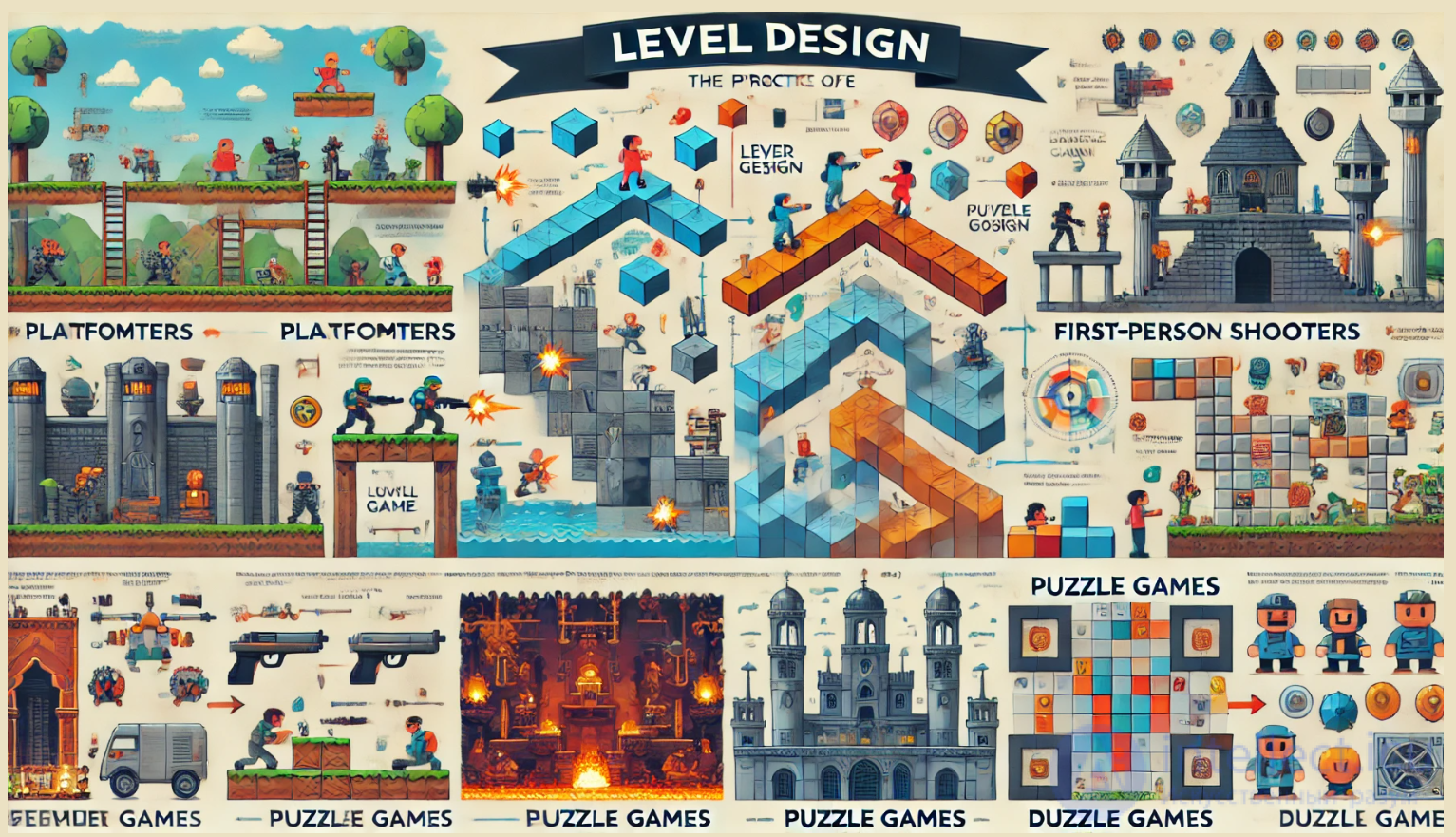
Fig. Infographic illustrating level design practices for different video game genres
1. Creating levels for first-person shooters (FPS)
Example games: Call of Duty, Halo, Doom
Levels in first-person shooters require a balance between the dynamism of the action and the structure of the environment. Key considerations include:
Clear navigation: It is important that the player can intuitively find their way through the levels despite the fast pace of the game. Visual cues, lighting, and environment design help guide the player toward objectives.
Spatial verticality: Adding different height levels (bridges, rooftops, balconies) increases strategic options. Players can use elevated positions for sniper attacks or defense.
Pacing control: Levels should alternate moments of intense combat encounters with periods of relative calm for recovery and preparation for the next challenge.
Arena design: For multiplayer shooters, special attention is paid to arenas, where players can actively use the environment for maneuvers, cover, and capturing points.
Example games: Super Mario, Celeste, Hollow Knight
Platformers require a precise balance between the difficulty of jumps, responsiveness to movement mechanics, and world exploration. The core elements of level design for platformers are:
Clear obstacle structure: Levels are built around elements that the player needs to overcome through jumping, avoiding, or using special skills (for example, a double jump or an air dash).
Difficulty progression: Levels should gradually become more difficult, introducing new mechanics or adding more complex variations of already familiar challenges. This allows players to get comfortable with the basics before encountering more difficult tasks.
Exploration potential: Many platformers include exploration elements, hidden rooms, secret items, or paths that reward players for their attentiveness and ingenuity.
Pace and speed: It is important to maintain the right pace, one that feels smooth and engaging. For example, in Sonic the Hedgehog, the balance between fast movement and moments of stopping to overcome obstacles is important.
Example games: StarCraft, Age of Empires, Command & Conquer
In RTS games, levels must be designed to provide interesting opportunities for tactical maneuvering and resource management. The main aspects are:
Balanced map: The map should offer equal opportunities for both sides. For example, starting positions should be equal in terms of access to resources, but located at different points to create different strategies.
Fortified zones and resources: It is important to place resources so that players have to fight for control over key points on the map. This can be implemented through a system of natural barriers (mountains, rivers) or man-made fortifications (bases, towers).
Terrain variety: The nature of the terrain (plains, mountains, forests) directly affects the players' tactics. In some games, terrain can enhance the defensive capabilities of units or slow down the enemy's advance.
Visibility and zone control: Maps should present a difficult choice between scouting territory, controlling important nodal points, and moving covertly across the map.
Example games: The Witcher 3, Final Fantasy, Skyrim
For RPGs, not only the visual design of the world is important, but also the creation of diverse mechanics for interacting with the world. Key aspects of level design in RPGs:
A world of exploration: Levels should encourage exploration, giving the player the opportunity to stray from the main storyline and discover side quests, secret areas, or valuable items. Open spaces and complex dungeons often contain a multi-layered structure that unfolds as exploration progresses.
Richness of detail: In RPGs, every element of the surrounding environment that helps tell the story of the world is important. The smallest details (old ruins, secret diaries, weapons) can provide clues about the past and the fate of the world.
Progression and character levels: Level design must take into account that players will develop as they progress through the game. Consequently, levels should offer varying degrees of challenge and adapt to the character's abilities.
Flexibility of interaction: In RPGs, players often have the ability to choose different ways of interacting with the world. For example, approaching a task through combat, using diplomatic skills, or bypassing difficult situations with the help of stealth. This should be taken into account in level design.
Many modern games combine elements of various genres, which imposes additional requirements on level design. For example, games like Destiny or Borderlands combine elements of a shooter, RPG, and cooperative mode. For such games, it is important to plan levels with both combat and exploration mechanics in mind, adapting the pace and structure depending on the specific task.
Designing levels for different genres requires knowledge of the mechanics, pacing, and audience preferences of each game. It is important to take into account the unique gameplay elements for each genre and to create levels that not only support but also enhance the gameplay. Spaces in games should not be merely a stage for events, but an active part of the game world that contributes to immersion and the dynamism of the game.

Comments