
Lecture
The term "Metroidvania" is a portmanteau of the names of two famous game series, Metroid and Castlevania. These franchises laid the foundations of the genre, combining nonlinear world exploration, gradual character development, and returning to previously visited locations with new capabilities.
Castlevania: Symphony of the Night (1997) had a particularly large influence, combining world exploration with role-playing elements and a character progression system.
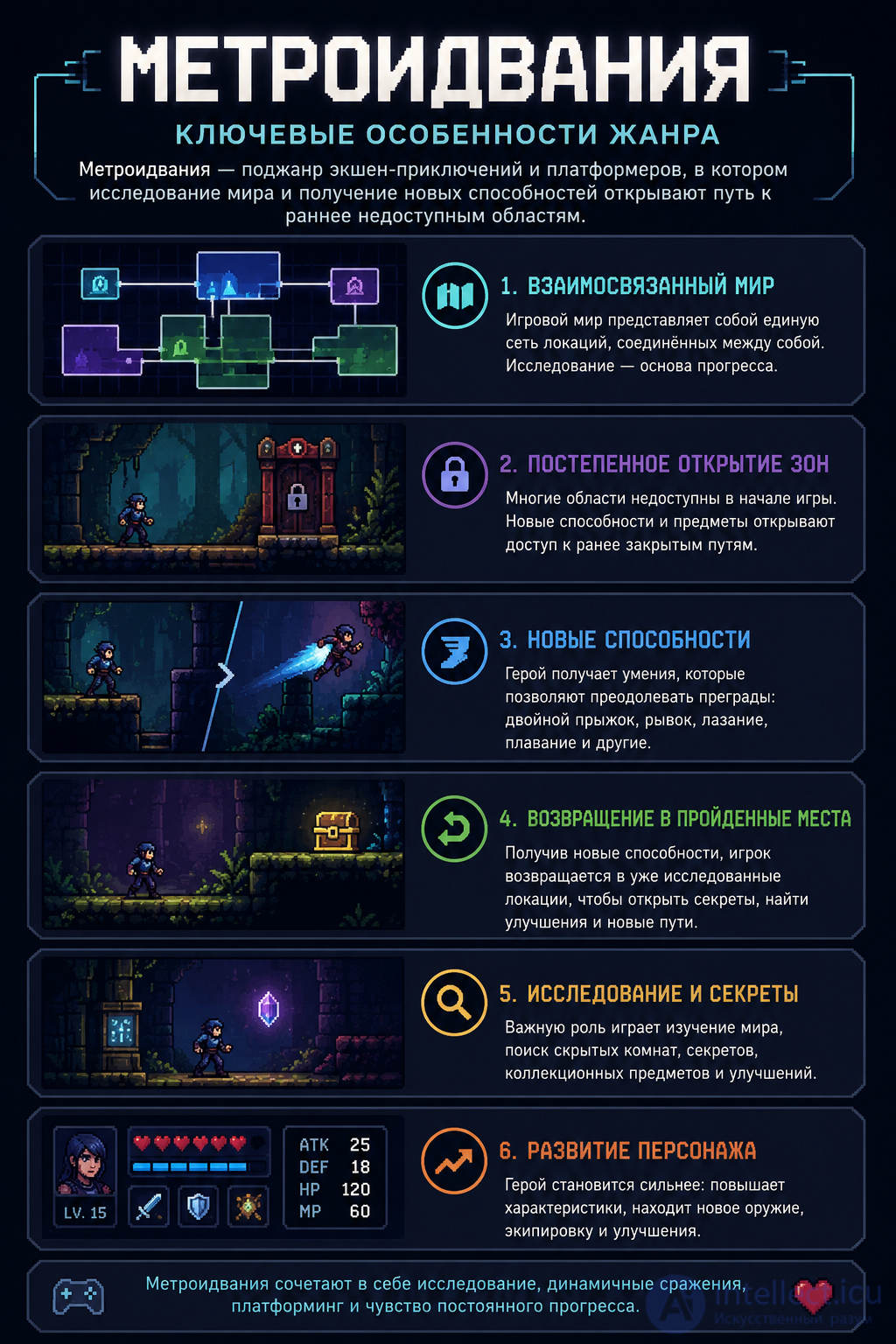
Metroidvania games have a number of characteristic traits:
A single interconnected world. Instead of separate levels, the player explores a large map made up of many linked areas.
Nonlinear progression. Although the story usually follows a certain sequence, the player can choose their own exploration route.
Gradual unlocking of new zones. Many passages and secrets become accessible only after obtaining special abilities, such as a double jump, a dash, wall climbing, or swimming.
Backtracking to already explored places. After gaining new skills, the player returns to old areas to open previously inaccessible paths, secrets, or items.
Exploration and secret hunting. Great attention is paid to studying the surrounding world and finding hidden rooms, collectibles, and upgrades.
Character development. As the game progresses, the hero becomes stronger thanks to new abilities, weapons, equipment, or improved stats.
Most Metroidvania games use a side view, although there are also three-dimensional examples of the genre. The player explores the world, fights enemies, solves simple puzzles, overcomes obstacles, and defeats bosses.
The world map is gradually filled in as the player explores. Checkpoints or special rooms for saving progress are often provided, as well as a fast travel system between previously discovered areas.
Metroidvania is often compared with classic platformers and action-adventure games.
Unlike linear platformers, where levels are completed in sequence, Metroidvania games offer free exploration of a large world and the ability to return to areas already visited.
Metroidvania games differ from open-world games in that progress is limited not only by difficulty level but also by the lack of certain abilities needed to overcome obstacles.
Among the most popular games in the Metroidvania genre are:
Super Metroid;
Castlevania: Symphony of the Night;
Hollow Knight;
Ori and the Blind Forest;
Ori and the Will of the Wisps;
Axiom Verge;
Blasphemous;
Ender Lilies: Quietus of the Knights;
Guacamelee!;
Prince of Persia: The Lost Crown.
In the 21st century, the genre went through a new stage of development thanks to independent developers. Modern technology has allowed small studios to create large-scale projects with deep exploration systems, atmospheric art styles, and original mechanics.
Today, Metroidvania games remain one of the most popular indie game subgenres. Developers continue to experiment with elements of role-playing games, roguelikes, Souls-like mechanics, and procedural generation, expanding the traditional boundaries of the genre.
Metroidvania games have had a significant influence on the development of the gaming industry. Their approach to world exploration, the gradual unlocking of new capabilities, and the organic development of gameplay is used in many modern action games and adventure projects. Thanks to the combination of exploration, dynamic combat, and a sense of constant progress, the genre continues to attract both new players and fans of classic games.

Comments