
Lecture
Transitions between scenes and levels are an important part of the gaming experience. They serve not only the technical function of loading data, but also an artistic one: they help maintain the player's immersion, convey mood, emphasize the story, and enhance the perception of the game world. A well-crafted transition makes a game feel cohesive, whereas an abrupt and inappropriate one destroys the atmosphere.
In game design, it is customary to distinguish three main categories of transitions:
They are often combined.
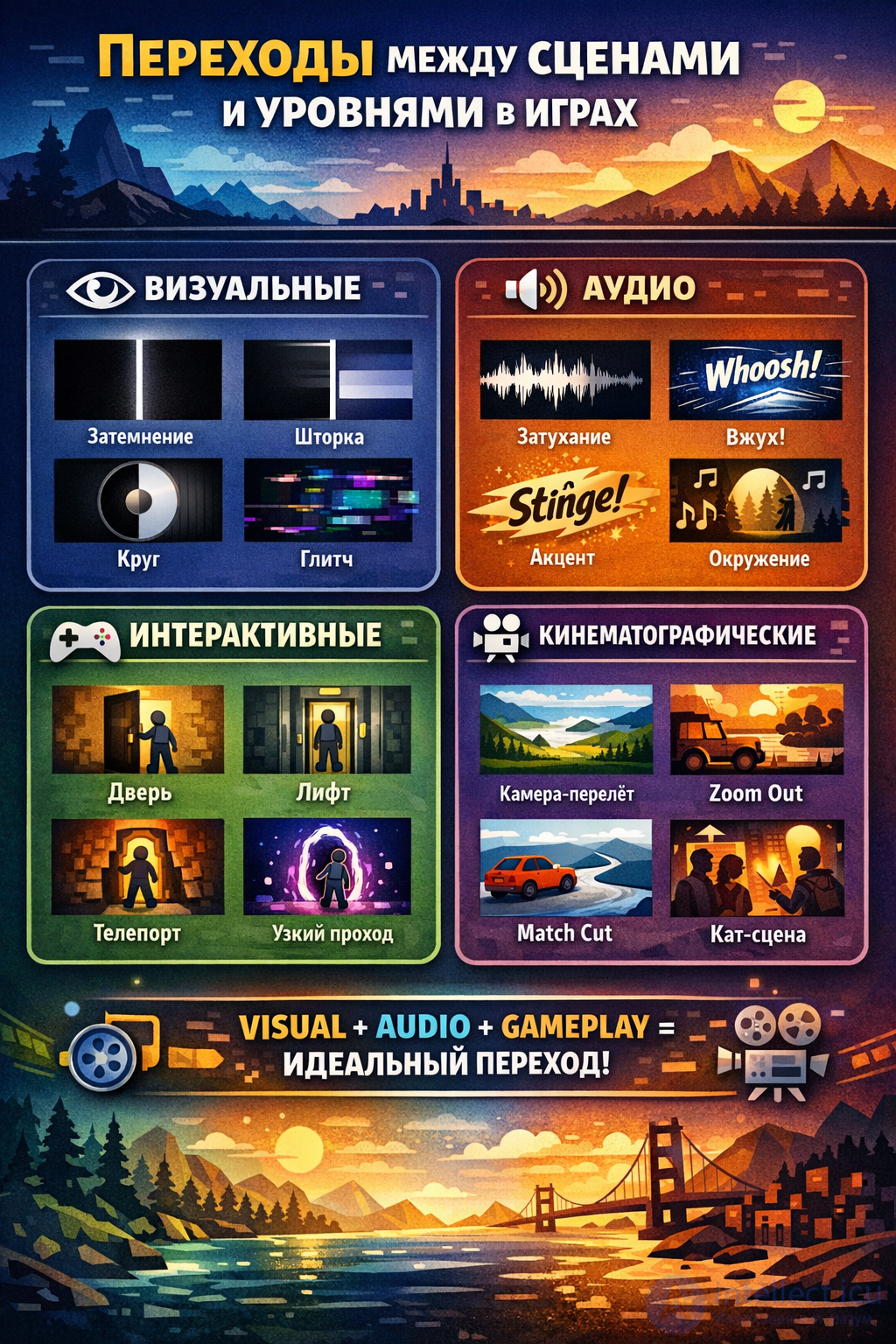
Visual transitions are changes in the image that signal to the player a change of scene or level. They are used in virtually every game.
Fade in / Fade out
The most common transition. The screen gradually darkens, then a new scene appears.
Used:
Crossfade
One scene gradually dissolves into another.
Suitable for:
Wipe
One scene "slides" the other away. Often used in:
Iris (circular closing)
The screen closes in with a circle. Frequently seen in:
Glitch transition
Uses digital interference. Applied in:
Transition through shifting scenery (environment sliding / moving scenery transition).
Instead of darkening the screen:
The player sees a natural change in the environment rather than a technical transition. It is often used to make the transition smooth and unnoticeable, and it is employed in 2D platformers (often background layers), mobile games, fairy-tale and cartoon styles, theatrical or stylized games, and seamless open-world transitions.
Visual transitions between scenes are an important element of visual storytelling in film, animation, video games, and multimedia projects, providing a smooth switch from one episode to another and helping the viewer or player perceive the unfolding of events both logically and emotionally. Such transitions serve not only the technical function of connecting scenes but also an artistic one, shaping the rhythm, mood, and semantic connection between parts of the work. One of the most common visual transitions is the straight cut, in which one scene instantly gives way to another with no additional effects; this method is used for dynamism and neutral delivery of the action. A smooth fade to black (fade out) and emergence from darkness (fade in) create a sense of a fragment's completion or the beginning of a new time span, and are often used to mark a pause or a transition to a different location. A dissolve involves the gradual overlay of one scene onto another, creating a soft transition that may symbolize the passage of time, a memory, or the simultaneity of events. A wipe is a transition in which the new scene "pushes out" the previous one by means of a line, shape, or movement, which adds stylistic expressiveness and is often used in stylized projects. Transitions through camera movement are also used, when an object or character obscures the frame and thereby creates a natural change of scene; this approach looks organic and reinforces the continuity of the action. Transitions through color or light are used for emotional connection between scenes; for example, a bright flash of light can signify a sharp jump in time or a dramatic event. In modern video games, visual transitions are often combined with interface elements such as loading screens, blur, changes in depth of field, or gradual camera movement, which allows the technical loading processes to be hidden and the player's immersion to be preserved. An important aspect is matching the visual transition to the pace of the narrative: fast, abrupt transitions heighten tension and dynamism, whereas slow, smooth ones create a calm atmosphere and allow the viewer to adapt emotionally. In addition, visual transitions can serve as semantic markers, indicating a change in the time of day, a character's memory, a move into another world, or a change in point of view. Well-chosen visual transitions enhance the integrity of the work, make the narrative clear, and strengthen the artistic impact on the audience.
Audio plays an enormous role in how transitions are perceived. Even a simple visual fade becomes significantly better with well-chosen sound.
Audio fade
The music gradually fades out during the transition.
Used almost always.
Stinger (musical accent)
A short sound or chord at the change of scene.
Examples:
Whoosh effects
Sounds of moving air or energy.
Suitable for:
Ambient crossfade
A smooth change of ambient sounds:
Sound filters
Used to convey space:
Audio transitions between scenes are sound-based ways of connecting different episodes in film, video games, animation, and multimedia, which help create continuity of perception and enhance the emotional impact on the viewer or player. Unlike visual transitions, audio transitions work through sound, music, noise, and silence, forming a smooth or contrasting transition between scenes. One of the most common methods is the gradual fading of sound (fade out), when the audio of the previous scene slowly diminishes, creating a sense of the episode's completion. The reverse technique is the smooth emergence of sound (fade in), in which the sound of the new scene gradually intensifies, gently introducing the audience into a new space. Audio crossfade is often used, when the sound of the next scene begins to play before the previous one has finished, creating a sense of continuity of time and space. This technique is especially effective for conveying a transition between locations without an abrupt break in perception.
Another important type of audio transition is the sound bridge, when a sound from the next scene appears in advance or continues after the image changes, thereby linking two episodes both semantically and emotionally. Musical transitions also play a major role: a change of musical theme can signify a change in mood, time, or storyline, while a smooth modulation helps avoid abrupt jumps in perception. Sometimes a sharp sound contrast is used — sudden silence after a loud scene, or, conversely, a sharp sound after silence; such transitions heighten the dramatic effect and draw attention. Ambient sounds, such as the noise of wind, footsteps, or an urban backdrop, can gradually transform, creating a sense of moving from one environment to another.
In video games, audio transitions are often adaptive and respond to the player's actions: the music can change dynamically upon moving to a new level, and the sound environment gradually blends with the new one, preserving immersion. In addition, the use of pauses and controlled silence plays an important role — the absence of sound sometimes serves as a powerful transitional element, creating tension or emphasizing an emotional turning point. Well-constructed audio transitions help unite scenes into a single whole, reinforce the rhythm of the narrative, and make the experience more natural and expressive.
Interactive transitions occur through the player's actions. They are considered the most natural.
Doors
The player opens a door → a new scene loads.
Elevators
While the elevator is moving, the level loads.
Narrow passages
The character squeezes between walls.
This technique is used to hide loading.
Teleports
An instant transition with effects.
Stairs
A transition between floors.
The advantage of interactive transitions:
Interactive transitions between scenes are ways of changing episodes in which the user or player directly influences the moment, form, and content of the transition, which makes the narrative more dynamic and engaging. Unlike purely visual or audio transitions, interactive transitions depend on the user's actions: pressing a button, choosing a dialogue option, completing a task, or moving the character through the game space. Such transitions are actively used in video games, interactive films, educational applications, and web projects, where it is important to preserve the sense of control and participation. For example, a transition may occur after a door is opened, and then the opening animation itself becomes part of the scene, seamlessly moving the user into a new location. Similarly, a transition through a world map allows the player to choose a destination, after which the scene changes according to the chosen route, creating the illusion of freedom of movement.
Another common type is the transition through a dialogue choice, when the subsequent scene depends on the user's decision. In this case, the transition not only connects episodes but also shapes the branching of the plot. Transitions through the fulfillment of conditions are also used: for example, after solving a puzzle a new level opens, and the very moment the mechanism is activated is accompanied by animation and sound that unite the scenes. Transitions through character movement create the effect of a continuous world — when the player enters a tunnel, elevator, or vehicle, the system gradually loads the new scene while preserving control and the sense of presence.
Interactive transitions may include user interface elements such as buttons, menus, loading indicators, and the selection of missions or levels. Some projects use so-called "seamless transitions," when scenes are connected without any explicit division: the player moves forward, and the surrounding environment gradually changes until a new area imperceptibly appears. Such transitions enhance immersion and make the world feel more cohesive. Transitions through events are also used — for example, upon reaching a certain point the camera automatically changes its angle, a cutscene begins, after which control is returned to the player. Importantly, interactive transitions take into account the pace of the user's actions: if the player lingers, the transition is postponed, and if they act quickly, the scene changes faster.
Well-implemented interactive transitions help avoid abrupt breaks between scenes, strengthen the sense of participation, and make the narrative adaptive. They combine visual, audio, and gameplay mechanics into a single process in which the user becomes an active participant in the change of scenes rather than merely an observer.
They use techniques from cinema. They are often applied in story-driven games.
Camera flythrough
The camera moves to a new location.
Zoom out → Zoom in
The camera pulls back, then zooms in on a new place.
Match cut
Similar shots are joined together.
Pan transition
The camera smoothly rotates.
Cutscene transition
A cutscene between levels.
Cinematic transitions between scenes in games are techniques of changing episodes borrowed from the language of cinema and adapted to an interactive environment, allowing for more expressive and emotionally rich storytelling. Such transitions use editing, camera movement, frame composition, and dramaturgy to smoothly connect gameplay moments and cutscenes. One of the common methods is the transition through camera movement, when control is temporarily taken away, the camera pulls back from the character, changes its angle, and gradually moves the player into a new scene, creating a sense of cinematic editing. A transition through a cutscene is also often used, when the gameplay is temporarily paused, a short story sequence is shown, and then the action continues in a different location or situation.
Another cinematic technique is the match cut — a visual coincidence of elements between two scenes; for example, when a rotating object in one scene smoothly transitions into a similar object in another, creating an artistic connection. Transitions through fade or a flash of light are also used, helping to indicate a change of time, a memory, or a sharp plot event. In modern games, "hidden cuts" are popular, when scenes are connected imperceptibly: the character passes through a narrow corridor, crawls under an obstacle, or rides an elevator, and at that moment a new area loads without any obvious break. This approach creates a sense of a continuous world and enhances immersion.
Cinematic transitions also include transitions through the focus of attention, when the camera first shows an important object, then smoothly shifts and reveals a new scene. Sometimes the effect of parallel editing is used — a rapid alternation of scenes to create tension, for example before an important event. Music and sound are often synchronized with the visual editing, reinforcing the dramatic effect. Importantly, in games such transitions must take interactivity into account: they either temporarily restrict control or gently return it to the player after the scene ends. Well-implemented cinematic transitions make a game feel more like a film, strengthen the emotional impact, and help connect the gameplay with the storytelling.
The best transitions use several methods at once:
Example:
This is:
Transitions perform several tasks:
Combined transitions between scenes in games are ways of changing episodes in which several types of transitions are used simultaneously: visual, audio, interactive, and cinematic, united into a single cohesive technique. This approach makes it possible to make the change of scenes smoother, more expressive, and less noticeable to the player, while preserving immersion in the game world. For example, when a character moves to a new location, the camera may smoothly pull back (a cinematic element), the screen darkens slightly (a visual element), the music gradually changes (an audio transition), and control remains with the player (interactivity). The result is a complex transition that feels natural and does not disrupt the rhythm of the game.
One of the common variants of a combined transition is the use of character movement together with a change in the sound environment and a cut. For example, the hero enters a building, the door closes, the noise of the street gradually fades, muffled interior music appears, and the camera smoothly changes its angle, revealing a new scene. Here the visual, audio, and cinematic components work simultaneously. Another example is a transition through transport: the character boards a train or elevator, a short movement animation begins, the music changes, the lighting changes, and after stopping the player finds themselves in a new area. Such a transition hides level loading and creates a sense of a continuous world.
Combined transitions are also actively used in transitions into cutscenes. For example, the player approaches an important point, the ambient sound is muffled, the camera automatically focuses on the character, a dialogue begins, then a smooth scene change occurs using a fade and a new musical theme. After the sequence ends, control is returned to the player in a different context. Some games use dynamic combined transitions that depend on the user's actions: if the player moves quickly, the transition happens almost imperceptibly, and if slowly — additional visual and sound elements are added.
The main advantage of combined transitions lies in their flexibility and expressiveness. They make it possible to unite different means of expression, strengthen the emotional impact, and simultaneously solve technical tasks such as loading levels or switching game logic. Thanks to this, scenes are connected more organically, and the gameplay is perceived as a continuous and cinematic experience.
The principles of good scene transitions in games are based on preserving immersion, logical coherence, and ease of perception for the player. One of the key principles is smoothness, in which the change of scene occurs without abrupt visual or audio breaks, so that the player does not feel an artificial division of the game world. Smoothness is achieved through the gradual change of lighting, camera movement, the fading of sounds, or the use of animations that naturally connect scenes. No less important is the principle of semantic coherence: the transition must be justified by the plot or a game action; for example, a transition through a door, elevator, or vehicle looks natural, whereas a sudden change of scene without cause can disrupt perception.
The next principle is preserving the player's control. Even if a transition includes cinematic elements, it is desirable to restrict control as little as possible or to return it quickly after the transition ends. This maintains the sense of participation and makes the process more interactive. The principle of hiding technical processes is also important: good transitions are often used to imperceptibly load new locations, update logic, or change the state of the world. For this, narrow corridors, fades, camera movements, or short animations are used to divert attention from the technical side.
The principle of rhythm implies matching the transition to the pace of the game. In dynamic scenes, fast and short transitions are used, whereas in calm ones — more smooth and slow ones. This helps maintain emotional balance and avoid destroying the atmosphere. In addition, visual-audio consistency is important: a change in the image should be accompanied by a logical change in sound, music, and environment, so that the transition is perceived as a single event. Another principle is predictability, in which the player understands that a transition is occurring but does not feel discomfort; for example, familiar door-opening animations or a travel map form a clear logic for the change of scenes.
Finally, a good transition should be brief and not irritating: overly long loading scenes or repetitive animations reduce engagement. Ideally, a transition should either enhance the narrative or be almost unnoticeable. Adhering to these principles makes it possible to create organic transitions that maintain the integrity of the game world, improve perception, and strengthen the emotional impact on the player.
Bad practices in the use of scene transitions in games and interactive projects are associated with breaking immersion, the logic of the narrative, and ease of perception for the player. One of the most common mistakes is an abrupt and unjustified change of scene without any visual or semantic connection. When the player suddenly finds themselves in a different location with no explanation, it destroys the sense of the game world's integrity and causes disorientation. A similar problem is the excessive use of fades or loading screens, especially if they are repeated too often and carry no semantic meaning — such transitions are perceived as technical pauses rather than part of the gaming experience.
Another bad practice is an overly long transition, when animations, elevator rides, or corridors are used solely to hide loading but take up a lot of time and add nothing to the gameplay. Repeating the same long animation quickly begins to annoy the player and reduces the game's dynamism. Transitions that completely take away control without necessity are also perceived negatively, especially if this happens often. When the player constantly loses control due to short cutscenes or automatic movements, it creates a sense of passivity and reduces engagement.
Another mistake is inconsistency between the audio and visual parts of a transition. For example, when the image has already changed but the sound of the previous scene continues to play without any logic, or, conversely, the music cuts off abruptly. Such mismatches create a sense of technical flaws and break the atmosphere. It is also considered bad practice to overuse flashy transitions — frequent flashes, complex camera animations, and unusual editing techniques can overload perception and distract from the gameplay. If transitions are too noticeable, they begin to compete with the content of the scene.
Another problem is the absence of logical motivation for a transition. For example, teleporting a character without explanation, a sudden change in the time of day, or moving to a new area without any visual or narrative basis. This violates the internal logic of the world. In addition, the unpredictability of transitions is considered bad practice, when the player does not understand what will happen after a certain action — this can lead to loss of orientation and a sense of chaos.
Finally, technically noticeable transitions are perceived negatively: objects loading in front of the player, the abrupt appearance of textures, camera jumps, or sharp changes in lighting. Such problems emphasize the artificiality of what is happening and reduce the quality of perception. On the whole, bad transitions are either too noticeable and irritating or, on the contrary, too abrupt and break the coherence of scenes. Good practice consists of making a transition either enhance the narrative or remain almost unnoticeable to the player.
Audiovisual transitions are an important game design tool. They unite levels into a single world, hide technical processes, and heighten the player's emotions. The best transitions are unnoticeable — the player perceives them as a natural part of the game.
By skillfully using visual effects, sound, and interactivity, a developer can significantly improve the quality of the gaming experience.

Comments