
Lecture
Multiplayer game modes have long become an integral part of the modern gaming industry. They allow players to interact with each other in real time, competing or cooperating, creating new levels of engagement. For developers of multiplayer games, it is important to take into account many factors, ranging from network architecture to server support. In this article, we will look at the main types of multiplayer, their features, and the key points worth paying attention to during development.
A multiplayer game, or multiplayer (from the English «multiplayer»), is a computer game mode during which more than one person plays.
Local multiplayer implies playing together on a single device or within a single local network (LAN). It is popular in console games, where several players can use one screen with split-screen. Examples of such games are the "Mortal Kombat" or "Mario Kart" series.
Features:
This type allows players to participate in cooperative or competitive games over the internet while being located far apart from one another. Examples are games such as "Fortnite", "League of Legends", or "Call of Duty".
Features:
MMO (Massively Multiplayer Online) games involve the participation of thousands, and sometimes millions, of players on a single game server. These are games such as "World of Warcraft" and "EVE Online", where players interact in enormous virtual worlds.
Features:
Cooperative mode involves several players completing the game together, usually against artificial intelligence. Examples include "Left 4 Dead" or "Portal 2".
Features:
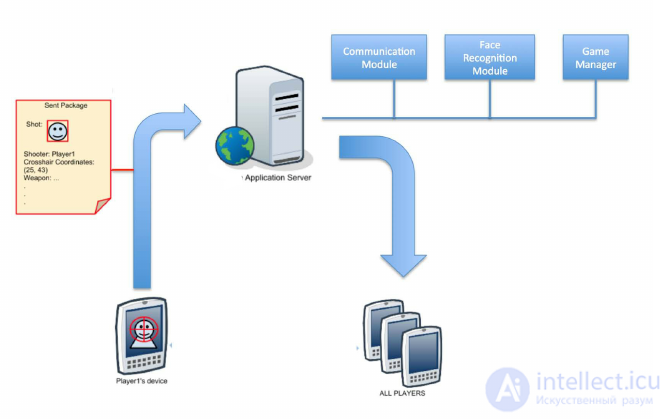
Multiplayer games require the correct choice of network interaction architecture. The main options are:
For multiplayer games, it is important to ensure minimal delay between players' actions. The network code must be optimized to minimize latency and packet loss. One of the main tasks is synchronizing the state of the game world across all devices.
In conditions of network latency or packet loss, it is necessary to provide mechanisms for correctly restoring the game state. This can be either state prediction (client-side prediction) or the use of server rollbacks (rollback) to fix desynchronizations.
One of the main threats to multiplayer games are cheaters. Protection mechanisms can include:
When developing multiplayer, developers can use different engines and platforms. Some of the popular tools for creating network games:
A key aspect of developing multiplayer games is testing network stability under heavy loads. This requires:
Even after the release of multiplayer games, developers are obligated to maintain the server infrastructure, release patches and updates to fix bugs, improve game balance, and protect against cheaters.
In the context of multiplayer programming, the terms client, server, and host refer to different roles and architectures of network interaction in a game. Let's take a closer look at them:
A client is a device or program through which a player connects to the game. Clients receive information from the server (or host) and send back data about their actions (movement, attack, interaction with objects, etc.).
Main functions of a client:
A client usually does not have full information about the entire game world — only about the limited part with which a particular player interacts, which helps minimize data transfer and provides security against hacking.
A server is the central controlling component that stores and controls the game state for all connected clients. A server can be either dedicated (dedicated server) or combined with a client (in small games).
Functions of a server:
In the client-server model, the server fully controls the gameplay, which makes it important for preventing network attacks and cheating.
A host is a participant in a multiplayer game who simultaneously performs the functions of a client and a server. In other words, one of the players acts as the host: they play the game, but at the same time their device also processes data for other players, as a server does.
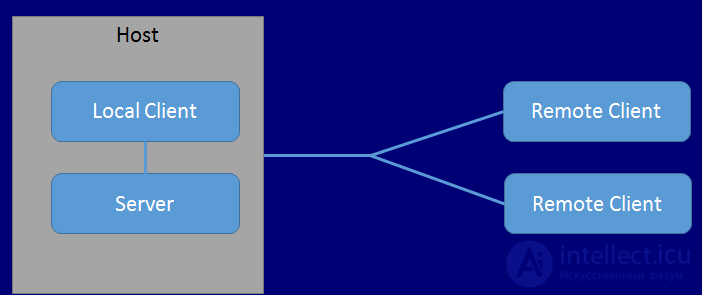
Main functions of a host:
Host-server architecture is often used in peer-to-peer networks (P2P). This is convenient for small games, since it does not require dedicated server infrastructure. However, there are downsides:
Each of these architectures has its own advantages and disadvantages, and the choice depends on the size of the game, the number of players, and the available infrastructure.
Organizing multiplayer requires the transfer of various types of data between clients and the server (or between clients in a peer-to-peer network). This data must be structured in such a way as to ensure synchronization of players' actions and the state of the game world. Here are the main types of data that are usually transmitted to organize a multiplayer mode:
One of the most important aspects of synchronization in multiplayer games is the transfer of information about the position and movement of players. This data includes:
This data must be updated with minimal delay so that players see each other's exact positions in real time.
Game actions are all of a player's interactions with the world and other players. This includes:
The server verifies these commands for validity and distributes the results to other clients.
Player characteristics that are important for the game, such as:
This data is transmitted so that the server can correctly process interactions between players (for example, subtracting health when taking damage).
In addition to data about the players themselves, it is necessary to transmit information about elements of the game world:
Many games contain special game events that must be synchronized for all players. Examples:
The server transmits this data to all clients so that they can update their display of the game world.
To organize communication between players (especially in MMOs or cooperative games), the following is transmitted:
In addition to game data, it is necessary to transmit technical information for managing the session:
Some games also transmit data about object physics in order to synchronize interaction with the environment:
This is especially important for games with realistic physics, where incorrectly synchronized behavior can ruin the gaming experience.
To hide network latency, a prediction mechanism is used. The server can predict a player's actions several milliseconds ahead based on the current data. For example:
These mechanisms allow players to see smoother animation, even if the connection is unstable.
To control the quality of the connection, the following is transmitted:
Spawning objects in multiplayer is the process of creating new objects (characters, weapons, items, etc.) in the game world, which must be synchronized for all players in the network. When developing multiplayer, it is important to implement spawning correctly so that all clients see the same picture and can correctly interact with the new objects.
In multiplayer, spawning can be performed both on the server side (server spawning) and on the client side (client spawning), depending on the chosen architecture.
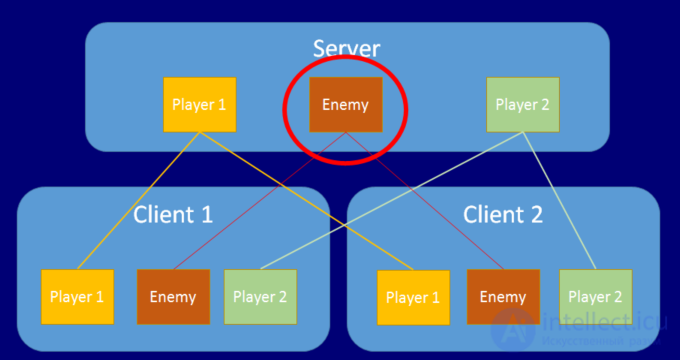
In most cases, objects in multiplayer are spawned on the server side, which manages all of the game's logic. After this, the server transmits information about the new object to all connected clients.
A player picks up an item (for example, a weapon), and the server decides that a new item needs to be spawned in its place. The server creates the item, assigns it a unique ID, and sends information to all clients about its location.
Client-side spawning is usually applied in less critical situations or for temporary objects, such as particle effects, that do not affect the gameplay. A client can also initiate spawning by sending a corresponding request to the server.
Client-side spawning is used with caution, since directly creating objects on the client side can lead to desynchronization or vulnerabilities to cheaters.
A player fires a weapon, and the client spawns temporary effects, such as a muzzle flash or smoke. These objects do not affect the gameplay and do not require server synchronization.
When a new object is spawned, it is important to ensure its synchronization for all players. This is achieved by transmitting the object's state over the network.
In a game of the «battle royale» type, the server may periodically spawn supply crates at various points on the map. This data (the spawn location and the type of crate) is transmitted to all clients, which then synchronize the positions of the crates on their devices.
Destroying objects (despawning) is the reverse process of spawning. When an object is no longer needed in the game (for example, it has been destroyed, picked up, or its lifetime has expired), the server initiates its despawn and notifies all clients about it.
In order not to overload the network and the device's performance, it is necessary to optimize the process of spawning objects:
Fraud, or «cheating» (from the English cheat — fraud), is a serious problem in networked computer games.
The very definition of the concept of «fraud» is murky. The classic definition of fraud as «gaining an unfair advantage» is not suitable, since the meaning of the word «unfair» remains unclear. The use of «aimbots» (from the English aimbot), which shoot quickly and without missing, is definitely fraud. Reconfiguring the controls is, of course, not fraud. But everything that lies in between is debatable. Even tuning drivers may turn out to be against the rules (for example, removing fog speeds up the game but increases visibility, so in some games this is regarded as fraud). Therefore, most leagues define which game modifications are allowed, and everything else is considered fraud.
The following are considered fraud:
Some cheating programs are so well disguised that even a person assigned to watch a cheater's monitor may not notice the trick. For example, an aimbot program can be activated by simultaneously pressing the «Left» and «Right» buttons.
Developing multiplayer games is a complex process that requires developers to take into account many factors, ranging from network architecture to protection against cheaters. However, the success of such games can lead to enormous player engagement and long-term popularity for the project. Choosing the right strategy and technologies at the development stage is the key to creating a successful multiplayer product.
To organize multiplayer, it is necessary to transmit diverse data — from the player's position and actions to the state of the game world's objects and the characters' characteristics. For each game, the set of data may vary depending on the genre and the features of the gameplay. However, the timely and accurate transfer of this data with minimal delays remains key, in order to ensure smooth and synchronized gameplay for all participants.

Comments