
Lecture
What is a metamechanic?
A metamechanic — is a system of rules, goals, progression, and rewards that exists on top of the core game mechanics and governs the player's long-term behavior (systems for management, player retention, and long-term goals).
Put simply:
A metamechanic — is the «game above the game».
In game development, people often talk about mechanics: jumping, shooting, crafting, trading, leveling up, building, combat, dialogue. But there is a higher level of design — the metamechanic.
If an ordinary mechanic answers the questions:
«What is the player doing right now?»
«what are you doing in the game world?»,
then a metamechanic answers the questions:
«Why does the player keep coming back to the game again and again?»
«what are you doing with the game itself?»
A metamechanic ties the player's individual actions into a long-term system of goals, progression, and motivation. It is precisely what turns a set of in-game actions into a sustainable gameplay loop.
For example, in a shooter the core mechanic is shooting, taking cover, aiming, moving.
And the metamechanic is upgrading weapons, unlocking new skins, ranked seasons, the battle pass, achievements, collections, daily quests.
In an RPG the core mechanic is battles, dialogue, exploring the world.
And the metamechanic is character development, the skill tree, gathering gear, faction reputation, progress through story branches.
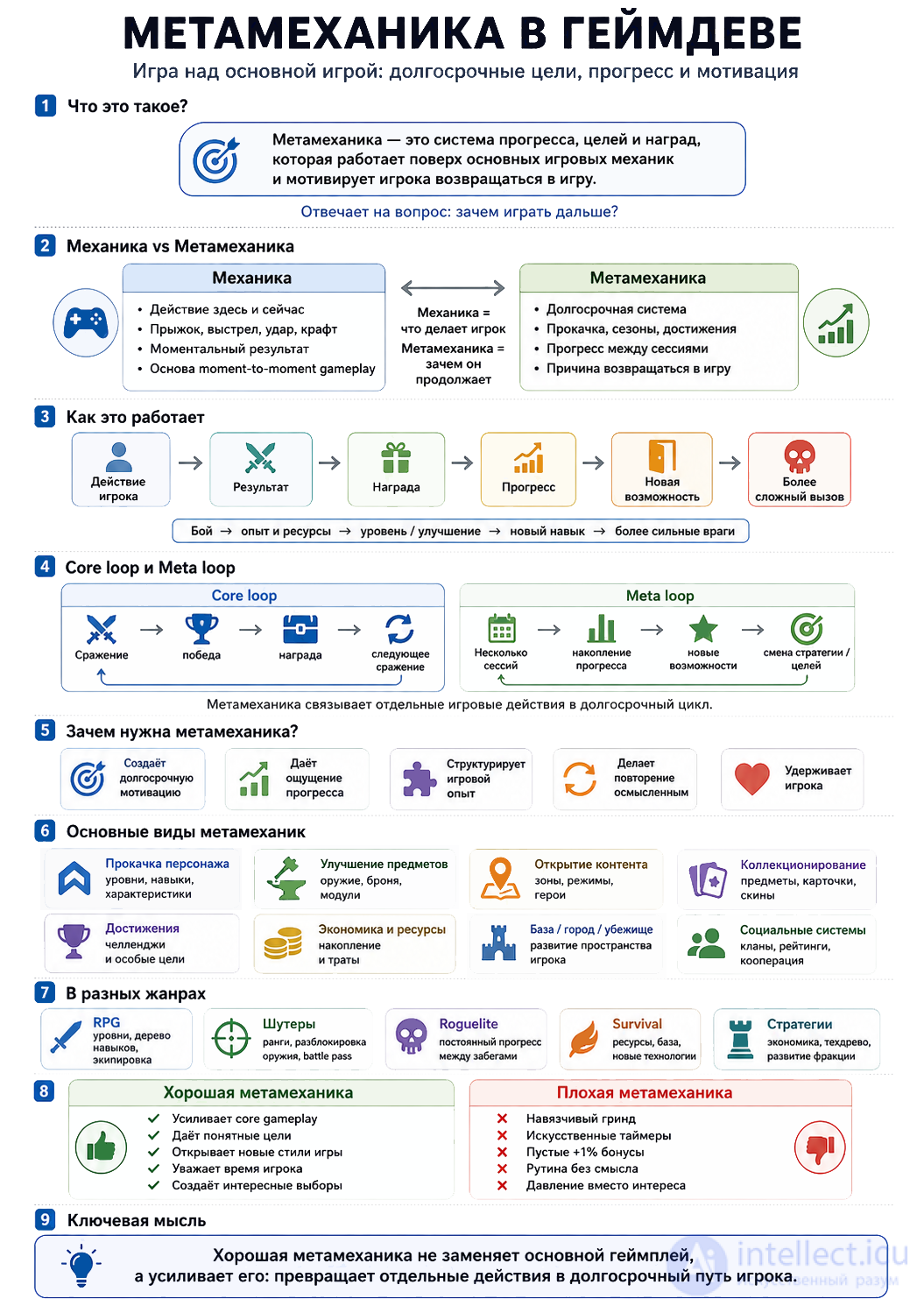
The difference between: mechanic and metamechanic
Mechanic |
Metamechanic |
|
A mechanic is a specific action or rule within the game. Examples:
A mechanic operates at the level of the instantaneous action. |
A metamechanic connects these actions into a larger system. Examples:
A metamechanic operates at the level of long-term motivation. |
Let's imagine a game where the player controls a knight and fights monsters.
Core mechanics:
If the game consists only of these actions, it can be interesting, but it will quickly become repetitive.
Now let's add a metamechanic:
Now the player gains a long-term goal:
«I'm not fighting just for the sake of combat, but to become stronger, unlock new zones, and get further».
In game design, the concept of the core loop — the main gameplay loop — is often used.
For example:
The player fights → receives a reward → upgrades the character → fights stronger enemies
But within this loop, two levels can be distinguished.
This is what the player does in the moment.
Movement → attack → defense → defeating an enemy
This is what happens after a series of actions.
Victory → experience → new level → new skill → new strategy
It is precisely the meta loop that often keeps the player engaged for a long time.
A metamechanic performs several important jobs.
It's important for the player to understand why they are performing repetitive actions.
If they simply play through identical battles, they may get bored.
But if every battle brings them closer to a new ability, a rare item, or a story revelation, their interest lasts longer.
A metamechanic answers the player's inner question:
«What will I get if I keep playing?»
Even if the player hasn't gotten noticeably better at the game, a metamechanic can give a sense of development:
This creates a feeling of moving forward.
A metamechanic helps guide the player.
For example, daily quests say:
Play 3 matches
Defeat 10 enemies
Gather 500 resources
Upgrade 1 item
The player doesn't just play chaotically, but is given clear goals.
Many modern games use a metamechanic for retention — keeping the player engaged.
Examples:
But here it's important to strike a balance. If a metamechanic turns into pressure or an intrusive routine, the player may feel fatigued.
Many games are built on repetition:
A metamechanic makes repetition meaningful.
For example, in a roguelike game the player may lose a run but still earn a resource for permanent upgrades. Then the defeat isn't perceived as a total waste of time.
One of the most common metamechanics.
The player earns experience, levels, skills, and stats.
Example:
Battles → experience → level → skill points → new abilities
This kind of system is especially common in RPGs, action RPGs, MMORPGs, and survival games.
The player gathers resources and strengthens their gear.
Example:
Gather materials → upgrade the sword → deal more damage → defeat a tough boss
This metamechanic works well when items genuinely change the player's behavior, rather than just giving a +2% stat boost.
The player gradually gains access to new possibilities:
This creates a sense of exploration and growth.
The player gathers sets of objects:
Collecting works through the desire to complete a set.
Example:
I already have 18 of the 20 rare cards. I just need to find two more.
Achievements motivate the player to try different play styles.
For example:
Good achievements don't just reward ordinary play, but nudge the player toward new ways of interacting with the mechanics.
Many games are built around accumulating and spending resources.
Example:
Gather wood → construct a building → unlock a new unit type → capture new territory
The economic metamechanic is especially important in strategy games, survival, city builders, MMOs, and mobile games.
The player upgrades not only the character, but also the space around them.
Examples:
This kind of metamechanic gives the player a sense of ownership:
«This is my place, and I'm developing it».
This includes:
A social metamechanic boosts engagement, because the player comes back not only for the game, but also for other people.
The seasonal structure is often used in online games.
Example:
New season → new quests → new rewards → limited time to obtain them
The battle pass — is a metamechanic that overlays an additional progression track onto the game.
The player can play ordinary matches while simultaneously advancing up the seasonal reward ladder.
In RPGs, the metamechanic is usually tied to character development.
Examples:
Here the metamechanic is responsible for the feeling of transforming a weak hero into a powerful one.
In shooters, the foundation is shooting and movement.
The metamechanic adds long-term goals:
The player keeps playing not only to win a particular match, but also for the overall progression of their account.
In roguelikes, the idea of repeated attempts is important.
The metamechanic can be of two types:
Within a run: temporary upgrades
Between runs: permanent progress
For example, the player dies but unlocks a new weapon or improves their base stats. This reduces the frustration of losing.
In survival games, the metamechanic is often tied to accumulating resources and developing a base.
Example:
Gather resources → build a shelter → craft tools → explore dangerous zones
Here the metamechanic reinforces the sense of survival and gradually mastering the world.
In strategy games, the metamechanic is often expressed through:
The player's main question:
«How will my current decisions affect the future state of the system?»
In mobile games, the metamechanic often plays a central role.
Examples:
But here it's especially important not to overdo it. If the player feels that the game controls them more than they control the game, it breeds resentment.
A good metamechanic:
Example of a good metamechanic:
The player gains a new skill that changes their combat style.
That is, the reward doesn't just increase a number, but expands the player's possibilities.
A bad metamechanic:
Example of a bad metamechanic:
Play 50 identical battles to earn a +1% damage boost.
The player may feel that their time isn't being respected.
«The best metamechanic is one the player doesn't suspect until the moment it kicks in. Then all of their past experience is reinterpreted instantly.»
A metamechanic works with different types of motivation.
The player wants to become stronger.
Suitable metamechanics:
The player wants to discover the unknown.
Suitable metamechanics:
The player wants to get better.
Suitable metamechanics:
The player wants to collect everything.
Suitable metamechanics:
The player wants to interact with others.
Suitable metamechanics:
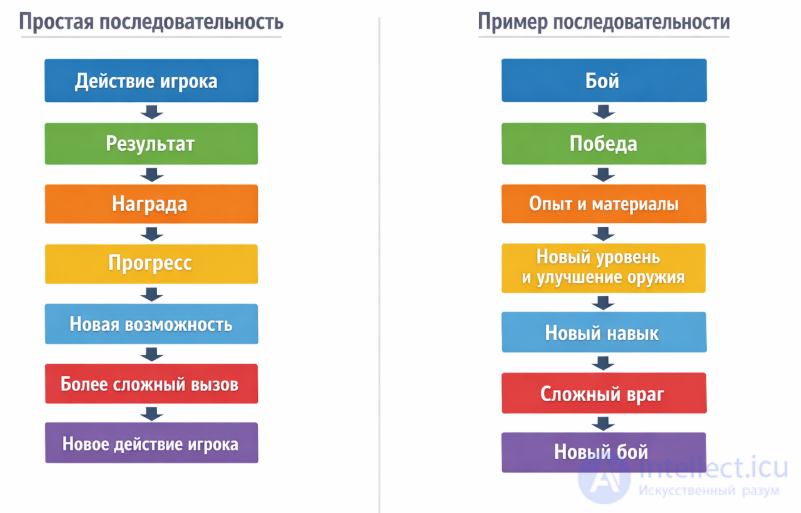
The structure of a game can roughly be represented like this:
1. Instantaneous action
The player pressed a button, the character attacked.
2. Local result
The enemy took damage, the player won.
3. Reward
The player received experience, an item, or a resource.
4. Long-term progress
The player became stronger, unlocked new content.
5. New possibility
The player can take on a more difficult challenge.
The metamechanic begins roughly at the third point — where the result of an action starts to affect the long-term state of the game.
Let's say we're making a game about a space explorer.
The player flies between planets, gathers resources, and avoids dangers.
Flight → scanning → resource gathering → returning to base
We add a long-term system:
Resources → ship upgrades → access to distant planets → rare materials → new technologies
Now the player gains a strategic dimension:
The metamechanic turns the simple repetition of flights into the development of an expedition.
For example, the player is playing a fast-paced action game, but the meta-progression boils down to a boring menu full of timers.
A good metamechanic should reinforce the game's core fantasy.
If the game is about a monster hunter, the metamechanic can be tied to trophies, upgrading weapons, studying monsters, and preparing for new hunts.
Sometimes a game adds:
If all of this appears without a clear structure, the player gets lost.
A metamechanic should be understandable:
«I understand what I'm doing, why I'm doing it, and where it leads».
If the player simply gains +1 level and automatically becomes stronger, it can work, but it quickly loses depth.
It's better when progress is tied to choice:
Choice makes the metamechanic part of the strategy.
Grinding isn't always bad in itself. Repetition can be pleasant if the core gameplay is interesting.
The problem begins when the player feels:
«I'm doing this not because it's interesting, but because the system forces me to».
If all the rewards give only small numerical bonuses, the player may stop noticing them.
A stronger metamechanic delivers qualitative changes:
When designing, you can ask a few questions.
For example:
The player should understand:
If the player receives rewards for actions that have nothing to do with the core game, the system may feel artificial.
A good metamechanic doesn't just hand out rewards, but forces the player to make decisions.
If progress is too slow or built solely on daily obligations, the player may get worn out.
In modern games, the metamechanic is often tied to monetization:
But it's important to understand:
A metamechanic shouldn't exist solely for the sake of monetization.
If the player feels that progress is artificially slowed to pressure them into paying, trust in the game falls.
A healthy approach:
First an interesting game → then a fair metamechanic → then careful monetization
A bad approach:
First monetization → then restrictions → then the game as a way to force payment
In single-player games, the metamechanic often helps to:
Example:
The player completes quests → earns experience → unlocks skills → gains access to new ways of playing through the game
In multiplayer games, the metamechanic is often responsible for:
Example:
The player plays matches → raises their rating → earns seasonal rewards → compares progress with others
A simple working sequence for a metamechanic might look like this:
Let's say we have a 2D platformer.
The player simply plays through levels:
Run → jump → avoid traps → reach the finish
This can be a good game if the levels are interesting. But the long-term motivation is limited.
Let's add:
Now the gameplay loop becomes broader:
Clear a level → collect crystals → unlock an ability → return to an old zone → find a secret → obtain a rare artifact
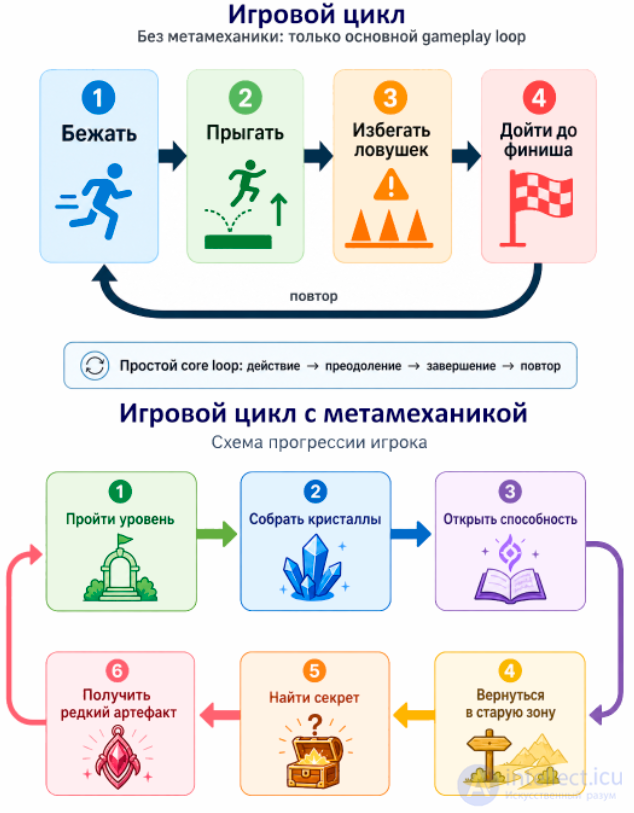
The player gains a reason to come back and rethink levels they already know.
A metamechanic affects not only progress, but also emotions.
It can provide:
For example, when the player has almost gathered a full set of items, tension arises:
«Just one last rare piece to go».
When the player gains a new skill, anticipation arises:
«Now I'll be able to go where I couldn't before».
When the player builds a base, attachment forms:
«This is my accomplishment, I created it myself».
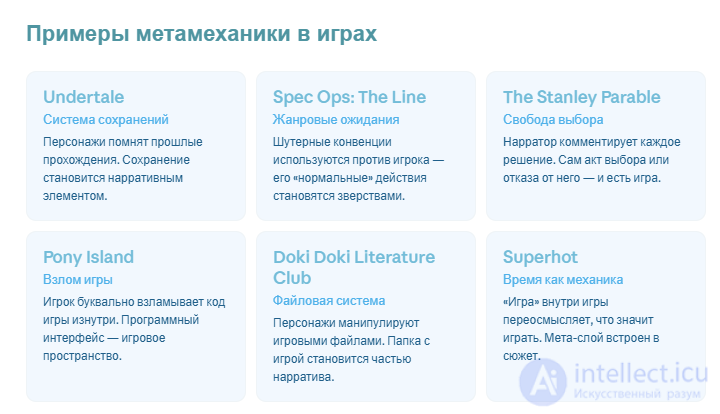
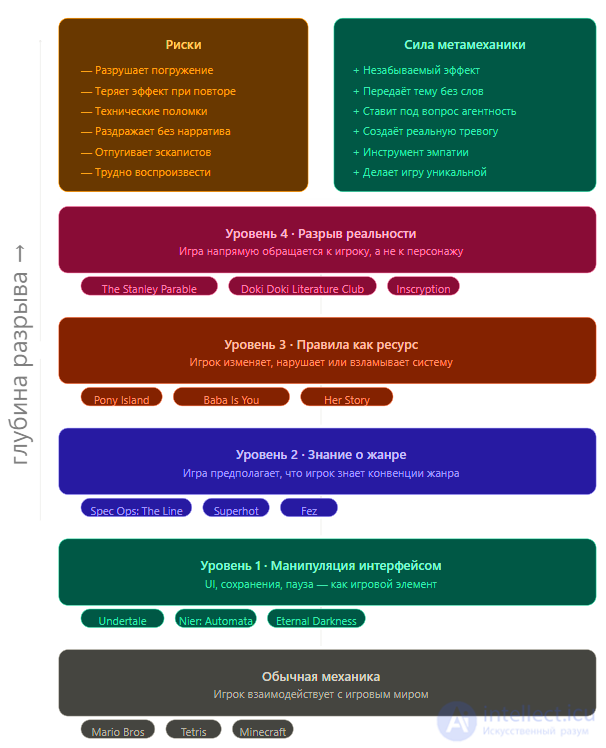
A metamechanic — is not a trick for the sake of a trick. It works when it reinforces a theme or emotion that can't be conveyed through ordinary narrative. Deleting saves creates real anxiety. A character who knows about their «game» nature calls the player's agency into question. These are tools of empathy and alienation at the same time.
At the same time, a metamechanic demands enormous precision from the designer: the slightest clumsiness turns a profound device into a cheap, flimsy gimmick. If breaking the fourth wall carries no narrative weight, it simply annoys.
Before implementing a metamechanic, ask the question: «Why can't this be told through in-game means?» If the answer isn't obvious — then an ordinary mechanic will most likely do the job better.
A metamechanic breaks immersion — that's its essence, but also its main danger. Players seeking escapism will perceive a direct address as an irritation. Moreover, after the first use, the device loses its power of surprise: repeating the Undertale effect is practically impossible precisely because it's already known.
A metamechanic — is one of the key tools of game design. It connects individual in-game actions into the player's long-term journey.
A metamechanic — is one of the most honest and, at the same time, most risky tools in a game designer's arsenal. When it works, it leaves a mark that's impossible to forget: the player suddenly realizes they were playing a different game than they thought all along. It is precisely that moment of realization that's worth hunting for.
The core mechanic is responsible for enjoyment in the moment:
The metamechanic is responsible for long-term meaning:
A good metamechanic doesn't replace the core gameplay, but reinforces it. It makes repetition meaningful, progress noticeable, and goals clear.
The developer's main task — is not just to add levels, rewards, and daily quests, but to build a system where every action the player takes is connected to development, choice, and a new, interesting experience.
That's exactly why a metamechanic — is not a secondary «wrapper» around the game, but an important layer that can determine whether the player will keep coming back to the game again and again.

Comments