
Lecture
A Computer Strategy Game is a genre of computer games in which the player is given the opportunity to manage various aspects, such as economy, troops, technology, diplomacy, and so on, in order to achieve certain goals, most often related to defeating an opponent or attaining a certain status.
This genre can include subgenres such as turn-based strategy, real-time strategy, grand strategy, 4X strategy (explore, expand, exploit, exterminate), tactical strategy, and others.
Players often make decisions about allocating resources, managing armies and fleets, building and upgrading settlements or bases, researching new technologies, and so on. A key aspect of computer strategy games is the strategic thinking and planning required to achieve the goals within the game.
A strategy computer game (colloquially a «strategy») — is one of the main genres of computer games, in which the player must apply strategic thinking in order to win. In popular games of this genre, the player is often invited to play not as a specific character, but as their conditional masses — for example, to direct the construction of a city or command entire armies in military campaigns.
Although games of many other genres may also contain strategic elements, in strategy games proper the main focus is on high-level planning, logistics, and resource management. Strategies are usually divided into two main subcategories: turn-based and real-time, but there are also a number of cross-/subgenres of strategy that contain additional elements such as tactics, diplomacy, economics, and exploration.
Strategy games also include abstract ones (Ataxx ), tabletop ones (chess, checkers, «Monopoly»), management simulation ones (M.U.L.E., Spaceward Ho! ) and others ; features of some of them were adopted by developers of narrative computer strategies in realistic, historical, or fantasy settings.
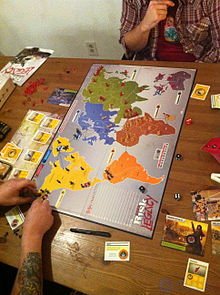
The first computer strategies were adaptations of tabletop ones, such as «Risk»
One of the early strategy games for mainframe computers was The Sumerian Game (1964) — a text-based economic simulator in which the player had to manage the Sumerian city of Lagash and allocate resources In 1972, the game Invasion was released for the Magnavox Odyssey television console — an adaptation of the tabletop game «Risk». On the television screen itself, only the battles, resembling the game Pong, were played out, while the strategic part was played on a tabletop board .
The appearance of true strategy computer games came with the release of the TRS-80 and Apple II microcomputers, for which a wave of adaptations of existing tabletop games began. Thus, Computer Bismarck (1980) from Strategic Simulations Inc. (SSI) strongly resembled the tabletop game Bismarck (English)rus. from Avalon Hill; in the following years, both SSI and Avalon Hill released computer wargames, becoming the leading producers of games in this genre and directly competing with each other. Although some of these games were still essentially tabletop games with a digital component and included paper maps and counters, others — like the very same Computer Bismarck — already assigned the role of opponent to the computer ].
The game Eastern Front (1941)[en], released by Atari in 1981, already contained a more advanced simulation of war: the player had to take into account many factors, such as the weather and the soldiers' morale. Reach for the Stars (1983) invited players to build a space empire with both a military and an economic component — this game contained all the hallmarks of the 4X genre long before that term appeared. The Japanese company Koei released series of grand strategies such as the Nobunaga's Ambition[en] series or Romance of the Three Kingdoms, based respectively on the history of medieval Japan and ancient China — in them the player had to keep track not only of armies, but also of peasants and harvests. The multiplayer economic strategy M.U.L.E. (1983) invited players to simultaneously cooperate and compete with each other within a single economy.
Herzog Zwei (1989), developed by the Japanese company Technosoft, became the first real-time strategy — strictly speaking, in it the player directly controlled only a single unit, but this game contained all the main elements of the genre, including micromanagement, resource economy, and base building; it also became a forerunner of the MOBA genre, which appeared only in the 2000s. Herzog Zwei was not commercially successful, but became a model to emulate for many subsequent games. Colossal success was achieved by Dune II (1992) from Westwood Studios, based on Frank Herbert's science fiction novel «Dune»; in it players had to mine a valuable resource in real time — «spice» — and use it to create soldiers, military equipment, and buildings. Dune II contained a long campaign consisting of a series of separate missions; its principle of «gather resources first, then expand» was copied by many subsequent real-time strategies .
The god simulator Populous (1989) and the city-building simulator SimCity (1989) had a great influence on the strategy genre — Dune II or Civilization II borrowed many elements from them, and games and series released in subsequent decades, such as Anno, Age of Empires, The Settlers, or Dungeon Keeper, combined elements of a city-building simulator and a military strategy game with unit creation and battles over territories . King’s Bounty (1990) and later the Heroes of Might and Magic series combined elements of strategy and computer role-playing games — in these games the player controlled one or several «heroes» who traveled across the world map, gathered armies, increased their stats, and took part in battles similar to wargames .
Programmer Sid Meier and the company MicroProse, which he founded in 1983, initially worked on flight simulators, but soon moved on to developing wargames, and from those — to complex and innovative strategy games that became important milestones in the development of the genre: among these games were the business simulator of railroad construction Sid Meier’s Railroad Tycoon (1990) and the grand strategy Sid Meier’s Civilization (1991), which invited the player to manage a civilization along a long historical path, from the ancient world to the exploration of space. Civilization, which became the first game in the Civilization series, was followed by other 4X games from MicroProse, such as Master of Orion and Master of Magic. X-COM: UFO Defense (1994), developed by Julian Gollop and becoming the first in the X-COM series, combined a strategic and a tactical component. Panzer General, released by SSI in 1994, was similar to traditional wargames, but represented a simpler and more accessible turn-based strategy on the theme of the Second World War; it too spawned many imitations . Sid Meier and Brian Reynolds, after leaving MicroProse in 1996, founded the company Firaxis Games — it released both new installments of the Civilization series and other games, such as Sid Meier’s Alpha Centauri (1996) — a turn-based 4X strategy similar to Civilization, but notable for its extraordinary flexibility and many possibilities. Age of Empires (1997) from Ensemble Studios, being a real-time strategy, borrowed from the Civilization series the concept of the development and succession of historical technologies — from the Stone Age to the Iron Age .
The real-time strategy Warcraft: Orcs & Humans (1994), developed by Blizzard Entertainment, on the whole resembled Dune II, but contained a multiplayer online mode that allowed players to fight each other over a local network. Command & Conquer (1995) from Westwood and Warcraft II: Tides of Darkness (1995) from Blizzard directly competed with each other — both of these games included FMV cutscenes that developed a complex plot and showed elaborate fictional worlds, like the Warcraft universe. They both also allowed the player to select several soldiers or units of equipment at once by enclosing them in a stretchable frame using the computer mouse. Many subsequent real-time strategies, both Westwood's and Blizzard's own developments and imitator games like Dark Reign: The Future of War or Z, on the whole reproduced the model laid down by Command & Conquer, often with their own additions such as destructible terrain .
Total Annihilation (1997), also being a game in the spirit of Command & Conquer, invited the player to control a multitude of diverse units under the command of a powerful and versatile «commander»; it was also distinguished by an original economic model with a simplified inflow of resources. Dungeon Keeper (1997) from Bullfrog combined elements of management, construction, and battles in an unusual way — in this game the player built their own fantasy dungeon, drew «evil» monsters into it, and defended it from «good» heroes. Styled in the spirit of science fiction, StarCraft (1998) from Blizzard, on the whole reproducing the main mechanics of Warcraft, offered players a choice of strongly differing «races» — the terrans, the zerg, and the protoss — each race had base building, resource gathering, and battles arranged in its own way, and the game was notable both for its «asymmetry» and for its finely tuned balance .
When, at the turn of the 1990s and 2000s, many genres of computer games shifted from two-dimensional graphics to three-dimensional, strategy games became a more niche and risky genre for developers — whereas in the 1990s many strategies were released for game consoles as well, from the beginning to the end of the 2000s strategies were predominantly games for personal computers. Although the action of the strategy games of that time almost always unfolded on a plane with a top-down view, Homeworld (1999) from Relic Entertainment invited the player to control spaceships in fully three-dimensional space. Games like Ground Control (2000) or Sacrifice (game) (2000) experimented with three-dimensional maps and free camera control; Majesty: The Fantasy Kingdom Sim (2000) was notable for its indirect control of units. The game Shogun: Total War (2000) from Creative Assembly and its sequels — the Total War series — combined real-time battles of armies with the turn-based gameplay of grand strategies, where the player had to manage a state on a complex map with many provinces .
Warcraft III: Reign of Chaos (2002) became an important milestone in the development of strategies — here the concept of «heroes» characteristic of computer role-playing games, who could be developed and supplied with equipment, was successfully combined with real-time strategy gameplay. Defense of the Ancients (2003), a free user-made modification of Warcraft III, laid the foundations of an entire new genre, MOBA. Warhammer 40,000: Dawn of War (2004) from Relic Entertainment was notable for an economic mechanic unusual for real-time strategies: in it the player had to capture special control points on the map and hold them — thus, the action in the game did not come down to the defense or assault of well-fortified bases, as in games patterned after Command & Conquer, but included small skirmishes all across the map. Relic developed these ideas in the even more complex and more tactical-simulator-like Company of Heroes (2006) — here the course of battle was influenced by equipped weapons, cover, and the soldiers' morale. Supreme Commander (2007) developed the ideas of Total Annihilation, and World in Conflict (2007) from Massive Entertainment became the successor to Ground Control II. On the whole, in the 2000s real-time strategies fell into decline; StarCraft II (2010), conservative and strongly resembling Blizzard's previous games, remained the most popular real-time strategy throughout the 2010s and even in the 2020s .
Civilization IV (2005) — yet another installment of the Civilization series — became not only the first three-dimensional game in the series, but also included a multiplayer online mode, unusual for 4X games. Whereas 4X games were usually turn-based, the action of Sins of a Solar Empire (2008) unfolded in real time — here the management of an empire and battles involving fleets of spaceships took place on a single screen, without a break. From the early 2000s, Paradox Development Studio took a special place among producers of grand strategies. The games developed by Paradox, such as Europa Universalis, Hearts of Iron, or Crusader Kings, were characterized by an extraordinarily deep simulation of various aspects of governing a state, extensive maps with many provinces, and real-time gameplay with a tactical pause .
In the early 2010s, MOBA games turned into an extremely commercially successful genre; among them, League of Legends (2009) from Riot Games and Dota 2 (2013) from Valve took the dominant positions. XCOM: Enemy Unknown (2012) from Firaxis became a successful «reboot» of the X-COM series; here the player controlled smaller squads of soldiers than in the previous games of the series, with a very simple and intuitive interface that made the game accessible to a wide audience. With the rise of indie games in the 2010s, many original strategies appeared — thus, Invisible, Inc. from Klei Entertainment combined the gameplay of XCOM with stealth games, placing the emphasis not on destroying enemies, but on moving unnoticed by them; Endless Legend (2014) diversified the gameplay of 4X strategies, introducing diverse and strongly differing «races», each with its own mechanics and rules of play .
All computer strategies belong to two main types:
The classification by time of action refers only to the principle of temporal organization in the game and has nothing to do with the presence or absence of such gameplay elements as base building, resource gathering, and the like.
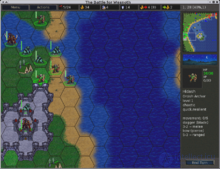
Battle for Wesnoth — a free turn-based strategy
TBS (English: turn-based strategy). Turn-based strategies — are games in which players carry out their actions in turn . Turn-based strategies appeared earlier than RTS and are distinguished by considerably greater variety. Dividing the gameplay into turns detaches it from real life and deprives the game of dynamism, as a result of which these games are not as popular as real-time strategies. On the other hand, in TBS the player has much more time to think; nothing rushes them during the making of a move, which allows more time to be devoted to planning.
A particular subtype of turn-based strategies is represented by the game Scorched Earth and the Worms series that descended from it. They have much in common with the arcade genre; logical thinking and choosing the right decisions are almost not required, and the player controls a very small number of characters (in Worms — a team of several worms) or even just one (Scorched Earth). Nevertheless, these games are classified as turn-based strategies.
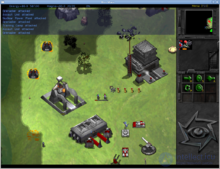
Screenshot of Bos Wars 2.5[en], a free real-time strategy
RTS (from English: real time strategy; a strategy in real-time mode). In these strategies, players carry out their actions simultaneously. They appeared somewhat later than turn-based ones, and the first game of this genre to gain fame was Dune II (1992), the plot of which is based on the work of the same name by Frank Herbert. At present, the real-time strategy genre has become quite broad and includes games of completely different types — from tactical wargames to grand strategies — and so classic real-time strategies like Dune are traditionally called «classic RTS». A special subtype is represented by real-time strategies with an active pause, where the player is given the opportunity to pause the game and issue the necessary orders (for example, Europa Universalis IV).
At the time of Dune II's release, the general principles of classic real-time strategies took shape (some of them shared with other strategies)[source not specified for 2383 days]:
Tactical strategies represent a simulation of tactics both in real time and in turn-based mode, thereby being subdivided into the genres RTT (Real-Time Tactics) and TBT (Turn-Based Tactics) . Unlike classic RTS, in these strategies the player does not have to deal with base management or resource gathering, and thereby these games are concentrated to a greater degree on the tactics of conducting combat operations with a predetermined quantity of troops and/or resources. The possibility of receiving reinforcements and additional resources in such games is either absent entirely or is not made the main emphasis. Examples: World in Conflict, Achtung! Cthulhu Tactics, the Jagged Alliance series.
Strategies that combine the main elements of a classic RTS with the possibility of collective play with a large number of players over the Internet. Examples of browser-based online strategies can be the games Travian, My Lands, OGame, Sphere of Destiny, Tribal Wars.
Construction and management simulators — are a genre of computer games standing at the intersection of simulators and strategies. They may be devoted to the construction of a city, an amusement park, and other objects, while offering economic challenges as opposed to military and tactical ones. They can be conditionally divided into several subgenres.
City-building strategies (English: city-building games) are devoted to the construction of cities and settlements. In them the player is engaged in the construction of their own city and solves the tasks and challenges associated with this — for example, they build housing and combat traffic jams.
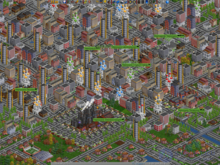
OpenTTD — a free clone of Transport Tycoon Deluxe, in which the player manages a transport company
Economic strategies (English: business simulation games; tycoon) — are strategies in which the player is engaged in creating and managing their own business. In such strategies the economic component is usually more elaborated, and it is on this that the main emphasis is placed. Sometimes such strategies feature rivals (competitors), but competition with them is mainly economic.
Economic strategies can be single-player, in which the market environment is fully modeled only by programmed algorithms, and multiplayer, in which the competitive environment and market are formed not only by algorithms, but also as a result of the interaction of a multitude of players, which makes the virtual economy and its behavior more realistic and unpredictable compared to single-player games. One of the most well-known classic single-player economic simulators is the game Capitalism by Trevor Chan. Among multiplayer economic simulators, one can single out the series of economic browser games from the publisher Virtonomics, in which users develop their own virtual business in competition and cooperation with a multitude of players, build cities, create political parties, and govern virtual states.
The most widespread are business simulators («tycoons», from the word tycoon — «magnate» — frequently found in their titles). The first game of this kind was Sid Meier's game Railroad Tycoon. In business simulators the player manages both huge industrial companies (Capitalism II, Industry Giant II) and smaller enterprises, such as a diner or a zoo (such simulators are of a less serious character and are often intended not for the player to calculate situations for a long time and make advantageous decisions, but simply for their entertainment; losing in such games is not easy, since there are no opponents in an explicit form). Very widespread are transport economic simulators, such as Transport Tycoon.
Among other kinds of economic strategies, one can note such subgenres as city-building simulators (the most well-known being the game SimCity that gave rise to this genre, as well as the series of city-building games whose action takes place in the ancient world — Caesar III, Zeus: Master of Olympus, and others; in the latter series military operations are present), sports managers (in which the player runs a sports club, usually a football one, but does not participate in the matches directly, instead performing the role of the team's coach and manager), life simulators (a very specific genre descending from the game The Sims).
In connection with the general global development of the Internet, economic online games are gaining strength — that is, games representing a certain world with its own rules and laws, in which the player is given the opportunity to engage in active commercial activity: to build trading and manufacturing enterprises and structures, engage in the development of natural resources, and conduct active financial and banking activity within the game space.
The development of remote online learning technologies gave a noticeable impetus to the use of economic online games and simulators in educational processes. Corporations and business schools began to actively use educational economic games such as CapSim or Simformer in the training of students and managers.
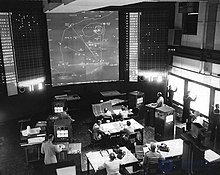
Navy Electronic Warfare Simulator — a computer wargame used for training American military personnel
Strategies in which the economic component is absent. Usually these are games in which the player commands a detachment or an army during battle. An example from popular games can be some mods for Sudden Strike and Blitzkrieg.
«Wargame» — is not a genre, but a characteristic of a specific game, which says — you will not have to count money in it; most of the game time you will be waging war with all available means. And exactly which means will be available to you, and what needs to be done for this, depends on the developers' imagination.
An example of such a game is Z from 1996 by the English company The Bitmap Brothers. Despite the complete absence of an economy, players readily improve the quality and quantity of their detachments by skillfully managing two of the most important game resources — territory and time. For strategic planning, commodity-money relations are not at all obligatory, although they are traditional. The genre itself remains the very same strategy or tactics.
In grand strategies the player takes part in an entire period of world history, governing a state; at the same time the game takes into account various factors of the development of states — economic, military, cultural, social, and political. Singling out grand strategies as a single genre is characteristic of Russian-speaking specialists; in the West this genre is usually divided into two — 4X and grand strategy. Grand strategies can be both real-time and turn-based.
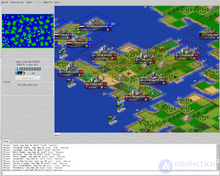
Freeciv — a free 4X strategy
The gameplay of 4X strategies includes 4 fully implemented elements: exploration (of new lands), expansion, exploitation, extermination. The name comes from the letter X in the corresponding English words eXplore, eXpand, eXploit, eXterminate. A classic example of 4X strategies is the Civilization series. In 4X strategies, as in grand ones, the player often manages an entire state. However, this is not an obligatory criterion. 4X strategies can be both real-time and turn-based.
The difference between 4X strategies and grand strategies consists in the fact that in grand strategies one of the X-elements may be absent or weakly expressed. For example, the grand strategy Hearts of Iron IV does not contain the eXplore element (exploration of new lands). This means that a strategy can be both 4X and grand at the same time, but not every grand strategy is 4X.
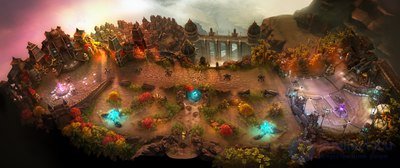
A map from the computer game Vainglory with the main elements characteristic of the MOBA genre.
Games of the MOBA genre (English: Multiplayer Online Battle Arena) combine elements of real-time strategies and computer role-playing games. This genre arose as an offshoot (through modifications) of real-time strategies, and many games of the MOBA genre use an interface similar to theirs, but differ in special rules of battle .
In games of the MOBA genre, two teams of players fight each other on a map of a special kind. Each player controls one character from a certain list of available heroes, differing in their abilities. During the course of the match, characters can become stronger, gain new abilities and equipment, similar to computer role-playing games. The ultimate goal during the match is to destroy the main building of the enemy team with the help of both the heroes controlled by the players and the units controlled by the computer .
Games similar to tabletop collectible card games. Example: Magic The Gathering.

Comments