
Lecture
A loot box is an in-game virtual container from which a player randomly receives various items. These items can be either cosmetic (for example, character skins) or gameplay-affecting (weapons, armor, etc.).
Loot boxes are one form of game monetization. Players can obtain them for free during play or purchase them for real money. Sometimes an additional paid «key» is required to open such containers. In some games this mechanic is called «gacha», referencing Japanese capsule-toy vending machines.
The concept of loot boxes originates from the reward distribution mechanics in massively multiplayer online role-playing games, as well as from mobile free-to-play games. They first began to appear between 2004 and 2007. For developers and publishers this system is advantageous, as it provides a steady income and sustains player interest through new content.
Loot boxes became especially popular in the mid-2010s, but at the same time they drew criticism. In some games, for example Star Wars: Battlefront II, loot boxes created unequal conditions, turning the game into «pay to win» (pay-to-win). This provoked a negative reaction from players and regulators, as a result of which a number of countries began to treat loot boxes as a form of gambling and to introduce restrictions on their use.
A gacha game (English: gacha game) is a genre of computer games that incorporates the mechanics of the gashapon or gacha (a capsule vending machine), similar to loot box mechanics. Players in both types of games spend money to obtain a virtual in-game item. Most examples of gacha games are mobile free-to-play games in which gacha serves as an incentive to spend real currency.
The use of the gacha model in computer games gained popularity in the early 2010s, predominantly in Japan. Almost all of the fast-growing Japanese games of that time used gacha mechanics, which subsequently became an integral part of Japanese mobile gaming culture. Outside Japan the game mechanism is also gaining popularity and is being incorporated into various Chinese and Korean games.
| Criterion | Gacha games | Loot boxes | Battle pass |
|---|---|---|---|
| Reward system | Random characters/items through summons (banners) | Random item drop from a container | Rewards for completing tasks/progress |
| Type of monetization | Most often free-to-play with in-game purchases | Purchase for real money or in-game currency | Paid seasonally (one-time payment) |
| Player control | The player chooses the banner, but the drop chance is limited | No control — items are given out randomly | A clear list of rewards; the player chooses which ones to obtain |
| Drop chance | Rarity tiers of characters/items with fixed odds | Different rarity tiers with fixed odds | Guaranteed rewards for activity |
| Impact on gameplay | May grant powerful characters/gear, affecting balance | May affect balance (pay-to-win) if it grants powerful gear | Usually cosmetic items, less often – in-game bonuses |
| Reliance on luck | High – rare items drop rarely, often there is a «pity» mechanic (pity system) | Medium – a random drop, but sometimes with a guarantee of a valuable item | Low – rewards are predictable |
| Update frequency | New banners with characters/items are released regularly | May change depending on events and game updates | Limited by the season's duration (usually 1–3 months) |
| Example games | Genshin Impact, Fate/Grand Order, Arknights | CS:GO, Overwatch, Apex Legends | Fortnite, Call of Duty: Warzone, Dota 2 |
Thus, gacha games and loot boxes are focused on random item drops, whereas a battle pass offers guaranteed rewards for activity.
A battle pass (Battle Pass) is an in-game progression system in which players earn rewards for completing tasks or reaching certain levels. A battle pass is considered a less gambling-like monetization system than loot boxes or gacha, since the player always knows what they will get if they meet all the conditions.
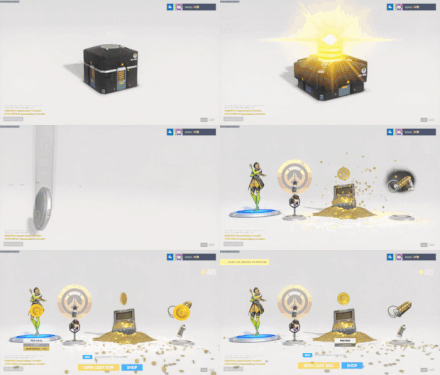
The process of opening a loot box in the game Overwatch. The following effects are used: shaking of the box, ejecting discs whose color indicates rarity, and a final presentation of the items. The effects are used to increase the appeal of opening loot boxes. Once the process is complete, the player is offered a button allowing them to buy more loot boxes.
A loot box may be named differently depending on the type of game in which it appears. The names «box», «container», or «case» are often used in shooters, where players can obtain a new appearance or gear for their characters. In digital card games (for example, Hearthstone) names such as «booster» or «card pack» may be used, by analogy with collectible card games.
Loot boxes are often given out by the game, for example as a reward for leveling up a character or for successfully completing an online match. Loot boxes can also be distributed as part of promotional campaigns outside the game, for example for watching certain streaming broadcasts. Players also have the option of directly purchasing loot boxes, usually for real money, but games that sell loot boxes for in-game currency also exist. Some types of loot boxes can be used immediately, while others may require an additional item, presented as a «key», in order to be used.
Loot boxes are usually used through the game interface, and the opening process is accompanied by attractive visual and audio effects. The appearance of such interfaces is clearly modeled on slot machines or a roulette wheel. When a player runs out of loot boxes or keys, the player may be shown a button through which additional loot boxes can be purchased.
The items that can be obtained through loot boxes are often divided by «rarity tiers», with the probability of obtaining an item decreasing significantly as its rarity tier increases. Despite the fact that the items a player receives are chosen at random, there are certain guarantees, for example that a loot box will contain at least one item of a certain (or higher) rarity tier. In some reward-determination systems, items that have not yet been obtained are represented by a certain color corresponding to their rarity tier, further fueling the excitement and the desire to obtain those items.
A game character's inventory is maintained by databases on a server managed by the game's developer or publisher. Because of this, players may be able to examine other players' inventories and begin negotiations to trade items. Items obtained through loot boxes and worn or used by a character are almost always visible to other players in the game through a modification of the character's appearance or the playback of a certain sound clip.
In most loot box systems the character receives items without regard to what it already has. Means are provided for getting rid of duplicates received, including trading with other players and converting them into in-game currency. After that, in some loot box systems, the player can use this currency to directly purchase certain items that their character does not have.
Some loot box systems, mostly of Asian origin, use an approach adapted from gashapon vending machines (capsule toys). In these gacha games, a «spin» (analogous to turning the lever on a capsule machine) is used to obtain random items, characters, and other virtual goods. One form of gacha is the so-called «complete gacha». In it, obtaining a rare item requires assembling a certain set of ordinary items. The first few items in such a set are acquired quickly, but as the number of missing items decreases, the probability that the item needed to complete the set will be obtained through a loot box also drops more and more. This holds true provided that the game contains a huge number of ordinary items, while one specific item is required. This particular mechanic was banned in Japan by the local Consumer Affairs Agency in 2012, however other types of gacha are still widely present in games.
Some games may feature seasonal loot boxes or loot boxes tied to special events, through which one can obtain special items that are available only during a certain time. In the case of digital collectible card games, where individual expansions are added and removed as part of the process of maintaining the «live» state of the metagame, boosters from certain expansions are offered for purchase only while that expansion is considered part of the standard game. As soon as an expansion ceases to be considered part of the standard game, the cards belonging to it are no longer included in boosters. Nevertheless, the cards are still available for purchase with in-game currency and for use outside the standard game.
These games most often feature several characters, cards, or items obtained during play. Some of them can be acquired only using the gacha mechanic. Such a system allows players to «pull» or «spin» the gashapon (by analogy with a slot machine or roulette), using a certain amount of in-game currency, which can be exchanged for a random character, card, or other item. In some games gacha may be present only in a limited way, during special events. Most often players need to spend many attempts before obtaining what they want. This happens because of the low drop probability of certain items set by the developers.
In many games gacha has a substantial impact on character development. Players can obtain the resource for performing gacha for free or at a discount, but they will have to pay to get more. Such games may include various tiers of gacha that give different sets of rewards. The gameplay of many gacha games is structured as follows: the player assembles a squad of characters, equips them, and sends them on various quests and battles, and the better the characters themselves and their gear, the easier it is to progress through the game. In doing so the player mainly engages in squad management, while the rest of the gameplay proceeds in automatic or semi-automatic mode.
The gacha game model is compared to collectible card games, as well as to gambling. One aspect of monetization that is typically encountered in the funding of gacha games involves a model in which a minority of players spend large sums of money on in-game gacha purchases, thereby providing the funding for most of the money needed to maintain the game, substantially subsidizing the game for the remaining players, who spend less money or do not spend it at all. Players who spend a lot of money are colloquially called «whales».
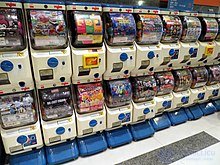
Gachapon machines arranged in a row in Hong Kong.
Loot boxes are a development of the concept of random loot drop systems from early computer games, a system of random reward distribution frequently used in massively multiplayer online games (MMOs or MMORPGs) and similar games. In addition to this approach, loot boxes also incorporate the approach used in free-to-play games for mobile devices. An element of chance is also used, analogous to the dispensing of capsule toys in gashapon.
The first known example of a loot box system is considered to be the Gachapon ticket item (from English — «Gachapon ticket»), introduced in June 2004 in the Japanese version of MapleStory, an MMORPG in the form of a side-scroller. These «tickets» were sold at a price of 100 Japanese yen apiece. Similar to real Gachapon machines, special booths were placed throughout the game world, and by using «Gachapon tickets» players could obtain random in-game items.
ZT Online (or Zhengtu), a Chinese free-to-play game published in 2007 by Zhengtu Network, is also considered an early example of a computer game in which loot boxes were part of the game system. Players in Asian countries generally do not have the means to purchase games at full price all at once and often use internet cafes or computer clubs to gain free access to games, or resort to copyright infringement to obtain free copies of a game. Not attempting to correct such an approach, games of Asian origin such as ZT Online introduce loot boxes as a means of monetizing games that otherwise would not have generated sales revenue. An estimate of the return on this scheme can be gleaned from a Zhengtu Network report, according to which the revenue from ZT Online in its first year exceeded 15 million US dollars. As a result, the approach came to be applied when publishing games that began to be released as free-to-play with microtransactions «on top of» the game itself. This approach began to be adopted in free-to-play games for mobile devices from the Asian region, among which the notable one is Puzzle & Dragons, released in 2011. This game, thanks to the gacha approach it used, was the first able to generate more than 1 billion US dollars in revenue using such a monetization scheme.
In the Western regions (North America and Europe), around 2009, the company Zynga and other major publishers of games for social networks achieved success, offering free games on internet sites such as Facebook that included microtransactions for accelerating the user's progress. Thus, publishers' revenue was made more dependent on post-sale microtransactions than on the initial sale. The first appearance of loot boxes in this region was the game Team Fortress 2 (September 2010), when Valve added to the game the ability to obtain «crates», opening which required purchasing keys. Robin Walker (English: Robin Walker) of Valve stated that the goal was to create «network effects» to attract a greater number of users to the game, in order to earn revenue from the large number of players buying keys to open «crates». Later Valve switched to a free-to-play model, reporting a 12-fold increase in the number of players after the transition, and hired Yanis Varoufakis to study the virtual economy. Over the next several years many MMOs and MOBAs were switched to a free-to-play model in order to increase the number of players, and many of them had loot box monetization added during the transition. The first of these were Star Trek Online[24] and The Lord of the Rings Online in December 2011.
Independently of these processes, Electronic Arts (EA)'s FIFA series of games introduced the FIFA Ultimate Team Mode (from English — «ultimate team mode»), in which, using so-called virtual trading cards (English: virtual trading card), the player can build a team. This mode, originally released as downloadable content, transitioned into the form of a free add-on to the main game in 2010, with the ability to purchase card packs used as a means of generating revenue from the game. EA extended this successful practice to the game Mass Effect 3, which is considered the first boxed game to include loot boxes from the outset following its release in March 2012. In Mass Effect 3 players were offered «packs» that could contain unusual equipment otherwise available only through grinding in the online game, as a means of offsetting the cost of maintaining the multiplayer services. The Mass Effect 3 team worked in close collaboration with the FIFA team in order to implement these «packs» the right way, which the developer Jesse Houston (English: Jesse Houston) compared to opening a pack of Magic: The Gathering cards, since it should always give the player a sense of gaining value from the «packs».
Other early examples of boxed games with loot boxes are Counter-Strike: Global Offensive, in which «weapon cases» (English: weapon cases) were introduced in an update in August 2013, and Battlefield 4, in which «battlepacks» (English: battlepacks) were introduced in October 2013, however they were not available for purchase until May 2014 and never contained duplicate items. The game Call of Duty: Advanced Warfare, released in November 2014, featured «supply drops» (English: supply drops) containing random items, including different variants of in-game weapons, character equipment, and experience points, for which modification of the player's character was possible.
Against the backdrop of the financial success of the game Overwatch and its loot box system, in 2016 and 2017 several games were released in which this mechanic became part of the metagame, among them Call of Duty, Halo 5: Guardians, Battlefield 1, League of Legends[30], Paragon, Gears of War 4, and FIFA 17. By the end of 2017 a large number of major AAA games in various franchises had been released with loot box systems incorporated into the game mechanics, including Middle-earth: Shadow of War, Forza Motorsport 7, and NBA 2K18. This led to a critical reassessment of this practice, starting in October 2017. Thus, the release of the landmark game Star Wars: Battlefront II, amid a wave of criticism of its built-in loot box systems in November 2017, led to a renewal of discussions at the level of various governments related to the need for legislative regulation of these systems. The review aggregator OpenCritic announced plans to introduce a «business model intrusiveness» rating (English: business model intrusiveness) for games, providing a metric of the degree of impact of loot distribution and downloadable content systems on the game. The reaction to loot boxes in the second half of 2017, as was noted, became one of the main trends of the computer games industry in 2017.
In view of the reaction to loot boxes, some developers and publishers, starting at the end of 2017, began removing loot boxes from their games. These include, for example, Star Wars Battlefront II (see more below), Middle-Earth: Shadow of War, and Forza Motorsport 7. Many games still use similar mechanics, however other monetization approaches have also been developed, for example the use of competition-based «battle passes» (English: battle passes), originating from the game Fortnite: Battle Royale[42]. In March 2019 the ability to purchase loot boxes for real money was removed from the game Heroes of the Storm. Loot boxes with random contents are still available in the game as free in-game rewards, however after the aforementioned update cosmetic modifications are also available for direct purchase.
The name «gacha» goes back to the concept of «gashapon» vending machines, devised by the Japanese entrepreneur Ryozo Shigeta in the 1960s. These machines resembled their Western counterparts, which had existed since the late 19th century, but differed in the distinctive packaging of the products sold — small toys were placed inside a spherical plastic capsule. The word «gashapon» consists of two onomatopoeias: the word «gasha» or «gacha» imitated the sound of the lever being turned on the side of the machine, and «pon» — the capsule dropping into the tray. Rare toys from gashapon machines became objects of collecting[10].
Elements similar to gashapon machines appeared in Japanese, and later Chinese and Korean, video games gradually: thus, the 1997 game Monster Rancher , similar in concept to Pokémon, allowed the player to spend in-game money at a virtual market, receiving a random set of monsters — in the hope of acquiring especially rare creatures. The game The Legend of Zelda: Oracle of Ages (2001) from Nintendo offered, among other activities, the growing of «gasha trees» that yielded random items; the fighting game Super Smash Bros. Melee offered a whole «gacha lottery», in which players tried to collect a complete set of virtual figurines. The Korean online game MapleStory implemented gashapon machines in virtual form — these machines accepted in-game currency and dispensed items valuable within the game .
The extremely popular mobile online game Dragon Collection[ released by Konami in 2010, paved the way for gacha games as an independent genre in its own right, flourishing mainly on mobile devices — these games used the mechanics of board and card games, but made collecting a deck or a set of items the main goal of the game. Among the most popular games of this kind in the early 2010s were Puzzle & Dragons Summoners War: Sky Arena and Fate/Grand Order. The revenues of the publishers of such games became quite substantial — thus, in 2014 Puzzle & Dragons became the first mobile game whose annual revenue exceeded 1 billion US dollars[. Gacha spin-offs appeared from various popular Japanese series of other genres, such as, for example, Final Fantasy Brave Exvius or Fire Emblem: Heroes. Games such as Star Wars: Galaxy of Heroes[ or Marvel Strike Force, using characters from comics and film, introduced an even larger audience to the genre]. The big-budget game Genshin Impact, developed by the Chinese company miHoYo, became an example of combining gacha mechanics with open-world action/RPG gameplay .
Game developers call gacha a magnificent monetization strategy. Most developers who work primarily with free-to-play games recommend incorporating gacha into a game from the very beginning in order to achieve maximum monetization potential.
There has been much debate about why gacha games draw in so many players. Some believe that gacha games mobilize the human hunter-gatherer instinct inherent in people, following which people are compelled to collect items. Others believe that the emotions from gacha games are similar to the sensations experienced in the process of gambling.
The complete gacha «Complete gacha» monetization model (Japanese: コンプリートガチャ kompurīto gacha), also abbreviated to «kompu gacha» or «compu gacha» (コンプガチャ), was popular in the Japanese mobile game market before it was banned by the Consumer Affairs Agency[English] in 2012. Under the rules of complete gacha, players tried to collect several common items in order to combine them into one rarer one. The first few items of a set can be obtained quickly, however as the number of missing items decreases, completing the set becomes increasingly unlikely (see the coupon collector's problem). This is especially relevant in cases where a game contains a large number of items, since ultimately, to complete the set, one item will remain to be found whose drop probability is minimal.
Gacha boxes are virtual boxes with sets of items with a known drop probability. The popularity of this type grew at roughly the time when the controversy over complete gacha was becoming increasingly heated. As items are obtained from a box, the probability of getting the desired item increases, since fewer items remain in the box. It is also possible to obtain all items from a box, provided the player is willing to spend a sufficient sum on it. For this reason, some players will calculate how much money is needed to be guaranteed to obtain the chosen item.
Gacha with a second chance allows the player to «spin» the gacha again if the result of the previous attempt does not satisfy the player. Some games provide free access to this option. In games that offer an initial free «spin» of gacha, players can try to «re-spin» the gacha by creating new accounts until they obtain the desired rare item or starting results.
Sequential gacha increases the chances of obtaining rare items when the player buys in bulk. As opposed to purchasing «spins» individually, the player can spend more money to «spin» the gacha several times in a row at a slightly reduced price. At the end of the «spin» the player receives all the items that dropped.
In escalating gacha the player's chances of obtaining a rare item increase with each «spin». This type of gacha is popular among people who spend a lot of money on a game, because the stakes rise each time.
Gacha that shows (open) or hides (closed) the probabilities of dropping rare items.
The element of discount gacha usually consists of campaigns or events during which developers allow players to «spin» the gacha at a reduced price.
Loot boxes are considered part of the so-called compulsion loop of game design, which is necessary to secure users' investment in a game. Compulsion loops are one of the factors associated with computer game addiction, and they are often compared to gambling addiction. This is due to the application of a «variable-rate reinforcement schedule» (English: variable-rate reinforcement schedule) in roughly the same way as slot machines dispense winnings. Despite the fact that many players never invest real money in a game's loot box system, such addictive systems bring in large monetary investments from so-called «whales», that is, players willing to spend significant amounts of money on virtual items. Questions regarding gambling are especially relevant in games where loot boxes are sold that are known to be played by children. Computer games were initially regarded as so-called «games of skill», that is, ones in which the outcome is determined to a greater extent by the mental and physical abilities of the player than by chance, and therefore they were not regulated by most gambling laws. However, researchers from New Zealand and Australia, in an article in the publication Nature Human Behaviour, concluded that «psychologically, loot boxes are akin to gambling».
Defenders of the use of loot boxes in games have put forward counterarguments regarding the similarity to gambling practices, linking loot boxes to the opening of such collectible toys as Hatchimals or packs of cards for real collectible card games (CCGs) such as Magic: The Gathering. Previously in the US, CCGs were the subject of litigation over whether they could be considered a form of gambling, however this was not established by the court[49]. In the gambling legislation of some countries, for example Belgium, there is an exception for CCGs, because these games do not contain an element of chance. Opponents of loot boxes responded to this by pointing out that opening a digital container is designed with the sensory experience and instant gratification in mind, which can affect people who have an inclination toward gambling. This factor is absent when opening a real pack of cards.
Arguments have been made that the increase in the number of loot box openings in games, starting with Overwatch, occurred because the act of opening a loot box is perceived as an exciting element both for the player themselves and for the viewers watching the player through video on YouTube or via a live broadcast on one of the streaming platforms, which creates a multimillion audience solely around the opening of loot boxes. The NPD Group, which tracks computer game sales, reports that games containing loot boxes released during September 2017 showed no change in player purchases in either a positive or negative direction. NPD also reports that the game NBA 2K18, which became a target of player criticism for its loot box system since its release in September 2017, ended that month as the best-selling game in North America. Juniper Research issued a forecast according to which the computer games market, valued at 117 billion US dollars in 2017, could grow to 160 billion US dollars by 2022 due to the increased use of loot boxes, primarily in China. For this reason some computer game developers began to see loot boxes as a natural way of monetizing games, knowing that some players will buy them even when the majority will not.
Games with random in-game rewards, including in the form of loot boxes, that provide the ability to trade items with other players, are becoming a venue for gambling on cosmetic modifications (English: skin gambling). In this, the objects of cosmetic modification, «skins», become a virtual monetary unit of a black market among players and operators of internet sites designed for trading these items for real money, or for using them as bets on esports or the outcome of «games of skill». This activity was subsequently defined as gambling by the authorities, and in the second half of 2016 certain legal issues were resolved to enable this activity to be curbed. Valve's game Counter-Strike: Global Offensive, which in 2013 was updated to add randomly dropping items within the game, became the most prominent example of skin gambling by mid-2016. Some games released in 2016 and later that use loot boxes or random rewards, including Rocket League and PlayerUnknown’s Battlegrounds, either lack the ability to trade items or provide it with restrictions, as a result of which this practice is absent in these games.
Some loot box systems that exist within free games are criticized for degenerating into a «pay to win» form (English: pay-to-win). In such cases, loot boxes contain items that go beyond insignificant character modifications and directly affect gameplay, for example card sets for digital CCGs. In this, the degree of impact on gameplay is proportional to the rarity tier of such items. Because of this, the quality of a player's skills for competing with others may be determined by items randomly dispensed through loot boxes. This can push players to purchase additional loot boxes in order to obtain items of a high rarity tier so as to compete on equal terms with others. The card game Hearthstone, released in 2014 by Blizzard, is often regarded as requiring financial investment in card sets in order to be a competitive player.
In the opinion of some commentators, in order for all such types of loot box systems to be considered successful by publishers, games are designed so as to promote and encourage the purchase of loot boxes, which qualitatively affects the fundamental principles of game design and can hollow out all the mechanics underlying the game. Among such elements is the repeated use of loot boxes as a means of avoiding tasks associated with grinding in order to obtain game-changing items that substantially help in progressing through a single-player game. This pushes the player to buy loot boxes for real money to reduce the loss of time. For example, the game Middle-earth: Shadow of War has a second, «true» ending, to reach which the player must obtain a multitude of powerful allies in order to match the increased difficulty of this ending. The developers tested the possibility of reaching this ending without the loot box system and additional monetization activated, but reviewers noted that the game requires a large amount of time to complete additional missions to have a chance of winning over additional allies to one's side. With a permanently operating loot box market present in the game, it becomes hard for the player to turn down the tempting offer to pay real money for the opportunity to get rid of this grind, which overall creates a negative experience. The presence in the game of a store front allowing the purchase of loot boxes or various gear for real money also affects the player's sense of engagement with the game. In July 2018 the developers of Shadow of War released patches that completely removed the store front and loot box system from the game.
The introduction of some loot box systems is considered by some players and commentators to be anti-consumer. Games with a one-time payment usually already have support for downloadable content, so the subsequent introduction of loot box systems is subjected to wide criticism from players. Some gaming journalists view the addition of loot boxes to a multiplayer game as a justified part of the publisher's efforts to reduce the cost of maintaining game servers, however their addition to single-player games is aimed exclusively at additional profit for publishers[
Developers and publishers view loot boxes as a necessary part of the monetization of AAA-class computer games after the initial sale. Publishers avoid raising the base price of such computer games above 60 US dollars, fearing an immediate drop in sales. Instead, they seek out sources of revenue after the initial sale as a response to the increase in costs due to the rising cost and speed of the development process, the stagnation of computer game audience growth, and the shortening of the time during which one-time sales can be made at full price. Monetization schemes such as loot box systems can be useful for obtaining a «long tail» of profit after a game's release. In the opinion of publishers, post-initial-sale monetization is necessary to compete successfully in the sphere of games for mobile devices, where the free-to-play monetization scheme is predominantly used. In the controversy regarding Star Wars Battlefront II, an analyst from the company KeyBanc Capital Markets pointed out that, calculated per hour, the price of computer games, even taking into account loot box purchases and microtransactions, remains lower than that of other media, and therefore computer games are undervalued relative to the value they represent.
Developers know that the decision to add loot boxes to a game and to set their prices in real currency may be made by the publisher or senior management, however the direct implementation of these systems, including their contents, how they are distributed, and similar matters, is decided by the developer themselves. Some developers note that the approach to loot boxes should be tied to the type of the specific game, and, since loot boxes should not be implemented in a predatory manner toward users, the decision to add loot boxes to a game may be made by the developer before receiving a corresponding directive from the publisher. When loot box systems are consistently used to create revenue after the initial sale instead of encouraging continued play, developers feel the need for a significant change in game design away from competitive gameplay toward pushing the player to spend money. They discovered that in games where the basic gameplay does not encourage or require spending money on purchasing loot boxes, the addition of new content available through loot boxes is generally welcomed in the community and can bring in a small income. It has also been discovered that support for a loot box system improves when its use is determined in the early stages of development, so that developers can work it out, rather than when loot boxes are added at the last moment. Developers noted that loot box mechanics are better received by non-Western audiences, as well as by younger Western audiences. These groups form different consumption patterns than older Western players, mainly thanks to growing up alongside free-to-play games for mobile devices.
The implementation of the loot box in Overwatch from Blizzard Entertainment does not affect gameplay, but other aspects of the system are subjected to criticism. A free box is given to the player each time the player accumulates enough experience to level up, but the rate of gaining experience depends on the player's skill. Although any item has only cosmetic appeal and does not affect gameplay, the desire to obtain a certain item creates a strong incentive to purchase additional boxes. Overwatch producer Jeff Kaplan spoke in detail about the desire to create an in-game currency that would allow players to directly purchase an item regardless of luck or skill, but the currency is given to the player only after opening a box. Overwatch's software-as-a-service model provides ongoing revenue, since Blizzard adds new items that can be obtained through loot boxes. In response to criticism, Blizzard made changes to its loot box system; for example, reducing the frequency of receiving duplicate items from loot boxes while attempting to maintain the same level of in-game currency earning in June 2017. Blizzard CEO Mike Morhaime said that with Overwatch's loot boxes Blizzard avoided including pay-to-win, gameplay-altering elements, and the ability to convert loot box rewards back into real money, and therefore «I don't think Overwatch belongs to this controversy [over loot boxes]». Industry analyst Michael Pachter suggested that Overwatch's loot box model, which uses only cosmetic items, would become a more preferred method of offering this monetization in the future. Despite this, Overwatch's system still does not allow players to directly use real funds to purchase a specific cosmetic item, and the rate at which they earn in-game currency for loot boxes can be slow; both aspects contribute to in-game spending and gambling potential.
Overwatch 2, released as a free game, did not use loot boxes, but instead offered new cosmetic items through a battle pass system. An update in February 2025 brought back loot boxes so that players could earn any cosmetic items not included in the current battle pass or the current seasonal or collaboration content of the shop. These loot boxes can be earned only through play or through the battle pass, and, in order to minimize concerns about gambling, they will always include a high-rarity item, as well as higher-rarity items guaranteed upon opening every five and every twenty loot boxes.
By contrast, Star Wars Battlefront II from Electronic Arts, developed by the studio EA DICE and released in November 2017, attracted heightened attention after the criticism of loot boxes in October 2017. Primarily an online multiplayer shooter, Battlefront II was designed to eliminate the «season pass» approach that was used in the original 2015 game, which was found to have divided the player base into those who paid for additional content and those who did not. Instead, Battlefront II introduced other microtransaction schemes that would still allow all players to play together, but provided the desired revenue streams for EA. These schemes include a loot box system that provides, among other rewards, «star cards», which provide boosts for a certain class of character and which have multi-tiered levels tied to rarity that provide larger boosts. Since these higher-tier star cards give direct advantages to players willing to buy many loot boxes for real money, compared to those that could be obtained simply by playing the game, its loot box system during the open beta test period was described as one of the most egregious «pay to win» systems for a full-price game.
EA revised this approach in response to criticism, and before the full release reworked the loot box system so that some items still offered in loot boxes, such as Star Cards, could also be obtained by other means, such as in-game achievements, in-game currency, or a direct monetary purchase. Shortly before release, EA Access members who had early access to the release version of Battlefront discovered that its other in-game currencies and microtransaction systems required players to spend many hours in game matches in order to earn credits at a sufficient rate to unlock special heroes, or else to spend real funds to purchase in-game currency or loot boxes that offered this currency as a possible reward. The combined loot box and microtransaction systems, all elements of «pay to win» schemes, provoked even greater criticism. Just a few hours before the game's official launch, EA and DICE temporarily disabled all microtransaction purchases until they could come up with a way to offer these systems in a consumer-friendly manner; DICE stated: «We will now spend more time listening, adjusting, balancing, and tuning», before they are reintroduced. According to The Wall Street Journal, the decision to remove microtransactions right before launch was imposed by Disney, which owns the rights to «Star Wars». Disney, knowing that the franchise attracts young players, feared that loot box systems would contribute to the development of a gambling inclination in children. Later EA confirmed its updated approach to microtransactions in the game, which would be released in March 2018, excluding any pay-to-win elements, such as Star Cards, as potential rewards from loot boxes: otherwise Star Cards could be earned only through experience points in the game, while loot boxes would be limited to only cosmetic items or in-game credits for purchasing these items.
The players' reaction to Battlefront's loot box system led the Belgian Gaming Commission to assess the nature of loot boxes specifically in Battlefront. In the United States it prompted legislative debate about a potential ban on sales in Hawaii and in some other US states. EA stated that it does not consider Battlefront's loot box approach to be gambling, since it is a strictly optional feature. [ The reaction and the change to the loot box and monetization scheme led to a drop in Battlefront's sales compared to expectations, and EA's stock lost 8% of its value a week after the game's release (equivalent to about 3 billion US dollars). Analysts expect that EA will have to reconsider the way it monetizes games in the future in order to avoid similar negative reactions, which could further reduce future revenues. In its financial quarterly results after the release of Battlefront II, EA reported missing its sales mark of 10 million units by about 10%, which EA's CFO Blake Jorgensen attributed to the controversy over loot boxes in the game. This, combined with the removal of microtransactions from the game while they were reconsidering the approach to loot boxes, led to the game falling short of EA's revenue forecasts for that quarter. In April 2018 Patrick Söderlund of EA stated that the controversy over loot boxes in Battlefront had substantially affected the company, which included a reorganization of leadership positions, and that: «For the games that will come next, for Battlefield or for Anthem, [players] made it clear that we cannot afford to make such mistakes. And we will not do so».
Electronic Arts also published the FIFA series of soccer games in annual releases, using the likenesses and attributes of real athletes on league teams. Part of the later entries in the system includes the «Ultimate Team» mode, where players can form their own teams by collecting «cards» of these players, which were offered through virtual card packs that can be bought for in-game currency or real funds (a points currency). Although this is a mechanism analogous to other games using loot box mechanics, its use here is criticized because cards obtained in one version of the game do not carry over to the following year's version (the teams remain on their account until the servers of the said edition are shut down). Thus, players must work to rebuild a competitive team by re-earning in-game credits or spending more money buying additional points, with the potential to continue this cycle every year. Since then EA has implemented mechanics similar to Ultimate Team in other series of sports simulators, including Madden NFL, NBA Live, NHL, and UFC. In 2016 EA reported that revenue from purchases of Ultimate Team packs amounted to 650 million US dollars per year, which constitutes roughly half of the total revenue from microtransactions across the entire portfolio and 30% of all revenue from digital sales. CBC reported, from a leaked 2021 EA presentation, on the company's intention to steer FIFA 21 players into Ultimate Team mode as the «cornerstone» of the game. In response, EA stated that they do not «push» players to spend money in their games and that the majority of FIFA players do not spend any money in the game.
Since games with loot boxes use random chance to obtain items after paying real funds, they can be considered a form of gambling. Although gambling laws differ across countries, a common feature that legally distinguishes loot boxes from gambling is the impossibility of turning the contents of a loot box back into real money by legal means in a video game.
Games with loot box systems have become the subject of regulation in several Asian countries, while questions of the legality of loot boxes are being considered in some Western countries. Steven Wright of PC Gamer noted that some concerns about loot boxes being related to gambling had already arisen earlier in the course of lawsuits in the 1990s against the baseball card industry, as well as against the physical Pokémon card game, but these cases did not have a substantial impact on either of these spheres.
продолжение следует...
Часть 1 Loot Boxes, Gacha Games, and Battle Passes as In-Game Loot

Comments