
Lecture
The use of game mechanics across various fields, including education, marketing, workflows, and even healthcare, has become an integral part of the modern digital landscape. However, as the application of gamification expands and computer and mobile games proliferate, legal problems arise that demand close attention from lawyers, developers, and users. One of the key issues is the protection of copyright and intellectual property. Game mechanics themselves are generally not protected by copyright, since they are considered ideas or concepts rather than the specific expression of those ideas. Nevertheless, the specific implementation of a mechanic — in the form of program code, graphic design, or a unique user interaction — can be an object of copyright. This creates a complication: copying a basic mechanic (for example, a loot box system, turn-based combat, or a survival mechanic) is often not considered an infringement if the design differs, but in practice this can lead to disputes and litigation. The question of using game mechanics in gamified services that are not games in the traditional sense is especially acute.
For example, if an educational platform uses a mechanic for "leveling up" skills or achieving "levels," questions may arise as to whether the rights of the developers of the original games where this idea was first applied are being violated. In addition, as technology develops, mechanics emerge that involve user data, and this already touches on questions of privacy and compliance with legislation on personal data, including regulatory acts such as the GDPR in the European Union. The use of game mechanics to influence user behavior also raises concerns from ethical and legal standpoints. Some mechanics, such as a reward system with variable reinforcement, may be regarded as manipulative and potentially capable of causing addiction. This is especially relevant when such mechanics are used in games for children and teenagers, which requires special regulation.
A separate topic is loot boxes and in-game purchases. In many countries, discussions are underway about recognizing loot boxes as a form of gambling, which entails the application of the corresponding legislation, including the need to obtain a license, age restrictions, and the obligation to disclose the probabilities of obtaining particular items. Another problem is the lack of transparency about exactly how a game mechanic is implemented and what algorithms lie behind it, especially in games that contain elements of randomness or monetization. Users often do not have access to information about the operating principles of such systems, which raises questions about the good faith of developers.
The difference between copyright and a patent for an invention is fundamental. These two regimes of intellectual property protection protect different objects, have different procedures for obtaining them, different terms of validity, and different rights that they grant to the holder.
Below is a detailed comparison:
Protects the form of expression of an idea, but not the idea itself.
Examples:
The text of a game's script
The program's source code
Music and graphics
Dialogue, characters, maps, interfaces (in their original form)
Copyright does not protect:
Ideas, principles, methods, algorithms, and mechanics (in the abstract).
Protects the essence of a technical solution, that is, the idea embodied in a specific form, if it is new and useful.
Examples:
A method of processing user input in a game
A new level-generation mechanic
A hardware controller with a distinctive method of control
An algorithm for processing game events in real time
A patent does not protect:
Aesthetics, the literary component, appearance (unless through a design patent/industrial design).
Arises automatically from the moment the work is created.
Does not require registration (although in some countries it can be registered to prove authorship).
There is no examination for novelty.
Requires filing an application with the patent office.
An examination is carried out for novelty, inventive step, and industrial applicability.
Can take from 1 year to 3–5 years.
Requires payment of state fees.
| Type of right | Term of validity |
|---|---|
| Copyright | Author + 70 years (in Russia, the EU, the USA) |
| Patent for an invention | 10-20 years (in most countries) with the right of renewal |
| Characteristic | Copyright | Patent |
|---|---|---|
| Arises automatically | ✅ Yes | ❌ No |
| Requires registration | ❌ Not required (in Russia) | ✅ Required |
| Subject to transfer | ✅ Yes (can be sold, licensed) | ✅ Yes |
| Protects the idea | ❌ No | ✅ Yes (if formalized as an invention) |
| Protects the design/expression | ✅ Yes (texts, code, music, graphics) | ❌ No |
| Ability to prohibit use | ✅ Yes | ✅ Yes |
Suppose you have developed a new game:
You wrote original code, invented characters and a plot, and drew the interface — all of this is protected by copyright.
You introduced a new mechanic in which the AI adapts to the user's play style in real time via a unique algorithm — this you can try to patent.
You developed a special gamepad with a unique haptic feedback system — this is already a technical device, and is also subject to a patent.
| Criterion | Copyright | Patent for an invention |
|---|---|---|
| What it protects | The specific form of expression of an idea | The technical essence/idea |
| Registered? | No (in Russia), can be done voluntarily | Yes, mandatory |
| Checked for novelty? | No | Yes |
| Term of validity | Author + 70 years | 20 years |
| Arises automatically | Yes | No |
| Cost of obtaining | Free or nominal | Expensive (state fees, lawyers) |
| Can it prohibit copying | Yes | Yes |
| Protects the idea as a mechanic | No | Yes (if in technical form) |
Copyright in computer games: legal protection of creative content
Computer games are a complex, multilayered product that combines code, graphics, sound, script, music, and game mechanics. From a legal standpoint, this is not just a program but a collection of intellectual property objects, the overwhelming majority of which are protected by copyright. This article examines how and which elements of a game fall under protection, as well as the specifics of legal regulation in different jurisdictions.
Copyright is a body of norms that protect works of science, literature, and art, including computer programs, starting from the moment of their creation. Unlike patent law, copyright does not require registration (in most countries, including Russia), arises automatically, and protects not the idea but the form of its expression.
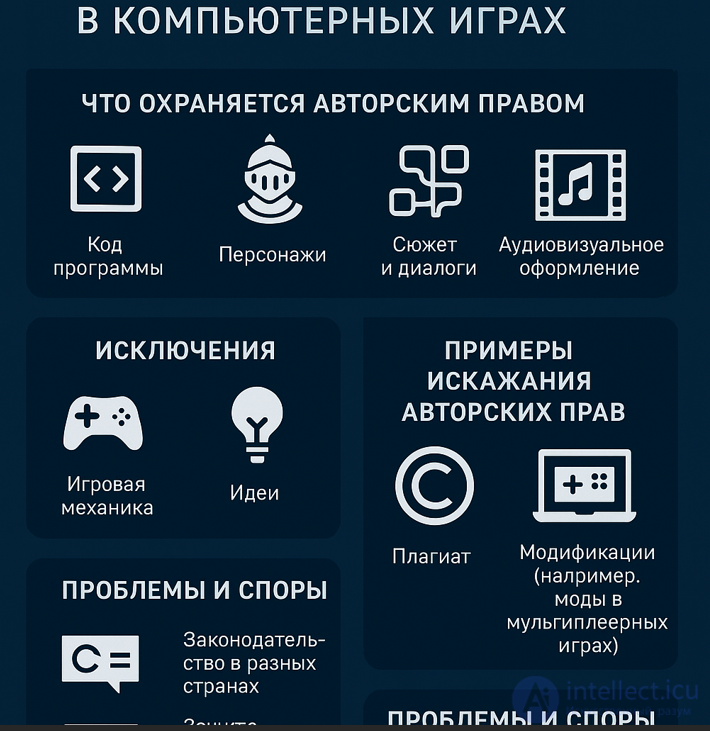
A computer game is a composite work spanning several levels of creativity. Copyright extends to the following elements:
Source and object code
A computer program is text written in a programming language. It is protected as a literary work.
Graphics and visual imagery
Characters
The game interface
Backgrounds, textures, 3D models
These elements are protected as fine art or applied graphics.
Music and sound
Background music
Sound effects
Voice acting
All of this is protected as musical works and phonograms.
Script and dialogue
The plot structure
Character lines
Cut-scenes
Protected as literary works.
Animation
Character movements
Transformations of objects
Transitions between scenes
Protected as audiovisual works.
The game world and levels
Unique architectural and artistic designs of maps, cities, structures, and other locations also fall under protection, especially given a high degree of originality.
Copyright does not protect:
Ideas (for example, the idea of a post-apocalyptic shooter)
Game mechanics (for example, a «lives» system or loot pickup)
The rules of the game
Methods and principles of programming
These elements can be protected by patent law (in limited cases) or trade secret, but not by copyright.
Depending on the conditions under which the game was created, the copyright may belong to:
An individual — if the game was developed independently outside of employment relations.
An employer — if the game was created as part of a work assignment under an employment contract.
A client — if the transfer of rights is provided for by contract (for example, outsourced development).
Important: the right of authorship (a personal non-property right) always remains with the individual — the creator. It is inalienable and perpetual.
Copyright in games is protected in all countries that have acceded to the Berne Convention (more than 180 states, including Russia, the USA, Japan, the EU countries, and others).
This means that protection automatically applies abroad as well — without additional registration.
Tetris Holding v. Xio Interactive (USA, 2009)
The court held that a nearly complete visual copy of the game Tetris (even in the absence of a patent on the mechanic) infringes copyright.
Epic Games v. Apple (USA, 2020–2021)
Although the case as a whole concerned monopoly, Epic defended its copyright in the appearance and program code of Fortnite.
Riot Games v. Moonton (China/USA, 2017–2022)
Riot accused the developers of Mobile Legends of copying the appearance, interface, characters, and animation from League of Legends. A settlement was reached, and Moonton modified the game.
Record authorship
Keep drafts, screenshots, and source code with dates.
Register the copyrighted work (optional) with RAO, RPP, or the US Copyright Office.
Draw up contracts with employees and contractors
Include provisions on the transfer of exclusive rights.
Specify that the work is a work made for hire.
Use license agreements with users (EULA)
Describe prohibitions on copying, modification, and distribution.
Specify measures of liability for violation.
A trademark is a means of legal protection that allows you to secure rights to a game's name, its logo, its characters, and unique graphic elements. Obtaining a trademark prevents the illegal use of similar or identical objects and increases the product's competitiveness.
Some game distribution platforms require the mandatory presence of a registered trademark, which makes the process of obtaining one an important stage for entering the market. For example, the names and logos of popular games such as GTA, The Sims, and S.T.A.L.K.E.R. are already registered with Rospatent.
Before filing an application, you must make sure the mark is unique. It must not coincide with already-registered trademarks or be similar to them. Additionally, you should check compliance with the requirements of the law and the presence of legal protectability. The grounds for refusing registration are listed in Article 1483 of the Civil Code of the Russian Federation.
One of the key advantages of a trademark for computer games is the ability to apply the registered mark to gamer merchandise — T-shirts, posters, figurines, accessories, and other goods.
The registration process takes from 3 to 18 months, after which the certificate is valid for 10 years. Once the term expires, the protection must be renewed in order to retain the rights to the mark.
Registering a character as a trademark is possible, but if it has unique characteristics, it also falls under copyright protection. This is confirmed by Resolution of the Plenum of the Supreme Court No. 10 dated 23.04.2019.
In addition, if a game uses the voices or likenesses of actors, related rights apply to them, which requires separate legal regulation.
Thus, registering a trademark not only protects gaming products,
Patents for inventions in computer games: legal protection of technical solutions in the entertainment industry
While copyright protects the external form of a computer game — graphics, music, plot, code — patent law makes it possible to protect the technical essence of the innovations underlying gameplay, interfaces, or software algorithms. A patent is a legal mechanism that allows the temporary prohibition of the use of an invention by third parties without the owner's consent. In this article, we will examine what can be patented in a computer game, what requirements apply to patents, provide examples, and also outline the legal specifics in different countries.
Patent legislation (including Russian, American, and European) requires that the object of a patent meet three key criteria:
Novelty — the solution has not been used or disclosed anywhere before.
Inventive step — the solution must not be obvious to a specialist.
Industrial applicability — the solution can be implemented in industry, including digital technologies.
On this basis, in games one can patent:
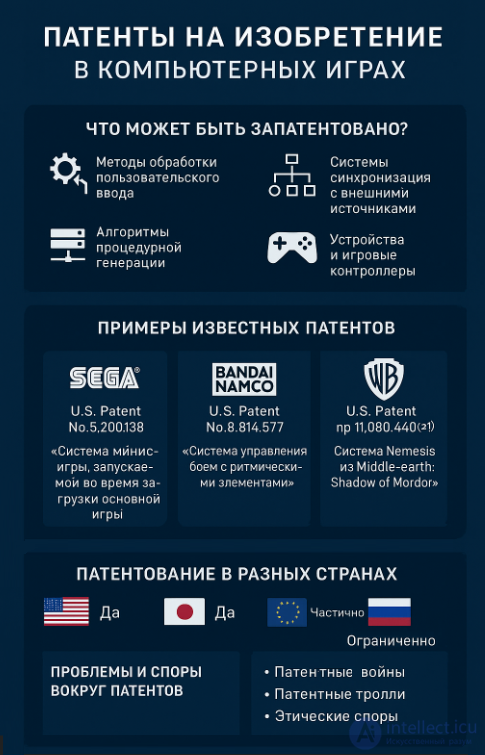
Methods of processing user input
For example, a unique way of controlling a character through sensors, or behavior that adapts to the player's style.
Procedural generation algorithms
Methods of creating maps, levels, quests, or plots, if they are technically implemented in an original way.
Systems for synchronization with external sources
For example, a game that adapts to the weather, the time of day, or the player's physiological data.
Devices and game controllers
Gamepads, VR headsets, sensor gloves with a distinctive mode of operation.
Methods of interaction with the server
Unique systems for transferring data between players, saving progress, or distributing load in an MMO.
Game mechanics as ideas (for example, a «crafting system» or «turn-based battle»)
The rules of the game
Scripts, plot, characters, visuals — they are protected by copyright, but not by a patent
Abstract algorithms not tied to a technical effect
Sega – U.S. Patent No. 6,200,138
A system for a mini-game launched during the loading of the main game
Used in «Sonic the Hedgehog».
It allowed the player to take part in an interactive mini-game while the main level was loading.
Namco – U.S. Patent No. 5,718,632
A game character that automatically learns the player's actions
Used in the Tekken series.
Warner Bros. – U.S. Patent No. 11,080,440 (2021)
The Nemesis System from Middle-earth: Shadow of Mordor
The patent protects a method of generating unique enemy characters that remember the player's actions and build a personal history of conflict.
Bandai Namco – U.S. Patent No. 8,814,677
A combat control system with rhythmic elements
Used in Taiko no Tatsujin.
U.S. Patent No. 6,935,954, issued to Nintendo in 2005 by the USPTO, and obtained even earlier under the PCT procedure, describes the use in a computer game of a «character sanity state» variable, the causes of its change, and its consequences (slowed reactions, hallucinations). The Free Software Foundation believes this does not differ greatly from the hypothetical patents on the plots of literary works described in Richard Stallman's article. Nintendo — Sanity System (US6935954B2, 2005)
The sanity system in Eternal Darkness: Sanity’s Requiem.
When «sanity» dropped, the player saw hallucinations, false errors, and strange effects.
Bandai Namco — Loading Screen Mini-Games (US5718632, 1998)
A patent on the ability to launch mini-games during the loading of the main content.
This is precisely why many games long lacked interactive loading screens.
Konami — Rhythm Action Game (DDR, 1999)
A patent on a system of dance games with sensor panels (Dance Dance Revolution).
It protected the mechanic of «pressing arrows in time with the music».
Sega — Fishing Controller (1997)
A patent on a unique controller in the form of a fishing rod for Sega Bass Fishing.
It included motion sensors and vibration to simulate fishing.
Namco — Ghost Camera System (Pac-Man, 1980s)
A patent on the behavior algorithm of the enemies («ghosts») in Pac-Man.
Each ghost had a unique movement strategy, which made the game unpredictable.
All of these patents protected specific technical solutions, not abstract ideas.
Many of them have already expired, and can now be used freely.
In the gaming industry, patents often served as a way to preserve a product's uniqueness, but over time they turn into part of the history of game design.
| Country / region | Patenting of game inventions | Specifics |
|---|---|---|
| USA | Yes | Software methods can be patented if there is a "technical contribution" |
| Japan | Yes | Actively supports patents on game algorithms and interfaces |
| European Union | Partially | Only where there is a "technical character" (not the idea, but the implementation) |
| United Kingdom | Partially | Abstract algorithms are not patentable, but implemented solutions — yes |
| Russia | Limited | Only technical devices and algorithms with a technical result are patentable |
| Country / Region | Government fees | Attorney services | Total approximate cost |
|---|---|---|---|
| USA (USPTO) | $1,500–2,000 | $8,000–12,000 | $10,000–15,000 |
| Europe (EPO) | $5,000–7,000 | $15,000–20,000 | $20,000–30,000 |
| China (CNIPA) | $1,000–2,000 | $4,000–8,000 | $5,000–10,000 |
| Japan (JPO) | $2,000–3,000 | $12,000–20,000 | $15,000–25,000 |
| South Korea (KIPO) | $2,000–3,000 | $10,000–18,000 | $15,000–25,000 |
| India | $500–1,000 | $3,000–6,000 | $4,000–7,000 |
| Canada | $1,500–2,500 | $8,000–12,000 | $10,000–15,000 |
USA, Europe, Japan, China, and most countries
20 years from the date of filing the application.
Cannot be renewed, except in rare cases of adjustments (for example, if the examination dragged on).
Exceptions
In some countries the term for utility models is shorter — usually 10 years.
For designs (industrial designs) the term is usually 15–25 years, depending on the country.
USA (USPTO): 2–3 years on average.
Europe (EPO): 3–5 years.
China (CNIPA): 2–3 years.
Japan (JPO): 2–4 years.
India: 3–5 years.
In some countries, examination can be expedited (for example, in the USA — through the Track One program), but this increases the cost.
Filing the application — the priority date is fixed.
Publication — usually after 18 months the application becomes public.
Examination — a check for novelty and inventive step.
Grant of the patent — after approval.
Maintenance — annual fees (maintenance fees).
If the annual fees are not paid, the patent may cease to be in force earlier.
After the term expires, the patent enters the public domain — anyone can use the technology.
For international protection, the PCT (Patent Cooperation Treaty) system is used, which gives up to 30 months to choose countries after filing the first application.
Patent wars
Large companies use patents to pressure competitors, often patenting even trivial solutions.
Patent trolls
Companies that do not develop products buy up patents and file lawsuits against developers (for example, Lodsys against dozens of mobile developers in the USA).
The patent as a defense. A counterclaim of patent infringement (patent counterclaim) is a method of defending against patent lawsuits: the defendant accuses the plaintiff of having itself infringed the defendant's patent.
Ethical disputes
Many believe that patents hold back innovation: for example, the mechanic of a «mini-game during loading» was patented for 20 years, and other companies were prohibited from using it until the term expired.
Determine whether the solution really is technical
There must be a technical effect, not just a gameplay result.
Prepare a description and drawings
Describe in detail the invention, the claims, and the field of application.
Check for novelty
Through patent databases (for example, Espacenet, WIPO Patentscope).
File the application with the patent office
In Russia — Rospatent
In the USA — USPTO
In the EU — the European Patent Office (EPO)
Pay the fees and undergo examination
Usually takes from 1 to 3 years. You can file an international application (PCT) to obtain protection in several countries at once.
Here are several striking examples of litigation related to the use of patented game mechanics. These cases illustrate how acute the question of the legal protection of mechanics is in the games industry, and how patents become an instrument of pressure or defense:
Essence:
Bandai Namco sued Capcom, claiming it had infringed a patent on the mechanic of using a touchscreen and a camera in arcade games.
Mechanic:
It concerned a patent protecting the player's interaction with the game through an external physical interface (for example, a camera or cards).
Outcome:
The parties reached a settlement. The terms of the settlement were not disclosed, but Capcom changed certain gameplay elements in future versions of its games.
Essence:
Uniloc, a patent troll, accused Mojang of infringing a patent related to authenticating users in a networked environment — a mechanic used in Minecraft.
Mechanic:
Although it concerned DRM and network-access mechanics more than anything, the case became notable because of the attempt to equate ordinary game network authentication with patentable technology.
Outcome:
The lawsuit was dismissed, and Mojang (then not yet acquired by Microsoft) came out with harsh criticism of patent trolling. The court sided with Mojang.
Essence:
Ironburg, a subsidiary of SCUF Gaming, claimed that Valve's Steam Controller infringed their patent on buttons located on the back panel of the controller.
Mechanic:
Although this is a physical aspect of control, it directly affects gameplay — the mechanic of quick access to actions through additional buttons.
Outcome:
The court awarded Ironburg more than 4 million dollars in compensation, finding infringement of patent rights.
Essence:
Konami sued Harmonix (the developers of Rock Band) for allegedly infringing a patent on the game mechanic of musical rhythm games using instrument-shaped controllers.
Mechanic:
Konami claimed it had patented the mechanic that allows a player to play on a guitar-like controller in time with music — analogous to the gameplay of Rock Band.
Outcome:
The case was settled out of court. Harmonix continued to release games, and also filed its own counterclaim to invalidate the patent.
Essence:
The company that owns the rights to Tetris sued Xio over the game Mino, which copied Tetris's gameplay.
Mechanic:
Although Tetris Holding did not have a patent on the "falling blocks" mechanic itself, they proved that the design, logic, and interface of Mino were so identical to Tetris that they infringed copyright.
Outcome:
The court sided with Tetris Holding, confirming that, despite the fact that game mechanics are not patented directly, their implementation can be protected.
Some patent numbers became known only from court materials or public registers.
Patent:
JP 2003-253153 A — for an arcade terminal with recognition and control functions via a physical interface (sensor, camera, card).
(A Japanese patent, with no exact equivalent in the USPTO.)
Mechanic:
The use of physical objects and a camera to control characters on the screen.
Patent:
US Patent No. 6,857,067 — System and method for preventing unauthorized access to electronic data.
(A network-authorization mechanism was patented.)
Mechanic:
Network verification of authenticity and a license key when launching software (including games).
Patent:
US Patent No. 8,641,525 — Game controller with ergonomically placed buttons.
(A controller with additional buttons on the back panel.)
Mechanic:
Additional controls placed on the back of the controller for use by the middle and ring fingers.
Patents:
US Patent No. 6,390,923 — Music playing game apparatus.
US Patent No. 6,645,067 — Music game system and method.
(Both patents concern the synchronization of a musical signal and user input via controllers.)
Mechanic:
A musical rhythm game using a controller in the form of a musical instrument (guitar, drums).
Patent:
There was no patent; the case concerned copyright, not a patent dispute.
The Tetris mechanic (falling blocks) was not patented, but its implementation (visual style, interface, rules) was protected through copyright.
Mechanic:
The implementation of the classic Tetris mechanic in a nearly identical visual form (Mino by Xio Interactive).
The question of patenting game mechanics is one of the most contentious in the field of intellectual property law. In many countries, a game mechanic as an abstract idea cannot be patented, but the specific technical implementation of that mechanic (for example, by means of a unique algorithm or device) can be. Below is an overview of the key jurisdictions:
Possible, but with caveats:
Game mechanics are not patented as abstract ideas, but if they are implemented through a technical means or a unique mode of interaction — they can be patented.
The key criterion is passing the Alice Test (the case Alice Corp. v. CLS Bank International, 2014), which determines whether an invention is an abstract idea without a technical implementation.
Patentable:
A method of control (for example, a gamepad with nonstandard buttons)
An algorithm that governs the game's logic
A method of synchronizing the player's actions with external data (for example, music or video)
Possible, but only as regards software or hardware implementations.
The Japan Patent Office (JPO) accepts applications for game mechanics in the form of software algorithms if they make a «technical contribution».
Example: arcade systems, control mechanisms via physical interfaces, unique schemes for processing user actions.
Possible, especially if the mechanic involves interactive data processing or technical features.
Similarly to Japan, here the emphasis on the technical aspect of the implementation is important.
Chinese patent legislation permits the patenting of interactive systems, VR/AR algorithms, and mechanics with hardware integration.
Example: a game mechanic with biometric control.
A game mechanic as such is not patentable.
According to Article 52(2)(c) of the EPC, "computer programs" and "methods for performing intellectual activity" are not subject to patenting.
However, if the mechanic is implemented with a technical effect (for example, interaction with external devices, a nonstandard event-processing architecture), then a patent is possible on the technical aspect, but not on the mechanic itself.
The principle is analogous to that of the EU:
A game mechanic as a «business model» or «abstract idea» is not subject to patenting.
You can patent a method of technical implementation if there is an «inventive step».
Game mechanics are NOT recognized as an object of patent law.
According to Article 1350 of the Civil Code of the Russian Federation, technical solutions are patentable, whereas methods of organizing a game, rules, and scripts are not inventions but, at best, objects of copyright (if formalized in the form of code, graphics, etc.).
However, you can patent:
Unique game controllers
Devices with games (for example, a lottery drum, a VR headset)
Software algorithms for processing input — with difficulty, but applications are possible in the field of automation.
| Country / Region | Is patenting of mechanics possible? | Comment |
|---|---|---|
| USA | Partially | If there is a technical implementation |
| Japan | Partially | In the form of software algorithms |
| South Korea | Partially | A technical implementation is mandatory |
| China | Partially | The presence of a technical effect is important |
| European Union (EPO) | No (if without technology) | Only the implementation, not the idea |
| United Kingdom | No (in pure form) | Hardware/algorithmic novelty is required |
| Russia | No | Only copyright on the implementation |
In conclusion, it can be said that the legal problems associated with the use of game mechanics touch on a wide range of issues: from copyright to data protection, from the regulation of gambling to ethical aspects. Given the rapid development of the industry, both an adaptation of existing legal norms and the development of new approaches are needed to ensure a balance between the interests of developers, users, and society as a whole.
Copyright is the main legal instrument for protecting a computer game as a creative work. It covers code, visuals, plot, music, and other forms of expressing ideas, but it does not protect the ideas and mechanics themselves. Understanding the boundaries of copyright is important for developers, investors, and publishers in order to avoid infringements and preserve the exclusivity of their product.
Patents in the games industry are a powerful instrument for protecting technical innovations, allowing one to monetize not only the product but also the ideas underlying it. However, only those who offer an original and technically feasible solution capable of passing a complex legal examination can make use of this instrument. It is important for developers to understand that not everything that seems new in gameplay can be protected — but everything that has a technical implementation deserves an assessment of its patentability.
Although game mechanics themselves are rarely protected by patents because of their abstract nature, specific implementations, especially those with elements of hardware interaction, network logic, or UI/UX, can be objects of patent protection. Litigation in this area shows just how complex and flexible the boundary is between an idea and its embodiment in the form of a patentable technology.

Comments