User testing is part of the game development process. It provides valuable insights into how players interact with a game, what difficulties they encounter, and what they enjoy. The goal of user testing is to improve the player experience and make a game more appealing to its target audience. It helps identify problems and improve the player experience based on real data and feedback from players.
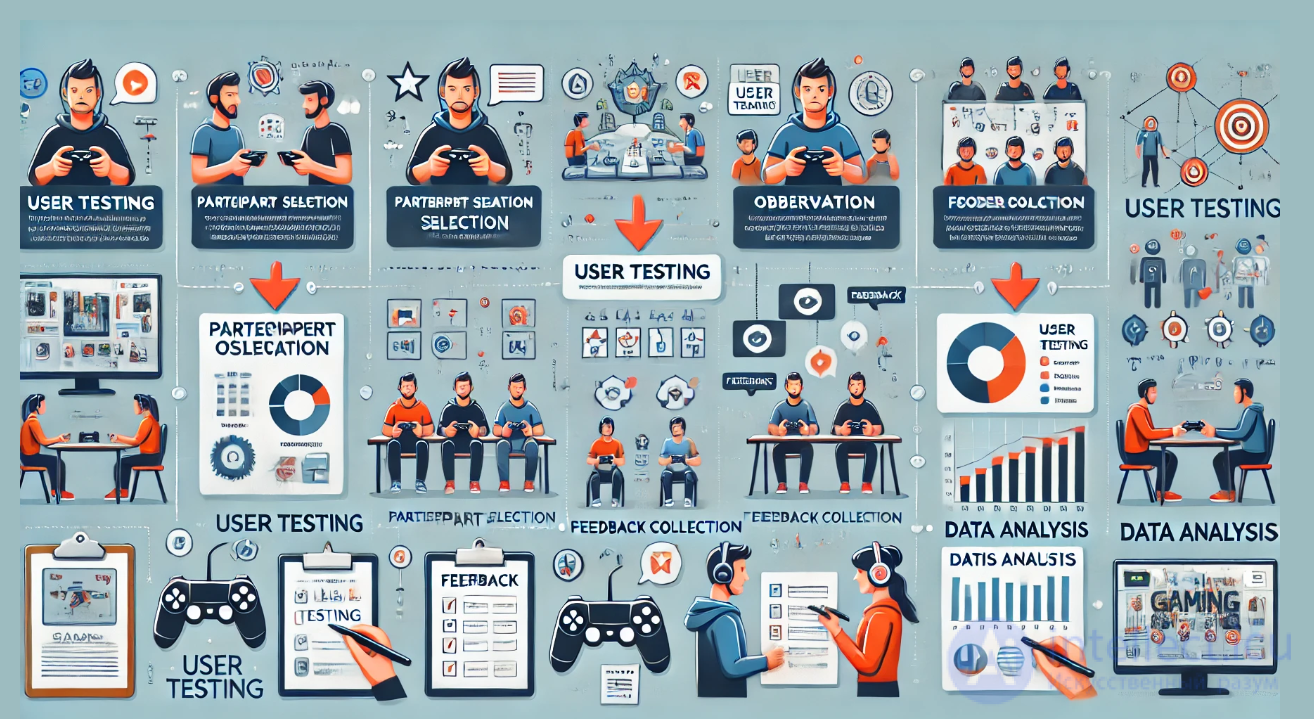
Fig. Infographic illustrating user testing
User testing to improve the player experience consists of sections covering various aspects of user testing: selecting participants, observing the gameplay, gathering feedback, and analyzing data. Each section includes corresponding images, such as players testing games, observers taking notes, feedback forms, and charts displaying the results of the analysis.
Why is it important to conduct user tests?
- Understanding the target audience: Testing helps you understand how well a game meets players' expectations and needs.
- Identifying problems: It allows you to uncover hidden issues that could degrade the player experience.
- Optimizing gameplay: It helps determine which game mechanics work well and which need refinement.
- Improving the user interface: It lets you evaluate the convenience and intuitiveness of the interface.
- Gathering feedback: It provides the opportunity to get direct feedback from players.
Types of user tests
- Focus groups: A group of players discusses the game under the guidance of a moderator.
- Playtests: Players play through the game and share their impressions.
- A/B testing: Comparing two versions of a game to determine which is more effective.
- Remote tests: Players undergo testing online.
- Eye-tracking testing: Tracking the movement of a player's eyes to analyze their attention.
- Electroencephalography (EEG) testing: Studying the player's brain response to various in-game events.
- Alpha testing: Conducted within the development team to identify major bugs and problems.
- Beta testing: Involves a limited number of external users to obtain more diverse feedback.
- Game analytics: Collecting data on player behavior in real time to analyze and improve the game.
How to conduct user tests
- Defining goals: Clearly formulate what you want to learn through testing.
- Selecting participants: Choose participants who match your target audience.
- Developing a scenario: Create a test scenario that includes tasks and questions for players.
- Preparing the environment: Prepare the necessary equipment and software.
- Collecting data: Record video, audio, and text data about the playthrough.
- Conducting tests: Running the tests and collecting data and feedback.
- Analyzing data: Analyze the collected data, identify patterns, and draw conclusions.
- Making changes: Adjusting the game based on the testing results.
Methods and tools
- Questionnaires and surveys: Gathering qualitative feedback from players.
- Game telemetry: Automatic collection of data on players' actions in the game.
- Observation and interviews: Directly observing players and conducting interviews to obtain in-depth information.
What can you learn through user tests?
- Clarity of game mechanics: Do players understand how to interact with the game world?
- Difficulty level: Is the game too easy or too hard?
- How engaging the game is: Does the game captivate players?
- Interface problems: Do players experience difficulties using the interface?
- Technical problems: Do players encounter any technical issues?
How to use the testing results
- Improving gameplay: Make changes to game mechanics based on the collected data.
- Optimizing the interface: Improve the design and layout of interface elements.
- Fixing bugs: Fix the identified technical problems.
- Making marketing decisions: Use the testing results to develop marketing materials.
Important aspects of user tests
- Neutrality: Create a comfortable atmosphere for players so they feel at ease.
- Openness: Be prepared for unexpected results and don't be afraid to change your plans.
- Confidentiality: Ensure the confidentiality of the test participants' data.
Examples of successful use of user tests
- The Witcher 3: Wild Hunt: The developers used extensive beta testing to improve balance and eliminate bugs.
- Fortnite: Continuous use of game analytics to optimize gameplay and introduce new features.
Conclusion
User tests are a powerful tool for improving the player experience. They provide valuable insights into how players interact with a game and what can be improved. Regularly conducting user tests will help you create higher-quality and more successful games.
User tests are an integral part of the game development process. They make it possible to create higher-quality and more engaging games that satisfy players' needs and expectations.
Assignments for independent work
- Conduct a small user test for your game or prototype.
- Explore various tools for conducting user tests.
- Analyze the results of user tests of some well-known game.
Questions for discussion
- Which types of user tests do you consider most effective for different types of games?
- How can you motivate players to participate in testing?
- What tools can be used to analyze the data obtained from testing?


Comments