
Lecture
Games affect players on a psychological level, evoking various emotions, stimulating cognitive processes, and influencing their motivation. Understanding player psychology helps game designers create more engaging and immersive games that respond to players' various needs and desires.
Two key concepts lie at the heart of this:
Games act on two main categories of motivation:
Example:
Self-Determination Theory (SDT) explains how games satisfy players' basic psychological needs:
Psychologist Mihaly Csikszentmihalyi developed the concept of the flow state (flow), which occurs when a player is fully immersed in an activity. The flow state is achieved when the tasks in a game match the player's skill level: they are neither too easy, which would become boring, nor too hard, which would cause frustration.
Conditions for the flow state:
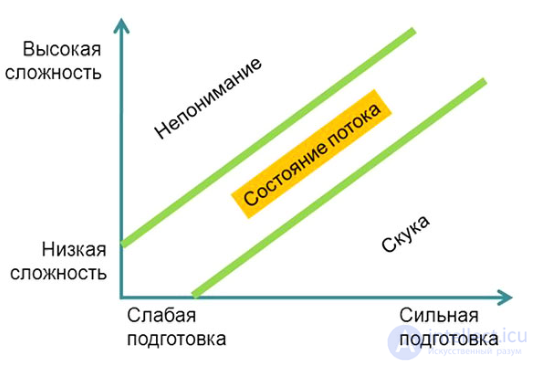
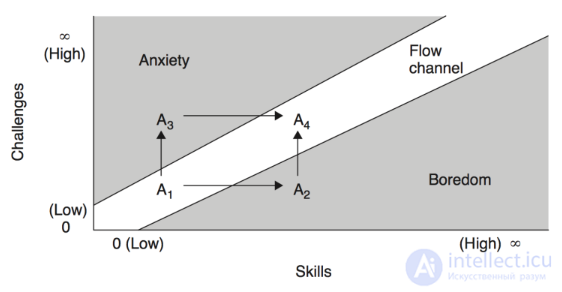
Fig. The flow state
• «Flow» is a state of the player in which they experience optimal experiences (roughly speaking, they get the best fun).
• «Flow» is achieved in a shifting balance between the Difficulty of the task and the Skill of the player
6 signs of «flow»:
1. Extraordinary focus on the task
2. A sense of active control over the situation
3. The merging of action and awareness
4. Loss of the sense of self-consciousness
5. Loss of the sense of time
6. The experience that the activity brings is the only necessary criterion for continuing it
4 characteristics of a game that help achieve «flow»
1. The presence of concrete goals with clear rules for achieving them.
2. It requires the player to take actions toward the goal that are within their capabilities
3. The presence of clear and timely feedback on the player's actions, their success metrics, and the completion of goals
4. As few distractions as possible, in order to maintain concentration
The Bartle model (Bartle’s Player Types) is one of the most well-known theories describing player behavior in multiplayer online games. It was developed in 1996 by the British researcher Richard Bartle based on observations of player interaction in MUDs (Multi-User Dungeons) — text-based multiplayer games. The Bartle model classifies players into four main types:
Killers — players who enjoy competing and beating other players. They take pleasure in overcoming opponents, dominating, and creating challenges for others. These might be participants in PvP battles who feel joy from winning duels.
Explorers — players who enjoy exploring the game world. They are interested in all the hidden aspects and secrets, love to discover new areas, find rare items, or investigate game mechanics. For them, the process of exploration and expanding their knowledge of the game is what matters.
Achievers — players who are motivated by progress and achievements in the game. They strive to reach the maximum results, collect all the rewards, reach all the levels, or complete all the quests. Their main goal is to be the best in the game by progress metrics.
Socializers — players who value interaction with other people. They prefer to spend time communicating with other players, building relationships, and creating communities. For them, interaction with people matters more than completing the game itself.
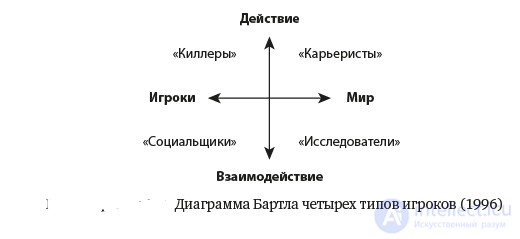
The four player psychotypes (Richard Bartle's typology)
This model helps developers understand which aspects of a game will be most appealing to different types of players. For example, PvP elements can attract killers, while complex game worlds and systems are more interesting to explorers.
The Koster model was proposed by game designer Raph Koster in his book "A Theory of Fun for Game Design". In his theory, Koster focuses on what makes games fun and why people play games. He argues that the main source of enjoyment in games is learning.
Games are learning: Koster argues that the key reason people play is that they solve problems, learn new skills, and discover new mechanics. Games help develop cognitive abilities and offer opportunities for solving puzzles, which is what produces a sense of satisfaction.
Enjoyment from patterns: Players find enjoyment in recognizing and mastering the patterns presented in a game. As soon as the patterns become obvious and easily solvable, the game stops being interesting. The difficulty level must increase in order to maintain the player's interest.
Tasks and challenges: Koster emphasizes the importance of the right balance between the difficulty and accessibility of tasks. Tasks that are too easy become boring, while tasks that are too hard cause frustration. The ideal game must constantly present the player with tasks that are at the edge of their abilities.
Feedback and motivation: Games offer quick and clear feedback, allowing players to quickly understand what they are doing right or wrong. This lets them learn from their mistakes and develop strategies.
The Koster model helps developers understand how to create mechanics that will encourage the player to learn and develop. It emphasizes the importance of adapting the difficulty level and varying the tasks to maintain players' interest throughout the game.
The Bartle model focuses on the types of players and their motivation, providing information about which aspects of the game to pay attention to depending on the target audience. This is useful for creating diverse content for different players.
The Koster model explains how exactly game mechanics and their structure can maintain a player's interest through the process of learning and problem-solving, focusing on intrinsic motivation and the enjoyment of development.
Both models are valuable for game designers, since they help understand player behavior and motivation from different perspectives: Bartle focuses more on social aspects and interaction with the game world, while Koster focuses on the cognitive process of learning and mastering game mechanics.
Game development, like other industries that rely on marketing, is constantly trying to improve the methods of studying its audience. Large retail companies have found that certain
scents or colors help increase sales. In economics, entire fields have emerged – neuroeconomics and neuromarketing, which study the influence of various factors on our brain with the aim of
influencing the user.
After long years of research, it became possible to find connections between game design and player satisfaction. This is how the BrainHEX model appeared, which is used by game studios around the world.
Scientists study the brain centers that work during play and are responsible for different emotions. New research is being conducted constantly, the information is publicly available, so we will not dwell on the biological side of the question. Above all, we are interested in certain «neurotransmitters»:
While playing, a person gets emotions precisely through a combination of certain hormones. They determine what we feel at a given moment: curiosity, a challenge, or the desire to smash the phone against the wall. Understanding what is going on in the player's head, game developers can predict the reaction to one game event or another and come up with a way to monetize it. Naturally, people can react differently to the same feature. All of this involves complex brain processes, but on their basis it became possible to create a theory about dividing players into groups.
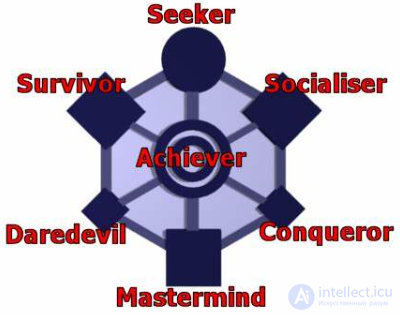
Fig. . The BrainHEX model
Game mechanics play a central role in how players experience motivation. Let's consider several key mechanics and their influence:
Progression mechanics motivate players by providing a sense of growth and improvement. Examples:
Rewards stimulate both extrinsic and intrinsic motivation. They can take various forms:
Creating a properly balanced level of challenge can sustain motivation:
Social mechanics stimulate a sense of relatedness and interaction between players:
Freedom of choice and exploration in games influence motivation by giving the player autonomy:
Game mechanics can create a strong emotional impact on the player:
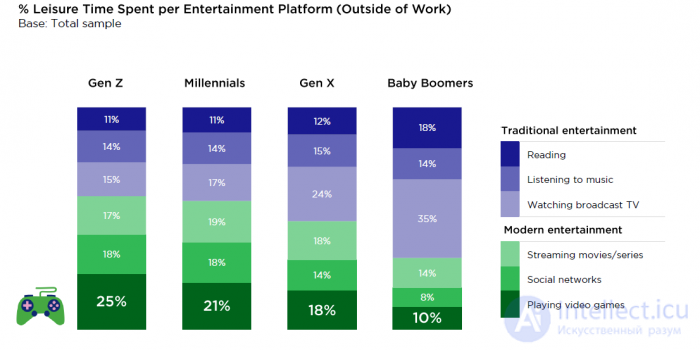
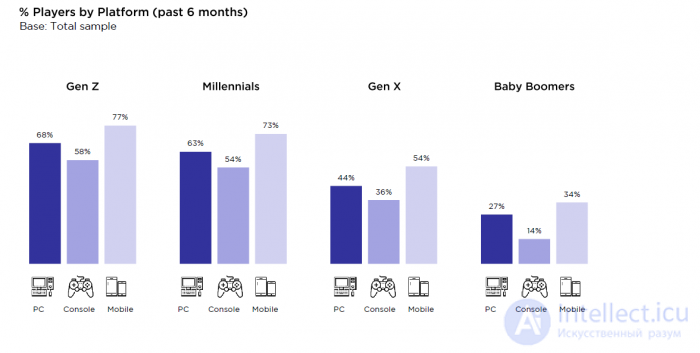
77% of Generation Z players, 73% of Generation Y players, 54% of Generation X players, and 34% of Baby Boomer players play on mobile devices. (Newzoo)
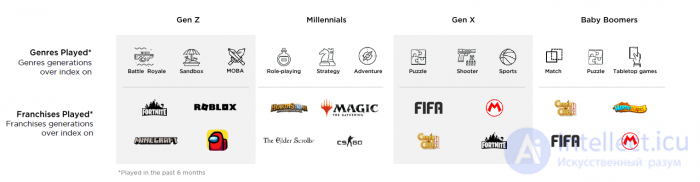
According to a Newzoo study, Generation Z players prefer games in the battle royale, sandbox, and MOBA genres. Fortnite, Roblox, Minecraft, and Among Us were their favorite franchises.
Millennials most enjoy RPGs, strategy, and adventure games such as Hearthstone.
Generation Z players are mainly into puzzles, shooters, and sports games.
Baby Boomers are also into puzzles, as well as board games and match-three games such as Candy Crush Saga.
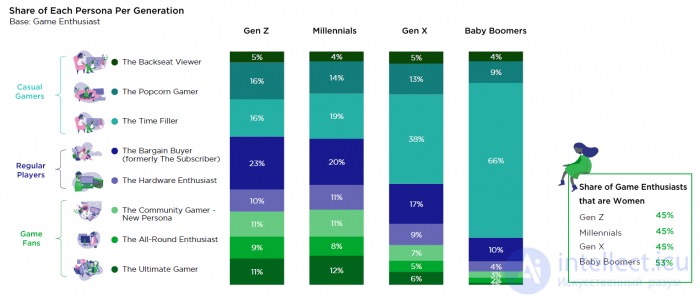
According to Newzoo, 23% of Generation Z players and 20% of millennials fall into the group of so-called discount buyers. This type of player likes high-quality free games.
38% of Generation X gamers and 66% of Baby Boomers identify as The Time Filler. These players play mobile games when they have free time.
The main reasons users play mobile games:
(Data source: Facebook Gaming)
Games use a wide range of mechanics to affect player psychology and sustain their motivation. Motivation, whether intrinsic or extrinsic, is built on the basis of players' interaction with game mechanics and their emotional involvement. Understanding these factors allows game designers to create more engaging and captivating gaming experiences that satisfy players' basic psychological needs and motivate them to return to the game again and again.

Comments