
Lecture
The Pacing curve (game tempo) is a graph that reflects changes in gameplay intensity throughout the player experience. It helps developers balance tense and relaxing moments, keeping the player engaged.
Usually in this context, pace means rhythm, tempo, the speed of a step. Pacing means «regulating the tempo», and a pacemaker is «someone who sets the rhythm».
In games this term is most often used in the context of storytelling, the speed at which the player is introduced to something new — content, plot, mechanics.
Accordingly, pacing in Russian can be called «rhythm tuning», «rhythm regulation», «rhythmization».
Pacing is one of the player's perceptions regarding a game's level design. Just as a book has plot development, climaxes, and resting points, tempo can be stretched out in a similar way. A well-paced game will capture the player's attention and keep them engaged in the process all the way to a satisfying climax and ending.
We want tension in the story and gameplay to rise as players approach the climactic finale.
To heighten the drama, we raise the stakes (what's in it for the characters) and intensify the conflicts (enemies, dangers, obstacles, challenges).
However, you shouldn't make every encounter even more intense than the previous one.
This leads to fatigue as the session continues, and everyone loses energy and enthusiasm.
All this mental and emotional labor, if relentless, wears you out.
To prevent this, we need the rising tension to resemble the teeth of a saw:
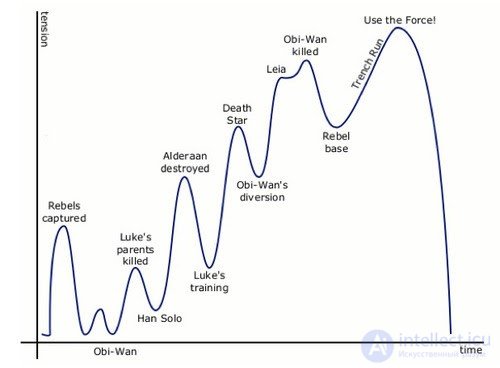
At peak moments we increase the tension.
The troughs are the places where we briefly take our foot off the gas pedal and let the player relax.
Flat Pacing
Wave Pacing
Rising Pacing
Arc Pacing
The structures and mechanisms that together create tempo are numerous, but many of them fall into the following categories.
Threat level is the actual danger the player faces in the game. Tempo can be increased by raising the threat level, introducing enemies, or bringing danger closer. A high threat level can be an overwhelming army of enemies capable of destroying the player with one wrong move.
Movement Impetus is the player's desire to keep progressing through the game's levels. Some ways to improve the player's movement encourage them by creating goals and rewards ahead or presenting a threat behind.
Tension is the perceived danger the player experiences. The difference between this and threat level is that threat level is often rooted in game mechanics, whereas tension makes use of atmospheric design. A high buildup of tension is a single unknown creature hidden in the shadows that makes the player doubt every step they take, even if, from a game-mechanics standpoint, nothing will happen to it until they reach a scripted climax. Survival horror games often rely on tension primarily for their pacing.
Tempo is the intensity of the action at a given moment in the game. High-tempo gameplay often requires split-second decision-making and reflexes, which is characteristic of many first-person shooters. On the other hand, low-tempo gameplay usually involves puzzles or things that require thought.
A well-designed game will have good tempo not only in the overall game (the Arc) but will also use the same tempo in the Scene and Action parts of the game. A Scene is the levels, and the Action is the actual game mechanics the player uses.
The most famous example of Portal stimulating Movement Impetus is the well-known «cake» reward. It also created good tension buildup through the use of the environment itself, such as the scrawled messages in some «hidden» rooms the player came across. The escalation of the threat level with the introduction of water, energy balls, turrets, a single rocket launcher, and neurotoxin kept the player in suspense while solving the portal puzzles.

Comments