Story is the heart of a game. It gives the game depth, meaning, and emotional resonance. It is through story that the player is immersed in a virtual world, empathizes with characters, and feels part of the narrative. However, creating and integrating a story into the game structure is a complex process that requires a deep understanding of both game design and storytelling. Story plays an important role in creating an engaging and memorable gaming experience. It helps players immerse themselves in the game world, motivates them, and gives meaning to their actions. In this lecture, we will look at how to create and integrate a story into the game structure so that it becomes an integral part of the gameplay.
One of the most common misconceptions about game designers is that their main task is to «invent worlds», create the lore, plot, and characters of a game. This can be compared to asking someone to «tell a fairy tale». Many people can probably make up a bedtime story, but making a game engaging and interesting for others is a far more complex and multifaceted task.
Lore (from the English word lore – «knowledge») is a general concept that combines the history and plot of a computer game. It includes all the information about the game world that the player can learn both directly during gameplay and through additional materials such as books, comics, films, and other sources that complement the game universe.
Setting (from the English word setting – «environment», «surroundings») is the environment in which the events of a work unfold. It includes the place, time, and conditions of the action. In works of fiction such as books, films, board games, or computer games, the setting is a description of the world where the plot unfolds, creating atmosphere and setting the tone for what happens.
First, plot and setting are far from the only elements that determine a game's success. Of course, in story-driven games, immersion, atmosphere, and character development are important, but a game only becomes a game when it can actually be played. This requires engaging entirely different mechanisms than those that work in books or films.
Second, there is a belief that a game designer develops the complete set of rules and mechanics of a game, as well as their interaction. In practice, however, this is usually handled by lead game designers or the project's producers, who have extensive experience. A rank-and-file game designer, as a rule, focuses on developing a specific mechanic or creating individual pieces of content. Senior specialists are responsible for elaborating complex systems.
Creating truly engaging and functional game mechanics requires enormous preparation: you need to play other games, analyze them, experiment, and think through solutions deeply. Moreover, the term «invent» does not always accurately reflect the essence of the work. More often it is a process based on analyzing competitors, logical reasoning, and mathematical calculations.
A game designer works directly on the gameplay, striving to make it engaging and captivating. Their entire professional activity is focused on understanding what exactly creates this feeling of «fun», and on studying the tools that can be applied across various genres and gameplay situations. What distinguishes an experienced game designer from a novice is a set of proven solutions and approaches that make it possible to create this special gaming experience.
What is a game story?
A game story is not just a linear narrative. It is an interactive experience in which the player actively participates in the development of events. It is built on the player's interaction with the game world, decision-making, and overcoming obstacles.
1. Fundamentals of story creation
-
Key elements of a game story:
- Plot: The sequence of events that unfold in the game. Develop a main plot that includes the setup, rising action, climax, and resolution. Make sure the plot is logical and consistent.
- Characters: The personalities the player interacts with and can play as. Create interesting and multifaceted characters that players can identify with or empathize with. The protagonist, antagonists, and supporting characters should be well developed.
- World: The setting in which the story unfolds, with its own rules, laws, and atmosphere.
- Conflict: The central problem that the player must solve.
- Development: The changes that occur to the characters and the world as the plot progresses.
- Concept and theme: Define the core idea and theme of your story. It could be an epic adventure, a personal drama, or a science-fiction saga.
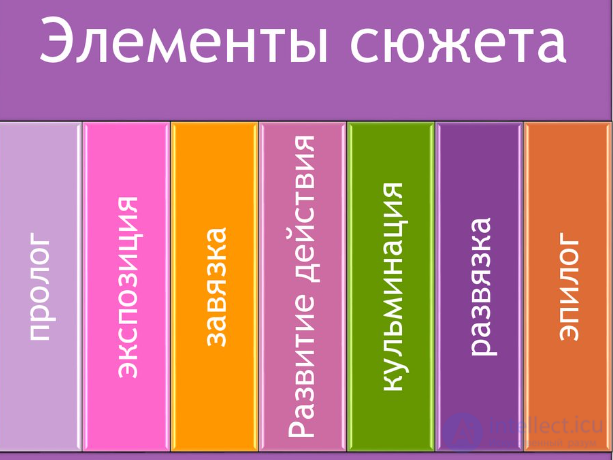
- prologue (from the Greek pro- «before» and logos- «speech») a kind of introduction to a work, which recounts events of the past; the prologue emotionally prepares the reader to perceive the game.
- exposition The introduction into the action, the depiction of the conditions and circumstances preceding the immediate start of the action; an acquaintance with the characters, the setting, the time, and the circumstances of the action.
- inciting incident The event with which the conflict begins. Conflict is a contradiction between characters; between characters and circumstances; within a character, underlying the action (the plot).
- Rising action- The system of events arising from the inciting incident, the development of the conflict.
- climax The peak of the conflict, the highest intensification of the contradiction.
- resolution The resolution of the depicted conflict, or an indication of possible ways to resolve it, or a demonstration of the fundamental unresolvability of the conflict.
- epilogue From the Greek «afterword»; the concluding part of a work, which briefly sets out: • what happened to the characters after the end of the main plot action; • the direction is indicated
- of the further development of events and the fates of the characters; • an assessment is given of what is depicted.
2. Integrating the story into gameplay
- Narrative mechanics: Use various mechanics to convey the story, such as dialogue, cutscenes, notes and diaries, as well as interaction with the surrounding world.
- Game quests: Tie quests and missions to the main plot so that players feel that their actions matter and influence the development of the story.
- World and environment: Create a world that supports and complements the story. Use visual and audio elements to create atmosphere and convey mood.
Successful integration of the story into the game structure means that gameplay and narrative complement each other, creating a unified whole.
Key points of integration:
- Gameplay as narrative: Every action the player takes should matter to the story. For example, solving a puzzle can reveal a new plot element, and winning a battle can change the course of events.
- The player's influence on the story: The player should feel that their decisions have consequences. This can be expressed in a change to the ending, the development of characters, or the opening of new plot branches.
- Consistency: All elements of the game – from the visual style to the soundtrack – should serve the story and enhance its perception.
- Balance: The story should not dominate the gameplay and vice versa. It is important to find the optimal ratio between them.
Methods of creating and integrating a story
- Writing the script: A detailed description of the plot, characters, and events.
- Creating the world: Working out the details of the world, its history, culture, and inhabitants.
- Developing characters: Creating convincing and memorable characters with unique motivations and goals.
- Level design: Creating game levels that not only entertain but also move the story forward.
- Dialogue: Writing dialogue that reveals the characters' personalities and advances the plot.
- Using interactive elements: Including interactive elements in the game, such as diaries, letters, and puzzles, that reveal details of the story.
- Applying game mechanics: Using game mechanics to convey the emotional state of characters or to create tense situations.
Examples of successful integration of story into a game
- The Last of Us: The player controls an aging Joel, who must escort the young Ellie through a dangerous post-apocalyptic world. The story permeates the entire gameplay, and the player's decisions have a significant impact on the development of events.
- Bioshock: The player is immersed in the underwater city of Rapture, where they encounter a dark history and its consequences. Gameplay and story are closely intertwined, and the player continually learns new details about the game world.
- Portal 2: The player solves puzzles using a portal gun, while learning the story of the creators of this technology and their motives. Humor and science fiction blend harmoniously in this game.
3. Dynamic story
- Choices and consequences: Include elements of choice in the game that affect the development of the plot and the fate of the characters. This makes the story dynamic and makes the gaming experience unique for each player.
- Multilayered narrative: Develop several storylines and side stories that players can explore. This adds depth and variety to the gameplay.
4. Testing and refinement
- Feedback: Get feedback from testers and players to understand how engaging and clear the story is. Make the necessary changes to improve the narrative.
- Polishing: Make sure that all elements of the story are well integrated into the gameplay and work harmoniously. Fix any inconsistencies and improve weak spots.
Conclusion
Creating and integrating a story into the game structure requires careful planning and attention to detail. A well-developed story can significantly enhance the gaming experience, making it more engaging and memorable. Game designers should strive to create stories that not only entertain but also evoke an emotional response in players.
Creating and integrating a story into the game structure is a complex and creative process that requires a deep understanding of both game design and storytelling. Successful integration of a story makes it possible to create a unique and memorable gaming experience that will interest players for many years.
Additional topics for study:
- Nonlinear narrative: How to create a game where the story develops depending on the player's actions.
- Emotional design: How to use game mechanics to evoke emotions in the player.
- Using interactive cinema: How to combine elements of film and games to create a unique experience.
- Role-playing: How to create a deep and elaborate role-playing system that allows the player to create a unique character.
Questions for discussion:
- Which games do you consider the most successful in terms of integrating story into gameplay? Why?
- What difficulties arise when creating and integrating a story into a game?
- How can various game mechanics be used to enhance the narrative?
- What role does the player play in creating the story in a game?
See also
- Nonlinear narrative
- Emotional design
- Interactive cinema
- Role-playing
- [[b12571]]
- [[b12582]]
- [[b12583]]
See also


Comments