
Lecture
Gamification is the application of game-design elements and game principles in non-game contexts. It can also be defined as a set of activities and processes for solving problems by using or applying the characteristics of game elements. Gamification typically employs game-design elements to enhance user engagement, organizational productivity, flow , [10] [11] learning , [12] [13] crowdsourcing , [14] knowledge retention, [15] employee recruitment and evaluation, ease of use , system usefulness, [11] [16] [17] physical exercise , [18] traffic violations, [19] voter apathy [20] and much more. A body of gamification research shows that most gamification studies find that it has a positive effect on people. However, individual and contextual differences exist. [21]
In 2019, the global gamification market was valued at USD 7.98 billion, and it is estimated that over the forecast period (2020-2025) the compound annual growth rate will be 25.10%. The exponential growth in the number of smartphones and mobile devices has directly created a vast base for the gamification market. This growth is also supported by the growing acceptance of gamification systems as a method of engineering human behavior architecture with the aim of stimulating innovation, productivity, or engagement. The use of gamification systems has also gone beyond the scope of traditional marketing. At present, they are widely used in preliminary applications such as crowdsourcing.
The growing penetration of smartphones has significantly expanded the possibilities of gamification. Americans are known to check their phones on average 80 times a day. The shift of both consumers and employees from desktop computers to mobile phones / internet devices offers banks a lucrative platform for capturing consumer attention with a greater likelihood of conversion / usage.
In addition, integration with social media platforms has allowed users to share their experiences with friends, acquaintances, and colleagues, thereby increasing the reach and effectiveness of this platform. Another advantage is that mobile applications allow brands to conduct surveys, even shorter than a single question, which enables them to collect first-hand data from members of their target audience and adapt their efforts accordingly.
A study of the use of gamification in companies showed that it is usually done in the most general forms. They use a points system, leaderboards, and badges for any process, without creating a thoughtful experience that balances competition and cooperation. This negligence in creating meaning for this approach is expected to lead to failure in 80% of the efforts of the companies that adopted them.
Another problem with this approach is that it encourages defeating other goals. As for learning and corporate training, employees who know how to pass an exam but do not necessarily know what they were taught are not needed. Working in a corporate environment has traditionally been an exchange of time and effort for money, and this naturally leads to a lack of motivation in the long term, especially for millennials who want to do meaningful work.
Thus, there is a growing need to develop thoughtful programs, which some companies failed to consider before applying this approach. So, although gamification can revolutionize the entire process of recruitment, onboarding, corporate leadership training, and staff compliance, game design is crucial for achieving the best results.
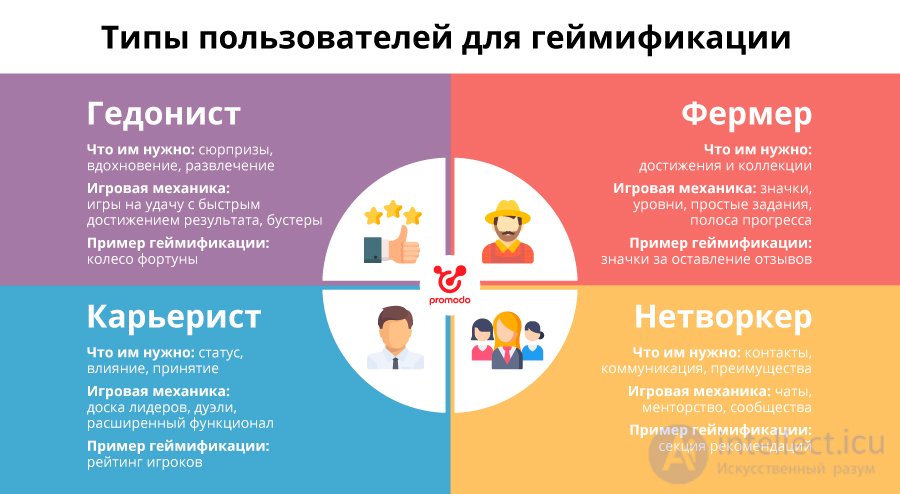
Gamification techniques are designed to leverage people's natural desires for socializing, learning, mastery, competition, achievement, status, self-expression, altruism, or closure, or simply their response to framing a situation as a game or play. Early gamification strategies use rewards for players who accomplish desired tasks or competition to engage players. Types of rewards include points, achievement badges, or levels, filling a progress bar, [25] or providing the user with virtual currency. Making rewards for completing tasks visible to other players or providing leaderboards are ways of encouraging players to compete.
Another approach to gamification is to make existing tasks feel more like games. Some methods used in this approach include adding meaningful choice, introducing a tutorial, increasing difficulty, and adding narrative.
Game-design elements are the basic building blocks of gamification applications. Among these typical game-design elements are points, badges, leaderboards, performance graphs, meaningful stories, avatars, and teammates.
Points are basic elements of a multitude of games and gamified applications. They are usually rewarded for the successful completion of certain activities within the game environment and serve to numerically represent a player's progress. [ Different kinds of points can be distinguished, for example, experience points, redeemable points, or reputation points, as well as different purposes that points serve. One of the most important purposes of points is to provide feedback. Points allow a player's in-game behavior to be measured and serve as continuous and immediate feedback and as a reward.
Badges are defined as visual representations of achievements and can be earned and collected within a gamification environment. They confirm players' achievements, symbolize their merits, and visually demonstrate their attainment of levels or goals. Earning a badge can depend on a certain number of points or on certain activities within the game. Badges perform many functions: they serve as goals if a player is aware of the prerequisites for winning them, or as virtual status symbols. Just like points, badges also provide feedback, since they show how players have performed. Badges can influence players' behavior, prompting them to choose certain routes and tasks in order to earn the badges associated with them. [39] In addition, since badges symbolize membership in the group of those who own that particular badge, they can also exert a social influence on players and fellow players, especially if they are rare or difficult to earn.
Leaderboards rank players according to their relative success, measuring them against a particular success criterion. Thus, leaderboards can help determine who performs best at a certain kind of activity [41], and are therefore competitive indicators of progress that relate a player's own performance to the performance of others. However, the motivational potential of leaderboards is ambiguous. Werbach and Hunter [33] regard them as effective motivators if only a few points remain until the next level or position, and as demotivators if players find themselves at the bottom of the leaderboard. The competition triggered by leaderboards can create social pressure to increase a player's level of engagement and can therefore have a constructive effect on participation and learning. However, these positive effects of competition are more likely if the respective competitors have roughly the same level of performance.
Performance graphs, which are often used in simulators or strategy games, provide information about a player's performance compared to their previous performance during the game. [31] Thus, unlike leaderboards, performance graphs do not compare a player's performance with other players, but instead evaluate the player's own performance over time. Unlike the social benchmark of leaderboards, performance graphs are based on an individual benchmark standard. By graphically displaying a player's performance over a fixed period, they focus on improvements. Motivation theory holds that this promotes a mastery orientation, which is especially beneficial for learning.
Meaningful stories are game-design elements that do not relate to the player's performance. The narrative context in which a gamified application can be embedded contextualizes the activities and characters in the game and gives them meaning that goes beyond the mere pursuit of points and achievements. A story can be conveyed by the game's title (for example, Space Invaders ) or by complex storylines typical of modern role-playing video games (for example, The Elder Scrolls Series ). [45] Narrative contexts can be oriented toward real, non-game contexts or serve as analogs of real conditions. The latter can enrich a boring, barely stimulating context and therefore inspire and motivate players, especially if the story matches their personal interests. [46] Thus, stories are also an important part of gamification applications, since they can change the meaning of real activities by adding a narrative «overlay», for example, hunting zombies during a run.
Avatars are visual representations of players within a game or gamified environment. They are usually chosen or even created by the player. Avatars can be designed very simply as plain pictograms, or they can be complex animated three-dimensional representations. Their main formal requirement is that they unmistakably identify players and set them apart from other human- or computer-controlled avatars. Avatars allow players to adopt or create a different persona and, in collaborative games, to become part of a community.
Teammates, whether other real players or virtual non-player characters, can provoke conflict, rivalry, or cooperation. The latter can be fostered, in particular, by introducing teams, that is, by creating certain groups of players who work together to achieve a common goal.
Play is taking on ever-new functions in the modern world. Through play activity, a person can gain new knowledge, make new acquaintances, develop social skills, and obtain emotional release in order to subsequently transfer the achieved results into real life. However, the process described above also has a downside. According to S.A. Solomatin, the sociocultural realities of modernity, given the ludic nature of postmodernism, where entertainment has been elevated by mass culture into an end in itself, «require their examination through the prism of the ludic conception of culture» and once again raise the question of the relationship between play and seriousness in modern society. Satiation with play as such, as well as the active development of new technologies, has turned postmodern society into a spoiled child. According to the ideas of J. Huizinga, play is an integral element of the development of human civilization as a whole, since «a living creature, when playing, follows an innate instinct for imitation. Or satisfies a need for release. Or requires exercise on the threshold of the serious activity that life will demand of it» . The play element manifests itself in virtually all spheres of human activity: in culture, sports, and communication. However, one must remember that play, unlike reality, is set apart from the external world by three criteria: place («it proceeds within a predesignated play space, material or imagined, deliberate or self-evident»), temporal duration, and closedness, that is, «its course and meaning are contained within itself» In the place where the game is played, its own special rules apply, and thus it turns out that play itself establishes order, «it is itself order»
Such a property of play — to order a nonexistent reality — leads modern adults to see in play a more reliable support than in other, rapidly changing social institutions. They trust the rules of the game into which they turn their entire life, inventing them along the way and self-actualizing through such activity. Play acts as a guarantor of stability, since it will always exist and it is precisely play that inspires more trust in people. The absolutization of the role of entertainment leads to puerilism — the pathological childishness of society, «a state of mind characteristic of an adolescent unrestrained by upbringing, customary forms, and tradition» , manifested in two tendencies. «On the one hand, there is an infantilization of adults; on the other — against the backdrop of the loss of values and of authorities that have lost trust, society's orientation toward the younger generation is clearly outlined, and moreover, a kind of ingratiation toward it» The described phenomenon echoes the following factor — the popularization and legitimization of the idea of the inner child among adults, as well as social projects aimed at protecting and supporting childhood. Modern society blurs boundaries and no longer presupposes such a rigid categorical division of the concepts of «childhood» and «adulthood», as a result of which one can now speak either of «adult childhood» or of «early maturation».
Consumer behavior as a way of signaling one's social status can be defined as the next factor of kidulting. Kidults, as a rule, are economically independent; their income allows them to support themselves and satisfy their leisure needs associated with consuming children's products: buying video games, animated films, anime, manga, comics, and toys. Such a juvenilization of society can be viewed from the standpoint of symbolic consumption, and then the consumer behavior of the kidult becomes not merely a random satisfaction of arising needs, but an attempt to signal one's status and one's belonging to a group, «in addition, the consumed items can be a means of competition between juvenilized individuals» .
Mass production picks up the idea of popularizing youth and youthfulness and forms new images that are attractive to adults in all aspects: manner of behavior, manner of dressing, and general bodily appearance. Media communications, and advertising in particular, develop a so-called form of collective regression, which denotes the need for immediate satisfaction of arising needs and calls on people to take from life, or rather from consumer society, everything it promises to give. Thus, youth is transformed from an age category into an object that can always be acquired. This same idea is emphasized by A.R. Kozharinova, who designates as the ideological function of mass culture its capacity to create new patterns of behavior and gradually displace traditional practices through active imposition from the outside «Mass culture is a peculiar sublimation of desires, instincts, and aspirations.
The individual is, as it were, transported into the world offered to them by the mass project, and only here do they feel comfortable and safe, while reality begins to be perceived according to the laws of mass spectacle» [23]. Thus, one can say that a certain massification and, at the same time, a mediatization occurs not only of the individual himself but also of his everyday practices. Beyond this, the media space in a certain way mediates the process of communication between people. There is a shift of emphasis from real, live communication to virtual communication, which relieves communication agents of the need to react here and now, giving a person the opportunity to construct a virtual intermediary image that will serve as a kind of shield. So, the new social phenomenon — kidulting — differs from social infantilism in that kidults independently choose to follow the behavioral patterns of previous age periods (youth and early maturity) as a mechanism of socialization, as new social practices. They are not excluded from public life, yet they differ, owing to their own specificity and the specificity of a changed world, in their manner of actualizing personal substructures. The modern environment forms a new psychosociotype with the following characteristic features.
Kidults experience difficulties in carrying out their life activity within traditional social institutions: the family appears as something that hinders mobility and flexibility, burdening them with unnecessary responsibility; religion likewise loses its significance and fundamentality; work ceases to be the leading type of activity. As a result, the mechanisms of socialization that previously operated in society turn out to be inapplicable to kidults, unclaimed, not relevant, viable for them.
One of the leading mechanisms of socialization becomes the «life through play» mechanism.
The process of identification of kidults takes place on the basis of identifying oneself with younger age groups and associating oneself with them, using practices of self-presentation and organization of the life world characteristic of these age groups.
The constant presence in a phantom world, which allows one to ignore the rules and norms existing in reality, disrupts the formation of clear ideas about objective cause-and-effect relationships in society and about oneself within society.
Closing in on himself, the kidult has a low reflection of social reality and of his own actions, and does not strive to form strong and trusting relationships with other people.
The kidult experiences difficulties in making choices within the system of values, in determining the priorities of his own life activity. — The kidult has a reduced level of responsibility for the life decisions he makes.
Global gamification can be classified by the criteria of purpose, deployment, enterprise size, and end use.
Depending on purpose, the gamification market can be either consumer or enterprise.
Depending on deployment, the market can be divided into on-premises and cloud-based.
In light of enterprise, the gamification market can be further divided into large enterprises and small and medium-sized enterprises.
Based on end use, the market can be divided into banking, financial services, and insurance, banking, government services, healthcare, IT and telecommunications, education, and others.
Gamification is applied to virtually every aspect of life. Examples of gamification in a business context include the U.S. Army, which uses the military simulator America's Army as a recruitment tool, and the pretzel game «Eye Spy» from M&M , launched in 2013 to strengthen the pretzel company's marketing campaign by creating an engaging way to «stimulate user engagement." Another example can be seen in the American education system. Students are ranked in class based on their grade point average (GPA), which is comparable to high scores in video games. [48] Students can also receive incentives such as an honorable mention on the dean's list, the honor roll, and scholarships, which are equivalent to leveling up a video game character or earning virtual currency or tools that increase success in the game. Hiring processes sometimes use gamification as a way of recruiting employees by assessing their suitability through questionnaires and mini-games that simulate the real work environment at that company.
Gamification is widely used in marketing. More than 70% of the companies surveyed by Forbes Global 2000 in 2013 stated that they planned to use gamification for the purposes of marketing and customer retention. [49] For example, in November 2011 the Australian agency Yahoo! 7 launched the mobile application Fango / SAP, which viewers use to interact with shows through techniques such as check-ins and badges. Gamification has also been used in customer loyalty programs. In 2010, Starbucks gave out personalized Foursquare badges to people who checked in at multiple locations and offered discounts to those who checked in most often at a particular store. [50] As a rule, gamification marketing or game marketing usually falls into four main categories;
1. Brandification ( in-game advertising ): messages, images, or videos promoting a brand, product, or service within the visual components of a game. According to NBCNews, game creators Electronic Arts used «Madden 09» and «Burnout Paradise» to advertise «in-game» billboards encouraging players to vote. [51]
2. Transmedia: the result of transferring a media property to another medium, both for advertising purposes and for monetization purposes. Nintendo's «007: GoldenEye» is a classic example of this. A video game created to advertise a film with the original title. In the end, the advergame brought in more money than the film with the original title.
3. Through-the-line (TTL) and below-the-line (BTL): text above, beside, or below the main game screen (also known as an iFrame), advertising images or text. An example of this could be «I Love Bees».
4. Advergames : Usually games based on popular mobile game templates, such as Candy Crush or Temple Run . These games are then recreated using platforms such as WIX, with software from Gamify, to promote brands, products, and services. Usually to encourage engagement, loyalty, and product education. They usually include social leaderboards and rewards that are promoted through social media platforms, such as the top 10 Facebook games. [52]
Gamification has also been used as a tool for customer acquisition , [53] and for encouraging desirable website-usage behavior. [25] In addition, gamification is applicable for increasing engagement on sites built on social media services . For example, in August 2010 the website builder DevHub announced an increase in the number of users who completed their online tasks from 10% to 80% after adding gamification elements. [54] On the programming question-and-answer site Stack Overflow, users receive points and/or badges for performing various actions, including sharing links to questions and answers via Facebook and Twitter. A large number of different badges are available, and when a user's reputation points exceed various thresholds, the user gains additional privileges, ultimately including moderator privileges.
Gamification can be used to generate ideas (structured brainstorming to produce new ideas). A study conducted at MIT Sloan found that idea-generation games helped participants generate more and higher-quality ideas, and compared this to evaluating the influence of scientific papers by the number of citations received in subsequent research. [55]
Applications such as Fitocracy and QUENTIQ (Dacadoo) use gamification to encourage their users to exercise more effectively and improve their overall state of health. Users receive different numbers of points for the actions they perform in their workouts and gain levels depending on the points earned. Users can also complete quests (sets of related activities) and receive achievement badges for fitness milestones. [56] Health Month adds aspects of social games , allowing successful users to restore points to users who failed to reach certain goals. Public health researchers have studied the use of gamification for self-management of chronic diseases and common mental disorders, [57] [58] STD prevention, [59] [60] and infection prevention and control. [61]
In a 2014 review of health applications in the Apple App Store, more than 100 applications showed a positive correlation between the gamification elements used and high user ratings. MyFitnessPal was named the application that uses the most gamification elements. [62]
Reviewers of the popular location-based game Pokémon Go praised the game for promoting physical exercise. Terri Schwartz ( IGN ) said that it is «secretly the best exercise app», and that it changed her walking routine. [63] Patrick Allan ( Lifehacker ) wrote an article with tips on how to work out using Pokémon Go . [64] Julia Belluz ( Vox ) said that it could be «the greatest unintentional health fad», writing that one result of the game that the developers may not have anticipated was that «it seems to get people moving». [65] One study found that after starting to use the application, users took an additional 194 steps per day, roughly 26% more than usual. [66] Ingress is a similar game that also requires the player to be physically active. Zombies, Run! , a game in which the player tries to survive a zombie apocalypse through a series of missions, requires the player to (physically) run, collect items to help the town survive, and listen to various audio narratives to unravel mysteries. Mobile context-aware serious games for sports and health have been given the name exergames. [67]
Gamification has been used in an attempt to increase the labor productivity of employees in healthcare, financial services, transportation, government [68] [69] and others. [70] In general, enterprise gamification refers to work situations in which «game thinking and game tools are used in a strategic manner to integrate with existing business processes or information systems. And these methods are used to achieve positive results for employees and the organization. . "
Crowdsourcing has been turned into a game in games such as Foldit , a game developed by the University of Washington , in which players compete to fold proteins into more efficient structures. In a 2010 article in the scientific journal Nature, 57,000 Foldit players provided useful results that matched or surpassed algorithmically computed solutions. [71] The ESP Game is a game that is used to create image metadata. Google Image Labeler is a version of the ESP Game that Google licensed to create its own image metadata. [72] A study at the University of Bonn used gamification to increase wiki contributions by 62%. [73]
Education and training are areas in which interest in gamification is being shown. [74] [75] Gamification is attracting attention in the context of education and training because it offers many benefits related to learning outcomes. [76] Helms et al. developed a taxonomy of educational game elements based on eight broad categories and 26 unique game elements. The authors linked each game element to positive and negative learning outcomes. [77] Microsoft released the game Ribbon Hero 2 as an add-on to its Office suite to help people learn to use it effectively. [78] This project was described by Microsoft as one of the most popular projects ever released by its Office Labs division. [79] The New York City Department of Education, with funding from the MacArthur Foundation and the Bill & Melinda Gates Foundation, created a school called Quest to Learn (the Q2L Center) around game-based learning, striving to make education more engaging and relevant for modern children. [80] SAP used games to teach its employees the principles of sustainable development. [81] The U.S. military and Unilever have also used gamification in their training. [69] Khan Academy is an example of the use of gamification techniques in online learning. [82] In August 2009, Gbanga launched the educational location-based game Gbanga Zooh for the Zurich Zoo, in which participants were asked to actively rescue endangered animals and physically return them to the zoo. Players maintained virtual habitats throughout the canton of Zurich in order to attract and collect endangered animal species. There is some evidence that gamification can be especially motivating for students with dyslexia in learning situations. [83] There is also growing interest in the use of gamification in the health sciences and education, where interactive quizzes, adventure games, and other modes can be used to increase engagement and interactivity with course content. [84] [85]
Gamification is used in corporate training to motivate employees to apply the knowledge gained during training to their work; in theory, this should improve productivity. [86] According to a study conducted by Badgeville , 78% of employees use game motivation at work, and almost 91% say that these systems improve their work experience by increasing engagement, awareness, and productivity. [87]
Alix Levine, an American security consultant , reports that some of the methods used by a number of extremist websites, such as Stormfront and various terrorism-related sites, to increase loyalty and participation, can be characterized as gamification. As an example, Levine cited reputation scores. [88] [89]
The government of China announced that it would begin using gamification to evaluate its citizens in 2020, introducing a social credit system in which citizens would earn scores reflecting trustworthiness. The details of this project are still unclear, but it was reported that citizens would receive points for good behavior, such as timely payment and academic performance. [90]
Traditionally, researchers believed that the motivation to use computer systems was primarily driven by external goals; nevertheless, the use of many modern systems is driven primarily by internal motives. [91] Examples of such systems, used mainly to fulfill users' inherent motivations, include online games, virtual worlds, online stores, learning/education, dating, digital music repositories, social networks, internet pornography, and so on. Such systems are excellent candidates for further «gamification» in their design. Moreover, even traditional management information systems (for example, ERP, CRM) are being «gamified», so that both external and internal motives increasingly need to be taken into account.
As an illustration, Microsoft announced plans to use gamification techniques in the development of its Windows Phone 7 operating system . [92] While companies face challenges in creating motivating gameplay strategies, the key question is what makes gamification [93] .
One important type of technology design in gamification is player-centered design. Based on the user-centered design methodology, its main goal is to promote greater interaction and positive behavior change among technology consumers. It consists of five steps that help computer users connect with other people online to assist them in achieving goals and other tasks they need to complete. The five steps are: a person or company must know their player (their target audience), define their mission (their goal), understand human motivation (the personality, desires, and triggers of the target audience), apply mechanics (points, badges, leaderboards, etc.), and manage, monitor, and measure how they use their mechanics to make sure it helps them achieve the desired outcome of their goal and that their goal is specific and realistic. [94]
Gamification is also applied to authentication . For example, the ability to use a game such as Guitar Hero can help someone implicitly learn a password. [95] In addition, games have been studied as a way to learn new and complex passwords. It is suggested that these games can be used to « level up » a password, thereby increasing its strength over time. [96] Gamification has also been proposed as a way to select and manage archives. [97] Recently, the Australian technology company Wynbox has achieved success in applying its gamification mechanism to the hotel booking process. [98]
To a certain extent, gamification has been used by online casinos. For example, the Casumo and Casino Heroes brands use a system of additional rewards to prolong the typical player life cycle and to encourage repeat visits and deposits of funds into the casino in exchange for rewards, such as free spins and cash-match bonuses on subsequent deposits. [99]
Although the term «gamification» first appeared online in the context of computer software in 2008, [100] [a] it did not gain popularity until 2010. [104] [105] Even before the term came into use, other fields borrowing elements from video games were a common occurrence; for example, some work with learning disabilities [106] and scientific visualization adapted elements from video games. [107]
The term «gamification» first became widespread in 2010 in a more specific sense, referring to the incorporation of the social/reward aspects of games into software. [108] This method attracted the attention of venture capitalists, one of whom said that he considered gamification the most promising area in games. [109] Another noted that half of all companies seeking funding for consumer software applications mentioned game design in their pitches. [25]
Some researchers consider gamification to be closely related to earlier work on adapting the elements and methods of game design to non-game contexts. Deterding et al. conducts a review of human-computer interaction research in which game elements are used for motivation and interface design, while Nelson [110] argues for a connection both to the Soviet concept of socialist competition and to the American management trend of «having fun at work». ". Fuchs [111] points out that gamification can be driven by new forms of game interfaces . Gamification conferences have also retroactively included simulation; for example, Will Wright, developer of the 1989 video game SimCity , was the keynote speaker at the Gsummit 2013 gamification conference. [112]
In addition to companies that use this technique, several companies have created platforms for gamification. In October 2007, Bunchball , [113] with the backing of Adobe Systems Incorporated, [114] was the first company to provide game mechanics as a service, [115] on Dunder Mifflin Infinity , the community site for the NBC TV show The Office . Bunchball's clients included Playboy, Chiquita, Bravo, and The USA Network. [116] Badgeville , which offers gamification services, was launched in late 2010 and raised 15 million dollars in venture capital in its first year of operation. [117]
Among well-known corporate firms, SAP AG , [118] [119] Microsoft, IBM, SAP, LiveOps , Deloitte, and other companies have begun using gamification in various applications and processes. [120]
Gamification 2013, an event devoted to the future of gamification, was held at the University of Waterloo's Stratford campus in October 2013 [121].
Due to the growing spread of gamification and its essence as a data aggregator, numerous legal restrictions may apply to gamification. Some relate to the use of virtual currencies and virtual assets, privacy and data protection laws, or labor legislation.
The use of virtual currencies, unlike traditional payment systems, is not regulated. The legal uncertainty associated with virtual currency schemes can become a problem for government authorities, since these schemes can be used by criminals, fraudsters, and money launderers to carry out their illegal activities.
A researcher at the University of Hamburg, Sebastian Deterding, characterized the initial popular gamification strategies as uninteresting and as creating an artificial sense of achievement. He also says that gamification can encourage unintended behavior.
As has been written above, the global introduction of gamification into all spheres of life will lead to the kidulting of society, a decline in the significance of traditional education, religion, and the institution of the family.
In a 2014 review of the hundred best health and fitness applications in the Apple App Store using gamification as a method of behavior change, the authors concluded that «Despite the inclusion of at least some gamification components, the average scores for the integration of gamification components were still below 50 percent. This is also true for the inclusion of game elements and the use of health behavior theory constructs, which indicates the absence of a clear industry standard for effective games, gamification, or health behavior theory in health and fitness applications ".
Concern was also expressed in a 2016 study, which analyzed outcome data from a thousand users who participated in gamified and motivated exercise using wearable devices. In this study, the authors suggested that the data could be strongly skewed by cohorts of already-healthy users, rather than by the target audience of participants who require behavioral intervention.
Game designers such as John Radoff and Margaret Robertson have also criticized gamification for excluding elements such as narrative and experience, and for using simple reward systems instead of true game mechanics.
Gamification practitioners have noted that although the initial popular projects in fact mostly relied on a simplified approach to rewards, even they led to significant improvements in short-term engagement. [130] This was confirmed by the first comprehensive study, conducted in 2014, which concluded that an increase in the number of gamification elements correlates with an increase in the motivation score, but not with the score for capability or opportunity/triggers.
The same study calls for standardization in the applications industry of the principles of gamification in order to increase the effectiveness of health applications from the standpoint of user health.
MIT professor Kevin Slavin called business research on gamification flawed and misleading to those unfamiliar with games. Heather Chaplin, writing in Slate , describes gamification as «an ostensibly populist idea that actually serves corporate interests rather than the interests of ordinary people». Jane McGonigal distanced her work from the label «gamification», listing rewards outside of gameplay as the central idea of gamification and setting apart game applications in which the gameplay itself is the reward under the term «game design».
The term «gamification» has also been criticized. Ian Bogost called the term a marketing fad and proposed «exploitationware» as a more appropriate name for games used in marketing. [ Other opinions on the criticism of the terminology explain why the term «gamification» makes sense.

Comments