
Lecture
Effective management of the player’s attention is the key to any game’s success. Even the most thoughtfully designed mechanics won’t save a project if it can’t captivate the player and hold their interest.
We analyzed lectures and interviews with developers, and now we’re sharing why the player’s attention plays a decisive role and how to hold onto it for as long as possible.
Richard Lemarchand, former lead game designer at Naughty Dog, argues that the player’s attention is the foundation of video games, and its importance is hard to overstate. Gameplay is only possible when a game not only attracts attention but also holds it.
Gordon Calleja, a professor at the University of Malta, developed a diagram of player involvement levels. According to it, attention sits at the second level, after the basic psychological «arousal» — a state of awareness that the developer cannot influence. Only after attention come involvement and immersion, which are what developers strive for.
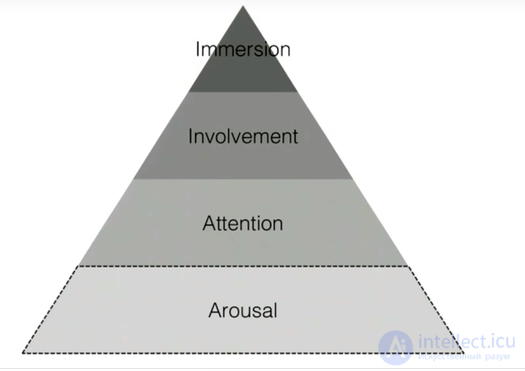
The player’s attention is an important part of game design that isn’t discussed all that often. The terms «attention», «involvement», and «immersion» are frequently used as synonyms, even though they denote different levels of engagement with the gameplay.
These three concepts are interconnected, but they describe different stages of interaction with a game. «Attention» means concentration on specific gameplay elements. «Involvement» is a state in which the player is interested and engaged by the game. And «immersion» sets in when the player becomes so absorbed in the virtual world that they temporarily forget about reality — this state is also called flow.
Cognitive psychology has long studied the mechanisms of attention, and its principles are actively applied in game design to make the gaming experience more captivating and comfortable.
Two types of attention
Attention can be divided into two types. Reflexive attention is an automatic reaction to sudden changes in the surrounding environment, such as explosions, loud sounds, or flashing lights. Its distinctive feature is that it is controlled subconsciously and does not require conscious control. If a light flashes or a loud sound rings out in the right place, the player will inevitably pay attention to it, even if they didn’t intend to.
This mechanism is universal and works not only in games but also in film or real life. However, it isn’t capable of holding the player’s attention for long. This is especially noticeable in certain parts of Call of Duty, where after a spectacular cutscene a series of monotonous firefights begins, and the initial excitement quickly gives way to fatigue.
To reinforce fleeting reflexive reactions with something deeper, voluntary attention is required. Many games are built on interactivity — the freedom to choose actions and routes. However, game designers usually want to steer the player in the right direction.
Voluntarily drawing attention to a specific object is a difficult task. Richard Lemarchand identifies three key elements that hold attention: aesthetics, system, and narrative.
This classification is universal and applicable not only to games but also to other kinds of media. Lemarchand emphasizes that this approach makes it possible to assess how effectively any work of art handles retaining attention.
Richard Lemarchand, former lead game designer at Naughty Dog:
This approach helps eliminate subjectivity when evaluating different media and allows for an objective discussion of what really works and what doesn’t. Whether we’re talking about games, film, sports, or even a drunk friend who has collapsed at a party, our judgments become clearer and more practical. In addition, this perspective makes it easier to compare different forms of media, helping to identify their similarities and differences.
Video games find themselves in an advantageous position, since they can simultaneously use all the elements that attract human attention. However, this isn’t always beneficial. When a game holds the player at the screen excessively, involvement can turn into addiction. This is especially relevant today, when many live-service games force game designers to aggressively draw players’ attention to their projects.
As a result, mechanics emerge that exploit players’ subconscious desires. Daily quests, leaderboards, login bonuses, surprise mechanics, and loot boxes are powerful motivators that can make a person spend an enormous amount of time playing. Although these game design elements are perfectly acceptable in themselves, their successful implementation must be backed by an interesting and rich gameplay experience.
One shouldn’t assume that video game developers are inherently more successful at attracting an audience than film directors. For example, Evan Skolnick, the writer of Concrete Genie and Dying Light, examines the differences between film and video game audiences in his book Video Game Storytelling. In his view, the key difference is that film viewers come prepared for the exposition in a movie to be measured and, perhaps, boring.
Evan Skolnick, writer of Concrete Genie and Dying Light:
Audiences of other story-driven media are willing to spend time getting to know the world and characters before the main conflict begins. Book readers and viewers of films and series usually perceive exposition as an integral part of the narrative, understanding that it helps create the right atmosphere.
Players, on the other hand, come to a game to play — they need the active part to begin within the first few minutes. The active phase usually means overcoming obstacles related to the conflict.
This is partly why many modern games avoid classic story exposition. For example, the latest Assassin’s Creed games open with a furious battle, and The Witcher 3, right after the intro cinematic, plunges the player into the main story conflict.
Tutorials and the forgetting curve
Since players expect engaging gameplay from the very start, the tutorial becomes one of the most important parts of a game. It must capture attention right away and offer an interesting experience that justifies the time spent playing. If the tutorial is engaging, the player will not only become interested but will also master new mechanics faster.
Celia Hodent, lead UX specialist at Epic Games, notes that when designing the tutorial in Fortnite, the studio focused on how the human brain works. New information first enters working — short-term — memory. However, after 20 minutes 40% of people forget it, and after a day — 70%. This process is called the «forgetting curve».
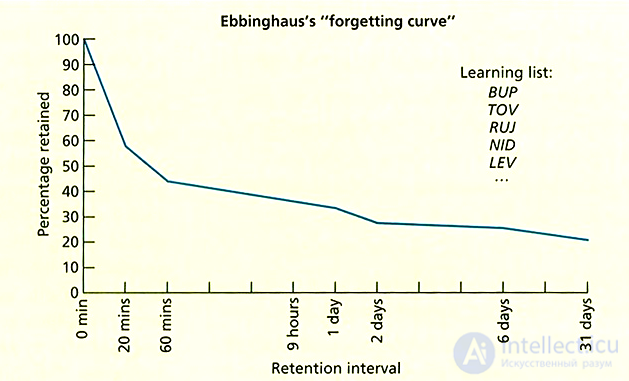
For information to be truly remembered, it must enter long-term memory. In games this process works more effectively when the player is actively involved in events. To achieve this, tutorial elements must be organically woven into the game context and carry meaning. Rather than immediately showing how to perform an action, it’s better to first explain why it matters to the player.
The 2016 Doom and Doom Eternal serve as examples of a successful approach. In the first game, the tutorial is very unobtrusive: the player puts on a suit, notices a partially empty health bar, and then in the next corridor is prompted to finish off a possessed enemy. When they do, health is restored — the player feels they’ve solved a problem.
In Doom Eternal the developers used a different approach: at the right moment the player is transported to a separate space where they learn new techniques. This method not only pulls the player out of context but also prevents them from grasping the real meaning and importance of the new mechanic.
In Fortnite, even before the Battle Royale mode appeared, there was a mechanic for gathering resources from destroyed objects. To speed up the process, players could strike special «weak points». However, during playtests it turned out that this mechanic went almost unnoticed. At first the developers thought the problem was with the tutorial and that the «weak points» were perceived poorly, so they changed their color and shape. But players continued to ignore it. In the end, Epic Games moved the mechanic into the skill tree and made it unlockable — thereby giving it importance.
Even if a player is captivated by a well-designed tutorial, they may still lose interest during play. When a person focuses on one thing, they begin to pay less attention to everything else. Multitasking, according to Celia Hodent, is largely a myth.
Celia Hodent, lead UX specialist at Epic Games:
If you don’t focus the player’s attention on some single element, they will probably just miss it. This is an example of a phenomenon called «inattentional blindness».
This is well illustrated by the «gorilla experiment», in which the test subject has to watch two teams with a ball and count the number of passes made by the players in white. Most subjects handle the task but fail to notice a person in a gorilla costume walking past them. Even though many people now recognize that multitasking is a myth, there are still games that overload the player with information during the tutorial.
For a tutorial to properly focus the player’s attention, it must account for the specifics of human skills. These skills can be divided into physical and linguistic, with the latter including any tasks involving the decoding of language.
Each of these categories heavily occupies attention. That’s why physical and linguistic skills shouldn’t be combined in a single game scene, unless such a combination is part of the mechanic’s design. However, this happens fairly often, for example when text prompts appear right in the middle of combat.
The player’s subconscious can take on part of the work of gathering and tracking information, which is called «vigilance». This helps the player maintain concentration and take in the game even in situations when too much information is coming in.
An example is Uncharted — a game in which, despite a relatively small number of mechanics, the player has to process a great deal of data during battles. While they are focused on shooting an opponent, their subconscious keeps track of ammo and equipment count, enemy positions, possible escape routes, and the direction of fire.
The subconscious’s help cannot continue indefinitely — this phenomenon is called «vigilance fatigue». After 15–20 minutes of intense action, the capacity for attention begins to deteriorate.
This is especially noticeable during fights with difficult bosses in games, particularly if the checkpoint is located right before them — as, for example, with Genichiro in Sekiro: Shadows Die Twice. With each attempt the player becomes more confident in the fight against the boss, learning its moves. But at some point something goes wrong: they start forgetting what they learned over the previous hours. Instead of dodging, they jump, or they try to parry when they should attack. To avoid situations like this, a game needs the right rhythm, or in other words — pacing.
Different game mechanics should replace one another gradually. This allows the player’s vigilance to recover and the game itself to become more varied — which directly affects attention. If players constantly receive the same experience, however high-quality it may be, over time their emotional response to it weakens.
Chelsea Howe, creative director at EA Mobile:
Unfortunately, even if we keep offering players emotional spikes, that doesn’t guarantee they will feel more and more emotions. We’ll simply raise their baseline level of emotional perception, as in adrenaline-fueled events, where the first experience is always unique and the most vivid.
A balanced tempo helps avoid the player’s fatigue and loss of concentration. An excellent example of this is Batman: Arkham City, where in the episode at the Penguin’s base different mechanics regularly replace one another.
After a long fight, Batman leisurely explores the location, then the player is introduced to a new mechanic for moving across thin ice. After that comes a stealth encounter with enemies. When it ends, the player is once again given the chance to rest and stroll across the ice before facing the mini-bosses. And just when the player has gotten used to the cyclical pattern, a shark suddenly attacks the hero.
You don’t always need to constantly introduce new tasks or tools for completing them. Sometimes it’s enough merely to hint to the player at something new — the anticipation of new mechanics also effectively holds their attention. Hints of upcoming changes can be delivered in various ways.
In the metroidvania genre, players are often shown interactive objects even before they understand how to interact with them. It’s also possible to present the player with a new ability or mechanic and then take it away, as is done in Prototype, where the hero is immediately introduced to almost all available abilities.
Richard Lemarchand, former lead game designer at Naughty Dog:
It used to be believed that the more boring an activity, the faster vigilance is lost. However, recent research has shown that this also holds true for engaging activities that require attention, such as video games.
Interestingly, switching to a less stressful activity restores vigilance in just a few minutes, especially if the new activity includes natural scenery. This partly explains why games like The Elder Scrolls V: Skyrim, or other RPGs where tense moments alternate with calm strolls, work so well.
It’s important to sustain the player’s attention, but a poorly executed «calm» episode can be more destructive to a game than constantly building tension. For example, after Doom Eternal’s release, many players noticed that the platforming sections didn’t suit the game. Although such calm segments can be part of well-designed pacing, in Eternal they turned out to be insufficiently engaging and didn’t mesh with the shooter’s overall atmosphere.
A good example of the proper use of alternation is the games from FromSoftware. Genichiro, who is located almost right at the checkpoint, is a rare case for this studio’s games. In their games you often have to walk a long way from the respawn point to the boss. This approach can annoy some players, but it, too, is part of the pacing that works in their favor. The walk before the fight relieves tension from the subconscious and vigilance, allowing the player to avoid mistakes such as fumbling the buttons during a battle.
Although video games are much younger than literature and film, game design developments have long been used to attract attention in other fields. Various gamification tools are actively applied in areas such as education, medicine, and even science.
Nevertheless, it’s important to remember that the attention a game attracts shouldn’t make the player spend too much time in front of the screen. Mechanics such as daily quests, leaderboards, or timers that limit access to new game elements can be dangerous. If too much focus is placed on these aspects, the player’s experience will become "forced" and won’t bring them any enjoyment.

Comments