
Lecture
Bullet trajectory, movement, and spread are a key component of shooting game mechanics. They shape the gameplay feel, affect balance, and define the visual style.
In virtual battles, where every second and every shot counts, the behavior of bullets and the nature of their spread play a key role in shaping balance, gameplay dynamics, and the overall user experience. While in the real world a bullet's trajectory obeys the laws of physics, in games developers have the freedom to model shots depending on the genre, style, and mechanics. This is precisely why in modern shooters you can observe a wide spectrum of spread patterns — from perfectly straight tracers to chaotic fan-shaped scatters. This article dives into the classification and analysis of various types of bullet movement patterns, examining not only their visual and physical characteristics but also their impact on strategy, balance, and the player's emotional perception.
To begin with, let's figure out what shooting mechanics in games are made of.
Player The subject who initiates the shot. They have a position in the game world (coordinates) and a viewing/camera direction.
Firing point The specific point from which the bullet appears or the trace begins (for example, the muzzle of the weapon).
In first-person shooters, the camera position is often used.
In realistic games — a point on the weapon model.
On-object aim A visual indicator (crosshair, dot) that shows the direction of fire.
It may coincide with the camera direction.
In some games, spread is taken into account, so the bullet does not fly strictly to the center of the crosshair.
Target An object in the game world that the player shoots at. The target has a hitbox (impact area), usually divided into zones (head, body, limbs).
Bullet The implementation of the shot:
Hitscan (instant hit): a ray is traced from the firing point in the direction of the crosshair. If the ray intersects the target's hitbox — a hit is registered.
Physical bullet: an object flying along a trajectory (accounting for velocity, gravity, air resistance). A hit is determined by the bullet colliding with the hitbox.
The player presses the fire button.
The firing point and direction are determined (usually coinciding with the camera/crosshair direction).
Depending on the mechanic:
Hitscan: a ray is launched, and its intersection with objects is checked.
Physical bullet: a bullet object is created and assigned a velocity and trajectory.
A hit on the target is checked (collision with the hitbox).
If there is a hit:
Damage is calculated (accounting for the hit zone, armor, distance).
An effect is displayed visually (animation, blood, sparks).
If it is a miss — the bullet either disappears (hitscan) or keeps flying (physical model).
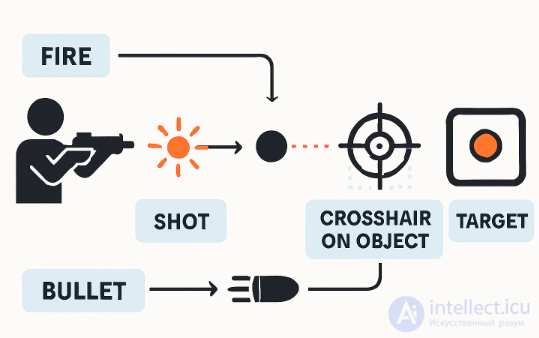
Let's look at the basic and extended templates:
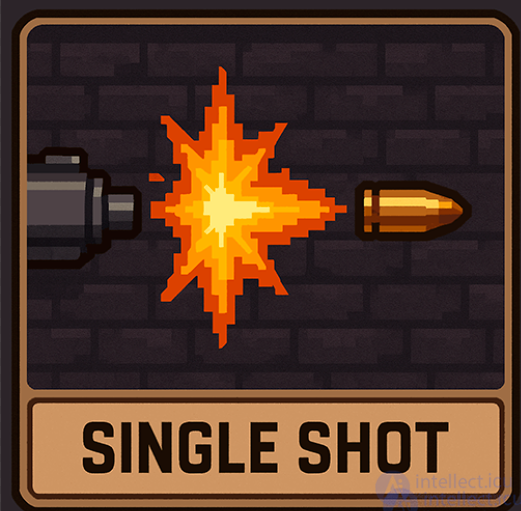
Description: Firing a single bullet in the chosen direction.
Application: The standard for sniper rifles and pistols.
Features: High accuracy, an emphasis on aiming.
The single shot is the most basic and accurate type of shooting, in which the weapon fires one bullet per button press. Each bullet flies along a strictly defined trajectory, determined by the direction of the muzzle at the moment of firing. In most cases, a straight-line hitscan trajectory or realistic ballistics for long-range shooting is used.
Used in:
Sniper rifles — where maximum accuracy matters.
Pistols — for mid-to-close-range combat with a high damage entry point.
Semi-automatic weapons — with a limited rate of fire.
Tactical simulators and hardcore shooters, where accuracy matters more than volume of fire.
Examples of weapons with single-shot fire:
| Game | Weapon |
|---|---|
| CS:GO | Desert Eagle, AWP |
| Escape from Tarkov | M700, SR-25 |
| Battlefield | M1911, Kar98k |
| Halo | Magnum (in the classic installments) |
| Call of Duty | Numerous bolt-action rifles |
| Feature | Comment |
|---|---|
| High accuracy | The bullet flies exactly where the crosshair points. |
| Emphasis on marksmanship | The player is required to have precise timing and knowledge of vulnerable zones. |
| Low rate of fire | Shooting is limited by the player's reaction speed or the delay between shots. |
| High damage | As a rule, a single shot can kill with a headshot/body shot. |
| Low forgiveness | A miss means losing the opportunity, especially in PvP. |
The single shot is used:
In games oriented toward precise shooting and realism.
When control over the rhythm of combat is needed.
In mechanics that reward high skill and caution.
To create weapons with psychological pressure — loud, powerful, rare-sounding.
One bullet = one raycast or projectile spawn.
No spread or minimal spread (depends on movement, stance).
Often a "button press" without automatic repetition is used.
Damage may scale with the hit zone (headshot modifiers).
Advantages:
Ideal for precise players.
Simple to implement and understand.
Delivers a strong payoff from a single hit.
Disadvantages:
Requires time to learn how to aim.
The slightest delay = a miss.
Often loses to high-rate-of-fire weapons in close-quarters combat.
Bolt-Action — the bolt must be cycled between shots.
Semi-Auto Single — fast manual pressing, without automatic fire.
Charge Shot — before firing, the bullet "charges up," growing stronger as the button is held.
Point AoE — a single shot with a small splash effect (for example, an energy pulse).
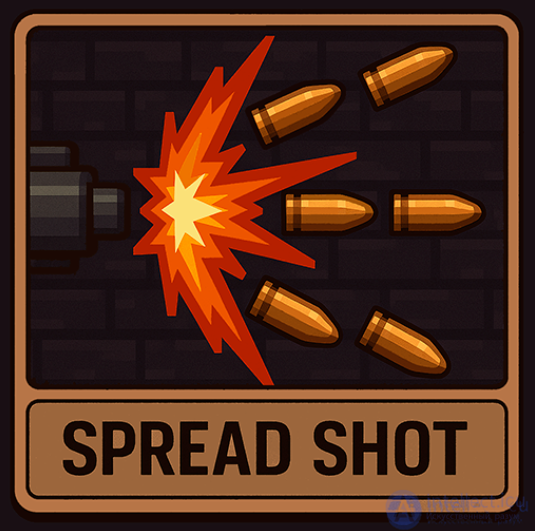
Description: Several bullets scatter within an angle (a cone).
Application: Shotguns, some abilities in shooters.
Features: A chance to hit several enemies or to compensate for imprecise shooting.
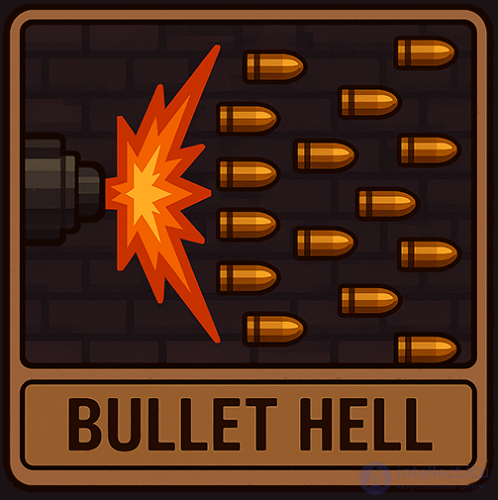
Description: A huge number of bullets with a variety of trajectories.
Application: Touhou-style games, Enter the Gungeon.
Features: Creates an effect of «visual chaos,» requiring dexterity and memorization of patterns.
Bullet Hell, also known as Danmaku (Japanese for «barrage of bullets»), is a shooting pattern in which a huge number of bullets appear on the screen, flying along varied, often complex trajectories. The player's main task is to dodge, not simply to shoot. This is not about realism, but about a visual challenge and concentration.
Most often used in:
Shmups (Shoot ‘em Up): vertical and horizontal scrollers.
Top-down arcade action games.
Boss fights in action RPGs or platformers.
Well-known games:
| Game | Pattern description |
|---|---|
| Touhou Project | A classic of the genre, complex spirals |
| Enter the Gungeon | A roguelike with danmaku combat |
| Cuphead | Bosses with complex bullet patterns |
| Furi | Arena duels with bullet hell techniques |
| Undertale | Duels with wave-dodging elements |
Mass bullet spawns (hundreds and thousands at once).
Geometric patterns: circles, waves, spirals, grids.
Slow bullets (as a contrast to their quantity).
A microscopic player hitbox.
Memorable and predictable boss patterns.
| Feature | Effect |
|---|---|
| Visual chaos | The player must learn to «see» a path through the bullets. |
| Memorization | Often requires memorizing patterns and rhythm. |
| Flow state | The player enters «the zone,» focusing solely on dodging. |
| Clear visual cues | Each wave must be readable and recognizable. |
| Minimal damage per touch | Sometimes 1 touch — 1 HP or even death. |
BulletSpawner — an object that creates bullets according to predefined patterns.
BulletPatternData — data (vector, spiral, sector, wave, etc.).
FPS optimization — important because of the huge number of objects.
Object pooling is often used.
Visual effects are split into bullets, effects, and masks.
| Name | Description |
|---|---|
| Spiral | Bullets unwind in a circle from the center. |
| Waves | Bullets move in a sinusoidal rhythm. |
| Ring burst | Bullets scatter evenly around a circle. |
| Checkerboard | Bullets appear as a grid, covering an area. |
| Tracking bullets | Slowly turn to follow the player. |
| Splitting bullets | After a certain time, each bullet splits into two. |
Often stylized after arcade games or anime.
Bright, colorful bullets for visually distinguishing patterns.
In the background — static scenes, so as not to interfere with perception.
Creates intensity and tension without requiring high aggression from the enemy.
Forms a unique game style — the player evades rather than attacks.
Allows visual and mathematical patterns to be used as gameplay.
Perfect for boss fights and memorable scenes.
Bullet Hell is not about damage, but about dodging and survival. When implemented correctly, the player feels flow, challenge, and style, rather than frustration. Successfully clearing the waves becomes a visually beautiful «dance» between death and dexterity.
Description: Bullets are evenly distributed along an arc.
Difference from ordinary spread: Strictly symmetrical placement, often visually pleasing and predictable.
Example: Spells in fantasy games, boss fights.
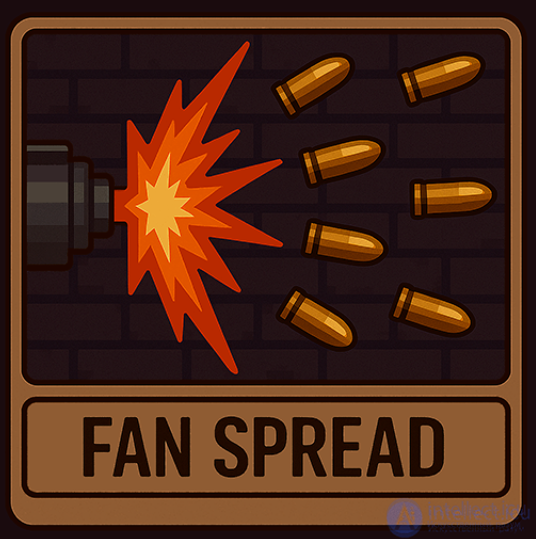
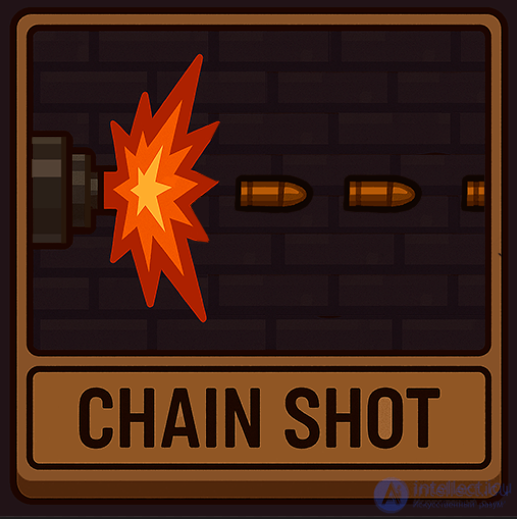
Description: Bullets move in a «snake» shape or follow one another in a chain.
Application: Magical or energy attacks.
The trick: Used to create a sense of magic or unconventional physics.
Chain shots are a pattern in which bullets or projectiles move along a winding, «living» trajectory, imitating a snake, lightning, or a wave oscillation. Such bullets can:
Wiggle through the air.
Follow one another with a delay, forming a chain.
Jump from target to target (chain lightning).
React to the movement of the player or enemies.
This pattern is often used in games with magic, pseudo-scientific weapons, or anomalies, where what matters is not realism but stylization and visual variety.
Most often found in:
| Game | Implementation example |
|---|---|
| Spellbreak | Magic spells with wave-like trajectories |
| Borderlands | Weapons with chain lightning / "snake" projectiles |
| Risk of Rain 2 | Chain lightning, Wisp fireballs |
| Dark Souls / Elden Ring | Magic with curved projectile paths |
| Hades | The gods' boons, especially Zeus's or Poseidon's |
| Feature | Comment |
|---|---|
| Unpredictability | Bullets do not move in a straight line, making them harder to predict or dodge. |
| Semi-automatic homing | Often adjust their course toward the nearest target. |
| Flexible physics | Waves, currents, or organic movement are simulated. |
| Magical feel | Perfectly conveys the effect of spells, curses, and anomalies. |
Each bullet moves along a sine wave, modified along the direction vector.
position += forward + sin(time * frequency) * amplitude * sideVector
The first projectile flies straight.
The rest follow it, as if along a trail, with a delay (or via bezier curves).
On hitting an enemy — the next nearby target is automatically selected.
A visual lightning effect is triggered between them.
The trajectory is defined in advance as a curved line (spline).
The bullet moves along it, without player input.
Lightning, ribbons, snakes, plasma — the main visual images.
Often accompanied by particles, trails, sparks.
Dynamic animation — so that the projectile "lives" in the air.
| Pros | Cons |
|---|---|
| A distinctly pronounced visual style | May interfere with accuracy in PvP |
| Conveys magic or technology well | Harder to implement and balance |
| Can be used as an AoE or CC tool | Optimization load with chain effects |
Orbit: bullets circle around the main bullet (like satellites).
Dancing bullet: the trajectory changes in real time depending on the surroundings.
Chain across enemies: damage passes from one enemy to another.
Pursuing snake: the bullet follows the player/enemy like a living creature.
The bullet in this pattern is not just a projectile, but a living character that dances, curves, and seeks a target. It adds a sense of magic, future technology, or otherworldly forces.
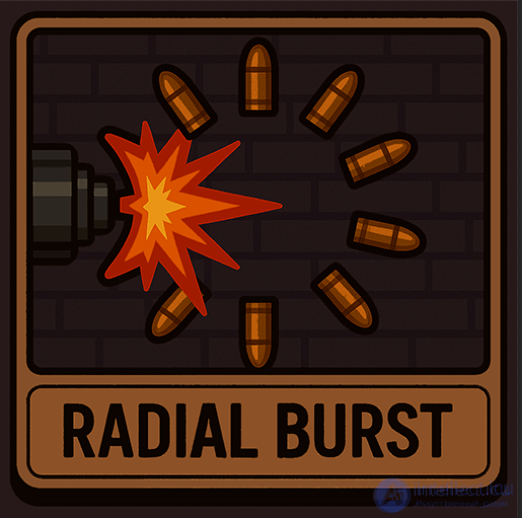
Description: Bullets emerge evenly from the center in a circle.
Used in: Boss attacks, traps.
Effect: Covers the space through 360°, requiring maneuverability from the player.
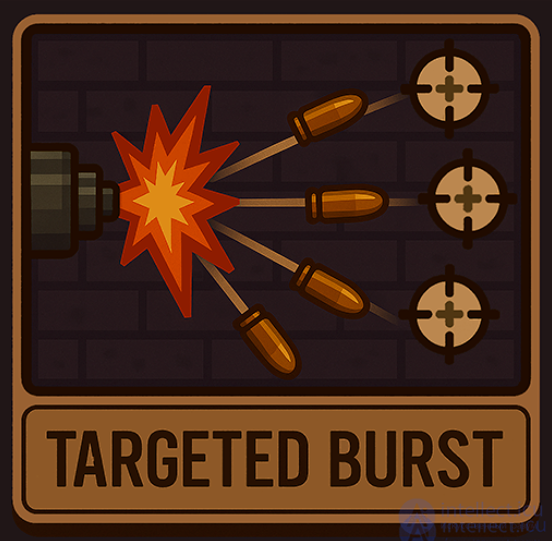
Description: Each bullet is directed at a specific target (a target designator), or the bullets slightly correct their trajectory toward the enemy (especially in console games).
Suitable for: Auto-homing turrets, complex AI opponents.
Interesting: Can be combined with predictive aiming (target leading).
Example games: Halo, Destiny (partially)
Pros:
Simplifies aiming with a gamepad.
Increases the satisfaction of landing hits.
Cons:
Reduces the hardcore factor.
Less fairness in PvP.
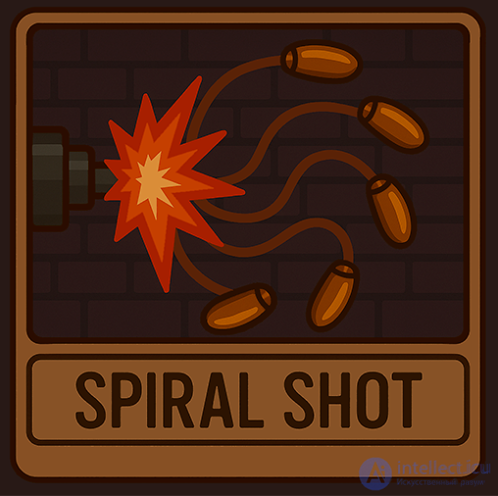
Description: Bullets form a spiral trajectory.
Application: For an effect of escalating difficulty or style.
Variants: A static spiral or one that rotates over time.
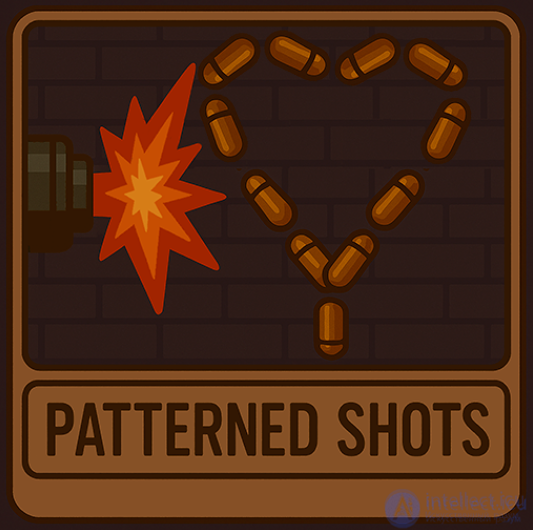
Description: Creating figures: hearts, crosses, waves, letters. Bullets deviate according to a predefined pattern that can be learned and compensated for manually.
Application: Visual accents, a stylistic signature of a boss/level.
Role: Aesthetics and recognizability.
Example games: CS:GO, Valorant
Pros:
Rewards study and practice.
Makes each weapon unique.
Cons:
A high barrier to entry.
Less dynamic during the first playthroughs.
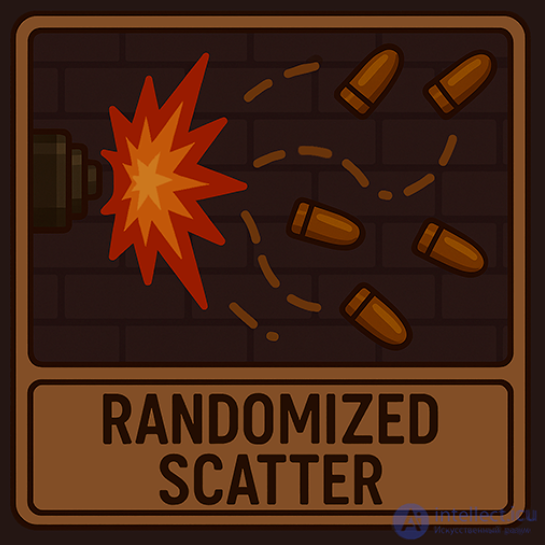
Description: Each bullet is given a random trajectory within constraints.
Usage: To imitate poor weapon control or instability.
Balance: Often used in combination with short range or high damage.
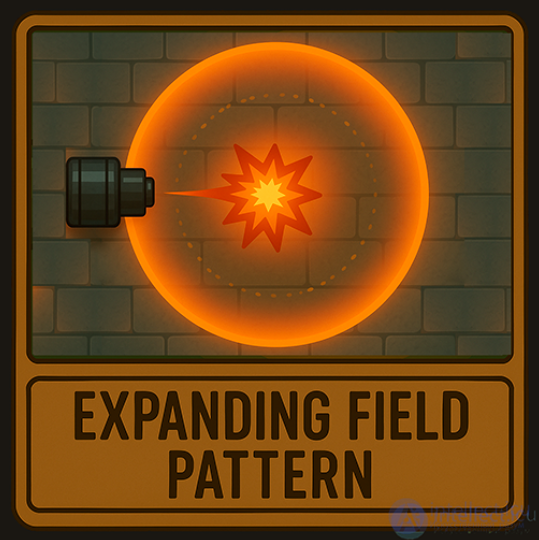
A pattern for an expanding continuous medium — a dense wave of bullets, evenly filling more and more space. Ideal for creating a sense of total onslaught, as if the environment itself becomes a weapon.
Bullet spread pattern: The expanding continuous medium is a type of shooting in which the shot is not perceived as separate bullets or projectiles, but as a continuous or semi-continuous front of impact, gradually expanding through space. This pattern is characteristic of weapons that imitate a wave, an impulse, or an energetic expansion of a medium, often — with an effect of push, pressure, or mass destruction.
Damage type: Wave-based, volumetric, planar.
Mechanic: A medium (energy, plasma, sound, fire, pressure, etc.) spreads in all directions or in a direction away from the weapon, increasing its radius of effect over time.
Trajectory: There is no clear trajectory — the impact fills the space.
Initially — a narrow front or a point.
Milliseconds later — a sphere, ring, or cone expanding from the center.
May pass through obstacles or push enemies away.
Sometimes leaves a residual effect (burn, freeze, slow).
| Example | Effect type |
|---|---|
| Half-Life 2 — Gravity Gun (alt-fire) | Pushing wave |
| DOOM (2016) — glory kill wave or BFG | Plasma expansion |
| Overwatch — Lúcio (sound knockback) | Shock wave |
| Destiny — energy pulse of the Warlocks | Magical expansion |
| Crysis — suit energy on ground impact | Shockwave |
| Any fireballs in an RPG | Expanding fire |
Crowd Control: knocking enemies back or creating impact zones.
Destroying cover: everything in the area of effect gradually takes damage.
Suppression: players are forced to leave the expansion zone.
The hitbox/volume grows with each frame.
The wave's lifetime is limited.
Can use a collision sphere, raycast in a radial pattern, or shader effects for visualization.
Cone-shaped expansion — only forward.
Spherical — in all directions from the point of explosion/shot.
Cylindrical — an effect across a surface (a wall of fire).
Pulsation — several expanding fronts in a row.
Picture how ripples spread across water from a thrown stone. The bullet in this pattern is not a point, but the initial cause of a wave that engulfs more and more space.
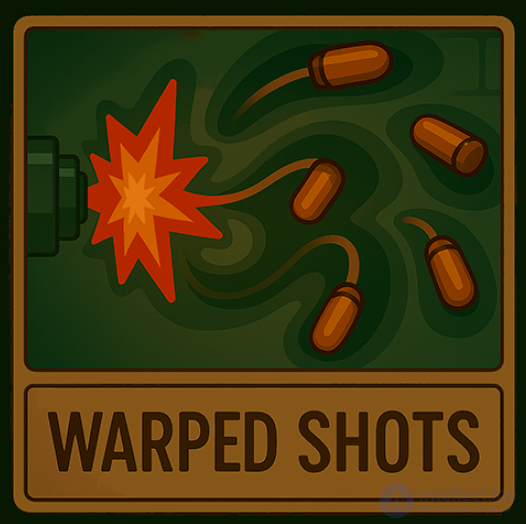
The «space distortion» bullet spread pattern is a non-standard, stylized, or fantastical approach to modeling shot trajectories, in which bullets (or energy projectiles) move along curved, non-straight trajectories, as if space around the weapon or target is being warped. Such a pattern is usually used in science fiction, magical games, or stylized shooters.
This is a type of pattern in which:
Bullets can bend in the air.
The trajectory deviates under the influence of "gravitational waves," "magnetic fields," "magic," and so on.
Gravitational lensing or wormholes may be imitated.
Unpredictability: The trajectory does not always follow a straight line from muzzle to target.
Controllability: Sometimes the player can control the projectile's curve (for example, by directing it with their gaze or by holding a button).
Visual effects: Effects of warping, blur, trails, and "waves" in the air are used.
| Mechanic | Implementation example |
|---|---|
| Automatic curving | Bullets bend on their own, going around obstacles or following enemies (for example, like «smart» rockets). |
| Semi-manual homing | The player can adjust the projectile's flight direction after firing (for example, with a mouse or joystick). |
| Physical space distortion | There are zones in the location where space is warped and all projectiles travel along an arc. |
| Spells or psi-weapons | Magical waves are used that make shooting strange and unstable. |
Examples of games with such mechanics
Control — the game features weapons and abilities that distort space.
Superhot (partially) — non-standard behavior of bullets and time.
Outriders and Destiny — energy bullets with twisted trajectories.
Dishonored (magic and bullets under the influence of supernatural effects).
Spellbreak — magic in the form of "projectiles" that change trajectories.
Creates unique visual and gameplay sensations.
Adds a sense of the fantastical or surreal.
Expands the ways weapons can be used (for example, shooting around corners).
Makes combat more varied and "cinematic."
Bezier or spline curves instead of straight vectors.
Physics with gravity modifiers.
Homing scripts with a delay.
Warp shaders for the visual distortion of space.
In game development, a «bullet» is not only a visual object, but also a logical entity with a set of characteristics. The main types of bullets can be divided into:
Straight-line bullets: move along a fixed trajectory without deviations.
Ballistic bullets: account for gravity and air resistance; the trajectory is an arc.
Homing bullets: correct their course toward the target.
Smart bullets: use algorithms to predict the opponent's movement.
Effect bullets: create visual or sound effects, but may deal no damage.
The bullet instantly "reaches" the target, without having a physical trajectory. The algorithm simply checks for a hit along the weapon's line of sight.
Example games: Counter-Strike, Call of Duty (partially)
Pros:
Simple implementation.
A clear sense of responsiveness.
Well suited for fast-paced battles.
Cons:
Lack of realism.
Less room for maneuvering and leading targets.
Description:
The bullet is treated as a physical object moving along an arc, accounting for gravity, velocity, air resistance, and so on.
Example games: PUBG, Battlefield, Escape from Tarkov
Pros:
High realism.
Requires leading targets and accounting for distance.
Cons:
Harder to land hits.
Requires optimization.
The direction of each bullet deviates by a random angle from the aiming direction within a cone.
Example games: CS:GO (when firing "from the hip")
Pros:
Balances automatic weapons.
Effective for close-quarters combat.
Cons:
Reduces the skill factor.
Hard to control the outcome.
Homing Missile — a classic example of self-guided weaponry.
Homing on the target: the missile corrects its trajectory using pursuit algorithms (for example, «pursuit» or «proportional navigation»).
Speed and inertia: usually slower than ordinary bullets, but this is compensated for by accuracy.
Blast area: often has an explosion radius, which makes it effective against groups of enemies.
Game balance: high accuracy requires limitations — rarity, high cost, or a long reload.
In shooters — for fighting fast or maneuverable opponents.
In strategy games — as a long-range weapon with a guaranteed hit.
SoftAimBullet — a more «intelligent» type of bullet that is not fully self-guided but uses soft trajectory correction.
Soft correction: the bullet slightly changes its course to increase the chance of a hit, but does not guarantee it.
Movement prediction: takes into account the target's speed and direction.
Game balance: preserves the feeling of a «fair» hit, without turning the weapon into an absolute one.
Application in PvP: helps newcomers, reducing the frustration of missing, while still leaving room for mastery.
In mobile games — to simplify shooting on touchscreens.
In competitive games — as a compromise between «auto-aim» and full player freedom.
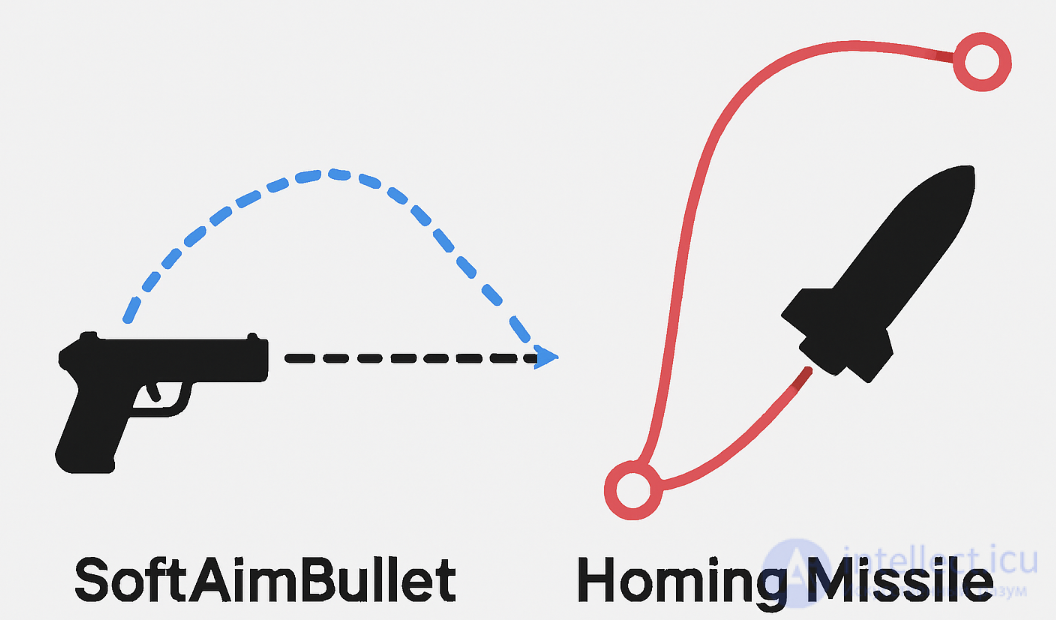
Comparison of Homing Missile and SoftAimBullet
| Characteristic | Homing Missile | SoftAimBullet |
|---|---|---|
| Homing type | Full self-homing | Soft correction |
| Speed | Medium/low | High |
| Accuracy | Almost 100% | 60–80% |
| Balance | Limited use | Support for newcomers |
| Effect | Explosion, blast area | Individual hit |
Homing Missile — a powerful self-guided weapon, ideal for fighting maneuverable targets.
SoftAimBullet — a flexible tool that increases the chance of a hit while preserving the element of mastery.
Both types of bullets help diversify the gameplay and balance difficulty for different categories of players.
Horizontal
Left to right / Right to left
Often used in platformers and side-scrollers.
Features: easily read by the player, especially if the bullets move at a constant speed.
Top-Down Shot
An imitation of a "rain of bullets" or an artillery bombardment.
Application: Bullet hell, attacks from the sky, traps.
Rising Shot (bottom to top)
A less familiar pattern. It can surprise the player.
Often used: as an enemy counterattack from below or from underground traps.
Diagonal shots
Require finer positioning from the player.
Variations: Toward the player or away from them.
Circular/Radial
Effective in the context of bosses or turrets.
Movement along an arc, spiral, or rotating circle.
Homing/Tracking shots
Bullets correct their trajectory toward the target.
An increased threat when combined with other patterns.
From an enemy / weapon (From Source Emitter)
The classic case: an enemy «fires» from their hands, maw, a turret, etc.
Suitable for: realistic and readable scenarios.
Out of "nothing" (Spawn Out of Thin Air)
Bullets appear instantly in the air.
Example: traps, magic, bullet teleportation.
The trick: it can subvert the player's expectations.
Inside the target (From Inside Target)
The bullet originates right inside the body of the opponent or player.
Used for explosions, space distortion, simulating corruption.
From the edges of the screen (Off-Screen Entry)
The bullet appears from the borders and flies toward the player.
Adds an element of surprise, often in final levels.
By trajectory of appearance (Teleporting Bullets)
The bullet disappears and reappears at a new point.
Can create the effect of a phase weapon or a glitch.
From environmental objects
For example, a bullet is «born» from a lamp, a chest, a wall.
Allows the inclusion of elements of interactivity and surprises.
The choice of spread pattern and trajectory type affects many aspects of a game: realism, dynamics, balance, and the perception of shooting. Developers often combine different approaches within a single project to create unique gameplay. Skillful use of patterns allows one not only to balance weapons but also to instill a sense of mastery and progress in players.

Comments