A narrative technique, also known as a literary technique, plays a key role not only in literature but also in the creation of video games — it is a specialized method used by an author to convey what the reader wants; it is a strategy employed in constructing a narrative to convey information to the reader and, in particular, to develop the narrative, usually in order to make it more complete, complex, or interesting. Literary techniques are distinct from literary elements.
A plot (French sujet, from Latin subiectum — «subject») in literature, drama, theater, film, comics, and games is a series of events (a sequence of scenes, acts) that occur within a work of fiction (on a theater stage) and are arranged for the reader (viewer, player) according to certain rules of presentation. The plot is the foundation of a work's form.
The concept of «narrative technique» is widely used in narrative theory (narratology) and is applied to denote the sum of the narrative techniques used by an author in writing literary works.
A narrative technique is a special kind of literary device that is used in storytelling. Some narrative techniques are widely used and can be found in most stories, while others are common strictly within particular genres. One of the most widely used narrative methods is the «inciting incident» — the moment in a story when everything changes for the protagonist, marking the point at which the central conflict comes into play.
A narrative technique, also known as a literary technique, plays a key role not only in literature but also in the creation of video games. In the gaming industry, narrative techniques are used to immerse the player in the world, manage emotions, unfold the plot, and form connections with characters. Games, as an interactive form of art, require adapting traditional methods to the specifics of gameplay and the player's interaction with the world.
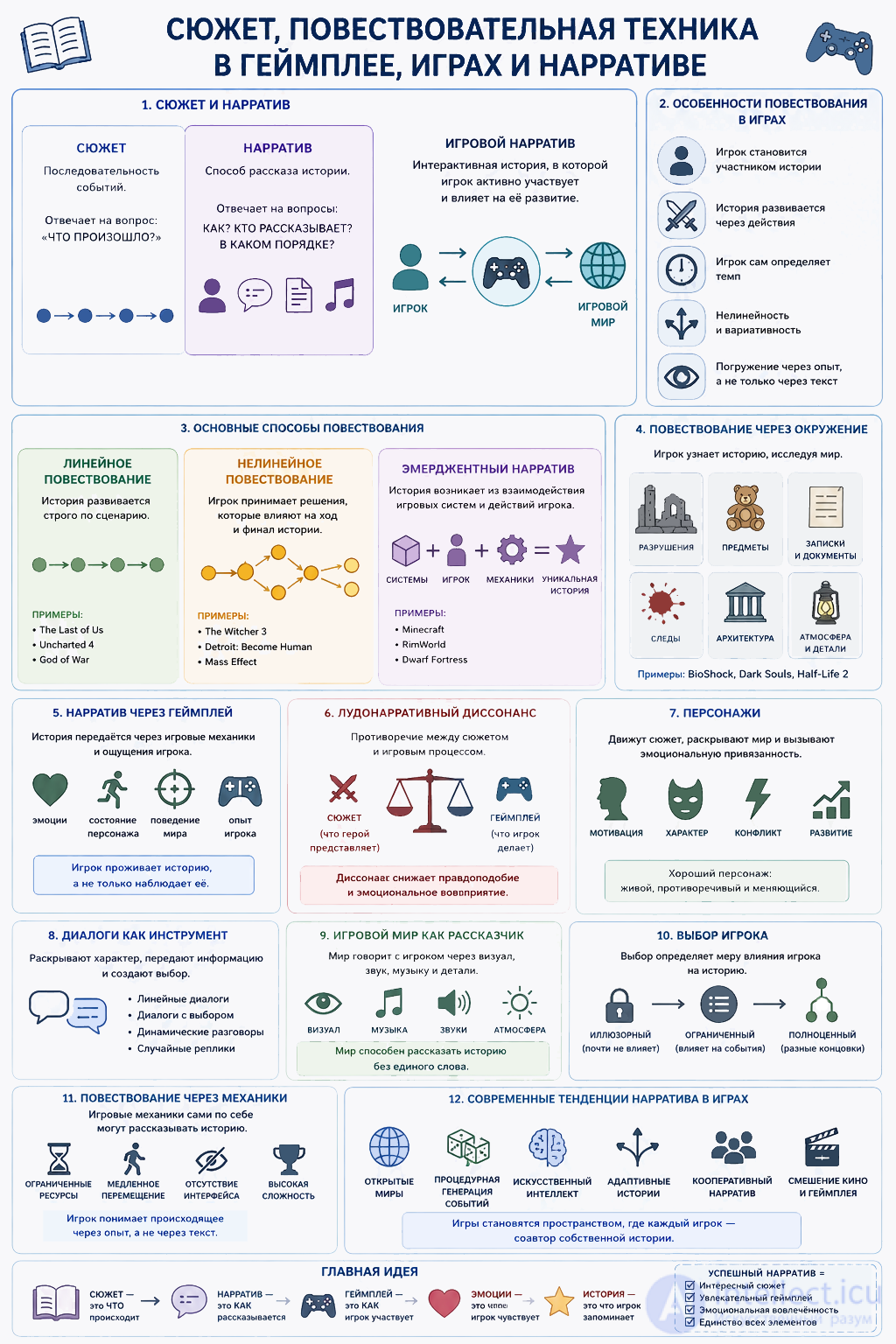
The role of narrative techniques in video games
Games combine two key aspects: gameplay (interaction mechanics) and narrative (the story and its delivery). Narrative techniques serve as a bridge between these elements, making the player's experience cohesive and meaningful. They help to:
-
Create a world and atmosphere: Through environmental details, dialogue, music, and visual elements.
-
Unfold the plot: Information can be delivered either linearly or non-linearly, depending on the genre and concept of the game.
-
Form an emotional connection with the characters: Using dialogue, player choices, and character development.
-
Manage choices and consequences: The player becomes not merely an observer, but an active participant in the story.
Below is a list of such narrative techniques.
Environment, setting
- Setting (English «Setting»; from English — «placement, installation, environment») — the environment in which the action takes place; the place, time, and conditions of the action. Setting can be considered in tabletop and computer games, in films, works of fiction, news, etc. By describing the setting, the user defines the properties of the reality modeled by a media product. Setting is both the time and the geographical location in a narrative. The literary element of «setting» establishes the primary background and mood of a story, often called the story world. In James Joyce's novel «Ulysses» (1922), the entire action takes place in a single city (Dublin) on a single day (June 16, 1904).
Plot
- Backstory — the history that precedes the events of the story being told — past events or a background that gives meaning to current circumstances. Although the action of the «The Lord of the Rings» trilogy takes place over a relatively short period, toward the end of the year 3021 of the Third Age, the narrative provides a sense of the mythological and historical events that occurred earlier in the Third Age preceding the action of the novel, as well as in the First and Second Ages.
- Cliffhanger — a narrative device used in constructing a storyline (mainly in film and television series), in which a character is faced with a difficult dilemma or the consequences of their own or others' actions, but at that moment the narrative breaks off, thus leaving the resolution open until a sequel appears. This device is often used by authors to increase the likelihood that viewers will be interested in the continuation, in the hope of finding out how the story ends. Every episode (except, of course, the last one) of American film serials of the 1930s—1950s ended with cliffhangers (for example, «Mysterious Doctor Satan», «The Purple Monster Strikes»); nowadays this device is frequently used in television series as well (for example, «Dexter», «Breaking Bad»).
- Unreliable narrator — a narrating character who reports knowingly inaccurate information. In doing so, the unspoken contract between the author and the reader is violated, according to which events are supposed to be described accurately. Such a narrator distorts the ending, revealing, almost always at the end of the narrative, that they manipulated or fabricated the preceding story, thereby causing the reader to doubt their previous assumptions about the text. Such a narrator is insincere or introduces bias into their narration and may possibly mislead the reader by concealing or downplaying events, characters, or motives. A striking example: Agatha Christie's detective novel «The Murder of Roger Ackroyd», which contains an unexpected plot twist at the end of the narrative; in the final chapter the protagonist, the physician James Sheppard, confesses what an unreliable narrator he had been. In cinema, this technique is often used in film noir.
- Frame story, or story within a story — a type of composition in a narrative work in which one or several plot units (novellas, fairy tales, fables, parables) are combined by being included in an independent plot or non-plot unit — a frame. A non-plot element of the narrative: a fragment of the text of a work of fiction that is not directly connected to the main narrative but is subordinate to the work's central idea. A main story that generates a linked series of shorter stories. Early examples: «Panchatantra», «Kalila wa Dimna», «One Thousand and One Nights», «The Decameron». A modern example: in Stephen King's novel «The Wind Through the Keyhole», the protagonist tells his companions a story from his past, and within it he tells another relatively unrelated story.
- Red herring — something that misleads or distracts from a relevant or important issue. A false clue intended to lead investigators toward an incorrect solution. A type of misdirection, a device intended to divert the protagonist and, consequently, the reader, from the correct answer or from the location of relevant clues or actions. Such a plot twist is most characteristic of the «detective» and «mystery» genres. For example, in detective fiction an innocent person may be deliberately portrayed as a highly suspicious character through appropriate emphasis or descriptive techniques, in order to divert attention from the true culprit.
- Ochi — a sudden interruption of the flow of wordplay that signals the ending of a rakugo or kobanashi (in the art of Japan).
- Predestination paradox — a time-travel paradox in which a traveler becomes caught in a loop of events that «predestine» their journey back in time. In the television series «Doctor Who», the protagonist is repeatedly forced to travel back in time because of something his future self did.
- Narrative hook — a literary device at the beginning of a story that «hooks» the reader's attention so that they keep reading. The «opening» may consist of several paragraphs for a short story or several pages for a novel, but ideally it should be the very first sentence in the book.
- Plot twist — an occurrence that changes the situation in a film or series from the perspective of the character and/or the viewer. A point in the screenplay where the story turns in some unexpected direction, and thus the author makes their work more unpredictable and therefore more interesting for the audience. An early example of a work with many plot twists was the tale «The Three Apples» from «One Thousand and One Nights». It begins with a fisherman discovering a locked chest. The first twist occurs when a corpse is found inside. The initial search for the murderer fails, and the next plot twist occurs when two men appear, each separately claiming to be the murderer.
- Poetic justice — a literary device in which, ultimately, virtue is rewarded and vice is punished. In modern literature this is often accompanied by an ironic twist of fate connected to the character's own actions. The cunning Coyote in every cartoon devises various ingenious contraptions to catch the Road Runner, but in the end all his plans fail, and often he ends up caught in his own traps. The punishment for each sin in Dante's «Inferno» is a symbolic example of poetic justice.
- Foreshadowing — a literary device in which the writer hints in advance at what will happen later. Foreshadowing often appears at the beginning of a story or chapter, and it helps the reader form expectations about upcoming events. It represents an implicit but deliberate effort by the author to suggest events that have not yet occurred in the course of the narrative. See also Chekhov's gun.
- Self-fulfilling prophecy — a prediction that indirectly influences reality in such a way that it ultimately turns out to be true. Early examples: the legend of Oedipus and the story of Krishna in the «Mahabharata». A modern example: in «Harry Potter», when Voldemort heard the prophecy (made by Sybill Trelawney to Dumbledore) that a boy born at the end of July, whose parents had defied Voldemort three times and survived, would be marked as his equal. Because of this prophecy, Voldemort sought out Harry Potter (believing him to be the boy referred to) and attempted to kill him. Harry's parents died protecting him, and when Voldemort tried to cast the killing curse on the boy, it rebounded and took away most of his power, while also giving Harry Potter a unique ability and connection with the Dark Lord, thereby marking him as his equal.
- The «ticking bomb» situation — the threat of an impending catastrophe, often used in thrillers where rescue and escape are important elements. In the post-apocalyptic novel «On the Beach», the main characters face rising radioactivity drifting across the equator toward Australia. The realization that the characters' agonizing death will, apparently, occur sooner than expected heightens the sense of intensity and urgency experienced by the characters and the reader.
- Flashback — a narrative device, primarily in cinema, involving a temporary interruption of the narrative sequence in order to show certain events in the past. The opposite of a flash-forward. The tale «The Three Apples» from «One Thousand and One Nights» begins with the discovery of a dead young woman in a chest. After the murderer reveals himself, he recounts the motives for the murder in the form of recollections of the events that led to her being found dead at the beginning of the story. Modern examples are the films «Marnie», «Once Upon a Time in the West», and the novel «The Odessa File».
- Flash-forward — a special case of prolepsis: a narrative technique consisting of a departure from reality and the narrative into the future. It often presents events that are expected, predicted, or imagined to happen in the future. They can also reveal important parts of the story that have not yet occurred but will soon be described in detail. The opposite of a flashback. A classic example: Charles Dickens's «A Christmas Carol» (the scene with the appearance of the Ghost of Christmas Yet to Come to Mr. Scrooge); a modern example: the final seasons of the television series «Lost».
- Chekhov's gun — a principle of dramaturgy according to which every element of a narrative must be necessary, and non-essential elements must be removed; a story should not contain elements that deceive the audience's expectations by never playing a role in subsequent events. «One must not put a loaded rifle on the stage if no one is thinking of firing it. One must not make promises» — a letter from A. P. Chekhov to the writer Alexander Lazarev (Gruzinsky) dated November 1, 1889. «If in the first act you have hung a pistol on the wall, then in the last it must go off. Otherwise — don't hang it» — Ilya Gurlyand, summer 1889.
- Eucatastrophe — a sudden turn of events in a story that ensures the protagonist does not meet some terrible, impending, and highly plausible and probable demise. The opposite of peripeteia. The device was coined by J. R. R. Tolkien. At the end of «The Lord of the Rings», Gollum forcibly takes the One Ring from Frodo, implying that Sauron will ultimately seize Middle-earth. However, Gollum celebrates his victory too zealously and clumsily falls into the lava, as a result of which the ring is destroyed, and with it Sauron's power vanishes. In a sense, Gollum does what Frodo and the Fellowship of the Ring intended to do throughout the plot of the trilogy, namely: to cast the ring into the fiery lake at the heart of Mount Doom.
- In medias res — a term from traditional poetics denoting the beginning of the action or narrative from a central episode of the plot (its inciting incident or even one of its turning points) without prefacing it with exposition and backstory, which are presented from the author's perspective or introduced through the monologues and dialogues of the characters. This device is actively used in «The Lusiads» by Luís de Camões (the narrative begins in the middle of a sea voyage to India and contextualizes the beginning of the aforementioned voyage; as well as the history of Portugal, when the ship's captain recounts it to an African king), and in Homer's «Iliad» and «Odyssey» (the story begins with Odysseus's return home to Ithaca, and then, in flashbacks, tells of his ten years of wandering after the Trojan War).
-
Plot device A plot device or plot mechanism is any device in a narrative used to move the plot forward.
A hackneyed plot device can annoy the reader, while a contrived or arbitrary device can confuse the reader, causing a loss of suspension of disbelief. However, a well-crafted plot device, or one that arises naturally from the setting or characters of the story, may be fully accepted or may even go unnoticed by the audience.
Perspective, point of view
- Breaking the fourth wall — the breaking of the imaginary wall between the characters and the audience. The author or character addresses the readers (viewers) directly, which may be an attempt to expand the story world in order to create the illusion that they are included in it. The characters of «Sesame Street» and «Dora the Explorer» often address their child viewers directly. This device is actively used by the creators of the series «House of Cards», so that viewers can understand what its protagonist, Frank Underwood, is thinking and planning. The protagonist of the film «Ferris Bueller's Day Off» regularly addresses the viewers, explaining his thoughts and actions.
- Magical realism — an artistic method in which magical (mystical) elements are incorporated into a realistic picture of the world. A depiction of events in the real world, but with magical attributes, often incorporating local customs and invented beliefs. It differs from urban fantasy in that the magic itself is not at the center of the plot. Such renowned writers as Gabriel García Márquez, Jorge Luis Borges, and Salman Rushdie have often used «magical realism» in their works.
- Multiperspectivity — a narrative in which the audience is presented with more than one point of view. The story is told from the perspectives of several characters, incorporating the various emotions and views of the characters regarding different events or circumstances that may not be felt by other characters in the story. The film director Robert Altman successfully used this device in many of his films. Notable literary examples: Roberto Bolaño's novel «2666»; Vladimir Nabokov's anti-novel «Pale Fire».
- Defamiliarization — a device aimed at drawing the reader «out of the automatism of perception». For example, the author takes an everyday object and presents it in a strangely unfamiliar way, so that the audience sees the object anew. The term was introduced by the Russian literary scholar Viktor Shklovsky in 1916. Example: in Jonathan Swift's «Gulliver's Travels», when Gulliver visits Brobdingnag and sees a giant woman's skin up close, he realizes that it (the skin) is by no means smooth and beautiful as it appears from a distance. Another common method of defamiliarization is «making strange» the story (the plot) by creating a distorted narrative.
- Stream of consciousness — a narrative device and type of narration in the literature of the 20th century, predominantly of the modernist trend, that directly reproduces the inner life of a character through the verbal registration of heterogeneous manifestations of the psyche (experiences, associations, memories, etc.), which are most often conveyed outside any logical and cause-and-effect connection — on the principle of auditory, visual, and other associations. The author uses narrative and stylistic devices to create the impression of an unedited inner monologue, characterized by leaps in syntax and punctuation that trace a character's fragmentary thoughts and sensory perceptions. It should not be confused with the concept of free writing. A striking example: James Joyce's novel «Ulysses» (for example, in one episode the protagonist strolls through the city, thinking: «Pineapple rock, lemon platt, butter scotch. A sugarsticky girl shovelling scoopfuls of creams for a christian brother… Some school treat. Bad for their tummies. Lozenge and comfit manufacturer to His Majesty the King. God. Save. Our. Sitting on his throne, sucking red jujubes white»).
- First-person narration — a mode of narration in which the story is told by a character, i.e., a narrator who is either a main or a secondary participant in the plot's action. Well-known examples: Huckleberry Finn tells the story in the first person in «The Adventures of Huckleberry Finn»; the secondary character Dr. Watson recounts, in his own voice, his shared adventures with Sherlock Holmes. This device is also actively used in the film «The Wolf of Wall Street»: the protagonist narrates events throughout the film, providing a clarity that could not be gained from the visuals and dialogue alone.
- Second-person narration — a mode of narration in which the story is told in the second person. Examples: «Sevastopol Sketches» by Leo Tolstoy, the novel «If on a winter's night a traveler» by Italo Calvino.
- Third-person narration — a mode of narration in which the story is told in the third person. Text written as if by an impersonal narrator who is unaffected by the events in the story. It may be «omniscient» or «limited». The vast majority of works are written in this way. Striking examples: the fantasy novel series «A Song of Ice and Fire» (several third-person narrators who change with each chapter); in the novel «The Master and Margarita» the narrator is «omniscient».
- Author surrogate, or author avatar — a character based on the author of a work, usually to support their personal views. Sometimes, whether intentionally or not, an idealized version of themselves. Such a character archetype is called a Mary Sue or Marty Stu. Plato rarely spoke «in his own voice» in his «dialogues», usually attributing all his words to his teacher Socrates. In his «Second Letter» he wrote: «There is no writing of Plato's, nor will there ever be; those that are now said to be his are those of a Socrates become fair and new».
- Audience surrogate — a character who voices the questions and confusion of the audience, one with whom readers (viewers) can identify. Often used in detective and science fiction, where an ordinary character asks the protagonist how they accomplished certain deeds, in order to prompt that hero to explain (for the curious audience) his (her) methods, or a character asks a relatively educated person to explain what constitutes the backstory. Striking examples: Dr. Watson in the works about Sherlock Holmes; Scott Evil in the Austin Powers film series. The Doctor's companions in Doctor Who, as a rule our contemporaries, are needed, among other things, so that the alien Doctor can explain to viewers his non-obvious actions, thoughts, and deductions. Jennifer Melfi from the television series «The Sopranos» also serves as an «audience surrogate».
-
Style
- Allegory — the artistic representation of ideas (concepts) through a specific artistic image or dialogue. The expression, by means of symbolic fictional figures and actions, of truths or generalizations about human conduct or experience. A striking example: «The Lion, the Witch and the Wardrobe» by Clive Staples Lewis is a religious allegory in which Aslan plays Christ and Edmund plays Judas.
- Alliteration — a device of sound organization consisting of the repetition of identical or similar consonants in the initial syllables of words. In the film «V for Vendetta», the protagonist delivers several monologues with intense use of alliteration; here is an example of one of them: «Voilà! In view, a humble vaudevillian veteran, cast vicariously as both victim and villain by the vicissitudes of Fate. This visage, no mere veneer of vanity, is a vestige of the vox populi, now vacant, vanished, as the once vital voice of the verisimilitude now venerates what they once vilified. However, this valorous visitation of a bygone vexation stands vivified, and has vowed to vanquish these venal and virulent vermin vanguarding vice and vouchsafing the violently vicious and voracious violation of volition. The only verdict is vengeance; a vendetta held as a votive, not in vain, for the value and veracity of such shall one day vindicate the vigilant and the virtuous. Verily, this vichyssoise of verbiage veers most verbose vis-à-vis an introduction, and so it is my very good honor to meet you and you may call me V.» Note how many times the letter v in general and the sound combination «vi» in particular are used here, especially considering the relatively low frequency of this letter in English words.
- Anagram — a literary device consisting of the rearrangement of the letters or sounds of a particular word (or phrase), which as a result yields another word or phrase.
- Bathos — a literary term for describing amusing failed attempts at the sublime (that is, at pathos). An abrupt shift in style from the sublime to the banal, producing a humorous effect. It can be either accidental or deliberate. Example: «The ballerina gracefully rose onto pointe and extended one slender leg behind her, like a dog at a fire hydrant».
- Asyndeton — a stylistic device; a construction of speech in which the conjunctions connecting a sentence are omitted. It lends the statement swiftness and dynamism, and helps convey a rapid succession of images, impressions, and actions. The opposite device is polysyndeton.
- Hyperbole — a stylistic figure of obvious and deliberate exaggeration for the purpose of enhancing expressiveness and emphasizing a stated idea. For example: «I've said this a thousand times» or «we have enough food to last half a year». The opposite device is litotes.
- Dramatic visualization — the representation of an object or character with abundant descriptive detail, or the mimetic rendering of gestures and dialogue, in order to make a scene more vivid or to present it graphically to the audience. This device has been known since the time of «One Thousand and One Nights».
- Leitwortstil (translated from German — «leading-word style») — the repetition of a phrasing, often with a theme, in a narrative to ensure that it captures the reader's attention. A device in which writers use a recurring phrase to emphasize important themes and concepts in a work. Example: the recurring phrase «So it goes» in Kurt Vonnegut's novel «Slaughterhouse-Five, or The Children's Crusade».
- Litotes — an understatement or deliberate softening of the properties, features, or significance of some objects or phenomena. The opposite device is hyperbole.
Your spitz — a lovely spitz, no bigger than a thimble!
I stroked it all over; its fur is like silk!
A. S. Griboyedov, «Woe from Wit»
- Metonymy — a type of trope, a phrase in which one word is replaced by another that denotes an object (phenomenon) standing in some (spatial, temporal, etc.) connection with the object denoted by the replaced word («the hall applauded» — cf. «the people in the hall applauded», «the kettle is boiling» — cf. «the water in the kettle is boiling»). The substituting word is thereby used in a figurative sense. It should not be confused with the device of synecdoche.
- Polysyndeton — a typified modification of structural syntactic units possessing an expressive meaning; it is a syntactic means of expressing expressiveness. A stylistic figure consisting of the deliberate increase in the number of conjunctions in a sentence. By slowing down speech with forced pauses or imparting to it a certain rhythm, expression, and expressiveness, polysyndeton emphasizes the role of each of the words, creating a unity of enumeration and reinforcing the coherence, logic, and emotionality of the text. A striking example — in the first chapter of Charles Dickens's «Great Expectations» one can find the following sentence: A man who had been soaked in water, and smothered in mud, and lamed by stones, and cut by flints, and stung by nettles, and torn by briars; who limped, and shivered, and glared and growled; and whose teeth chattered in his head as he seized me by the chin. The opposite device is asyndeton.
- Oxymoron — a figurative combination of mutually contradictory concepts; a witty juxtaposition of contradictory concepts, a paradox; a stylistic figure or stylistic error — a combination of words with opposite meanings (that is, the combination of the incompatible). Possessing brevity and expressiveness, oxymorons are often used as the titles of literary works, for example, «The Squire's Daughter», «The Living Corpse», «The Honest Thief».
- Onomatopoeia — sound imitation that arises on the basis of phonetic resemblance to non-speech sound complexes. Most often, onomatopoeic vocabulary is directly connected with creatures or objects that are sources of sound: for example, verbs such as «to croak», «to meow», «to crow», «to rattle», and the like.
- Paradox — an anomalous juxtaposition of incompatible ideas for the sake of a striking presentation or an unexpected insight. Example: «It was the best of times, it was the worst of times» (Charles Dickens, «A Tale of Two Cities», 1859).
- Parody — a type of comic stylization whose purpose is to ridicule the imitated object. A comic image of a work of art, a style, or a genre. A comic imitation of a work of art or a group of works. Mad is the most famous parodic-satirical magazine in the world.
- Pastiche — a secondary work of art that constitutes an imitation of the style of the works of one or several authors, a stylization, a particular case of eclecticism in art. Unlike parody, pastiche does not so much ridicule as celebrate the original. Examples: works about Sherlock Holmes not written by Arthur Conan Doyle; works about Cthulhu not written by Howard Lovecraft.
- Pathos — a device of appealing to the emotions of the audience. One of the three methods of persuasion in rhetoric, which the author uses to evoke pity or sorrow toward a character; it usually does not balance the target character's suffering with a positive outcome, as in tragedy. In «Romeo and Juliet», the two protagonists commit suicide at the sight of their supposedly dead beloved, yet the audience knows that these actions are rash and unnecessary. Thus, Shakespeare creates an emotional appeal for the needless tragedy that lies behind the young characters' rash interpretations of love and life.
- Polyptoton — a stylistic scheme in which words derived from the same root are repeated (for example, «beloved» and «love»; the Latin expression Vanitas vanitatum et omnia vanitas). A related stylistic device is antanaclasis, in which the same word is repeated, but each time with a new meaning.
- Satire — a sharp manifestation of the comic in art, constituting a poetic, degrading denunciation of phenomena by means of various comic devices: sarcasm, irony, hyperbole, grotesque, allegory, parody, and others. A classic example: «Gulliver's Travels»; modern examples: the film «Network», the animated series «South Park».
- Amplification — a literary device by which the author embellishes a sentence, adding more information to it in order to increase its value and comprehension. For example, the plain sentence «The thesis was difficult» after applying this device may turn into the following: «The thesis was difficult: it required extensive research, data collection, selective conversations, interviews, and laborious fieldwork».
- Artistic imagery — a category of artistic creation, a form of interpreting and mastering the world from the standpoint of a certain ideal, through the creation of aesthetically affecting objects. The formation of mental images of a scene using descriptive words, especially through the use of the senses. Example: «When the leather-creaking boots slipped from his feet, the small tent was immediately filled with the smell of sourdough and a fish market. The skin on his toes was red, coarsened, and tender. The fetid air was so poisonous that it seemed to him he could almost taste his own toes.»
- Caesura — a pause, especially a sense pause, usually closer to the middle of a line of verse. This device is often found in a poetic line grammatically connected to the end of the preceding line by means of enjambment.
- Euphuism — characterized by an exquisitely ornate diction and consisting of a large number of rhetorical figures and figurative expressions. An artificial, highly elaborate manner of writing or speaking. The technique is named after John Lyly's novel Euphues (1578), which abounds in such phrases, for example, «Is it not far better to abhor sins by the remembrance of others' faults, than by repenting of our own follies?»
- Distancing effect — a device that deliberately prevents the audience from identifying with the characters, in order to allow them to be examined dispassionately. The term was popularized in the 20th century by the renowned German playwright Bertolt Brecht.
Theme (narrative)
- Irony — a satirical device in which the true meaning is concealed or contradicts (is opposed to) the apparent meaning; a type of trope: a sly allegory expressing mockery, when in the context of speech words are used in a sense opposite to their literal meaning. The discrepancy between expectations and reality manifests itself in three forms: situational irony, when a situation is characterized by a discrepancy between what is expected and what actually happens; dramatic irony, when a character is unaware of key information already revealed to the audience (the discrepancy here lies in the different levels of awareness between the character and the audience); and verbal irony, when a person states one thing while meaning another. The difference between verbal irony and sarcasm is quite insignificant and is often disputed. Unfortunate circumstances and coincidences are not irony (but neither do they qualify as tragic).
- Metaphor — a word or expression used in a figurative sense, based on a comparison of an object or phenomenon with some other one on the grounds of a common feature. For example, «Tears flowed in a river down her cheeks».
- Thematic patterning — the insertion of a recurring motif into a narrative. The distribution of recurring thematic concepts and moralistic motifs among the various incidents and frames of a story. In a skillfully constructed narrative, thematic patterning can emphasize a unifying argument or important idea that disparate events and frames have in common. For example, John Steinbeck's novella «Of Mice and Men» contains several scenes devoted to loneliness.
Character
- Anthropomorphism — the transfer of the human image and its properties onto inanimate objects and animals, plants, natural phenomena, supernatural beings, abstract concepts, etc. Striking examples: Pinocchio, the Cheshire Cat.
- Hamartia — a historical concept, the tragic flaw in the character of the protagonist of a tragedy, or his fatal mistake, which becomes a source of moral torment and greatly heightens in him the awareness of his own guilt, even if this guilt, by modern notions, is absent. A flaw in the character of an initially rich and powerful hero that leads to his tragic downfall. For example, in «Oedipus Rex» the protagonist kills his father and takes his mother as his wife, having no idea who they are to him.
- Pathetic fallacy — a literary term denoting the attribution of human emotions and behavior to things and objects found in nature that have nothing in common with humans. It is a kind of personification that is found in poetic descriptions, when, for example, clouds seem sullen, leaves dance, or when stones seem indifferent. It reflects the mood of a character (usually the protagonist) in the atmosphere or in inanimate objects. The concept is related to anthropomorphism and projection. Example: the description of the storm in «King Lear», which reflects the mental deterioration of the protagonist.
- Personification — the representation of natural phenomena and forces, objects, and abstract concepts in the guise of acting figures, including humans, or the recognition in them of human properties; the attribution of the properties of the human psyche to objects and phenomena of the real or imagined world: animals, plants, and natural phenomena. For example, in «Romeo and Juliet» there are the lines:
When well-appareled April on the heel
Of limping winter treads.
The role of narrative techniques in video games
Games combine two key aspects: gameplay (interaction mechanics) and narrative (the story and its delivery). Narrative techniques serve as a bridge between these elements, making the player's experience cohesive and meaningful. They help to:
-
Create a world and atmosphere: Through environmental details, dialogue, music, and visual elements.
-
Unfold the plot: Information can be delivered either linearly or non-linearly, depending on the genre and concept of the game.
-
Form an emotional connection with the characters: Using dialogue, player choices, and character development.
-
Manage choices and consequences: The player becomes not merely an observer, but an active participant in the story.
Examples of narrative techniques in games
1. Point of view
Games often use various points of view to engage the player:
-
First-person: The player sees the world through the hero's eyes (for example, Half-Life), which heightens immersion.
-
Third-person: The player observes the hero from the outside (The Witcher), maintaining a certain distance but allowing more details of the world to be seen.
-
Unreliable narrator: Some games, such as BioShock: Infinite, use characters whose perception of reality turns out to be distorted, adding an element of surprise.
2. Non-linear narrative
Open-world games, such as The Elder Scrolls V: Skyrim, allow the player to choose the order in which to complete quests. This gives a sense of freedom but requires developers to carefully work out the world and events so that they appear connected.
3. Flashbacks and alternative timelines
Used to reveal the backstory of characters or the world. For example, The Last of Us Part II actively employs flashbacks for emotional impact and to reveal conflicts between characters.
4. Stream of consciousness
Games such as Hellblade: Senua's Sacrifice convey the hero's inner world through auditory and visual elements. The voices in the heroine's head create a sense of presence and help to understand her emotional state.
5. Dialogue choices and consequences
Interactive narrative games, such as Mass Effect or Detroit: Become Human, allow the player to choose lines and actions that influence the development of the plot and the fate of the heroes. This heightens the sense of responsibility and personalizes the gaming experience.
6. Environmental narrative
Instead of delivering the story directly through dialogue or cutscenes, some games, such as Dark Souls and Hollow Knight, tell about the world through the environment, objects, and hidden details. The player becomes an explorer, assembling the story bit by bit on their own.
Heroes as the center of the narrative
Characters in games are a key element of the narrative. Their motivations, goals, and conflicts determine how the player will interact with the world. Developers use the following techniques to reveal characters:
-
Character development arc: For example, Joel from The Last of Us undergoes a transformation from a withdrawn man into a loving father.
-
Interactive engagement: Characters react to the player's actions, as in Red Dead Redemption 2, which makes them more alive.
-
Unique traits and weaknesses: Geralt of Rivia in The Witcher possesses not only strength but also moral dilemmas, which makes him more realistic.
Conclusion
Narrative techniques in video games are a powerful tool that unites gameplay and story. They make it possible to create unique worlds, engage players, and evoke emotions in them. Modern games are becoming increasingly complex, combining traditional literary techniques with interactive elements, which makes them not only entertaining but also profound works of art.
If the plot determines the sequence of events, then the narrative is responsible for the ways in which they are presented and perceived. Video games have a unique feature — they allow the player not only to observe the unfolding of events but also to actively participate in them, making decisions and influencing the course of the story.
Effective storytelling is achieved through the combination of various methods: linear and non-linear plot, environmental narrative, game mechanics, dialogue, visual design, and sound accompaniment. Of particular importance is the consistency between the story and the gameplay, which makes it possible to avoid ludonarrative dissonance and to enhance the emotional impact.
Current trends show that the development of gaming technology opens up new possibilities for interactive storytelling. Games are becoming a space where the story is created not only by the author but also by the player. It is precisely this that makes the game narrative one of the most dynamically developing areas of contemporary digital culture.
See also
- gameplay
- narrative
- hero
- story
- plot
- [[b12787]]
- [[b8892]]
- [[b13600]]
- [[b13632]]


Comments