
Lecture
Difficulty balancing is one of the most critical aspects of level design in games. It directly affects the player's level of engagement, providing a challenge that won't scare them off but also won't let them get bored. In this lecture, we will discuss the key aspects of balancing level difficulty, including the placement of enemies and objects and the structuring of space in a way that maintains a dynamic and engaging gameplay experience.
Difficulty in games reflects the degree of effort a player must put in to achieve success. It is important to distinguish between natural difficulty (based on the mechanics and skills themselves) and artificial difficulty (based on forced or random elements).
The main factors of difficulty:
The designer's goal is to find a balance between these factors so that the game remains engaging throughout the entire playthrough.
Difficulty progression is a key aspect of level structure. The ideal gameplay begins with simple tasks, teaching the player the basic mechanics, and gradually becomes more difficult, adding new challenges and elements.
Difficulty curves: A smooth increase in difficulty helps players feel a sense of progress and avoid sudden spikes that can cause frustration. For example, in the platformer Super Mario, the early levels introduce the player to basic jumps, and more complex elements are gradually added — enemies, moving platforms, traps.
Alternating difficult and easy segments: It is important to alternate moments of intense activity with calmer ones, giving the player time to recover and prepare for the next challenge. This reduces cognitive load and increases engagement.
Games must take into account that different players have different skill levels. Some solutions for this include:
Difficulty levels: A mechanic where the player selects the difficulty allows different audiences to enjoy the game. An easy mode may contain fewer enemies or more forgiving mechanics, while a hardcore level is a challenge for the most experienced.
Adaptive difficulty: Some games use mechanisms to adjust the difficulty level on the fly. For example, if a player loses frequently, the game may lower the difficulty by reducing the number of enemies or their strength in order to avoid frustration.
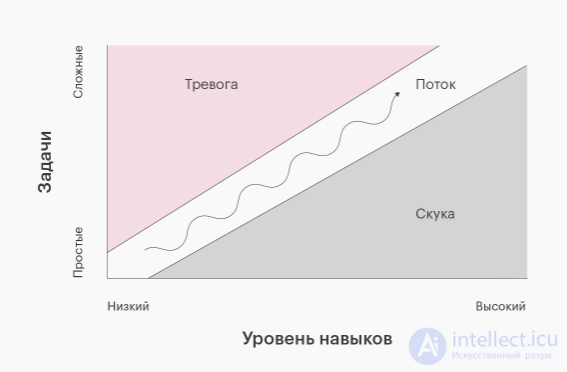
Developers strive to find a balance between boredom and frustration, which psychologists call the state of flow. This state is characterized by the player's complete concentration on solving the task and maximum enjoyment of the gameplay.
Jesse Schell notes that alternating small increases and decreases in difficulty is more engaging for players than a steady, continuous rise. This creates a dynamic that sustains the player's interest and engagement.
The placement of enemies within a level is an important part of its design. What matters is not only the number of enemies, but also their behavior, characteristics, and interaction with the surrounding environment.
Types of enemies: Enemies can be either simple foot soldiers or bosses with unique mechanics. Creating a variety of enemies helps maintain interest in the combat portion of the game. For example, in Dark Souls, simple enemies teach the basics of combat, while bosses require careful study of their behavior and vulnerabilities.
Strategic placement: Enemies should be positioned in such a way that players are forced to use different tactics. For example, weak enemies can be placed in open spaces where the player can maneuver easily, while stronger ones are placed in narrow corridors where the room for maneuver is limited.
Alternating types of enemies: It is important to vary the types of opponents so that the player does not get used to monotony. For example, in the game Doom Eternal, melee and ranged enemies are frequently alternated, which requires the player to maneuver actively and make quick decisions.
Objects are elements that directly affect the player's interaction with the world. These can be useful items (ammunition, medkits) as well as traps that make progression more difficult.
Resources and balance: It is important to balance the quantity and placement of resources, such as health or ammunition. A shortage of resources forces the player to seek more effective combat strategies, while an overabundance of them makes the game too easy.
Interactive objects: Objects within a level may include doors, buttons, or secret paths that players must find or activate. This adds an element of exploration and addresses the challenge of increasing interest in exploring the environment.
Secret areas and hidden items often reward attentive players, encouraging exploration. It is important that such objects are located in reasonably noticeable places, in order to motivate searching, while at the same time not becoming a mandatory part of the playthrough.
Balancing levels and difficulty requires thorough testing. Players may react differently to the same difficulty elements, and it is important to gather feedback from different types of users. Most often, this is done through:
Playtesting: Observing how players progress through levels makes it possible to assess where they encounter difficulties or, conversely, where the game seems too easy.
Statistical analysis: Tracking data on level completion can reveal patterns in player behavior, which helps to adjust the difficulty. For example, if many players get stuck on one level, it may mean that its difficulty is too high.
Balancing level difficulty and placing enemies and objects is a complex but extremely important aspect of game design. Successfully solving this task depends on understanding how the player interacts with the game world and what makes the game engaging and enjoyable. It is important to constantly test and fine-tune levels so that the game remains a challenge while at the same time not becoming excessively difficult or, conversely, boring.

Comments