
Lecture
Video game development (gamedev) is the process of developing a video game. This effort is undertaken by a developer, ranging from a single person to an international team spread across the world. Development of traditional commercial PC and console games is usually funded by a publisher, and can take several years to complete. Indie games usually take less time and money and can be created by individuals or small developers. The independent game industry is on the rise, aided by the growth of accessible game development software such as the Unity platform and Unreal Engine and new online distribution systems such as Steam and Uplay, as well as the mobile game market for Android and iOS devices.
The first video games, developed in the 1960s, were usually not sold. They required mainframes to run and were not accessible to the general public. Commercial game development began in the 70s with the arrival of the first generation of game consoles and early home computers such as the Apple I. At that time, thanks to the low cost and modest capabilities of computers, a lone programmer could develop a full and complete game. However, in the late 80s and 90s, the ever-growing computing power of computers and the increased expectations of gamers made it difficult for a single person to create a major console or computer game. The average cost of producing a Triple-A video game slowly rose, from US $1–4 million in 2000 to more than $5 million in 2006, then more than $20 million by 2010.
Mainstream commercial PC and console games are generally developed in stages: first, in pre-production, pitches, prototypes, and the design document are written; if the idea is approved and the developer receives funding, full-scale development begins. Developing a complete game usually involves a team of 20–100 people with various responsibilities, including designers, artists, programmers, and testers.
Games are produced through the software development process. Games are developed as a means of creativity and to generate profit. Creating games is considered both an art and a science. Development is usually funded by a publisher. Well-made games more easily generate profit. However, it is important to assess a game's financial needs, such as the costs of developing individual features. A lack of clear consequences to the game's expectations can lead to exceeding the allocated budget. In fact, most commercial games do not turn a profit. Most developers cannot afford to change their development schedule midway and require an assessment of their capabilities with the available resources before production.
The game industry demands innovation, since publishers cannot make a profit from continuously releasing repetitive sequels and imitations. Every year new independent development companies open, and some manage to develop a hit title. Likewise, many developers close down because they cannot find a publishing contract or their production is unprofitable. It is difficult to create a new company because of the large initial investment required. Nevertheless, the growth of the casual and mobile game market has allowed developers with small teams to enter the market. Once companies become financially stable, they can expand to develop larger games. Most developers start small and gradually expand their business. A developer that profits from a successful project can accumulate capital to expand and reorganize their company, as well as endure missed deadlines.
The average budget for developing a multiplatform game is US $18–28 million, while high-end games often exceed $40 million.
In the early era of home computers and game consoles in the early 1980s, a single programmer could handle almost all game development tasks - programming, graphic design, sound effects, etc. Developing a game could take as little as six weeks. However, the high user expectations and requirements of modern commercial games far exceed the capabilities of a single developer and require a division of responsibilities. A single full-time project may involve a team of more than a hundred people.
Game development, production, or design is a process that begins with an idea or concept. Often the idea is based on a modification of an existing game concept. A game idea can relate to one or more genres. Designers often experiment with different combinations of genres. A game developer usually writes an initial game proposal document, which describes the core concept, gameplay, feature list, setting and story, target audience, requirements and schedule, and finally an estimate of staffing and budget. Different companies have different formal procedures and philosophies regarding game design and development. There is no standardized development method; however, common traits exist.
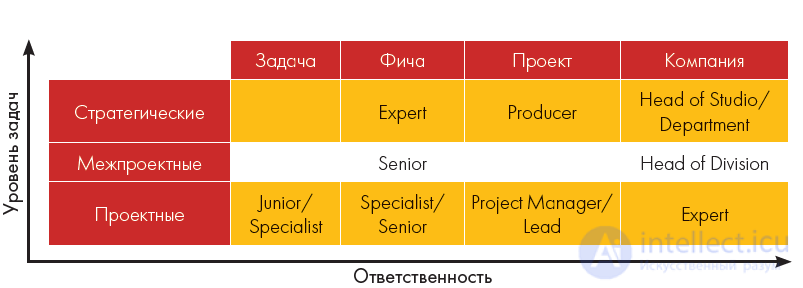
Fig. Areas of responsibility by role
A game developer can range from a single person to a large multinational company. There are both independent studios and studios owned by publishers. Independent developers rely on the financial support of a game publisher. Usually they have to develop a game from concept to prototype without external funding. Then a formal game proposal is sent to publishers, who may fund the game's development for anywhere from a few months to years. The publisher would retain exclusive rights to distribute and market the game and would often own the intellectual property rights to the game franchise. The publisher company may also own the developer company, or it may have in-house development studio(s). As a rule, the publisher is the one who owns the intellectual property rights to the game.
All but the smallest development companies work on several projects at once. This is necessary because of the time that elapses between shipping a game and receiving royalty payments, which can range from 6 to 18 months. Small companies may structure contracts, request royalty advances, use shareware distribution, hire part-time employees, and use other methods to meet payroll requirements.
Console manufacturers such as Microsoft, Nintendo, or Sony have a standard set of technical requirements that a game must meet in order to be approved. In addition, the game concept must be approved by the manufacturer, who may refuse to approve certain games.
Most modern PC or console games take three to five years to create, whereas a mobile game can be developed in a few months. The development duration depends on a number of factors, such as genre, scale, development platform, and the amount of resources.
Some games can take much longer than average. A notorious example is 3D Realms' «Duke Nukem Forever, announced into production in April 1997 and released fourteen years later, in June 2011. Planning of Maxis' game Spore began in late 1999; the game was released nine years later, in September 2008. The game Prey was briefly profiled in a 1997 issue of PC Gamer, but was not released until 2006, and only then in a heavily altered form. Finally, Team Fortress 2 was in development from 1998 until its 2007 release and emerged from a convoluted development process involving, according to Gabe Newell, «probably three or four different games».
Revenue from retail game sales is divided among the parties in the distribution chain, such as the developer, publisher, retail, manufacturer, and royalties. Many developers do not benefit from this and go bankrupt. Many developers seek alternative economic models through internet marketing and distribution channels to increase profits. Since through a mobile distribution channel the developer's share can be up to 70% of total revenue, , while through an online distribution channel it is almost 100%.
The history of game development begins with the development of the first video games, though which video game was the first depends on the definition of a video game. The first games created had little entertainment value, and their development did not depend on user interaction - in fact, playing these games required mainframes. OXO, written by Alexander S. Douglas in 1952, was the first computer game to use a digital display. In 1958 Willy Higinbotham, a physicist working at Brookhaven National Laboratory, developed a game called «Tennis for Two», whose results were displayed on an oscilloscope. In 1961 a mainframe computer game called Spacewar! was developed by a group of MIT students led by Steve Russell.
Real commercial game design and development began in the 1970s, when arcade video games and first-generation consoles appeared on the market. In 1971 Computer Space was the first commercially sold coin-operated video game. It used a black-and-white television for its display, and the computer system was made from 74 series TTL chips. In 1972 the first home console system called the Magnavox Odyssey, developed by Ralph H. Baer, was released. In the same year Atari released Pong, an arcade game that boosted the popularity of video games. The commercial success of Pong prompted other companies to develop clones of Pong, giving rise to the video game industry.
Programmers worked at large companies creating games for these devices. The industry saw little innovation in game design, and a large number of consoles had very similar games. Many of these early games were often clones of Pong. Some games were different, however, such as Gun Fight, which was significant for several reasons: an early 1975 on-foot, multidirectional shooter, which depicted game characters, game violence, and combat between people. Tomohiro Nishikado's original version was based on discrete logic, which Dave Nutting adapted using the Intel 8080, making it the first video game to use a microprocessor. Console manufacturers soon began producing consoles that could play independently developed games and run on microprocessors, marking the start of second-generation consoles, beginning with the release of the Fairchild Channel F in 1976.
The flood of Pong clones led to the video game crash of 1977, which eventually came to an end with the major success of Taito's 1978 arcade shooter game Space Invaders, marking the beginning of the golden age of arcade video games and inspiring dozens of manufacturers to enter the market. Its creator Nishikado not only designed and programmed the game, but also created the artwork, designed the arcade hardware, and assembled a microcomputer from scratch. It was soon ported to the Atari 2600, becoming the first «killer app» and quadrupling console sales. At the same time, home computers appeared on the market, allowing individual programmers and hobbyists to develop games. This allowed hardware and software manufacturers to operate separately. A single person could create a very large number of games, since games were easy to make because graphics and memory limitations did not allow for much content. Larger companies emerged that focused separate teams on working on a title. The developers of many early home video games, such as Zork, Baseball, Air Warrior, and Adventure, later carried their work over as products of the early video game industry.
I would not recommend [developing computer games] to those with a weak heart or a big appetite.
- John Freeman, 1984
At that time the industry expanded significantly: the arcade video game sector alone (representing the largest share of the game industry) generated higher revenue than pop music and Hollywood films combined. [64] The home video game industry, however, suffered heavy losses after the North American video game crash of 1983. In 1984 John Freeman warned in «Computer Gaming World»:
Q: Are computer games the road to fame and fortune? A: No. Not unless your idea of fame involves the recognition of your name by one or two discerning people from Origins... I have made a living (of sorts) creating games for most of the last six years. However, I would not recommend it to those with a weak heart or a big appetite.
Chris Crawford and Don Daglow in 1987 similarly advised aspiring designers to first write games as a hobby rather than quit their jobs early. The home video game industry was revived shortly after the widespread success of the Nintendo Entertainment System.
The Compute! magazine stated in 1986 that, although most early video games were developed by individuals, «it is impossible for one person to possess the many talents needed to create a good game». By 1987 a video game required 12 months to develop and another six months to plan marketing. Projects remained, as a rule, individual efforts, with individual developers delivering finished games to their publishers. With the ever-growing computing and graphics capabilities of arcade, console, and computer products, as well as the rise of user expectations, game design moved beyond the capabilities of a single developer and created a marketable game. The bulletin stated: «The process of writing a game involves creating an original entertainment concept, the ability to bring it to life through good, efficient programming, as well as being a fairly respectable artist». This marked the beginning of team development. In broad terms, during the 1980s pre-production involved sketches and testing procedures by a single developer. In the 1990s pre-production mostly consisted of game art previews. In the early 2000s pre-production usually produced game demos.
In 2000 a publisher funded a development project lasting 12 to 36 months for US $1–3 million. In addition, $250 thousand–1.5 million was spent on marketing and sales development. In 2001 more than 3,000 games were released for the PC; and of the approximately 100 games that made a profit, only about 50 brought significant profit. In the early 2000s middleware game engines such as the Quake engine or the Unreal engine were increasingly used.
In the early 2000s mobile games also began to gain popularity. However, mobile games distributed by mobile carriers remained a marginal form of gaming until the Apple App Store launched in 2008. .
In 2005 a major console video game cost from US $3M to $6M to develop. Some games cost up to $20 million to develop. In 2006 the profit from selling a console game at retail was divided among the parties of the distribution chain as follows: developer (13%), publisher (32%), retail (32%), manufacturer (5%), console royalties (18%). In 2008 a developer would retain about 17% of the retail price and about 85% when sold online.
Starting with the third generation of consoles, the home video game industry grew and expanded steadily. Industry revenue since the 1990s has increased at least fivefold. In 2007 the software share of video game revenue was $9.5 billion, exceeding the revenue of the film industry.
The Apple App Store, introduced in 2008, was the first mobile app store managed directly by the owner of a mobile platform. This significantly changed consumer behavior, making it more favorable for downloading mobile content, and rapidly expanded the mobile game markets.
In 2009 the annual value of the game market was estimated at $7–30 billion, depending on which sales figures were included. This is on par with movie box office receipts. A publisher usually funds an independent developer in the range of $500 thousand to $5 million to develop a title. In 2012 the total value of the game market had already reached $66.3 billion, and by that time video game markets were no longer dominated by console games. According to Newzoo, the MMO share was 19.8%, PC/MAC 9.8%, tablets 3.2%, smartphones 10.6%, handhelds 9.8%, consoles just 36.7%, and casual online games 10.2%. The fastest-growing market segments are mobile games, with an average annual rate of 19% for smartphones and 48% for tablets.
Over the past few years many developers have opened, and many have closed. Every year a number of developers are acquired by larger companies or merged with existing companies. For example, in 2007 the parent company of Blizzard Entertainment, Vivendi Games, merged with Activision. In 2008 Electronic Arts nearly acquired Take-Two Interactive. In 2009 Midway Games was acquired by Time-Warner, and Eidos Interactive merged with Square Enix.
In the game industry (gamedev) there are many roles and professions that cover the various stages of game development. Here are the main categories and examples of professions in each of them:
Management positions in game development play a key role in coordinating the team, planning, allocating resources, and achieving project goals. Here are the main management positions that may be needed:
Creative Director
Leads the overall concept of the game, ensures it aligns with the vision and goals. Responsible for the art style, story, and gameplay.
Executive Producer
Manages the project at the highest level, handles budget, strategy, and interaction with investors or publishers.
Producer
Coordinates the development process, organizes interaction between departments, monitors adherence to deadlines and budget.
Associate Producer
Helps the producer with day-to-day tasks, such as scheduling, monitoring task completion, and communication.
Project Manager
Plans and controls the development process, distributes tasks, manages resources, and monitors adherence to the schedule.
Team Lead
Leads a specific team (for example, programmers, artists, or designers), ensures the completion of tasks within the department.
Technical Director
Manages the technical part of the project: code architecture, technology choices, performance optimization, and development of key technical solutions.
Art Director
Leads the art style and visual part of the game. Coordinates the work of artists and ensures alignment with the conceptual vision.
Technical Art Director
Ensures the integration of art assets into the engine, responsible for optimization and technical requirements.
Design Director
Responsible for the overall quality of game mechanics, balance, progression, and player interaction with the game.
Lead Level Designer
Organizes the work of creating levels and integrating them into the overall concept.
Marketing Director
Develops the strategy for promoting the game, including advertising campaigns, cooperation with media, and influence on the target audience.
Community Manager
Leads interaction with players, responsible for community development and gathering feedback.
Business Manager
Responsible for budget management, attracting investment, and financial planning.
Resource Manager
Manages human resources, including hiring employees, training, and distributing responsibilities.
Quality Assurance Director
Leads the game's testing processes, controls the quality of builds and the elimination of bugs.
Lead QA Tester
Organizes the work of testers, distributes testing tasks, and monitors reporting.
Localization Manager
Organizes the translation of the game into other languages and adaptation to regions.
Support Manager
Leads the work of the player support service.
HR Manager
Responsible for recruiting staff, evaluating team performance, and creating a comfortable work environment.
Coordinator
Helps synchronize the work of various teams and departments.
All of these roles may overlap or be combined, especially in small studios. In large companies each of them may be a separate position.
Each of these roles can be highly specialized or combine several responsibilities, especially in small teams. The choice of profession depends on your skills and interests.
Development is overseen by internal and external producers. A producer working for the developer is known as an internal producer. They manage the development team, set the schedule, report on completed work, hire and assign staff, and so on. A producer working for the publisher is known as an external producer and oversees the progress of development and the budget. [83] A producer's responsibilities include PR, contract negotiations, maintaining communication between staff and stakeholders, adherence to schedule and budget, quality assurance, managing beta testing and localization. This role may also be referred to as project manager, project lead, or director.
A video game publisher is a company that publishes video games developed by them in-house or developed by a third-party video game developer. Like book publishers or DVD film publishers, video game publishers are responsible for the production and marketing of their products, including market research and all aspects of advertising.
They usually fund development, sometimes paying a video game developer (the publisher calls this external development), and sometimes paying internal development staff, called a studio. Consequently, they also usually own the game's IP. Large video game publishers also distribute the games they publish, while some smaller publishers instead hire distribution companies (or larger video game publishers) to distribute the games they publish.
Other functions usually performed by the publisher include deciding on and paying for any license the game may use; paying for localization; layout, printing, and possibly writing the user manual; and creating graphic design elements such as the box design.
Large publishers may also try to improve the efficiency of all internal and external development teams by providing services such as sound design and code packages for frequently needed features.
Because the publisher usually funds development, it usually tries to manage the risk of development through a staff of producers or project managers to track the developer's progress, critique current development, and help when necessary. Most video games created by a third-party video game developer are paid for by periodic advances in the form of royalties. These advances are paid when the developer reaches certain development stages, called milestones.
Independent video game developers create games without a publisher and can distribute their games digitally.
The size of developers can range from small teams creating casual games to housing hundreds of employees and producing several large games. Companies divide the subtasks of game development. Individual positions may differ; however, the roles in the industry are the same. A development team consists of several people. Some team members may perform more than one role; similarly, more than one task may be handled by the same member. Team size can range from 20 to 100 or more members, depending on the scale of the game. Most commonly, artists are represented, followed by programmers, then designers, and finally sound specialists, with two or three producers in leadership. These positions are full-time. Other positions, such as testers, may work only part-time. Salaries in these positions vary depending on the experience and location of the employee. An entry-level programmer may earn an average of about $70,000 per year, while an experienced programmer may earn an average of about $125,000 per year.
A development team includes the following roles or disciplines:
A game designer is a person who designs the gameplay, conceives and develops the rules and structure of the game. In development teams there is usually a lead designer who coordinates the work of the other designers. They are the main visionaries of the game. One of the designer's roles is to be a writer, often hired part-time to create the game's narrative, dialogue, commentary, cutscene plots, journals, video game packaging content, hint systems, and so on. Larger projects often employ different designers for different parts of the game, for example, game mechanics, user interface, characters, dialogue, graphics, and so on.
A game artist is a visual artist who creates video game art. Art production is usually overseen by an art director or art lead, ensuring that their vision is followed. The art director manages a team of artists, setting the schedule and coordinating the work of the development team.
An artist's work can be two-dimensional or three-dimensional. 2D artists can create concept art, sprites, textures, environment backgrounds or terrain images, and the user interface. 3D artists can create models or meshes, animation, 3D environments, and cinematography. Artists sometimes perform both roles.
A game programmer is a software engineer who mainly develops video games or related software (for example, game development tools). Development of the game's codebase is handled by programmers. There is usually one or more lead programmers, who implement the game's initial codebase and consider future development and the distribution of programmers across individual modules.
The roles of individual programming disciplines include:
A level designer is a person who creates levels, tasks, or missions for computer and/or video games using a specific set of programs. These programs can be publicly available commercial 3D or 2D design programs or specially developed and adapted level editors created for a specific game.
Level designers work with both incomplete and complete versions of the game. Game programmers usually create level editors and design tools for use by designers. This saves developers from having to access or modify the game code. Level editors may use special high-level scripting languages for interactive environments or AI. Unlike level editing tools, which are sometimes available to the community, level designers often work with placeholders and prototypes, aiming to ensure consistency and a clear layout before the required artwork is completed.
Sound engineers are technical specialists responsible for sound effects and sound positioning. Sometimes they oversee voice-over and the creation of other audio materials. Composers who create music for the game are also part of the game's sound team, although this work is often outsourced.
Quality control is carried out by game testers. A game tester analyzes video games to document software defects as part of quality control. Testing is a highly technical field, requiring computer knowledge and analytical skills.
Testers ensure that the game conforms to the proposed design: that it both works and is engaging. This includes testing all features, compatibility, localization, etc. Even though testing is necessary throughout the entire development process, it is expensive and is often used intensively only for the completion of the project.
Game Designer: Responsible for the overall concept of the game, mechanics, and player interaction with the system.
Environmental Artist: Creates the visual elements of levels, such as textures, models, and lighting.
Technical Designer: Helps integrate levels and their elements into the game, resolves technical issues related to the game engine.
Game development is a software development process, since a video game is software with graphics, sound, and gameplay. Formal software development methods are often overlooked. Games with poor development methodology can go over budget and time and will contain a large number of errors. Planning is important for both individual , and group projects.
In general, game development is not suited to typical software life cycle methods, such as the waterfall model.
One of the methods used for game development is agile development. It is based on iterative prototyping, a subset of software prototyping. Agile development depends on feedback and refinement of game iterations with a gradually increasing set of features. This method is effective because most projects do not begin with a clear scheme of requirements. Scrum is a popular agile software development method.
Another successful method is the Personal Software Process (PSP), which requires additional staff training to raise awareness of project planning. This method is more expensive and requires commitment from team members. PSP can be extended to the Team Software Process, where the entire team works independently.
In game development these methods usually overlap. For example, asset creation can be done using the waterfall model, since the requirements and specifications are clear, , but gameplay design can be done using iterative prototyping.
Commercial game development usually includes the following stages:
The pre-production stage or design stage is the project planning stage, focused on developing the idea and concept and producing the initial design documentation. The goal of concept development is to create clear and easy-to-understand documentation , in which all tasks, schedules, and estimates for the development team are described. The set of documents prepared at this stage is called the production plan. This stage is usually not funded by the publisher, however, good publishers may require developers to draw up plans during the pre-production stage.
Concept documentation can be divided into three stages or documents - high concept, pitch, and concept; however, there is no industry-standard naming convention, for example, both Bethke (2003) and Bates (2004) call the pitch document the «game proposal», but Moore, Novak (2010) call the concept document the «game proposal».
The late stage of pre-production may also be referred to as proof of concept, or technical review , when more detailed game documents are produced.
Publishers have begun to expect broader game proposals, even involving game prototypes.
The high concept is a brief description of the game. The high concept is a one- or two-sentence answer to the question: «What is your game about?».
The pitch, concept document, proposal document, or game proposal is a brief summary document intended to present the game's selling points and detail why the game would be profitable to develop.
Verbal pitches can be made to the management of the developer company, and then presented to publishers. Before funding is approved, publishers may need to be shown a written document. A game proposal may go through one to several coordination meetings with publisher executives, who determine whether the game should be developed. The project presentation is often conducted by game designers. Demos can be created for the pitch; however, they may be unnecessary for experienced developers with a good reputation.
If the developer acts as its own publisher or both companies are subsidiaries of the same company, then only top management needs to give consent.
The concept document, game proposal, or game plan is a more detailed document than the pitch document. It includes all information about the game. This includes the concept, game genre, description of gameplay, features, setting, story, target audience, hardware platforms, projected schedule, marketing analysis, team requirements, and risk analysis.
Before the approved design is finalized, a skeleton team of programmers and artists usually begins work. Programmers can develop quick prototypes demonstrating one or more features that stakeholders would like to include in the final product. Artists can develop concept art and object sketches as a springboard for developing real game assets. At this stage producers may work on the game part-time, scaling up to full-time as development progresses. Game producers' work during the pre-production stage involves planning the schedule, budget, and estimating tasks together with the team. The producer aims to create a solid production plan so that there are no delays at the start of production.
Before full-scale production can begin, the development team creates the first version of the game design document, incorporating all or most of the material from the initial stage. The design document describes in detail the game's concept and the main elements of gameplay. It may also include preliminary sketches of various aspects of the game. The design document is sometimes accompanied by functional prototypes of some sections of the game. The design document remains a living document throughout the entire development process - often changing weekly or even daily.
Compiling a list of a game's needs is called «requirements capture».
Writing prototypes of gameplay ideas and features is an important activity that allows programmers and game designers to experiment with various algorithms and usability scenarios for the game. Much of the prototyping can take place during the pre-production stage before the design documentation is finalized, and can, in fact, help determine which features the design defines. Prototyping at this stage is often done by hand (paper prototyping) rather than digitally, since it is often easier and faster to test and make changes before spending time and resources on what may be a cancelled idea or project. Prototyping can also occur during active development to test new ideas as the game emerges.
Prototypes are often intended only to verify a concept or test ideas by adding, changing, or removing certain features. [146] Most of the algorithms and features presented in a prototype can be carried over into the game after they are completed.
Often prototypes need to be developed quickly, with minimal time for preliminary design (about 15-20 minutes for testing). Therefore, usually very prolific programmers have to quickly write code for these tools. RAD tools can be used to help with the rapid development of these programs. If the prototype is in physical form, programmers and designers will make the game using paper, dice, and other easy-to-use tools to make the prototype faster.
A successful development model is iterative prototyping, in which the design is refined based on current progress. Various technologies are available for video game development.
Production is the main development stage, at which the assets and source code for the game are created.
Main production is usually defined as the period of time when the project is fully staffed. Programmers write new source code, artists develop game assets such as sprites or 3D models. Sound engineers develop sound effects, and composers develop music for the game. Level designers create levels, and writers write dialogue for cutscenes and NPCs. Game designers continue to develop the game design throughout production.
Game design is one of the most important and collaborative [149] processes of designing the content and rules in a game, [ requiring artistic and technical competence, as well as writing skills. Creativity and open-mindedness are vital to completing a successful video game.
During development the game designer implements and modifies the game design to reflect the current vision of the game. Features and levels are often removed or added. The artistic treatment may evolve, and the backstory may change. A new platform may be targeted, as may a new demographic group. All of these changes need to be documented and distributed to the rest of the team. Most changes occur as updates to the design document.
Game programming is handled by one or more game programmers. They develop prototypes to test ideas, many of which may never make it into the final version of the game. Programmers incorporate new features required by the game design and fix any errors that appear during development. Even if a standard game engine is used, a lot of programming is required to customize almost every game.
In terms of time, developing the first level of a game takes the most time. As level designers and artists use tools to create levels, they request features and changes to internal tools that enable faster and higher-quality development. Newly introduced features can cause old levels to become outdated, so levels developed early on may be redeveloped and discarded. Because of the dynamic game development environment, the design of early levels may also change over time. It is not uncommon to spend more than twelve months on a single level of a game being developed over three years. Later levels can be developed much faster, since the feature set is more complete and the vision of the game is clearer and more stable.
A game's audio can be divided into three categories: sound effects, music, and voice-over.
Creating sound effects is the creation of sounds by adjusting a sample to achieve the desired effect or reproducing it with real objects. Sound effects are important and affect the flow of the game.
Music can be synthesized or performed live.
Music can be presented in a game in several ways.
A game title with 20 hours of single-player gameplay can include about 1 hour.
Voice-over and voice acting create the interactivity of the characters' gameplay. Voice acting adds personality to the game's characters.
At the end of the project, quality assurance plays an important role. Testers begin working when there is something that can be played. This may be a single level or a subset of the game software that can be used to any reasonable extent. At first, game testing takes relatively little time. Testers can work on several games at once. As development approaches its end, many testers are usually involved in a single game on a full-time basis (and often with additional ones). They aim to test new features and verify existing ones. Testing is vital for modern complex games, since individual changes can lead to catastrophic consequences.
At this point features and levels are being completed at maximum speed, and there is more new material to test than at any other time in the project. Testers need to conduct regression testing to ensure that features that have been used for several months still work correctly. Regression testing is one of the vital tasks required for effective software development. As new features are added, subtle changes to the codebase can lead to unexpected changes in various parts of the game. This task is often overlooked for several reasons. Sometimes, when a feature is implemented and tested, it is considered «working» for the rest of the project, and little attention is paid to retesting. In addition, features added in the late stages of development take priority, and existing features often do not have enough time for testing. Proper regression testing also becomes increasingly expensive as the number of features grows and is often not carried out correctly.
Despite the danger of ignoring regression testing, some game developers and publishers cannot test the full set of a game's features and release the game with bugs. This can lead to customer dissatisfaction and failure to meet sales targets. When this does happen, most developers and publishers quickly release patches that fix the bugs and make the game fully compatible again.
To achieve the goals set by the publisher, commercial game development projects may be required. Milestones mark major events during game development and are used to track the game's progress. Such milestones can be, for example, the first playable, alpha, or beta versions of the game. The main stages of the project depend on the developers' schedules.
Milestones are usually based on several brief descriptions of functionality; examples could be «Player wandering in the game environment» or «Physics, collisions, vehicle working», etc. (numerous descriptions are possible). Usually the developer is paid for these milestones; sometimes as an «advance against royalties». These milestones number from three to twenty, depending on the developer and publisher. The list of milestones is usually a collaborative agreement between the publisher and developer. The developer usually advocates for the milestone descriptions to be as simple as possible; depending on the specific publisher - milestone agreements can be very detailed for a specific game. When working with a good publisher, the "spirit of the law" is usually observed regarding milestone completion... in other words, if a milestone is 90% complete, the milestone is usually paid with the understanding that it will be 100% complete by the next relevant milestone. This is a collaborative agreement between the publisher and developer, and usually (but not always) the developer faces large monthly development costs that need to be covered. In addition, sometimes milestones are «swapped», the developer or publisher may mutually agree to change the agreement and change the goals of milestones depending on changing requirements and available development resources. Milestone agreements are usually included in legal development contracts. After each «milestone», a payment order is usually specified.
There is no industry standard for defining milestones, which depends on the publisher, year, or project. Here are some common milestones of a two-year development cycle:
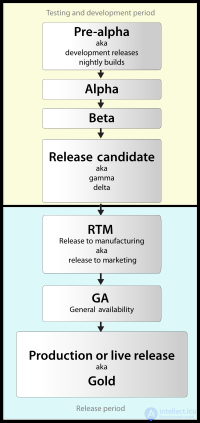
The first playable is a version of the game containing representative gameplay and assets, it is the first version with functional core game elements. It is often based on the prototype created during the pre-production stage. The alpha version and first playable are sometimes used to denote a single milestone, however, in large projects the first playable must come before the full alpha version. The first playable occurs 12–18 months before code release. It is sometimes called the «pre-alpha» stage.
Alpha is the stage at which key gameplay features are implemented and assets are partially completed. The alpha version of the game is fully functional, meaning it can be played, and it contains all the main features. These features can be refined based on testing and feedback. Additional small new features may be added, but similarly planned yet unimplemented features may be cut. Programmers mainly focus on completing the codebase rather than implementing additions.
Code freeze is the stage when new code is no longer added to the game, and only errors are fixed. Code freeze occurs three to four months before code release.
Beta is the complete version of the game, in which only errors are fixed. In this version there are no errors that prevent the distribution of the game. No changes are made to the game's features, assets, or code. Beta testing occurs two to three months before code release.
Code release is the stage at which many errors have been fixed and the game is ready to be shipped or sent for review by the console manufacturer. This version is tested in accordance with the QA test plan. The first code release candidate is usually ready three to four weeks before code release.
The gold master is the final build of the game, which is used as the master for producing the game.
Most AAA game developments are announced a year or more in advance and given a scheduled release date or approximate window, so they can promote and market the game, place orders with retailers, and encourage consumers to pre-order the game. Delaying a video game's release can have negative financial consequences for publishers and developers, and significant delays can lead to the cancellation of the project and layoffs of employees. To ensure that a game has a set release date, publishers and developers may require their employees to work overtime to complete the game, which is considered a common occurrence in the industry. This overtime is often called «crunch time» or «crunch mode». In 2004 and later, the crunch time culture in the industry came under close scrutiny, leading many publishers and developers to lower their expectations of developers regarding overtime work and improve schedule management, although crunch time can still occur.
Once the game goes «gold» and is released, some developers will give team members time to play (perhaps up to a week or two) to compensate for the overtime spent completing the game, although this compensation is not standard.
After a game is released, the video game's maintenance phase begins.
In the past, games developed for game consoles required almost no maintenance. The shipped game would forever contain as many bugs and features as it had at release. This was common for consoles, since all consoles had identical or nearly identical hardware; making incompatibility, the cause of many bugs, not an issue. In this case, maintenance would only occur in the event of a port, sequel, or improved remake, in which most of the engine and assets are reused.
Recently the popularity of online console games has grown, and online game consoles and online services such as Xbox Live for the Xbox have been developed. Developers can maintain their software using downloadable patches. These changes would have been impossible in the past without the widespread availability of the internet.
PC development is different. Game developers try to account for most configurations and hardware. However, the number of possible hardware and software configurations inevitably leads to the discovery of critical circumstances that programmers and testers did not account for.
Programmers wait a while to receive as many bug reports as possible. Once the developer believes it has received enough feedback, programmers begin work on a patch. A patch can take weeks or months to develop, but it is intended to fix most of the identified bugs and problems with the game that were overlooked in the past code release, or, in rare cases, to eliminate unintended problems caused by previous patches. Sometimes a patch may include additional features or content or even change the gameplay.
In the case of a multiplayer online game (MMOG), such as an MMORPG or MMORTS, the delivery of the game is the initial phase of maintenance. Such online games are in constant maintenance, since the game world constantly changes and iterates, and new features are added. The maintenance staff of a popular MMOG can number in the dozens, sometimes including members of the original development team.
Some development disciplines, such as audio, dialogue, or motion capture, are carried out over relatively short periods of time. Effectively using these roles requires either a large development studio with several titles being released simultaneously, or engaging third-party vendors. Hiring staff to perform these tasks on a permanent basis is expensive, so most developers outsource part of the work. Outsourcing plans are developed during the pre-production stage; where the time and finances required for outside work are estimated. [172]
Game production has the same distribution methods as the music and film industries.
The publisher's marketing team targets the game at a specific market and then advertises it. The team advises the developer on the target demographic and market trends , and also suggests specific features. The game is then advertised, and its high concept is incorporated into promotional materials, from magazine ads to commercials. The connection between the developer and marketing is important.
The duration and purpose of a game demonstration depends on the goal of the demonstration and the target audience. A game demonstration can range from a few seconds (for example, clips or screenshots) to hours of gameplay. A demo is usually intended for journalists, buyers, trade shows, the general public, or internal staff (who, for example, may need to familiarize themselves with the game to promote it). Demo reels are created with public relations, marketing, and sales in mind, ensuring the maximum effectiveness of the presentation.
As a game approaches completion, the publisher will want to demonstrate a game demo at trade shows. For many games, "trade show demos" are planned.
The largest annual trade shows are, for example, the Electronic Entertainment Expo (E3) or the Penny Arcade Expo (PAX). E3 is the largest show in North America. E3 is intended primarily for marketing and business deals. At E3 new games and platforms are announced, which are widely covered by the press. Thousands of products are demonstrated, and press demonstration schedules are followed. In recent years E3 has become a more closed event, and many advertisers have dropped out, reducing E3's budget. [ PAX, created by the authors of the Penny Arcade blog and web comic, is a mature and fun event with a player-oriented philosophy.
A game created in one language may also be published in other countries where a different language is spoken. For that region, developers may want to translate the game to make it more accessible. For example, some games created for the PlayStation Vita were initially published in Japanese, such as Soul Sacrifice. Native speakers of the game's original language may have to wait for the game to be translated into their language. But most modern big-budget games account for localization during the development process, and games are released simultaneously in several different languages.
Localization is the process of translating a game's language resources into other languages. By localizing games, they increase their level of accessibility, where games can help effectively tap into international markets. Game localization is usually referred to as language translation, but the «full localization» of a game is a complex project. Different levels of translation range from: zero translation, where there is no translation of the product and everything is shipped raw; basic translation, where only a few texts and subtitles are translated or even added; and full translation, where new voice-over and game material changes are added.
There are various important elements of game localization, including translating the game's language and adjusting game resources for different cultures to attract more potential consumers in other regions (or globalization for short). Translation seems to fall within the scope of localization, which itself is a significantly broader task. This includes various levels of translation into the globalization of the game itself. However, some developers seem to be divided in opinion about whether globalization falls under localization or not.
Moreover, to match local markets, game production companies often change or redesign the graphic design or packaging of a game for marketing purposes. For example, the popular game Assassin's Creed has two different packaging designs for the Japanese and US markets. By localizing the graphics and packaging design, companies can attract more attention and interest from consumers in different regions.
Independent games or indie games [189] are produced by individuals and small groups not affiliated with large developers or publishers. Indie developers usually rely on online distribution schemes. Many amateur indie developers create modifications of existing games. Indie developers are credited with creative game ideas (for example, Darwinia, Weird Worlds, World of Goo). The current economic viability of indie development is questionable, however, in recent years internet delivery platforms such as Xbox Live Arcade and Steam have improved the success of indie games. In fact, some indie games have become very successful, for example, Braid, World of Goo, and Minecraft. In recent years many communities supporting indie games have emerged, such as the popular indie game marketplace Itch.io, indie game channels on YouTube, and a large indie community on Steam (service). Indie game developers usually release games for free and earn revenue by other means, such as microtransactions (in-game transactions), in-game advertising, and crowdfunding services such as Patreon and Kickstarter.
The video game industry (formally called interactive entertainment) is the economic sector concerned with the development, marketing, and sale of video games. The industry has several unique approaches.
In the United States, at the early stage of video game development, the main location for game development was the corridor from San Francisco to Silicon Valley in California. Most new developers in the US open near such «hotbeds».
Currently, many major publishers still operate there, such as: Activision Blizzard, Capcom Entertainment, Disney Interactive, Eidos Interactive, Electronic Arts, Foundation 9, LucasArts Entertainment, Namco Bandai Games, Sega of America, Sony Computer Entertainment America, THQ. However, due to the specifics of game development, many publishers are present in other regions, for example, Big Fish Games (Washington), GarageGames (Oregon), Majesco Entertainment (New Jersey), Microsoft Corporation (Washington), Nintendo of America (Washington), Take-Two Interactive (New York), SouthPeak Games (Virginia).
Many universities and design schools offer courses specifically dedicated to game development. [14] Some have created strategic alliances with major game development companies. These alliances ensure that students have access to the latest technologies and are given the opportunity to find work in the game industry after obtaining their qualifications. Many innovative ideas are presented at conferences such as the Independent Games Festival (IGF) or the Game Developers Conference (GDC).
Indie game development can motivate students who create a game for their final projects or thesis work and can start their own game company.
Employment in the video game industry is quite unstable, as in other art industries, including television, music, etc. Dozens of game development studios emerge that work on a single game and then quickly disappear. This may be one of the reasons why game developers tend to gather geographically; if their current studio goes bankrupt, developers can move to a neighboring one or start another from scratch.
In an industry where only the top 20% of products make a profit, this fluctuation is easy to understand. Many games may begin development and be cancelled or even completed but never published. Experienced game developers may work for years but never release a game: such is the nature of the business.

Comments