
Lecture
Sound design and visual effects (VFX) are key elements that significantly enhance the quality and atmosphere of any game or film. They intensify emotions, help players navigate the game space, and create an immersive and engaging experience. Developing sounds and visual effects requires both a creative approach and technical expertise, which makes them an integral part of the content creation process.
Sound design in games performs several key functions:
Background music:
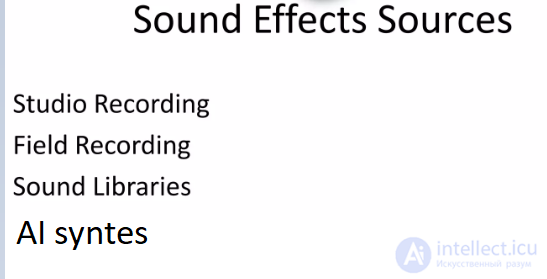
Sound effects (SFX):
Voice acting:
Synchronization with the visuals: Sound effects must clearly correspond to visual actions. For example, the sound of a gunshot should occur at the same time as the gunshot animation.
Moderation and balance: The sound palette should not overwhelm the player. It is important to maintain a balance between the various sounds so that they complement rather than distract.
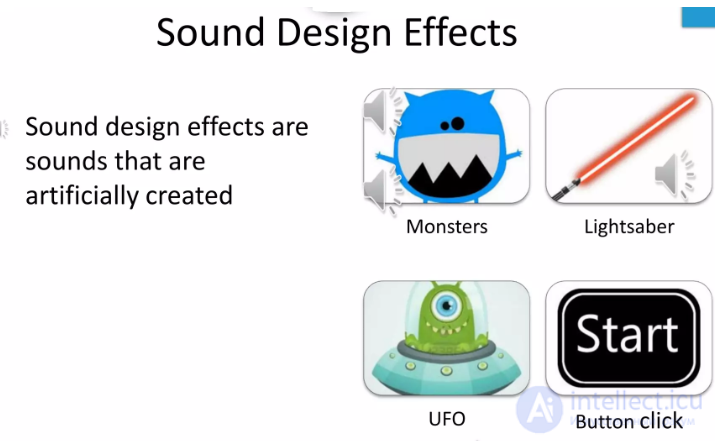
Layering of sounds: A single sound can consist of several effects overlaid on one another. For example, the sound of a monster may include animal roars, human screams, and mechanical noises.
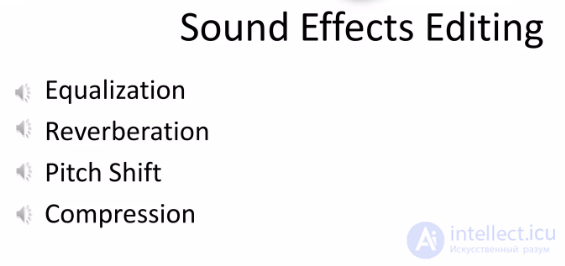
There are various programs and tools for recording, editing, and creating sounds:
1.5 Classification of sound effects in computer games
Sound effects (SFX) play an important role in creating atmosphere and maintaining interactivity in computer games. They can be classified according to various criteria, based on their functional role, context of use, interaction with the player, and technical aspects.
These sounds originate within the game world and are perceived by the characters in the same way as by the players. They are closely tied to game objects and events:
Sounds that only the player hears, but which are not part of the game world and are not perceived by the characters:
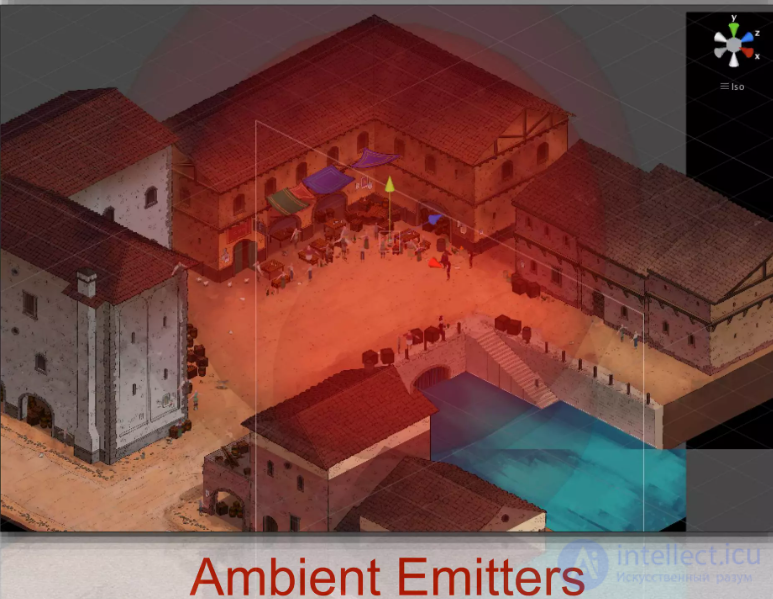
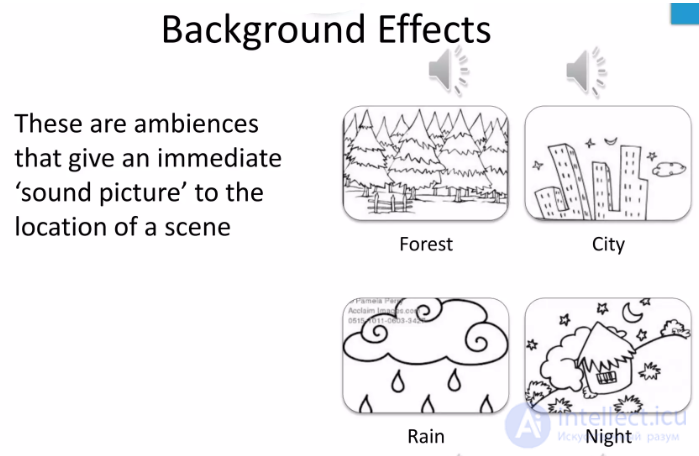
These sounds form the overall sonic environment in the game, creating the atmosphere of a location. This can be:
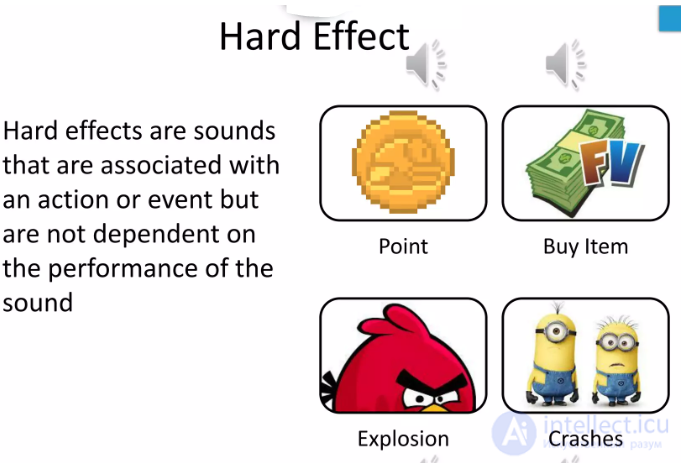
These sounds are triggered by game events and are directly linked to the player's actions:
Used to notify the player of important information, such as:
Related to the player's direct interaction with the interface and game objects:
Used to convey information to the player about their actions or the character's state:
Used to create an emotional response in the player and to sustain the game's mood:
Sounds that play cyclically with no beginning or end, creating a continuous sound design:
Sounds that play once when a specific event occurs:
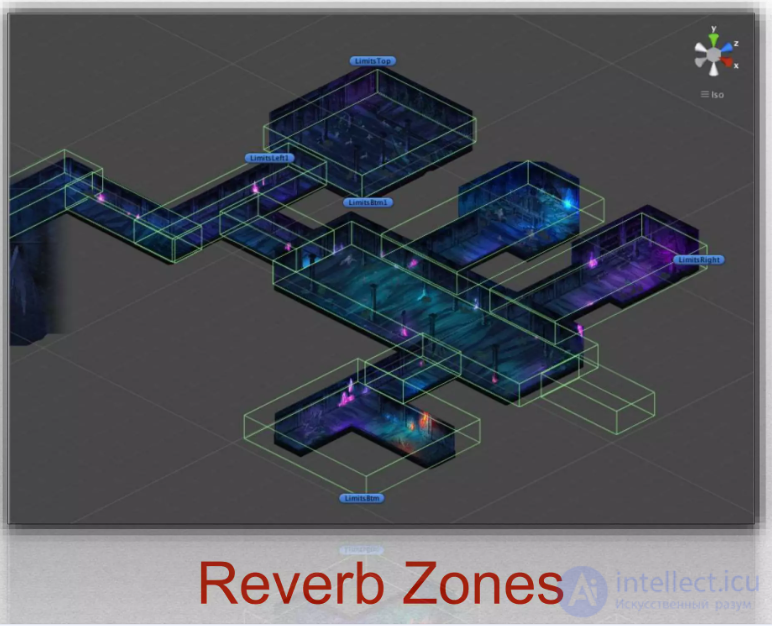
These sounds model a three-dimensional sound space, which allows the player to distinguish the direction of and distance to the sound source:
Sounds that accompany the destruction of objects and interaction with the physics of the world:
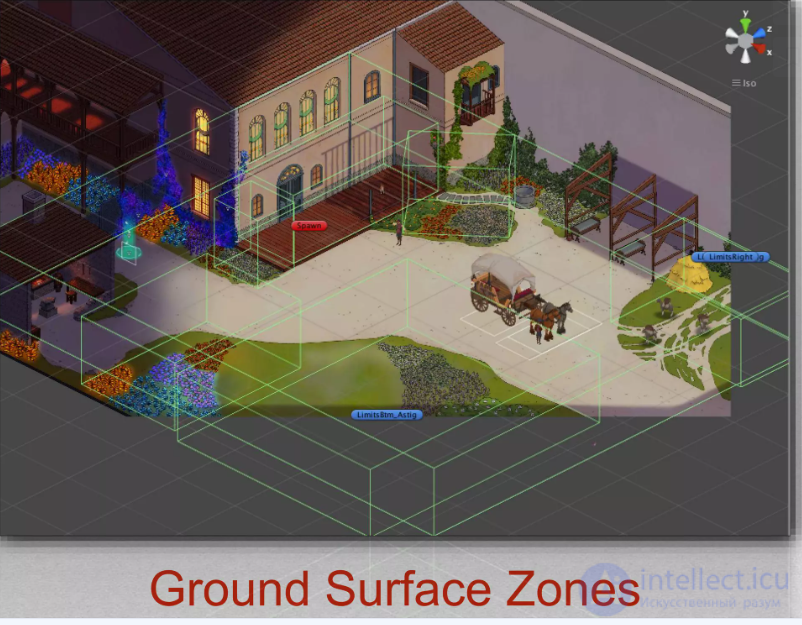
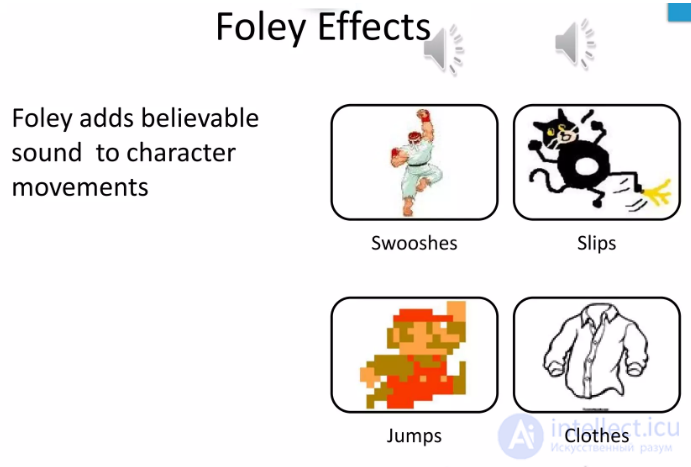
These sounds accompany any actions related to the movement of objects or characters:
The classification of sound effects in games helps to organize and manage the sonic landscape, ensuring a balance between atmosphere, interactivity, and informational importance. Determining when and how to use different types of sounds helps developers create a more immersive and engaging gameplay experience.
1.6 Problems with sound effects in computer games
Sound effects play a key role in immersing the player in the game world; however, their implementation can encounter a number of problems that affect the perception of the game and interaction with it. Let us consider the main problems with sound effects in computer games:
Problem: Too many sound effects in a short period of time can create «noise» that makes it difficult to perceive important information.
Solution: Applying a sound hierarchy in which important sounds are emphasized while less significant ones are muted or adjusted in volume. The player should also be given the ability to adjust the intensity of various sounds through the menu.
Problem: Ill-timed or context-inappropriate sound effects can shatter immersion in the gameplay. For example:
Solution: Improving the synchronization of sounds with actions and events in the game. This requires both skilled work by sound designers and the integration of sound effects at the programming level so that they are aligned in time with the animation.
Problem: Incorrectly configured spatial sounds can interfere with orientation in the game space, especially in 3D games.
Solution: Using spatial sound (3D audio) and technology such as HRTF (Head-Related Transfer Function) for more accurate conveyance of the direction of and distance to the sound source. This improves the player's orientation in the game space.
Problem: Frequently repeated sound effects can quickly become tiresome for the player and shatter immersion.
Solution: Introducing variety in sounds by using different versions of the same effect (for example, different footstep sounds on different surfaces). It is also possible to dynamically change the volume or timbre of sounds for variety.
Problem: An incorrect balance between sound effects and musical accompaniment can make it difficult to perceive important game information.
Solution: Balancing the volume between musical and sound effects. The player should also be given the ability to independently adjust the volume levels of different sound components through the menu.
Problem: In some games, adaptive sound effects may be configured incorrectly, which leads to disruptions in the game's atmosphere. For example:
Solution: More refined tuning of adaptive sound design. Sound effects and musical accompaniment should dynamically adjust to the context of the game, preserving immersion and atmosphere.
Problem: Low-quality sounds or distortions can significantly reduce the quality of the gaming experience.
Solution: Using higher-quality sound files and carefully working with the audio mixes. Optimizing the game's sound engine in order to avoid overloading the sound scene.
Musical instruments have unique timbres that directly influence the listener's emotional perception: strings often evoke a feeling of tenderness and melancholy, brass — grandeur and solemnity, percussion — energy and tension, and keyboards — a rich palette ranging from calm to drama.
Violin — associated with lyricism, tenderness, longing. High notes can evoke a feeling of anxiety or tension.
Cello — a deep, velvety sound, often evoking a sense of warmth, sadness, or philosophical contemplation.
Guitar — versatile: the acoustic conveys intimacy and romance, the electric — drive, protest, or expression.
Flute — lightness, airiness, associations with nature and freedom.
Saxophone — sensuality, passion, sometimes melancholy.
Trumpet — solemnity, heroism, inspiration.
Drums — energy, rhythmic power, excitement. They can create a feeling of anxiety or a combative mood.
Xylophone/marimba — playfulness, childlike joy, lightness.
Piano — a versatile instrument: from calm meditativeness to dramatic expression.
Organ — grandeur, spirituality, a mystical atmosphere.
How instruments shape emotions
Timbre — the coloration of the sound determines the emotional shade (for example, the soft sound of an oboe evokes sadness).
Dynamics — the volume and force of the sound intensify feelings (quiet notes — intimacy, loud ones — tension).
Cultural context — a trumpet may be associated with military marches, while a flute — with pastoral scenes.
Personal perception — each listener has individual associations connected to experience and memory.
Comparison table
| Instrument | Emotions and feelings | Context of use |
|---|---|---|
| Violin | Lyricism, longing, tenderness | Symphony, romantic music |
| Cello | Warmth, sadness, philosophy | Chamber music, soundtracks |
| Guitar | Intimacy, drive, protest | Pop, rock, folk |
| Flute | Lightness, freedom | Classical, ethnic music |
| Saxophone | Sensuality, passion | Jazz, blues |
| Trumpet | Solemnity, heroism | Marches, fanfares |
| Drums | Energy, tension | Rock, ethnic, military rhythms |
| Piano | Calm, drama | Classical, pop, film |
| Organ | Grandeur, spirituality | Church music, |
Creating sound design and visual effects requires not only a creative approach but also a deep understanding of technique and technology. The combined use of sounds and VFX allows developers to create unique, immersive worlds that captivate players and make the gameplay more dynamic and engaging.

Comments