
Lecture
In computer games, the concept of human micro-movements can be viewed as the basic, minimal actions of the player that shape control and interaction with the virtual environment. These movements are often analyzed in game design and esports, because it is precisely they that determine a player's reaction speed, accuracy, and effectiveness.
In psychology and biomechanics, micro-movements — are small, often automatic actions of the body that we perform constantly:
Facial expressions: facial micro-expressions, barely noticeable muscle changes.
Gestures: movements of the fingers and hands (tapping, snapping, habitual «tic» gestures).
Posture and balance: micro-corrections of posture, shifting body weight.
Breathing: rhythm, depth, pauses.
Eye movements: gaze fixation, microsaccades.
Nervous habits: bouncing a leg, tapping fingers, adjusting clothing.
Human micro-movements — are very small, often involuntary movements of the body that reflect physiological processes, emotions, or cognitive activity. They are studied in psychology, neurophysiology, medicine, biometrics, and behavior recognition systems.
Associated with the workings of the body:
micro-movements of the chest during breathing
micro-oscillations of the body due to the heartbeat
muscle tremor (natural, fatigue-related, stress-related)
micro-movements of the eyeballs (microsaccades)
Brief movements of the facial muscles (fractions of a second):
twitching of the corners of the mouth
brief tensing of the eyebrows
micro-clenching of the jaw
instantaneous changes in gaze
Often associated with emotions (surprise, fear, irritation), even if a person tries to hide them.
twitching of the fingers
micro-clenching of the fist
tapping with a fingernail
involuntary gestures during tension or concentration
Maintaining balance:
micro-swaying of the torso while standing
micro-shifts of the center of gravity
compensatory movements of the spine
Even in a «motionless» posture, the body is constantly moving.
microsaccades
gaze drift
eye tremor
Necessary for normal vision and information processing.
micro-movements of the lips before speaking
tongue movements
micro-pausing of breathing
Used in speech and intent recognition systems.
Associated with mental state:
frequent blinking
touching the face
adjusting clothing
micro-gestures of uncertainty or tension
| No. | Type of micro-movements | Body part | Character | Main manifestations | What it reflects | Areas of application |
|---|---|---|---|---|---|---|
| 1 | Physiological | Whole body | Involuntary | respiratory oscillations, pulsation, muscle tremor | general state of the body | medicine, biometrics |
| 2 | Facial micro-expressions | Face | Brief | micro-movements of the lips, eyebrows, cheeks | true emotions | psychology, profiling |
| 3 | Oculomotor | Eyes | Automatic | microsaccades, drift, tremor | attention, load | neuroscience, AI |
| 4 | Hand micro-movements | Hands, fingers | Partially conscious | finger twitching, clenching | stress, concentration | behavior analysis |
| 5 | Postural | Torso | Involuntary | micro-swaying, weight shifting | balance, fatigue | ergonomics |
| 6 | Speech | Lips, tongue | Deliberately-automatic | micro-movements before speaking | intent to speak | speech recognition |
| 7 | Behavioral | Whole body | Habitual | touching the face, adjusting clothing | anxiety, uncertainty | behavioral analysis |
| 8 | Neurological | Muscles | Pathological/normal | tremor, spasms | CNS disorders | clinical diagnostics |
| 9 | Compensatory | Joints, back | Automatic | micro-bends, posture corrections | fatigue | medicine, sports |
| 10 | Motor micro-reactions | Limbs | Reflexive | micro-twitches in response to a stimulus | reaction speed | simulators, training |
Below — is a medical classification of human micro-movements from the standpoint of norm and pathology, as it is considered in neurology, physiology, and clinical medicine.
Norm
barely noticeable trembling of the muscles
intensifies with fatigue, cold, agitation
Associated with the workings of the CNS and muscle tone
Norm
micro-swaying of the body while standing
constant correction of balance
The work of the vestibular system
Norm
microsaccades
gaze drift
eye tremor
Necessary for normal vision
Norm
brief contractions of the facial muscles
reflection of emotions
Controlled by subcortical structures
Norm
movements of the lips and tongue before speaking
Preparation of the speech apparatus
Norm
micro-bends of the spine
posture adjustment during fatigue
Protection of the musculoskeletal system
Norm
micro-contractions in response to a stimulus
Rapid protection of the body
under stress
with caffeine
with overexertion
Normal when reversible
brief muscle twitches
more often in children and adolescents
May disappear on their own
repetitive small movements
Possible with anxiety, concentration
A sign of disease
resting tremor
intention tremor
essential tremor
Parkinson's disease, cerebellar lesions
Pathology
sudden brief muscle contractions
Epilepsy, metabolic disorders
Pathology
involuntary repetitive movements
Neuroses, Tourette syndrome
Pathology
chaotic, «jerky» movements
Lesion of the basal ganglia
slow writhing movements of the fingers
Cerebral palsy
Pathology
persistent pathological muscle contractions
Disruption of muscle tone regulation
Possible pathology
twitching of individual muscle fibers
Lesion of the peripheral nerves
Pathology
impoverishment and slowing of movements
Parkinson's disease
Norm:
micro-movements support vision, balance, speech, and tone
Pathology:
micro-movements become
asymmetrical
rhythmically disturbed
uncontrolled
persistent over time
Games increasingly integrate real human micro-movements through technologies:
Motion capture (MoCap) – actors record the tiniest movements of the body and face so that characters look alive.
Face tracking – reading facial micro-expressions (for example, in VR or AR) so that the avatar reproduces the player's emotions.
Eye tracking – accounting for microsaccades and gaze direction to control the camera or interface.
Gesture recognition – Kinect, VR controllers, and cameras capture small movements of the hands and fingers.
Behavioral animation – characters in the game make micro-movements on their own (scratching, adjusting clothing, breathing) in order to look natural.
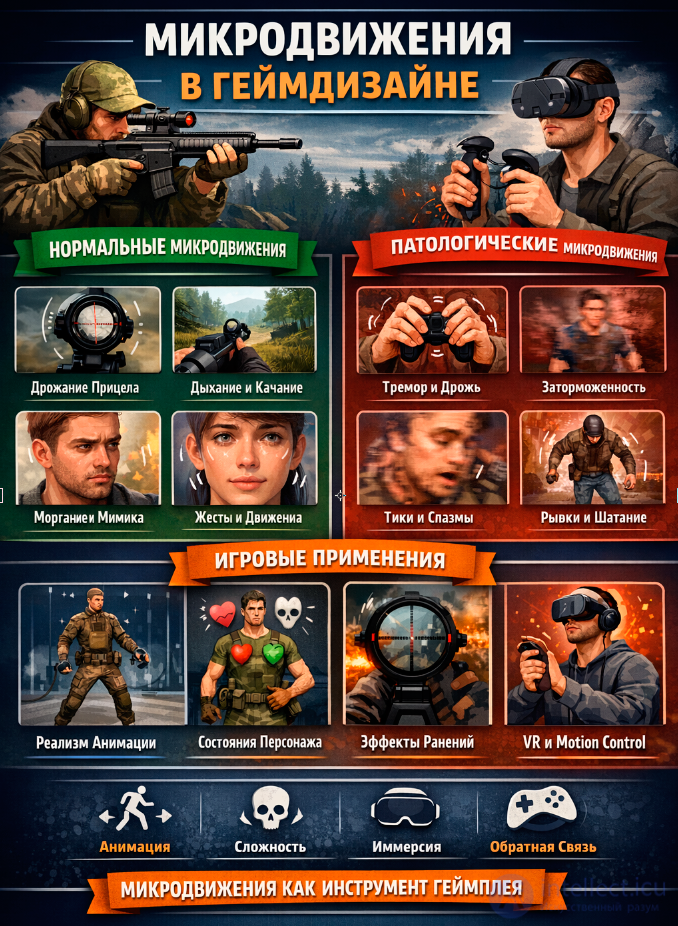
In computer games, normal and pathological micro-movements are not reproduced with medical accuracy, but they are modeled, imitated, or interpreted to increase realism, gameplay, and the player's interaction with the system.
Below — is exactly how they are taken into account and used.
Physiological micro-movements are used so that the character does not look static:
micro-swaying of the body at rest
respiratory movements of the chest
micro-movements of the hands and head
blinking, micro-mimicry
Where: RPGs, shooters, simulators
Why: the effect of a «living person»
Imitate:
postural micro-movements
compensatory movements
behavioral micro-gestures
The character slightly changes posture, adjusts equipment
Increases visual realism
Physiological tremor is used:
oscillations of the crosshair
the influence of breathing
arm fatigue
Where: FPS, military simulators
Mechanic: the higher the stress/fatigue — the more micro-movements
Modeled:
micro-movements of the head
breathing
step-related micro-oscillations
Increases the sense of presence (immersion)
The player's normal micro-movements are actually read:
trembling of the hands
micro-displacements of the head
involuntary gestures
Used for:
camera stabilization
intent recognition
interface adaptation
Through micro-movements, the following are shown:
tension
fear
fatigue
concentration
For example:
rapid blinking
clenched fingers
micro-clenching of the jaw
NPCs use micro-movements as state signals:
alertness
aggression
uncertainty
The player can «read» the opponent's behavior
Important: in games they are stylized, not medically accurate.
Used to indicate:
injuries
poisoning
exhaustion
fear
Manifestations:
strong trembling of the hands
an unstable camera
reduced accuracy
Imitation of:
slowed reactions
«jerky» micro-movements
poor coordination
Often temporary, as a debuff
In narrative games:
tics
spasms
uncontrolled movements
Used:
to reveal character
as a plot element
for atmosphere
| Human micro-movement | Tracking technology | Application in games |
|---|---|---|
| Facial expressions | Face tracking, MoCap | Realistic character emotions |
| Hand gestures | VR controllers, cameras | Object manipulation, combat combos |
| Body balance | Motion capture | Animation of walking, falling |
| Breathing | Biosensors, MoCap | Character realism, immersion |
| Eye movements | Eye tracking | Aiming, mouse-free interface |
| Nervous habits | Behavioral animation | Living NPCs, avatar realism |
Micro-movements are used as:
hidden state parameters
feedback to the player
a difficulty mechanic
a tool for realism
Example:
The higher the stress → the stronger the micro-movements → the harder the control
Modern games and simulators:
analyze the player's micro-movements (mouse, gamepad)
determine fatigue or tension
dynamically change the difficulty
Especially in VR and training simulators
| Type of micro-movements | Use in games |
|---|---|
| Normal | realism, animation, aiming |
| Behavioral | emotions, AI, state signals |
| Pathological | debuffs, plot, visual effects |
psychology and profiling
medicine (neurology, diagnostics)
emotion recognition systems
biometrics and AI
analysis of the behavior of operators and personnel
Thus, the micro-movements of an ordinary person become the basis for realistic animations and control. Games increasingly strive not only for «big» actions (a strike, a jump), but also for the natural little details that make characters feel alive.

Comments