
Lecture
In game design, the Mechanics-Dynamics-Aesthetics ( MDA ) framework is a tool used to analyze games. It formalizes the properties of games by breaking them down into three components: Mechanics , Dynamics and Aesthetics . These three words have been used informally for many years to describe various aspects of games, but the MDA framework gives precise definitions to these terms and seeks to explain how they relate to one another and influence the gameplay experience.
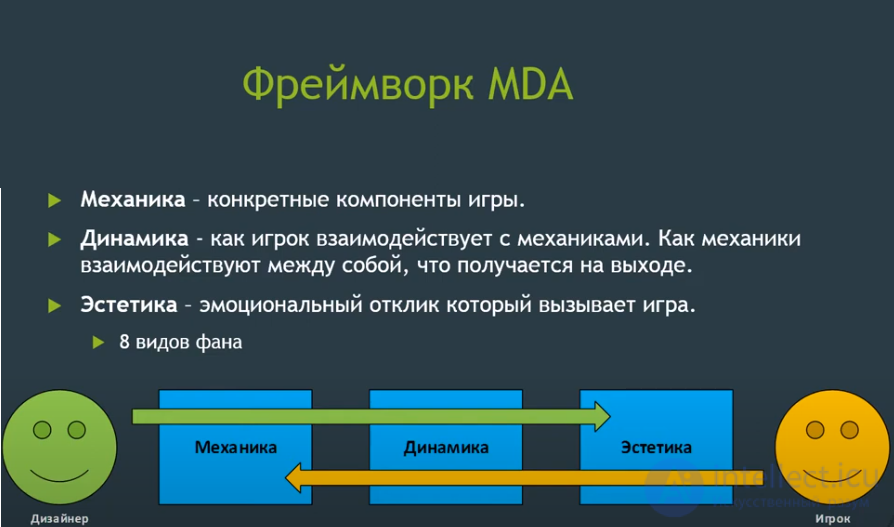
Mechanics, dynamics and aesthetics from the perspective of the designer (blue) and the player (green)
There are many types of aesthetics, including but not limited to the following eight, identified by Hunicke , LeBlanc and Zubek:
The article also mentions a ninth kind of fun, competition . The article attempts to better define terms such as « gameplay » and «fun», and to expand the vocabulary of game studies by proposing a non-exhaustive taxonomy of eight different types of games. Within the framework, these definitions are used to demonstrate the encouraging and discouraging properties of various dynamics across the eight subcategories of game use.
From the designer's perspective, mechanics generate dynamics, which generate aesthetics. This relationship poses a challenge for the game designer, since they can only influence the mechanics, and it is only through them that meaningful dynamics and aesthetics can be created for the player. From the player's perspective, it is the other way around. They experience the game through the aesthetics, which are provided by the game dynamics, which in turn arose from the mechanics.
Despite its popularity, the original MDA framework has been criticized for several potential shortcomings. The eight kinds of fun represent a rather arbitrary list of emotional goals, lacking a foundation and any way to explore more types of emotional responses. It has also been criticized for ignoring many aspects of game design while placing too much emphasis on game mechanics, and consequently being unsuitable for all types of games, including especially gamified content or any type of experience-oriented design.

Comments