
Lecture
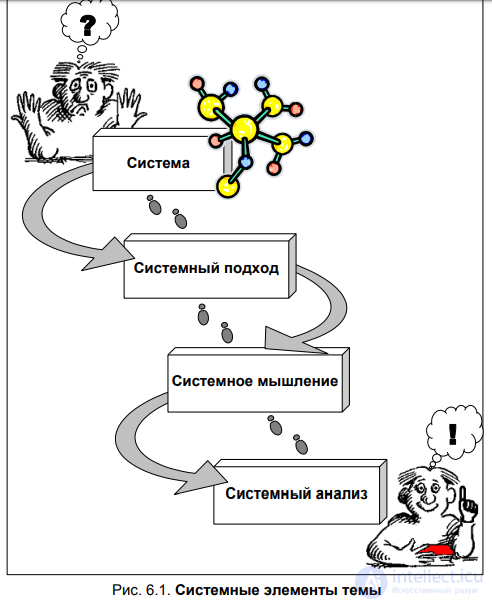
INTRODUCTION TO THE CHAPTER
104
104
The world in which we live is both unified and diverse. The whole multitude of
natural phenomena and processes is permeated with interconnections and mutual influences. Every object is multifaceted and at the same time integral. It is a
certain style of thinking that allows a person to see the world in precisely this way – the so-
called systems thinking. Systems thinking in science and
management is realized in the form of the systems approach. In this chapter we
will try to understand what systems thinking and the systems
approach are, and how they are interconnected. We will see what they should be applied for and what benefit they bring. We will find out what relation the systems
approach has to systems analysis. We will also examine the main stages
of systems analysis and some methods typical of it.
Key concepts of this chapter: system, systems approach,
systems thinking, systems analysis, problem, alternative.
THEORETICAL MATERIAL
§ 6.1. The Concept of a System
The concept of a "system" is one of the most fundamental and most
widespread concepts in science. Probably it is precisely for this reason that a single,
unified definition of this concept does not exist: different levels of abstraction correspond to different formulations. However, in all the definitions
the following is emphasized:
A system is a set of interconnected elements
that form a certain integrity.
In order for the meaning of this formulation to become clear, it is necessary to introduce definitions of the concepts "element", "connection" and "integrity".
An element is the name given to some object (material,
energetic, informational), which, within the framework of a specific
study, it is sufficient to consider without revealing its internal structure (content).
In other words, an element is a relatively indivisible object.
The term "relatively" emphasizes the fact that an element is indivisible only from the point of view of solving a specific task.
A connection is the name given to an exchange, important for the purposes of the study,
of matter, energy, or information between objects (Fig. 6.2).
The most essential and stable interconnections between elements form the structure of the system.
A set of elements forms an integrity if this set acquires new qualities that are absent in the elements forming it.
The property of a system that consists in the appearance of new qualities in it is called the property of emergence (from the English emergent –
arising unexpectedly).
"The whole is greater than the sum of its parts..." Aristotle
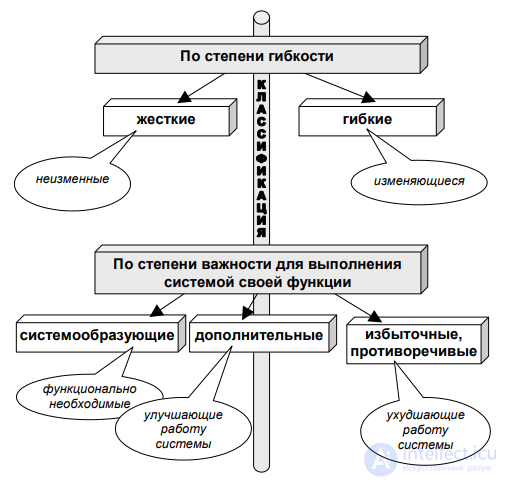
Fig. 6.2. Classifications of connections in a system
The concepts of system, element and integrity are subject to the principle
of relativity. With respect to a system, this principle is formulated as follows:
any set of objects can be considered both as a system and as not a
system. But in that case, how then can one determine whether the set of objects
under consideration is a system in this particular case? To do this, one needs to determine which function (or purpose) of the system serves
as the subject of the study. The fact is that the function of a system appears in
the role of a system-forming factor (for systems of purposeful
action). It is precisely the function that reorganizes the system, freeing it of
superfluous elements and superfluous connections. Each element of an integral system is necessary, while all of them together are sufficient for the system to perform its function.
In order to understand whether the set of objects under consideration is a system, one must answer the question of whether
the set of elements and connections is necessary and sufficient for the
system to perform its function, for the system to achieve its goal.
Systems can be classified according to different criteria.
By the nature of their elements, systems are divided into real (objective, material) and ideal (abstract, conceptual).
Real systems are all objectively existing systems of inorganic and organic nature, as well as social
systems.
Ideal (abstract) systems are systems that exist only in human consciousness in the form of a logically connected set of concepts, judgments, hypotheses and laws.
From the point of view of their origin, systems are divided into natural and artificial.
Artificial systems are systems that are the product of human labor and intellect.
107
107
Natural systems are systems that are the product of the development of nature and that arose without human intervention.
Depending on the nature of their interaction with the environment,
systems are subdivided into open and closed.
Open systems are systems that interact with the
environment through the exchange of matter, energy or information.
Closed systems are systems that have no exchange with the
environment (more precisely, ones that operate with a relatively small exchange).
From the point of view of variability over time, systems are divided into static and dynamic.
Static systems are systems in the study of
which the changes over time in the characteristics of
their essential properties can be neglected. It can be said that a static system
is a system with a single state.
Dynamic systems are systems that change over
time.
According to the degree of influence of random factors on the system, systems are divided into deterministic and stochastic.
A deterministic system is a system that is not
affected by random influences; its behavior is fully predictable.
A stochastic system is a system that is affected by random influences. Its behavior and the result of its action
can be described and foreseen only with a certain degree of
reliability.
According to the degree of complexity, systems are subdivided into simple and complex. The distinguishing features of complex systems are: a great
variety of possible states; the complex nature of the connections between
individual elements; the uncertainty and complexity of the functions
being realized; the presence of functional and structural redundancy (this
feature allows systems to perform their functions when some
108
108
elements fail); interaction with the external environment; the impossibility of a formal description

Comments