
Lecture
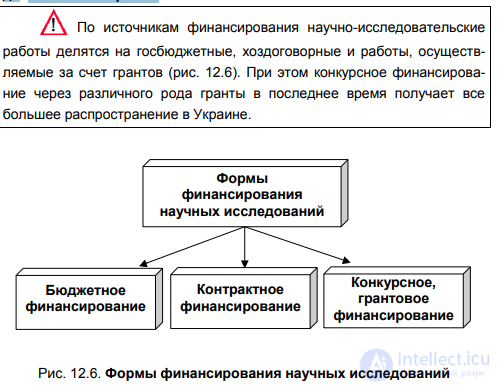
State-budget R&D is R&D that is financed from
funds allocated to the research institution through
the agency to which it is subordinate.
Contract-based R&D is R&D that is financed
by enterprises and agencies of interested branches of the national economy on the basis of specially concluded economic contracts.
A grant (from the Latin gratiis – free of charge) is funds transferred free of charge by a donor (grantor, sponsor, donor) to a private
person or a non-commercial (non-profit) organization and intended for carrying out specific programs in the field of education,
art, culture, environmental protection, as well as for conducting specific scientific research.
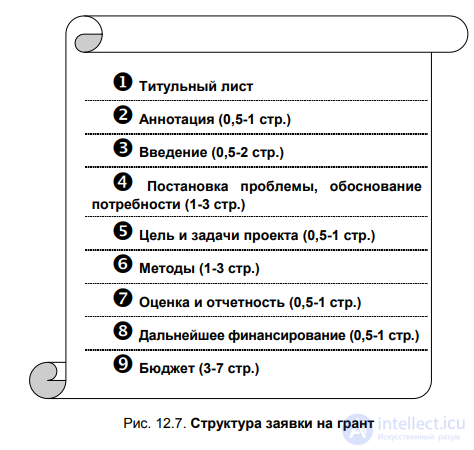
A grant is awarded on the basis of a competitive review by the grantor of applications from persons applying for the grant (Fig. 12.7). The grant recipient
is obliged to provide the grantor with a report on the targeted use of the funding received.
Grantors may be citizens and legal entities, including foreign citizens and legal entities, as well as
international organizations that have received the right to provide
grants on the territory of Ukraine.
Interesting fact. According to sociologists' estimates, searching for information about grantors, analyzing it and drawing up applications for
grants takes European and American scientists up to 20%
or even 30% of their working time [47].
A special case of the grant form of financing is
grant support provided by national scientific foundations (Example 12.1). This form of financing involves:
- a scientific assessment of each project, ensuring strict control over the use of state funds,
- competition among scientists at the national level,
- uniformity of selection and financing criteria,
- national recognition of scientists' merits, important for their scientific
growth.
Example 12.1
On grant support
provided by national scientific foundations
In his interview to the journal "EKO", academician of the Russian Academy
of Sciences, director of the Institute of Economics of the Russian Academy of Sciences Leonid Abalkin assessed
the activity of national scientific foundations (in particular, the Russian
235
235
Humanitarian Science Foundation and the Russian Foundation for Basic
Research) in the field of grant provision as follows: "A multi-channel system of financing science is taking shape, which gives a certain
flexibility and freedom of behavior. The Academy of Sciences finances the institute, not
the problem, not the structure, not a specific topic or idea. This is normal, if you recognize that the country needs the institute. There must be some basic funding... And there is a second channel. If some problem is singled out that is important from a national-economic, state, or socio-political point of view... then it requires support. We defend the project, competitive selection takes place, a certain system of priorities is built up, and it is not officials but scientists who take part in the evaluation. In
the end, a combination is obtained of a basic, stable part and a flexible, mobile system for advancing priority directions, for the search for new
approaches. Both support for research scientists, who receive more or less decent material support, and
the solution of the problems themselves, which yield a large national-economic
return, are ensured. I think that in principle this model is well conceived and has
a future" [43].
PRACTICAL COMPONENT
DRAWING UP A GRANT APPLICATION
Purpose of the assignment:
- to gain experience in drawing up an application for a grant to
finance a scientific study.
Supporting material
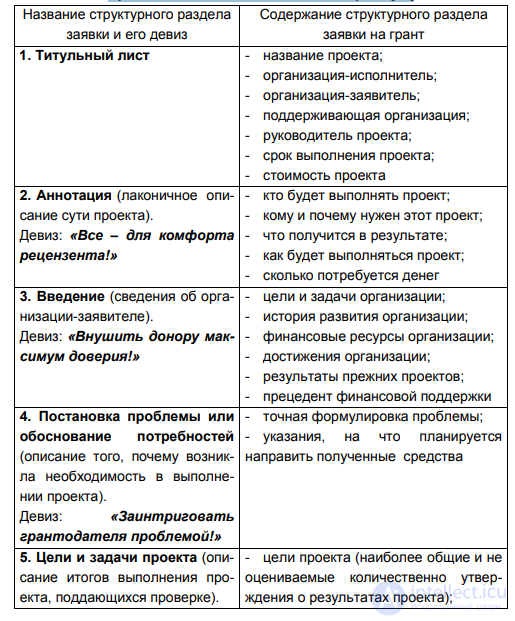
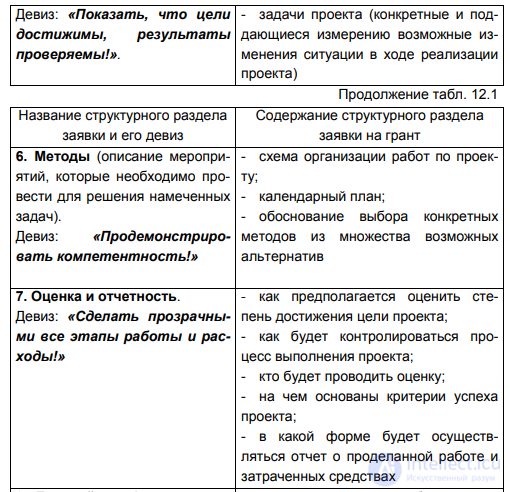
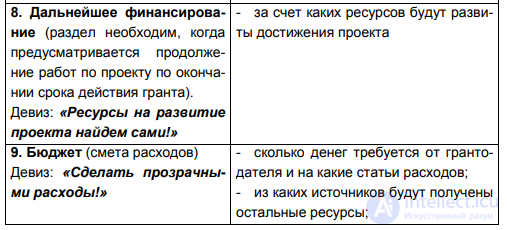
As the authors state [47], the ability to write grant applications resembles an art in the sense that this ability cannot be taught by means of some algorithm, but it can and must be learned in practice, through repeatedly drafting written appeals to grantors. The work of drawing up applications can be made somewhat easier by
recommendations from specialists experienced in this matter. Recommendations regarding drawing up the structure and content of a grant application
are given in Table 12.1.
Table 12.1 Principles of drawing up a grant application [47]

Assignment
1. Based on the recommendations presented in Table 12.1, draw up an application for a grant to finance your research work.
2. Using Internet resources, find a potential sponsor
to provide a grant for your research.
REVIEW QUESTIONS
1. What kinds of activity fall under the concept of scientific activity?
2. In what forms is the organization of scientific research carried out?
3. What forms of financing of scientific research exist in Ukraine?
4. Which organization is the highest scientific organization
of Ukraine?
5. What is contract-based R&D?
6. What is the specific nature of the grant form of financing
research work?
7. What are the principles of drawing up a grant application?
SUMMARY
Let us sum up what was set out in Chapter 12:
Scientific activity includes, besides research, also scientific-pedagogical, scientific-organizational and other kinds of activity.
The highest scientific organization of Ukraine is the National
Academy of Sciences of Ukraine. It has 13 departments of sciences, which
bring together research institutes of the corresponding
orientation. Besides NASU, the Ukrainian system of academies of sciences in-
239
239
cludes also branch academies of sciences and non-state specialized academies.
The traditional forms of organizing scientific
research for Ukraine are the factory, branch, university and academic forms. In recent years our country has been borrowing new forms of organizing R&D from the practice of other countries (project
firms, project teams and innovative spin-off firms are appearing).
The traditional forms of financing scientific research for Ukraine are budgetary and contract-based financing.
Recently, alongside these, competitive financing through various kinds of grants
has been acquiring increasing importance.
Grants are awarded on the basis of a competitive review by grantors of applications from persons applying for the grant. The purpose of drawing up a grant application is to interest the grantor in the problem and the possible results of the project, as well as to instill in them maximum confidence regarding the targeted and effective use of
the funds received.

Comments