The concept of "science" has several main meanings. First, science is understood as a sphere of human activity aimed at producing and systematising new knowledge about nature, society, thought and the cognition of the surrounding world. In its second meaning, science appears as the result of this activity – the system of scientific knowledge obtained. Third, science is understood as one of the forms of social consciousness, a social institution.
The immediate goal of science – is the attainment of objective truth, obtained as a result of knowledge about the objective and the subjective world.
Classifications of the Sciences in Ancient Times
- Attempts to classify the fields of human knowledge on various grounds were made as far back as antiquity. Thus Aristotle distinguished three large groups of such fields: theoretical (physics and philosophy), practical (ethics and politics), and poetic (aesthetics).
- The classification of the Roman encyclopaedist Marcus Varro included the following disciplines: grammar, dialectic, rhetoric, geometry, arithmetic, astrology, music, medicine and architecture.
- Muslim Arab scholars divided the sciences into Arabic sciences (poetics, oratory) and foreign sciences (astronomy, medicine, mathematics).
The universe as understood by Aristotle and Ptolemy, from Peter Apian's work "Cosmographia", 1524. The Earth consists of four elements: earth, water, fire and air. The Earth does not move and does not rotate. It is surrounded by concentric spheres containing the planets, the sun, the stars and the heavens. [4
Attempts to Classify the Sciences in the Middle Ages
- Hugh of Saint-Victor, in the Didascalicon, divides the sciences into four groups:
- Theoretical sciences (mathematics, physics).
- Practical sciences.
- Mechanical sciences (navigation, agriculture, hunting, medicine, theatre).
- Logic, including grammar and rhetoric.
- Roger Bacon likewise distinguished four classes of sciences: grammar and logic, mathematics, natural philosophy, and metaphysics and ethics. In doing so, he considered mathematics to be the foundation of the sciences of nature.

Portrait of Luca Pacioli and an Unknown Young Man, by Jacopo de' Barbari (1460-1516)
1500
Lev Landau had a playful classification of the sciences: he called the natural sciences natural; the sciences created by humans about humans (that is, the humanities) he called unnatural; and the mathematical sciences he assigned to the supernatural. Not only Landau's classification, but any other classification of the sciences, is quite conventional. However, there exists a generally accepted classification that one needs to know, if only so as not to get confused in a library catalogue (Fig. 1.6.).
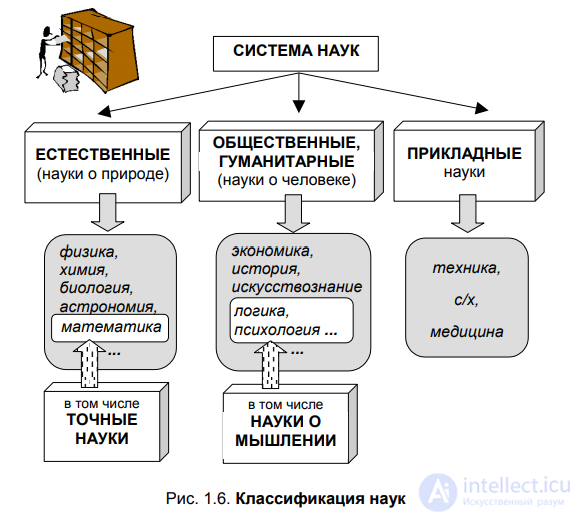
Besides librarianship, the classification of the sciences is used in the following areas:
- - in forming the structure of scientific institutions;
- - in developing curricula for universities;
- - in determining the content of textbooks and study aids;
- - in planning and coordinating scientific research;
- - in establishing connections between science and practice.
- - in writing works of an encyclopaedic character.
Tasks of science: gathering, describing, analysing, generalising and explaining facts; discovering the laws governing the movement of nature, society, thought and cognition; systematising the knowledge obtained; explaining the essence of phenomena and processes; forecasting events, phenomena and processes; establishing the directions and forms of the practical use of the knowledge obtained.
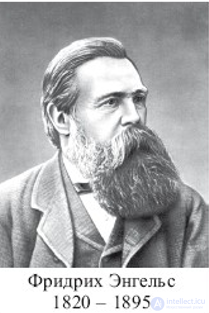
F. Engels' Classification of the Sciences
Based on the development of moving matter from lower to higher forms:
- mechanics,
- physics,
- chemistry,
- biology,
- the social sciences
B.M. Kedrov's Classification of the Sciences
- subatomic-physical,
- chemical,
- molecular-physical,
- geological,
- biological
- social.
Classification of the sciences depending on the sphere, subject and method of cognition:
- about nature — the natural sciences;
- about society - the humanities and social sciences;
- about thought and cognition - logic, gnoseology, epistemology, etc.
Classification of the sciences:
By subject and method of cognition:
1) natural sciences – sciences about nature;
2) humanities – sciences about society and humankind;
3) technical sciences – sciences about artificial objects.
By "distance from practice":
- - fundamental (research oriented toward increasing subject-matter knowledge, fixed in the form of the most general concepts and laws);
- - applied (research oriented toward increasing subject-matter knowledge used directly to solve practical problems).
By fields of education
- natural sciences and mathematics (mechanics, physics, chemistry, biology, soil science, geography, hydrometeorology, geology, ecology, etc.);
- humanities and socio-economic sciences (cultural studies, theology, philology, philosophy, linguistics, journalism, book studies, history, political science, psychology, social work, sociology, regional studies, management, economics, art, physical education, commerce, agricultural economics, statistics, art, jurisprudence, etc.);
- technical sciences (construction, printing, telecommunications, metallurgy, mining, electronics and microelectronics, geodesy, radio engineering, architecture, etc.);
- agricultural sciences (agronomy, animal husbandry, veterinary medicine, agricultural engineering, forestry, fisheries, etc.).
Branches of Science in the Nomenclature of Specialities of Scientific Workers
- physical and mathematical,
- chemical,
- biological,
- geological and mineralogical,
- technical,
- agricultural,
- historical,
- economic,
- philosophical,
- philological
- geographical,
- legal,
- pedagogical,
- medical,
- pharmaceutical,
- veterinary,
- art history,
- architecture,
- psychological,
- sociological,
- political,
- cultural studies
- earth sciences
Theoretical and applied sciences
- philosophy,
- fundamental sciences
- particular sciences.
Classification of the so-called "interface" sciences:
- intermediate sciences, arising at the boundary of two neighbouring sciences (for example, mathematical logic, physical chemistry);
- hybrid sciences, formed by combining the principles and methods of two sciences distant from one another (for example, geophysics, economic geography);
- complex sciences, formed by the hybridisation of a number of theoretical sciences (for example, oceanology, cybernetics, science of science) .
Classification of the Sciences by the Departmental Affiliation of Science Sectors
- academic,
- branch (sectoral),
- university,
- factory (in-house).
See also
See also




Comments