
Lecture
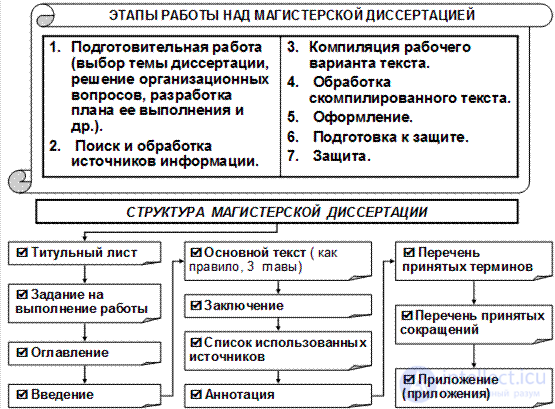
The defence of a master's thesis takes place publicly at a meeting of the State Examination Commission. For the defence of master's theses, a State Examination Commission (SEC) is set up by order of the rector, made up of the most experienced members of the teaching staff. The Commission holds its meetings openly and according to a schedule of its work, which is approved by the rector of the university. The defence must take the character of a scholarly discussion and proceed in an atmosphere of high standards, principled conduct and observance of scholarly ethics; in doing so, the reliability and validity of all conclusions and recommendations of a scientific and practical nature contained in the master's thesis must undergo thorough analysis.
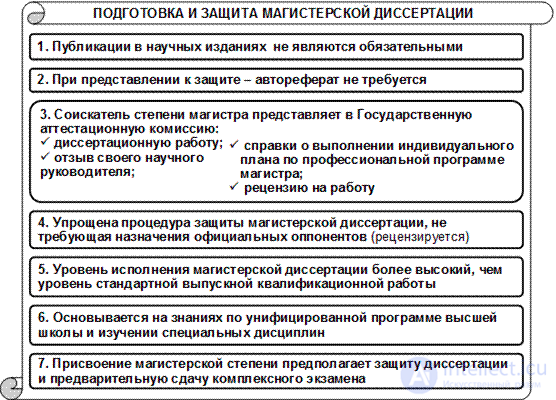
The package of documents that must be submitted for the defence of a master's thesis:
the full text of the master's thesis on paper (bound in a hard cover);
illustrative material for the master's thesis (posters);
materials that characterise the scientific and practical value of the work: printed articles, methodological developments, etc. (if any);
the supervisor's review;
a review signed by the dean of the faculty.
A meeting of the SEC is considered valid if at least two-thirds of its members take part in its work, and it begins with the chairperson announcing the defence of the master's thesis, naming its title and the surname, first name and patronymic of its author. The chairperson reads out a certificate on the master's student's completion of the curriculum.
Then the floor is given to the candidate themselves to report the main results of the research. Through their presentation they demonstrate a high level of theoretical training, erudition and the ability to present the main results of the research conducted in an accessible way. The presentation should focus on the new theoretical and applied propositions developed personally by the author of the master's thesis.
Up to 10 minutes is allotted for the student's presentation before the SEC. The text of the presentation must be agreed with the supervisor. Naturally, it is desirable to refer to the material presented on the posters, and it is also possible to use prepared slides, films and videos.
All materials placed on the posters must be arranged so that the candidate can demonstrate them without particular difficulty and so that they are visible to everyone present in the hall.
Since not only the content of the presentation text but also the manner of its delivery (or retelling) and the confidence of the answers to questions asked largely determine the assessment of the defence, it is worth noting some rules of public speaking:
It is especially important that the candidate's speech be clear, grammatically precise and confident, which makes it understandable and convincing. This does not at all mean that the presentation should be prepared in some simplified form, given that the SEC is made up of scholars from various specialties. On the contrary, the candidate should set themselves the task of making the presentation strictly scholarly and well argued in content. Then it will be understandable to a broad audience of specialists.
The candidate's speech must be not only clear and confident but also expressive, which depends on pace, volume and intonation. If they speak hurriedly, swallowing the endings of words, or very quietly and indistinctly, the quality of the presentation drops sharply as a result. A calm, unhurried manner of delivery always appeals to listeners.
It is completely unacceptable to violate the so-called norms of literary pronunciation, in particular, the use of incorrect stress in words.
A few tips can be given to help the candidate prepare the text of their presentation:
write out all numbers in the text in words only, so that you do not have to count zeros;
underline the words to be emphasised;
leave wide margins when typing, so that the speech can be supplemented with your own remarks;
repeat nouns, avoiding pronouns;
use simple words and simple affirmative sentences;
do not overload the text with subordinate clauses.
One should also consider such matters as the choice of clothing, posture during the presentation, as well as gestures, manners and other external forms of behaviour. All of this is important for the candidate. A certain elegance, neatness and trimness in dress (without emphasising foppishness) contributes to a favourable impression and to the goodwill of the SEC members, as well as of everyone present at the defence, towards them.
The candidate delivers their presentation standing, drawing attention with a pointer to various objects depicted on the posters or figures. It leaves an unattractive impression when the presenter walks up and down along the table with the SEC members during the presentation.
After the presentation, the content of the review is announced, or the floor is given to the reviewer for a statement (if they are present at the defence).
After this, the members of the SEC may verbally ask any questions on the sections of the master's thesis and the research methods, and clarify the results and procedure of the experimental work. In addition, all specialists and guests present at the defence of the master's thesis have the right to ask questions and receive answers to them.
When answering their questions, one should address only the substance of the matter. The candidate should show modesty in assessing their own scientific results and tact towards those asking questions.
Before answering a question, one must listen to it carefully. It is preferable to answer each question as it is asked, rather than hearing out all the questions and then answering them afterwards. At the same time, it should be kept in mind that a clear, logical and well-reasoned answer to a previous question may pre-empt a subsequent one.
The defence of a single master's thesis lasts no more than 30 minutes.
After the answers to the questions, comments and wishes of the members of the commission, the main part of the procedure for the defence of the master's thesis can be considered complete.
Based on the results of the defence of the master's thesis, the SEC, at its closed meeting, takes a decision on the grade for each master's thesis individually and on awarding the student a qualification, issuing them a diploma of the state-approved form (the standard form or with honours).
A master's thesis is not admitted to defence if it:
has not passed a preliminary defence at the profiling department, as evidenced by the minutes of the department meeting;
was submitted to the supervisor for review in violation of the deadlines set by the master's student's individual plan for completing the master's thesis;
was written on a topic that was not approved in time by order of the rector of the university, or was not corrected in time;
has no review from the supervisor or an external review.
A repeat defence of a master's thesis for the purpose of raising the grade is not permitted.
The SEC's decision is announced publicly on the day of the defence of master's theses. It is final and not subject to appeal. The grade determined by the commission is recorded in the minutes of the SEC.
A student who receives an unsatisfactory grade at the defence of a master's thesis must be expelled from the university, and in this case is issued an academic transcript of the established form. They have the right to be re-admitted to the defence of a master's thesis within the following three years during the period the SEC is in session.
In the event of an unsatisfactory grade being given, the SEC determines whether the student may submit the same work for a repeat defence after revision, or whether they must work on a new topic determined by the profiling department.
If a student fails to appear at a meeting of the SEC for the defence of a master's thesis, it is noted in the minutes of the commission that they are unassessed due to non-attendance at the meeting of the SEC.
The criteria for assessing master's dissertations come down to the following points. The SEC assesses all stages of the dissertation defence: the presentation of the work's results, the understanding of the questions posed to the master's student by the SEC members and the answers to them, the ability to conduct a scholarly discussion with the reviewer, the qualification and general level of understanding of the problem studied demonstrated by the master's student during the defence, and the general level of culture in communicating with the audience. When determining the final grade, account is taken of the preliminary grade given by the reviewer, as well as the grades given for the defence by each member of the SEC. The final grade based on the results of the master's student's defence is determined as the arithmetic mean of the grades given by the members of the SEC and the reviewer. In the event of a disputed final grade, the chairperson of the SEC has the right of a casting vote. The final grade may differ from the preliminary assessments of the work.
| Quality indicators | Grade | |
|
Name of criterion |
Scientific, theoretical level and relevance of the topic |
|
|
The topic is relevant, the decisions taken and the conclusions reached are based on scientific achievements and accumulated practical experience, are original in character, thoroughly thought through, well substantiated and expedient |
Excellent 90-100 points A |
|
|
|
The same as "excellent", except that not all the questions considered in the master's dissertation have been studied deeply enough |
Good 75-89 B |
|
|
The scientific content and subject matter of the work generally meet the requirements of the higher professional education programme within the field of study, however the questions considered have not been studied deeply enough |
Satisfactory 50-74 C |
|
|
The scientific content and subject matter of the work are not relevant and do not meet the requirements of the higher professional education programme |
Unsatisfactory below 50 |
|
Name of criterion |
Student's personal contribution to the development of the topic | |
|
The work was carried out independently, with elements of creativity, a well-considered use of the theoretical knowledge and practical skills acquired. The results obtained in the course of the research are brought to completion with well-substantiated concrete conclusions, proposals and recommendations for their implementation |
Excellent 90-100 points A |
|
|
The work was carried out fairly independently, with elements of creativity, however not all the conclusions drawn from the results of the research are deeply substantiated. Individual proposals and recommendations are of no practical interest |
Good 75-89 B |
|
|
The work was not carried out sufficiently independently. The student experienced difficulties in determining the subject and object of the research, as well as in formulating the research concept. The research was not conducted deeply enough, the topic is not fully disclosed, the conclusions and proposals are insufficiently substantiated, unspecific, of a general character and poorly supported by personally obtained results |
Satisfactory 50-74 C |
|
|
The work is not independent in character but represents a compilation of literary sources. The conclusions do not reflect the content of the material, the proposals for their implementation are not specific |
Unsatisfactory below 50 |
|
|
Name of criterion |
Quality of formatting of the final qualification paper | |
|
The volume of the work meets the established requirements. The material is presented competently, in a logically consistent manner, the text of the work and the illustrative material are formatted in accordance with the requirements of the regulatory documents |
Excellent 90-100 points A |
|
|
The same as "excellent", except that there are certain violations of the requirements of the regulatory documents on formatting |
Good 75-89 B |
|
|
The volume of the work does not fully meet the standards. The material is presented insufficiently consistently. The text of the work and the illustrative material are formatted with violations of the requirements of the regulatory documents |
Satisfactory 50-74 C |
|
|
The volume of the work does not meet the established standards. The material is presented inconsistently. The structure of the work is not maintained. The text of the work and the illustrative material are formatted poorly, with violations of the requirements of the regulatory documents |
Unsatisfactory below 50 |
|
|
Name of criterion |
Quality of the defence of the master's final qualification paper | |
|
The presentation is substantive, deeply argued, with a well-considered use of illustrations. The material is presented fluently, competently, confidently and methodically consistently. The student demonstrated a firm knowledge of the research topic, substantiating the decisions taken; gave satisfactory answers to all the questions asked |
Excellent 90-100 points A |
|
|
The same as "excellent", except that the student did not give clear answers to all the questions |
Good 75-89 B |
|
|
The presentation mostly discloses the content of the work, but is insufficiently argued. During the presentation a previously prepared text is used from time to time. On the whole the degree candidate demonstrated knowledge of the research topic, although exhaustive answers were not given to all the questions asked |
Satisfactory 50-74 C |
|
|
The presentation is delivered mostly using a text prepared in advance and poorly discloses the content of the work. The illustrative material is used without proper thought, the argumentation is insufficient. Correct answers were not given to most of the questions from the members of the State Attestation Commission. The student has a poor command of the research topic |
Unsatisfactory below 50 |
What is the procedure for conducting a preliminary defence of a master's thesis?
What is the procedure for the defence of a master's thesis?
Within what period must the student submit the completed work to their supervisor?
Within what deadlines must the work be signed by the supervisor, the standards inspector, and the head of department?
What parts does the presentation consist of. What should be paid attention to in the presentation?
Answers to which questions will help candidates successfully prepare their presentation?
What requirements are placed on the composition of speech during the defence of a master's thesis?
How should one prepare to respond to the reviewer's comments?
What are the main requirements for reviewing a master's thesis?
What documents need to be prepared for the public defence of a master's thesis?
How does the defence of a master's thesis proceed after the presentation is delivered?
What are the main rules of conduct for a master's student during the defence?
In what cases is a master's thesis not admitted to defence?

Comments