
Lecture
What needs to be done in the course of a scientific research study? What facts should be collected? What experiments should be conducted? Answers to these questions take shape at the stages of developing the hypothesis, the procedure, and the working plan of the study. The initial direction and scope of the work is set by the working hypothesis, refined in the process of determining the research procedure and fixed in the working plan.
... For the experimenter ... it is far more advantageous to work with poor hypotheses than with no hypotheses at all, when it is unknown what needs to be tested
(N.K. Koltsov, Soviet biologist-geneticist).
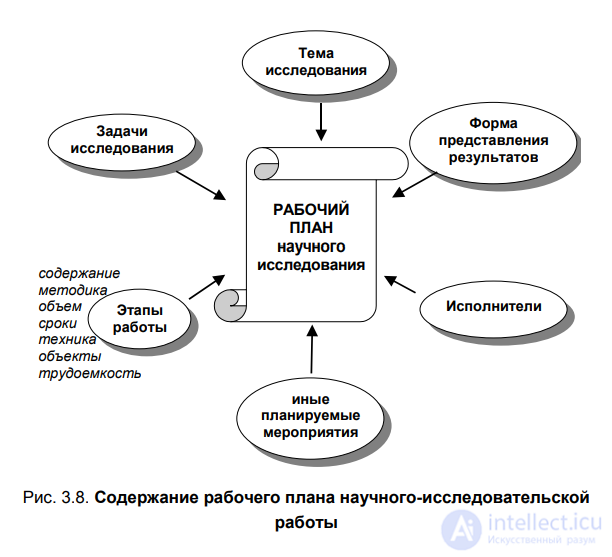
A carefully thought-out working plan is an essential condition for the rational organisation of scientific work. It should, as a rule, be drawn up after the hypothesis and research procedure have been developed. In certain cases, when the basis of the study is an analysis of literary sources, the working plan is formed at the very beginning of the research work. Together with the working plan, an explanatory note is usually drawn up for it, which contains a justification of the topic, brief information on the current state of the problem under consideration, a detailed description of the tasks and goals, as well as a justification of the working hypothesis of the study.
The joint work of the researcher and their supervisor begins with drawing up a plan for writing the scientific work. Such a plan is the main guiding document that determines the specialisation, content, scope, deadlines and forms of certification, and the topic of the work is also formulated, the completion of which is carried out according to a separate, so-called working plan.
Subsequently, the academic supervisor helps the degree candidate draw up a working plan for the research study. The duties of the academic supervisor also include drawing up a schedule of the candidate's work. In addition, the academic supervisor:
Thus, the supervisor provides scientific and methodological assistance, systematically monitors the progress of the work, makes certain adjustments, gives recommendations on the advisability of adopting one or another decision, as well as a conclusion on the readiness of the work as a whole.
Work on the research study begins with the development of the topic, i.e. the conception of the intended scientific research. It is possible that such a conception will be based on nothing more than a hypothesis, i.e. an assumption, formulated either on the basis of intuition (a premonition) or on a preliminarily developed version (that is, on a statement of something for the purpose of a preliminary explanation). But even such an approach to the matter will make it possible to systematise and organise all subsequent work.
Initially, the working plan characterises the subject of the study only in its main outlines; however, in the course of further work such a plan can and should be refined, while the main task facing the work as a whole must remain unchanged.
The working plan has a free form. Usually it is a plan-rubricator, consisting of a list of headings arranged in a column, linked by the internal logic of researching the given topic. Such a plan is used at the first stages of the work, making it possible to present the problem under study "in outline" in various versions. It is advisable to write the individual headings of the plan on separate cards (or strips of paper). This will make it possible, as a result of a series of mechanical rearrangements, to find the most logical and acceptable arrangement scheme for the given study.
At later stages of the work, a plan-prospectus is drawn up, that is, a plan that represents a summary presentation, arranged in logical order, of the questions according to which all the collected factual material will subsequently be systematised. Further, by systematically including more and more new data in such a plan, it can be brought to the final structural and factual outline of the scientific work. In practice, the plan-prospectus is already a draft table of contents of the scientific work with a summary disclosure of the content of its chapters and sections.
Thus, at the next stage of planning the scientific research, a refined working plan is drawn up with all the details and the greatest specification of tasks.
The degree candidate needs to understand the order and logical sequence of the planned work. With organisational sequencing, tasks are carried out depending on the availability of opportunity, and the order of their execution may change, provided that within a given period of work they are all completed.
Logical sequence dictates the disclosure of the essence of the task. Until the first section has been studied, one cannot move on to the second. It is important to learn to find in any work the main, decisive point on which all attention should be concentrated. This will make it possible to find optimal solutions for the planned tasks as well.
The researcher determines the general overall goal of their work, formulates the central task, identifies all available resources for carrying out the conception and idea, selects the necessary methods and techniques of action, and finds the most convenient time for performing each operation.
In creative research, the plan always has a dynamic, flexible character and cannot and must not constrain the development of the researcher's idea and conception, while a clear and definite scientific direction in the work is maintained.
Given the specifics of the creative process, the research plan should provide for everything that can be foreseen in advance. Of course, chance discoveries are also possible in science, but one cannot build scientific research relying on chance.

Comments