Models can be classified according to various criteria.
Depending on the nature of the modelling tools used, models are divided into abstract and material ones (Fig. 10.5).
- Material (real, tangible) models are models constructed by means of the material world.
- Abstract (ideal) models are ideal constructs, built by means of human thought and consciousness.
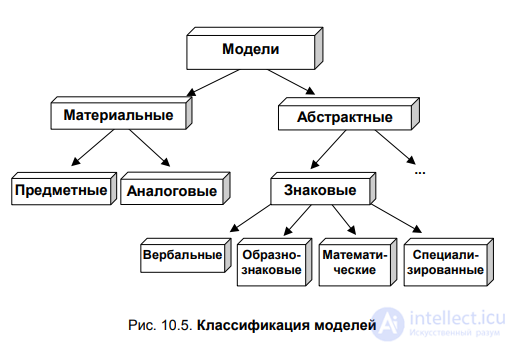
Among abstract models, a distinction is made between models built by means of natural language, and sign models, which are recorded using special signs and symbols, that is, by means of any formal language. Abstract models based on natural language are characterised by ambiguity and approximateness. In order to achieve unambiguous definiteness when constructing sign models, artificial languages are used, as well as
formalised dialects of natural language. The universal language of modelling is the artificial language of mathematics.
Sign models include verbal, figurative-symbolic and mathematical models.
- A verbal (textual) model is a model recorded in a formalised dialect of natural language and reflecting the essential features of a certain area of reality. Examples of this kind of model are traffic regulations and a company's charter.
- Figurative-symbolic (graphical) models are models presented in the form of drawings, graphs, diagrams, and tables.
- A mathematical model is a model reflecting the essential features of an object by means of mathematical relations (systems of equations, inequalities, logical relations). Material models are divided into physical and analogue models – depending on the type of similarity between the model and the original.
- A physical (scale) model is a model based on direct similarity to the original. In the case of direct similarity, the model and the prototype have a similar structure or the same nature of the processes occurring in them. Examples of direct similarity are photographs, models of ships and aircraft, and mock-ups of buildings and enterprises.
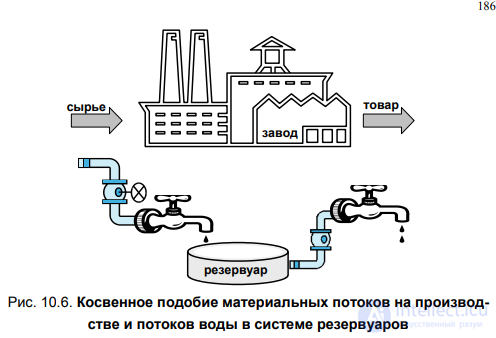
- An analogue model is a model based on indirect similarity to the original. In the case of indirect similarity, the prototype and the model have a different physical nature of the processes occurring in them, but these processes are described by identical mathematical relations. For example, certain regularities of mechanical and electrical processes are described by identical equations (Fig. 10.6).
Depending on the purposes of modelling, models are divided into
descriptive and normative ones.
- Descriptive (cognitive) models are models that reflect the existing or predicted behaviour of an object and answer the question «What is (was, will be) the case in reality?». The main requirement for a descriptive model is an adequate reflection of reality. When a discrepancy is found between a descriptive model and reality, this discrepancy is eliminated by changing the model.
- Normative (pragmatic) models are models that reflect the desired behaviour of an object and answer the question «How should it be?». Normative models are prescriptive in nature and serve as a means of representing goals. When a discrepancy is found between a normative model and reality, the task is to change reality in such a way as to bring it closer to the model. Examples of normative models: plans and programmes of action, the charters of organisations, codes of law, job descriptions, examination requirements.
From the point of view of taking the time factor into account, models are divided into
static and dynamic ones.
- A static model is a model of a specific state of an object (as it were a «snapshot» of the object). An example of a static model is the structural model of the subject area of the study.
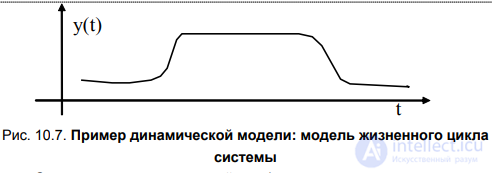
- A dynamic model is a model that displays the process of change in the state of an object over time (Fig. 10.7).
From the point of view of taking random factors into account, models are divided into deterministic and stochastic ones.
- A deterministic model is a model in which the influence of random factors is not taken into account, so that the values of the output quantities are uniquely determined by the input parameters.
- A stochastic model is a model that displays the course of random processes. The result of a stochastic model is determined with a certain degree of reliability (i.e. the result is not uniquely determined by the input parameters).
Depending on how fully the model takes into account
the internal structure of the object being modelled, the following
types of models are distinguished: a «black box», a composition model, a structure model, and
a structural diagram of the system.
- The “black box” model is a model that displays only the connections of the system with its environment, without describing its internal structure, arrangement and the processes occurring within it (Fig. 10.8).
- A composition model is a model reflecting the internal composition of a system, that is, the set of its subsystems and elements (Fig. 10.9).
- A structure model is a model reflecting the relations between the elements of a system. In practice, relations are usually not considered without elements, so a structure model is often combined with the composition model of the system.
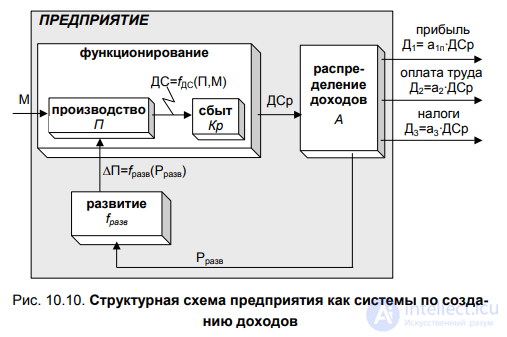
- The structural diagram of a system (a «white box» or a «transparent box») is a model reflecting the elements of the system, the connections between the elements, and also the connections of the system with its environment. The structural diagram of a system represents a combination of the «black box» model, the composition model, and the structure model of the system (Fig. 10.10).
A representation of the structural diagram of a system is often made in the form of a graph.
The connections of the system with its environment are described in models in terms of the input
and output parameters of the system («inputs» and «outputs»). Input parameters describe the effects of the environment on the system. Output parameters describe the effects of the system on the environment. Input parameters can be regarded as control actions, and the desired values of the outputs – as the goal of control.
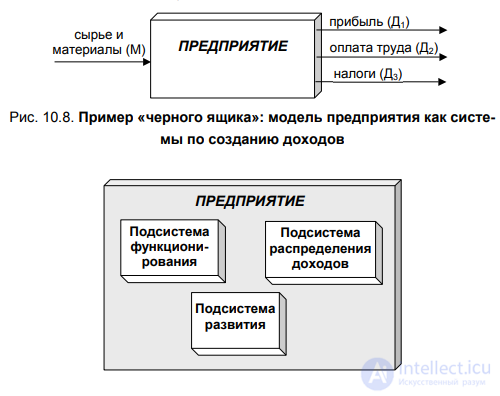
Fig. 10.9. Composition model of an enterprise as a system for generating income
See also
- [[b5835]]
- modelling
- [[b5235]]
- [[b9005]]
See also


Comments