
Lecture 19 min.
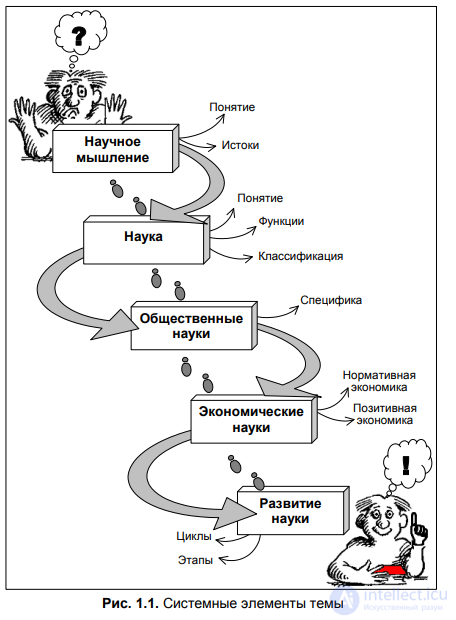
The purpose of this chapter – is to give a general idea of science and scientific thinking, to explain the key concepts of science, non-science, pseudoscience, protoscience, and the phenomenon of science, to awaken in the reader an interest in these phenomena of human life, and to show that scientific thinking is by no means divorced from everyday thinking, that some of its elements are familiar to all of us since childhood, and that some of it will be useful in professional activity. We will also show that the social sciences possess an interesting specificity, and that any scientific discipline – is a highly dynamic phenomenon, passing through its own stages of development and experiencing crises and even revolutions. Thus, in this chapter we will not delve into the details of organizing scientific research, but will touch on general questions of the philosophy and history of science.
Our tasks include answering the following questions:
The phenomenon of science — is a special socio-cultural phenomenon and a form of human cognitive activity aimed at obtaining objective, systematized and verifiable knowledge about nature, society and man.
The phenomenon of science — is science as a special phenomenon of human culture and society, by means of which a person obtains, verifies, systematizes and explains knowledge about the world.
Put simply: science — is not just a set of facts, but a special way of understanding reality.
The word «phenomenon» means an occurrence that is of interest for study. Therefore, when philosophers speak of the «phenomenon of science», they are considering not only scientific discoveries, but also questions such as:
Science — is activity aimed at obtaining objective, systematized and verifiable knowledge about the world.
Main features:
Example: physics, chemistry, biology, astronomy.
Non-science — is knowledge or ways of understanding that do not meet the requirements of scientific research, but which are not necessarily false or harmful.
Non-scientific knowledge can be based on:
Example: the statement «this music gives me a feeling of calm» — is personal experience, not a scientific theory.
Important: non-science ≠ falsehood. It simply uses other ways of understanding.
Pseudoscience — is a body of teaching that presents itself as scientific, using scientific terms and the outward appearance of science, but not meeting its main criteria.
Typical signs:
Examples: astrology as a way of scientifically predicting character and the future, «healing» methods without proven effectiveness, and certain theories about «bioenergy» without confirmation.
Protoscience — is knowledge and ideas that preceded modern science and were on the path toward its formation.
Protoscience is especially characteristic of antiquity and the Middle Ages.
Example:
alchemy → chemistry
astrology and ancient astronomy → modern astronomy
Alchemy was not modern chemistry, but some of its experiments, methods and knowledge about substances later contributed to the development of chemistry.
| Concept | What is it? | Example |
|---|---|---|
| Science | Verifiable and systematized knowledge | Physics |
| Non-science | Knowledge outside the scientific method | Art, personal experience |
| Pseudoscience | Imitation of science without sufficient grounds | Astrology as a «scientific» prediction |
| Protoscience | Predecessor of established science | Alchemy → chemistry |
Conclusions:
Science — investigates and proves.
Non-science — understands the world in other ways.
Pseudoscience — portrays itself as science, but does not meet its requirements.
Protoscience — historically precedes science and can contribute to its emergence.
Demarcation — is differentiation.
The problem of demarcation in the philosophy of science — is the question:
By what criteria can scientific knowledge be distinguished from non-scientific and pseudoscientific knowledge?
The problem turned out to be difficult, because it is hard to find a single universal criterion of science.
The philosopher Karl Popper proposed an important criterion: falsifiability.
The idea is simple:
A scientific statement must allow for the possibility of a test which could, in principle, show that it is wrong.
For example:
«All metals expand when heated» — is a scientific statement, because an experiment can be carried out and an attempt made to find a metal that behaves differently.
But a statement of the type:
«There exists an invisible force that always acts, but that cannot be detected» — cannot be normally verified or refuted. It is therefore difficult to consider it scientific.
Falsifiability, too, does not fully resolve the question. In real science, a single experiment can contradict a theory because of a measurement error, incorrect initial assumptions, or particular features of the conditions.
Therefore, today people usually speak not of a single sign, but of a set of criteria of scientificity.
The problem of demarcation — is the philosophical problem of determining the criteria that allow science to be distinguished from non-science and pseudoscience. One of the well-known solutions is Karl Popper's criterion of falsifiability.
The key to understanding the essence of science, and the most important attribute of scientific activity, is scientific thinking. We will therefore begin our discussion of science by examining the specific properties of scientific thinking in comparison with everyday thinking.
Throughout his entire life, a person comes to know the surrounding world.
Colors, sounds, smells – these become accessible to us thanks to the five senses. This level of cognition is called sensory. However, not all knowledge about the world can be obtained at the sensory level of cognition. There is no specialized sense organ that would pick up regularities the way, for example, it would pick up the smell of shashlik. There is no sense organ that would allow one to «feel out» the causes and consequences of events. The sensory way of cognition does not allow one to penetrate into the essence of things. Laws, regularities, and cause-and-effect relationships cannot be reflected directly in our consciousness, the way taste or color can.
A person reflects the essential connections between phenomena indirectly – by comparing various facts. It is precisely in this way that the process of thinking is carried out.
Thinking – is one of the cognitive processes of the personality (alongside sensation, perception, memory and imagination), representing a reflection, in a person's consciousness, of the essence
of the objects and processes of the objective world, their essential properties and the relationships between them. Thinking makes it possible to obtain knowledge about such objects, properties and relationships as cannot be directly perceived at the sensory level of cognition.
Thinking is classified into everyday (ordinary) and scientific.
Everyday thinking – is thinking based on common sense, on so-called everyday experience, generalized by means of a primitive logical analysis.
Scientific thinking – is thinking directed at understanding the deep essence of the real world and conforming to the criteria of evidentiality, objectivity, and systematicity (Fig. 1.2).
«All of science is nothing other than a refinement of everyday thinking». Einstein
Researchers of the processes of thinking gradually came to the conclusion that everyday thinking is not so «unscientific», and scientific thinking is not so detached from everyday life. Both kinds of
thinking are based on the same mechanisms of cognition. Both kinds of thinking are prone to the same errors (for example, the error of «after this – therefore because of this»). Both kinds of thinking make broad use
of the technique of abstraction.
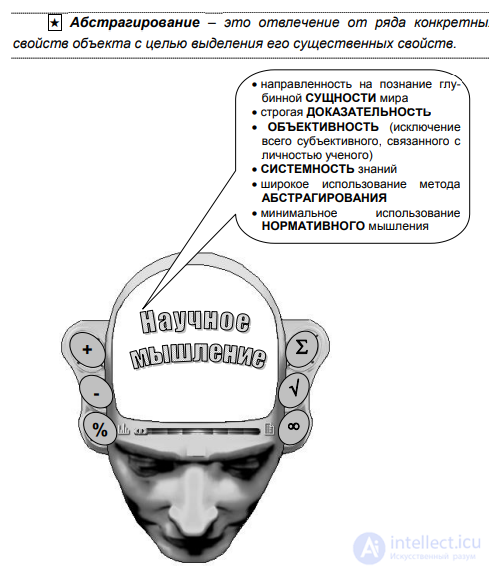
Fig. 1.2. The main properties of scientific thinking
The use of abstraction in everyday thinking allows a person to carry out the simplest analysis of life situations – comparing, generalizing, classifying. Any adult engages in comparing objects and phenomena and sorting them. Why does he do this? In order to know how to behave with these objects and phenomena. After all, we behave differently with superiors and subordinates, men and women, old and young people. Therefore, every one of our actions is based on the conscious or unconscious construction of classification boundaries. We divide food into tasty and untasty, and we refuse the untasty. We divide people into those we find likeable and those we do not, and we make friends with the former. The level of abstraction just described – is the simplest level, characteristic of everyday thinking. Developed scientific thinking is characterized by higher levels of abstraction. Generally speaking, the entire process by which science has formed can be represented as the process of the development of abstract thinking. This process stretched over millennia and passed through 3 stages, corresponding to three levels of abstraction [53].
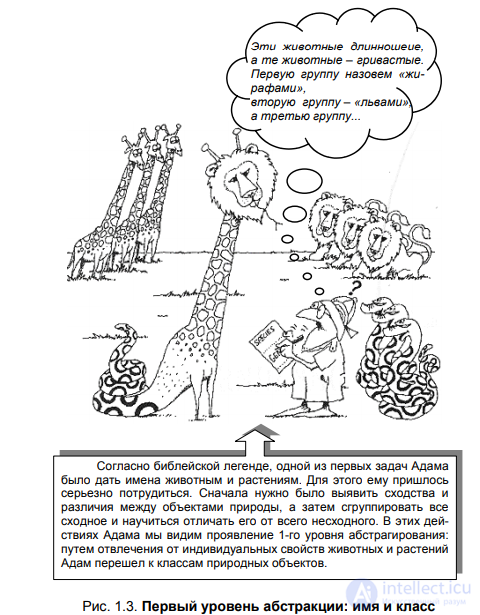
The 1st level of abstraction – is the level of qualitative, classifying science. At this level, abstraction consists in identifying the essential properties of objects and, on this basis, forming
classes of objects and assigning names to these classes. The name of a class represents an abstraction of the 1st level (Fig. 1.3).
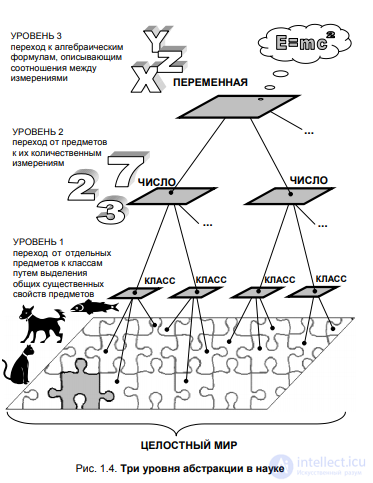
The 2nd level of abstraction: number. This is a much stronger abstraction than a name: whereas a name «represents» a particular group of objects (for example, bears), a number applies to any group of a given quantity of objects (for example, the number «seven» describes seven bears, and seven rhinoceroses, and seven piglets). Whereas a name forms a class by abstracting from all the individual properties of separate objects, a number forms a «class of classes» by abstracting from all the properties of a group except the quantity of objects it contains. With the appearance of numbers, people gained the ability to make measurements of the objects of the surrounding world.
The 3rd level of abstraction: algebra, which is based on the concept of a variable. A variable – is an even stronger abstraction than a number: whereas a number represents any group of objects, a variable represents any number. Just as the number «seven» can apply to any seven objects, the variable «x» can apply to any number within a given range. That is, a variable forms a class
of classes of classes. With the appearance of algebra, humans gained the ability to find abstract relationships between phenomena – that is, to discover the laws and regularities of our world. Ultimately, the goal of fundamental science is precisely to seek universal, that is, the most abstract, laws describing the processes taking place at various points in the Universe. Such laws include,
for example, the law of conservation of energy and mass:
E=mc2
, where E – is energy, m – is the rest mass of the body, and c – is the speed of light in a vacuum.
The historical process of the formation of abstract thinking in science has led to the situation where modern scientific thinking involves constantly switching between different levels of abstraction (Fig. 1.4.).
Evidentiality — is one of the main features of scientific knowledge. A scientific statement must have a justification: observations, experimental data, measurements, mathematical calculations, or logical arguments.
For example, it is not enough to say: «This drug helps with the disease». In science one needs to conduct research and obtain data that confirms or refutes this statement.
At the same time, proof in science does not always mean absolute truth. Scientific conclusions can be revised if more convincing data appears.
Empirical facts — are knowledge obtained through observation, measurement and experiment.
A scientific theory must not contradict reliably established facts.
For example, if it has been established experimentally that a particular substance has a particular melting point under specific conditions, a theory claiming the opposite must either provide very serious evidence or be rejected.
At the same time, it is important to understand: sometimes a new theory does not simply discard old facts, but explains them in a new way.
Reproducibility means that other researchers, using the methods described and comparable conditions, should be able to repeat the study and obtain a similar result.
This is important because a single chance result does not yet prove a scientific regularity.
For example:
A scientist conducted an experiment and obtained a particular result → other scientists repeated the experiment → obtained similar results → confidence in the conclusion increases.
If, however, no one can repeat the result, a question arises: has a regularity really been discovered, or was it a chance occurrence, an error in the method, or a measurement error?
Scientific skepticism — is the habit of not accepting a statement on faith without sufficient evidence.
A skeptic does not say:
«This is definitely not true».
Rather, he asks:
«What evidence is there? Can this be tested? Can the result be repeated? Are there other explanations?»
Scientific skepticism is therefore — not a rejection of everything new, but a critical attitude toward claims.
For example, if someone claims: «I have discovered a new way to treat the disease», the scientific approach requires not simply believing the researcher, but verifying the method through research.
It can be remembered as a chain:
Statement → evidence → verification against facts → reproducibility → critical evaluation → scientific knowledge.
Conclusions:
Scientific knowledge is characterized by evidentiality, consistency with empirical facts, and the reproducibility of results. Scientific skepticism involves a critical attitude toward claims and a requirement for sufficient evidence before they are accepted.

Comments