
Lecture
INTRODUCTION TO THE CHAPTER
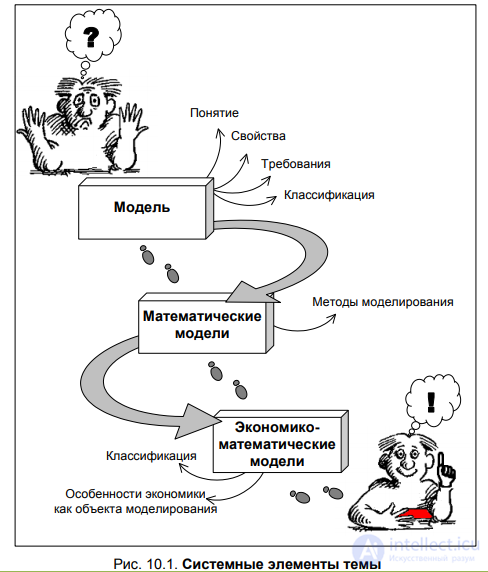
The aim of this chapter is to present the basic concepts of modelling, describe the properties and types of models, and also characterise
the features of the mathematical modelling of economic systems.
180
180
In this chapter we will answer the following questions: What is a model? What properties, essential from the point of view of scientific research,
do models possess? What requirements are placed on models? What types of models exist? What is an economic-mathematical model? What is the specific nature of the mathematical
modelling of economic objects and processes?
Key concepts of this chapter: model, adequacy of a model,
figurative-symbolic model, mathematical model, economic-mathematical model.
THEORETICAL MATERIAL
§ 10.1. The concept of a model
A model is an image (analogue) of the original object, reflecting its essential properties and replacing it in the process of research.
Modelling is the study of certain objects (phenomena, processes) by constructing and studying their models (Fig. 10.2).
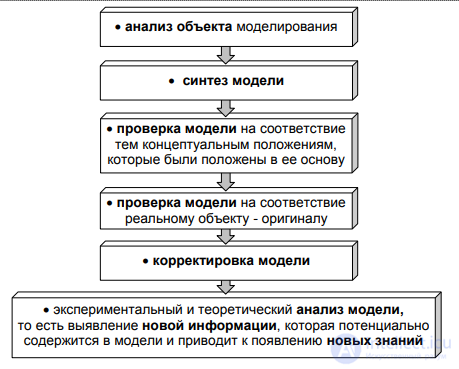
Fig. 10.2. Stages of the modelling process
The replacement of the object of study by a model is carried out for the following reasons:
- because the object is inaccessible (in space, in time,
for ethical reasons, etc.),
- because the object is uncontrollable,
- because the object is complex.
The following important properties are common to all models:
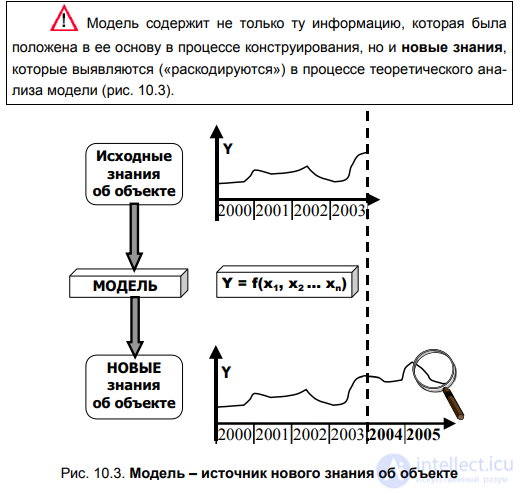
1. The presence of potential knowledge in models.
2. Simplification (finiteness) of models.
The finiteness of real models is manifested in the fact that a real
model resembles the original in only a limited number of properties and relations.
The finiteness of abstract models is manifested in the fact that abstract
models are from the outset endowed with a limited number of properties.
The simplification of a model in comparison with the original object is quite acceptable and even, in a certain respect, useful. First, simplification makes it possible to identify the key elements and properties
in the object under study. Second, simplification makes it possible to carry out
a theoretical analysis of the model (complex models may not lend themselves
to analysis owing to the absence of methods suitable for this).
3. Inaccuracy (approximateness) of the representation of reality by
means of models.
The degree of accuracy of a model can be determined only by relating it to the purpose of the modelling. For example, the accuracy of a clock that is sufficient for everyday purposes is insufficient for the purposes of astronomy.
The following typical requirements are placed on models:
- completeness of the model (taking into account all the essential aspects of the
object being modelled);
- simplicity of the model (the possibility of carrying out an analysis of the model using
known methods);
- accuracy (a high degree of closeness of the quantitative
values of the parameters, obtained in the process of applying the model, to
the real values of the corresponding parameters);
- economy (the need for insignificant expenditure of resources
for synthesising and analysing the model);
- explanatory and predictive power (the model's ability to uncover the causes of observed facts and to predict new
facts).
As we can see, the requirements placed on models contradict
one another (Fig. 10.4). In each specific case of modelling, a certain compromise is reached between these requirements.
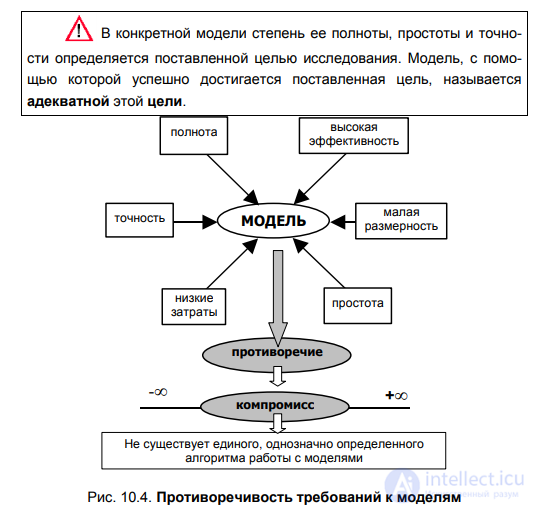
The adequacy of a model is the correspondence of the model to the original object and to the purpose of modelling.
Adequacy means that the requirements of completeness, simplicity and accuracy of the model are met not in an unlimited sense, but only to the extent sufficient for achieving the goal.

Comments