
Lecture
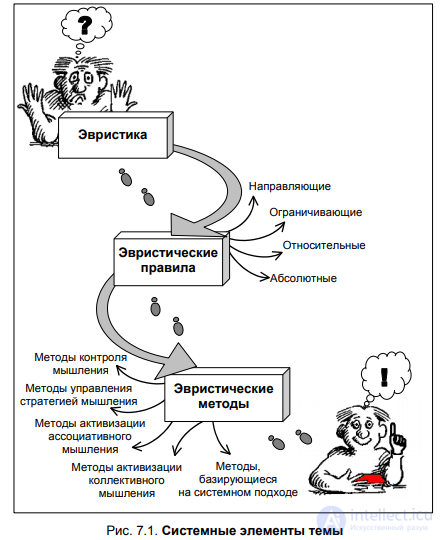
INTRODUCTION TO THE CHAPTER
The purpose of this chapter is to equip readers with a useful and enjoyable
toolkit of heuristic rules and methods that help activate a person's thinking, imagination and intuition.
128
128
This chapter will address the following questions: What is
heuristics, heuristic rules and heuristic methods? What is distinctive about heuristic rules and methods? When are
heuristic rules and methods applied? How are specific heuristic methods implemented – the method of control questions, the method of focal
objects and synectics?
Key concepts of this chapter: heuristics, heuristic
rules, heuristic methods, the method of control questions, the method
of focal objects, synectics, TRIZ techniques.
THEORETICAL MATERIAL
§ 7.1. The concept of heuristics
Scientific thinking is creative thinking, and science is a form of human creative activity. Scientific
creativity bears the mark of the unpredictable and the random, which is why since ancient times people have tried to find recipes, algorithms and mechanisms that would help them gain new knowledge, make discoveries and produce inventions "to order" (Example 7.1).
E
Example 7.1
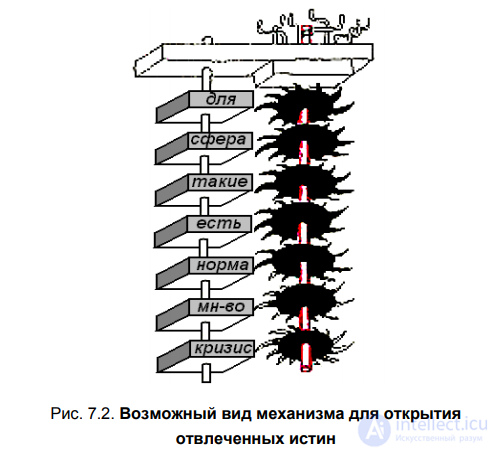
A mechanism for discovering abstract truths
One of the mechanisms designed for making discoveries
was observed, for instance, by Lemuel Gulliver: "I was immediately struck by
an enormous frame that took up most of the room. Noticing this, the professor explained to me that he was working on the construction of special mechanical devices intended for discovering abstract truths.
... He then led me to the frame, along the sides of which stood rows of all his
students. ... Its surface consisted of a great many small wooden tablets, each about the size of a die – some larger, some smaller. They were all linked together by thin wires.
The tablets were pasted over with pieces of paper, and on these papers were
written all the words of the Balnibarbian language in their several moods, tenses and cases, but without any order. ... The machine was so contrived that after every turn the tablets shifted their places, and the words disposed themselves anew" (fig. 7.2). Jonathan
Swift. Travels into Several Remote Nations of the World, by Lemuel
Gulliver, first a surgeon, and then a captain of several ships.
Naturally, there is no instruction manual for "how to make discoveries".
And yet, scientific creativity does contain elements bearing the character of regularities, and, as a consequence, there are rules that help increase
the effectiveness of the creative process.
There exist recipes that help a scientist activate creative thinking, raise the intensity of idea generation
and find effective solutions to the problems under study. Such
recipes are called heuristic rules and heuristic meth-
130
130
ods. The specifics of applying these rules and methods are studied by the science
of heuristics.
Heuristics is:
1) a science that studies productive creative thinking;
2) a method of teaching by means of leading questions (a method going back to Socrates);
3) the theory and practice of organising a selective search in
solving complex intellectual problems;
4) a set of special rules and methods for discovering the new.
Heuristic methods of problem-solving are systems
of principles, rules and approaches that stimulate a person's creative thinking,
activate the generation of new ideas, and on this basis substantially increase the effectiveness of solving a certain class of creative problems.
Heuristic rules (heuristics, heuristic operators) – these are recommendations for choosing a possible course of action under conditions of alternative search, formulated on the basis of experts' practical knowledge.
Rules and methods classified as heuristic possess a number
of specific properties that determine their scope of application. The main characteristics of heuristic rules and methods are given in
fig. 7.3.

Comments