
Lecture
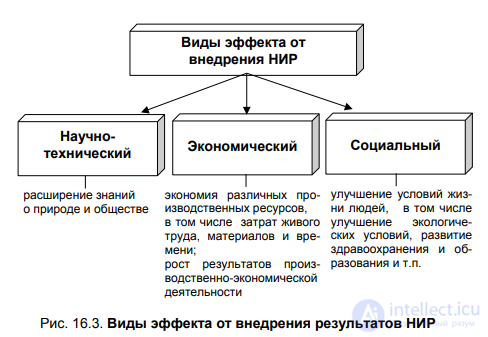
The implementation of R&D results into practice is preceded by an assessment of the effect and effectiveness of the research. Such an assessment is necessary in order to justify the expediency of implementing the scientific product that has been created. The effect of implementing R&D is the totality of the scientific, economic and social results obtained as a result of implementing the R&D (Fig. 16.3).
The effectiveness of R&D is a characteristic of R&D, defined as the ratio of the results of implementation (that is, of the
R&D effect) to the costs of carrying out the work and implementing it.
The concepts of the effect and effectiveness of R&D should be distinguished from the concept of the productivity of a research study: when determining the productivity of R&D, the socio-economic effect of
implementing the R&D results into practice is not taken into account.
The productivity of R&D is the quantity of scientific output
(scientific information) obtained by a researcher or an organisation over a given period of time.
There is an entire system of assessments of the effectiveness of research studies (Fig. 16.4). In addition to assessments of the effectiveness of R&D itself, this system also includes assessments of the effectiveness of the work of research
staff and research organisations. Let us examine these assessments in more detail.
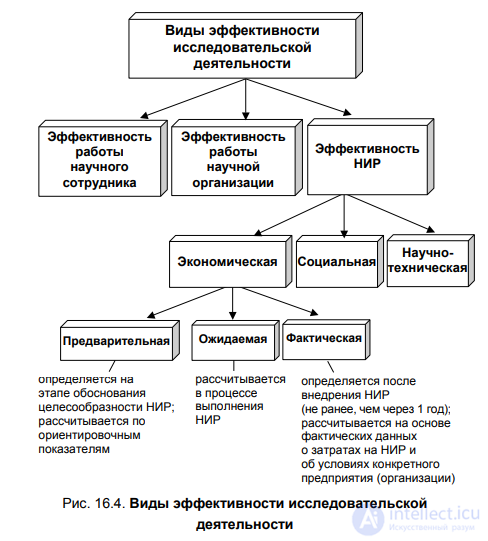
The assessment of the effectiveness of basic research is based mainly on qualitative indicators characterising
the validity and novelty of the research results, the breadth of their applic-
293
293
ation in various fields of human activity, as well as the possibility of carrying out applied research on their basis. An important indicator is also the citation index of publications produced based on the results of the research.
Several quantitative criteria are used to assess the economic effectiveness of applied R&D,
above all the following:
1) the criterion of economic effectiveness from the implementation of R&D, which is calculated according to the formula [22]:
K = E/C ,
where: E – the effect of implementing the R&D,
C – the costs of carrying it out and implementing it;
2) investment effectiveness indicators, such as:
- net present value (NPV);
- profitability index (PI);
- internal rate of return (IRR);
- discounted payback period (DPB), etc.
To assess the social effect of implementing R&D, indicators are used that characterise the living and working conditions of people at
the workplace:
- physico-biological comfort parameters at the workplace;
- air purity parameters;
- thermal regime parameters;
- the noise level at the workplace,
- indicators of the volume of production waste, etc.
The following criteria are used to assess the effectiveness of a researcher's work:
1) the publication criterion – the total number of published
works and their total volume in printer's sheets;
2) the economic criterion – the labour productivity indicator
of the researcher (output in thousands of UAH of the estimated cost of the R&D);
3) the novelty criterion – the number of inventor's certificates and patents;
4) the citation criterion – the number of references to the published works
of the given researcher.
A whole range of criteria is also used to assess the effectiveness of the work of a research organisation:
1) the average annual number of R&D projects;
2) the number of implemented topics;
3) the economic effectiveness of the implemented topics;
4) the number of inventor's certificates and patents obtained;
5) the number of licences sold;
6) the revenue from the sale of scientific output.
The calculation of quantitative and qualitative assessments of R&D effectiveness serves as the initial basis for carrying out an analysis and organising
measures to increase the effectiveness of research
activity.
In order to increase the effectiveness of research studies, the following measures are applied, in particular:
- improving the planning and organisation of R&D,
- reducing the time between investing funds in a research project and obtaining a return from the implementation of its results,
- implementing intermediate R&D results into practice,
- reducing the time needed to prepare scientific publications,
- material incentives for the scientific work of staff,
- improving the psychological climate in the research team.
PRACTICAL COMPONENT
DRAFTING A TERMS OF REFERENCE
Purpose of the assignment: to learn how to draft the terms of
reference for carrying out a research study.
Supplementary material
The requirements for the scientific product to be implemented are formulated when
drawing up the contract between the client organisation and the executing organisation. These requirements are reflected in the terms of reference,
which is appended to the contract. An approximate outline of the contents of the terms of reference is given in Fig. 16.5.

Among other things, the terms of reference define:
296
296
- the form and conditions for implementing the results of the work (for example,
the implementation of a developed procedure);
- the type of reporting documentation (for example, a scientific report containing the developed procedures);
- the procedure for financing the work (for example, payment for the work is made in stages, according to the schedule);
- the list of documents drawn up following the completion of the stages of work (for example, stage No. 1 – an information report, stage No. 2
– an interim report, stage No. 3 – a final scientific report).
Assignment
Using the outline presented in Fig. 16.5, draft the terms of reference for carrying out a research study on the topic of your own research.
REVIEW QUESTIONS
1. How is scientific output implemented into practice?
2. What characteristics are used to assess the results
of research studies from the point of view of their contribution to the development of socio-economic systems?
3. Carry out a comparative analysis of the concepts of "the effect of implementing R&D", "the effectiveness of R&D" and "the productivity of R&D".
4. What types of effects from the implementation of R&D are distinguished?
5. What criteria are used to assess the effectiveness of a research study?
6. What criteria are used to assess the effectiveness of a researcher's work?
7. What criteria are used to assess the effectiveness of a research organisation's work?
8. What is the difference between the preliminary, expected and
actual effectiveness of R&D? Which of them is the most
reliable?
9. What measures are taken to increase the effectiveness of R&D?
297
297
CONCLUSIONS
Let us sum up what has been set out in Chapter 16:
The ultimate goal of carrying out applied research is to implement its results into practice.
The process of implementing scientific output involves close
interaction between representatives of the client organisation and the executing organisation, the conducting of trial testing of the product, as well as
the drawing up of a certificate of implementation of the R&D results.
The concepts of "effect" and "effectiveness" are used to characterise the results of research studies from the point
of view of their contribution to the development of socio-economic systems.
The effect of implementing R&D is the totality of the scientific, economic and social results obtained as a result of implementing the R&D.
The effectiveness of R&D is defined as the ratio of the results
of implementing the R&D (that is, the effect of the R&D) to the costs of carrying out
the research study and implementing it.
The problem of assessing the effectiveness and quality of research studies is among the least developed problems of the methodology of
science. The absence of an integral criterion of R&D effectiveness means that, in practice, an entire system of criteria is used to analyse the results of the development of a research topic, including both quantitative and qualitative, and both economic and
non-economic indicators.

Comments