A widely used type of inductive inference is analogy. There is an interesting mode of reasoning that requires not only intellect but also rich imagination, filled with poetic flight, yet not yielding firm knowledge and not infrequently simply misleading. This very popular mode is inference by analogy. A.A. Ivin .
Analogy – is an inductive (i.e. probabilistic) inference by which knowledge about the object under study is achieved on the basis of its similarity to other objects. Analogy involves transferring a feature inherent in one object onto another object similar to the first. ANALOGY (lit. – correspondence, similarity) is a likeness, similarity of objects, phenomena, processes in some respects, properties, relations – specifically of objects
that are otherwise different on the whole
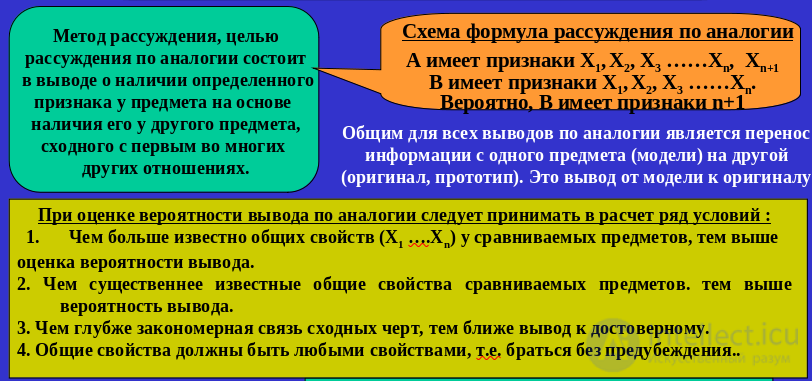
An example of analogy in economic practice is the application, at Ukrainian enterprises, of the experience of foreign companies. A well-known example of analogy in the natural sciences is the analogy between the fall of an apple and the fall of small celestial bodies, which led Isaac Newton to the discovery of the law of universal gravitation.
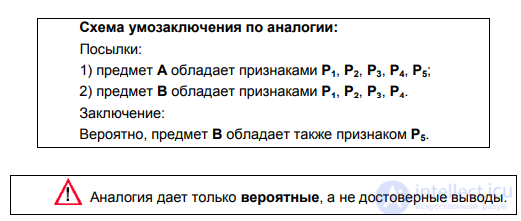
Increasing the probability that a conclusion by analogy is true is facilitated by
the following actions of the researcher:
- - careful identification of similar features of the objects being compared (the more similar features there are and the more essential they are, the more grounds there are for assuming that the conclusion by analogy is true);
- - identification of differences between the objects being compared (the fewer such features, the closer to the truth the conclusion by analogy is);
- - clarifying the significance of similar and differing features;
- - investigating the interdependence of similar features and their connection with the feature that is being transferred to the object under study.
The method of analogy gives the most valuable results when an internal organic interconnection is established between similar features and the feature that is being transferred to the object under study
Kinds and types of analogies
- Simple.
- Strict.
- Non-strict.
- Of properties.
- Of relations.
- Of isomorphism
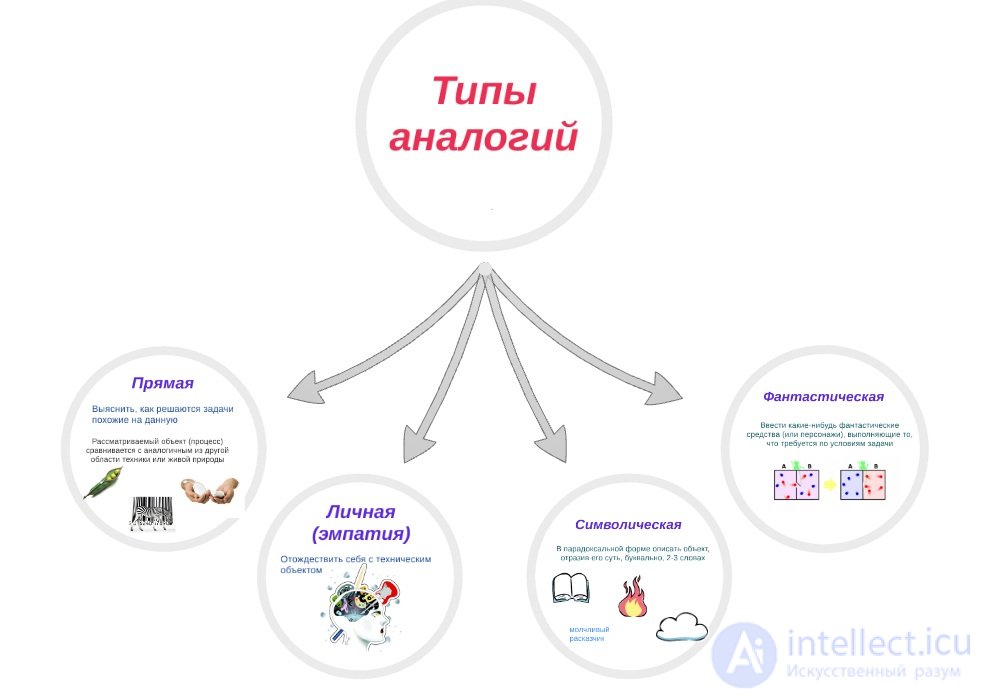
Direct analogy. The object (process) under consideration is compared with an analogous one from another field of technology or from living nature in order to find a model solution.
For example, given the problem: a mixture of iron ore particles and water — pulp — moves through a pipeline. The gate valve regulating this flow wears out very quickly, and replacing it requires stopping the process. How can the gate valve be made long-lasting?
The synectics group, in its search, will examine how plant stems, in particular tree trunks, protect themselves from the effects of the external environment; how the digestive tracts of animals that feed on «prickly» food are structured, and so on. Something similar could be applied to protect the gate valve from friction and wear.
Personal analogy (empathy). The synector imagines himself as a technical object (for example, an airplane, a lunar rover) and tries to grasp how it would act in the given circumstances. This is how actors «immerse» themselves in the image of their character, living through his feelings, thoughts, and sensations.
Imagining ourselves as the gate valve, we would first start dodging the impacts, and then pick up a shield to push away the ore particles. In this image lies the key to the solution. In actual practice, the gate valve was magnetised, and it became covered with ore particles as if with armour. This layer was continuously worn away by friction, but was constantly replaced by new particles captured by the valve's magnetic field.
Symbolic analogy. It is required, in a paradoxical, metaphorical form, to define the object (concept), bringing out its essence. The definition should consist of two words (usually an adjective and a noun), where one word contradicts the other in meaning, i.e. the connection between the words should contain something unexpected, surprising (see the table).
|
The concept being defined
|
Definition
|
|
Cigarette
|
Solid smoke
|
|
Fan
|
Rigid wind, desktop draft, frozen vortex
|
|
Solution
|
Suspended confusion
|
|
Book
|
Silent storyteller, dialogue in private
|
|
Flame
|
Visible heat
|
|
Cloud
|
Light heaviness, airy water, opaque emptiness
|
|
Strength
|
Forced integrity
|
|
Grinding wheel
|
Precise roughness
|
Thus, to prevent wear of the gate valve from the pulp, in the process of searching for a figurative characterisation of the protection process, the following metaphors were proposed: living armour, an invisible chainmail, a regrowing shell. The last analogy suggested the technical solution: supplying a cooling agent to the gate valve to protect it with a layer of growing ice.
Fantastic analogy. One must imagine the object being changed as we would ideally like to see it, without regard for existing constraints and possibilities (the availability of energy sources, necessary conditions, physical laws, etc.). After formulating the fantastic analogy, it is necessary to find out what prevents the found solution from being transferred to real conditions, and to try to get around this obstacle.
Examples. The German astronomer J. Kepler, who discovered the laws of planetary motion, likened the attraction of celestial bodies to mutual love. He compared the Sun, the planets, and the stars to various images of God. These comparisons led Kepler to the idea of introducing the concept of force (gravity) into astronomy.
In the 17th century, the movement of blood in the body was compared to sea tides and ebbs. The English physician and physiologist W. Harvey introduced a new analogy — a pump — and arrived at the fundamental idea of the continuous circulation of blood.
See also
- [[b5673]]
- Generalisation
- Abstraction
- Thinking
See also


Comments