
Lecture 26 min.
Modern science is developing amid a rapid growth in the volume of information, the digitalization of research activity, the expansion of international cooperation and, at the same time, the intensification of global social, environmental and technological challenges. Under these conditions, the openness of scientific knowledge, data, methods and research processes acquires particular importance. Science is increasingly seen not as an activity accessible only to a narrow circle of specialists, but as a public resource that should serve the development of society and be accessible to the widest possible circle of people.
One of the most consistent international approaches to this issue has become the concept of Open Science. UNESCO defines it as an inclusive system of practices and approaches aimed at making scientific knowledge openly accessible, understandable and reusable, expanding scientific cooperation, and opening up the processes of creating, evaluating and disseminating knowledge to societal actors beyond the traditional scientific community. In 2021, the UNESCO General Conference adopted the Recommendation on Open Science, which became the first international normative instrument setting out an agreed framework for open science.
Open science is not limited to free access to scientific articles. It presupposes the transformation of the entire research culture: from the formulation of a scientific problem and the collection of data to the publication of results, their verification, reuse and the interaction of scientists with society. Open science therefore concerns not only the results of research, but also the tools, infrastructure, methods, participants and modes of communication involved.
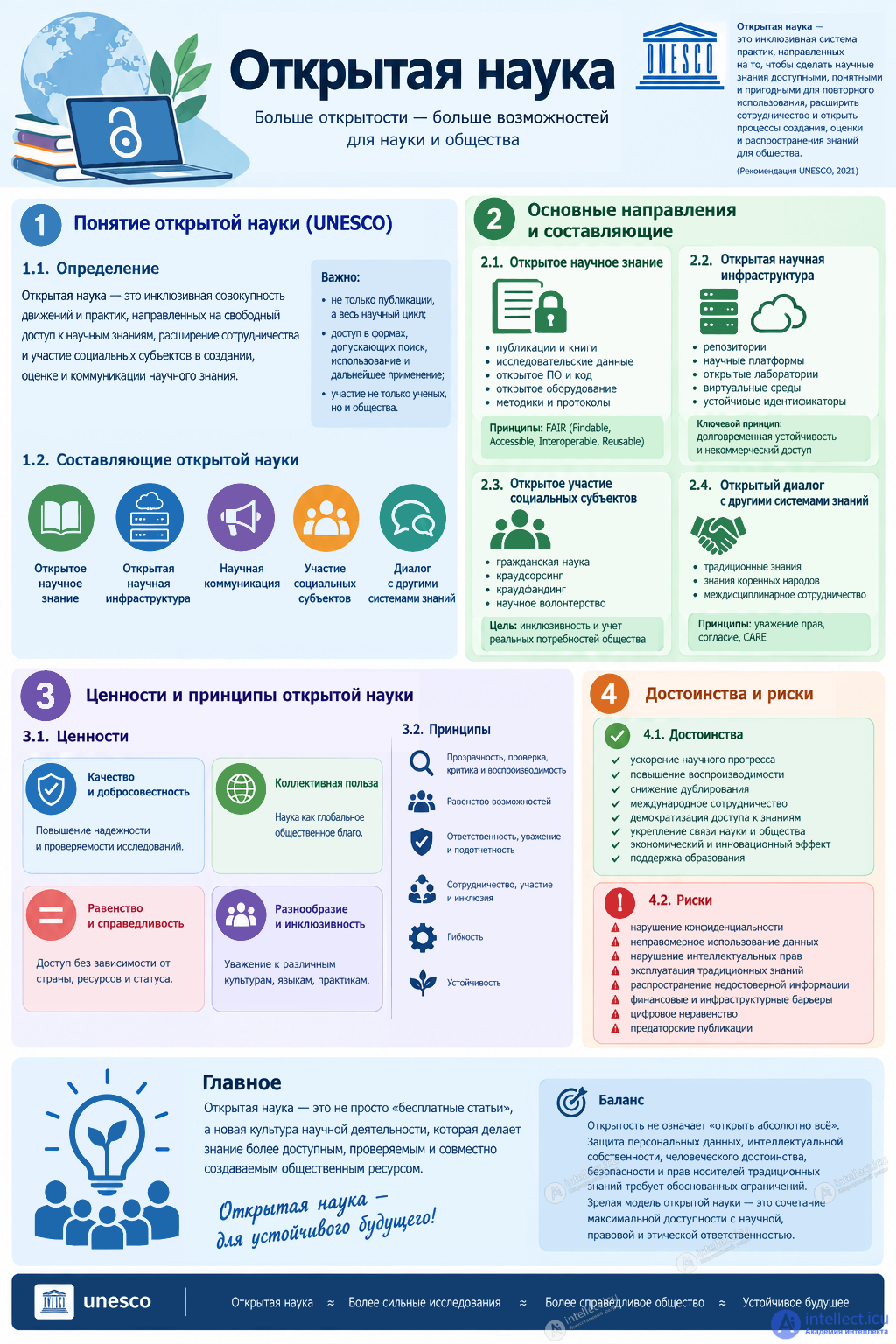
According to the 2021 UNESCO Recommendation on Open Science, open science is an inclusive construct of diverse movements and practices aiming to make multilingual scientific knowledge openly available, accessible and reusable for everyone; to increase scientific collaborations and the sharing of information for the benefit of science and society; and to open up the processes of scientific knowledge creation, evaluation and communication to societal actors beyond the traditional scientific community. This approach extends to all scientific disciplines — natural, technical and social sciences, and the humanities — as well as to basic and applied research.
Several provisions in this definition are of fundamental importance.
First, this is a matter of the opening up of knowledge, not merely its publication. Scientific information must not only be posted online, but also provided in a form that allows it to be searched, used, analyzed and further applied.
Second, openness extends to the entire scientific cycle. This means that open science does not begin only after the completion of a study, but already at the stage of formulating the hypothesis, choosing the methodology, developing protocols, and collecting and processing data. UNESCO explicitly links openness with transparency, reproducibility, sharing and collaboration.
Third, open science presupposes the involvement of not only professional scientists, but also other interested groups: citizens, local communities, representatives of public authorities, practitioners, civil-society organizations, developers, holders of traditional knowledge and other actors.
Thus, open science can be represented as a transition:
from the closed production of scientific knowledge to an open, collaborative and verifiable system of its creation and use.
At the same time, openness is not absolute. UNESCO emphasizes that access should be "as open as possible", and that restrictions are permissible when justified by the protection of human rights, confidentiality, privacy, national security, intellectual property, personal data and certain categories of traditional knowledge.
In accordance with the UNESCO approach, open science is built around several interconnected components. The Recommendation identifies open scientific knowledge, open science infrastructure, science communication, open engagement of societal actors, and open dialogue with other knowledge systems.
Open scientific knowledge covers significantly more than scientific publications. It includes:
UNESCO emphasizes the need for such materials to be provided free of charge and on terms allowing access, reuse, adaptation and distribution in accordance with a license. For research data, compliance with the FAIR principles is especially important: Findable, Accessible, Interoperable, Reusable — that is, data should be findable, accessible, interoperable and reusable.
Open science also presupposes improving communication between science and society. Scientific results should be accessible not only to specialists in a single discipline, but also to policymakers, educators, practitioners, journalists and the general public.
This requires the development of science-popularization formats, open educational resources, public lectures, digital platforms and other ways of explaining scientific results in understandable language.
Open scientific knowledge is the foundation of the entire concept. Without access to scientific results, it is impossible to achieve either the reproducibility of research, broad scientific cooperation, or the full participation of society.
One of the best-known forms of open scientific knowledge is open access (Open Access). It provides for free access to scientific publications without a mandatory fee on the part of the reader. A publication may be placed directly on an open-access platform or in an open repository. UNESCO notes that a publishing model in which immediate access to a scientific article is possible only for a fee does not correspond to the approach enshrined in the Recommendation.
However, open access to publications is only one element of the system. Open research data are of enormous importance. They allow other researchers to verify conclusions, repeat analyses, use already-collected information to solve new scientific problems, and reduce the costs of duplicating research.
No less important is open source code. Modern science increasingly uses software tools for data processing, computer modeling and statistical analysis. If algorithms and code are accessible to researchers, it becomes possible to examine how a result was obtained, detect errors, and reproduce the study.
Another component is open hardware. The publication of designs, schematics and technical specifications allows other groups to reproduce equipment, modify it and adapt it to their own tasks.
Consequently, open scientific knowledge creates conditions not only for the dissemination of results already obtained, but also for the accumulation of new knowledge on the basis of previous research.
The functioning of open science requires appropriate infrastructure. The mere existence of open publications and data does not yet guarantee real accessibility of scientific knowledge.
UNESCO classifies as open science infrastructure both physical and virtual resources: scientific instruments and laboratories, repositories of publications and data, archives, digital platforms, computing environments, research information management systems, open bibliometric systems and other collaborative tools.
Among the most important components are:
Repositories. These are digital storage facilities in which articles, dissertations, research data, program code and other scientific materials are placed.
Scientific digital platforms. They enable researchers to work together, search for information, process data and share results.
Open laboratories and research centers. Such venues allow several scientific teams to share equipment and resources.
Virtual research environments. They create a space for the remote conduct of computational and analytical procedures.
Persistent identification systems. For effective knowledge sharing, it is important that publications, datasets, program code and other objects have persistent identifiers, allowing them to be unambiguously found and linked to one another.
UNESCO pays particular attention to the principle of long-term sustainability of infrastructure. Open infrastructure should be maintained over the long term and, as far as possible, provide public access on a non-commercial basis.
Thus, open science requires not only the willingness of scientists to share results, but also a technological and organizational environment that makes such sharing possible.
One of the most significant features of the UNESCO concept is the expansion of the circle of participants in scientific activity. Scientific research is no longer viewed exclusively as interaction among professional scientists.
Open engagement of societal actors means the collaboration of researchers with citizens, local communities, representatives of public authorities, practitioners, entrepreneurs, civil-society organizations and other interested parties.
An especially notable manifestation of this approach is citizen science. This is the participation of non-professional researchers in scientific projects according to specific methodologies, often together with professional scientists.
For example, citizens can:
Other forms of open engagement include:
Crowdsourcing — involving a large number of people in solving a research task.
Crowdfunding — financing scientific initiatives through a large number of voluntary contributions.
Scientific volunteering — the voluntary participation of people in individual research activities or projects.
The significance of this model lies not only in expanding the resource base of science. It allows research programs to better take into account the real needs of society. UNESCO regards the engagement of societal actors as a means of increasing the inclusiveness of science and building a collective intellectual capacity to solve socially significant problems.
At the same time, the participation of citizens does not mean abandoning scientific standards. The data obtained must undergo the necessary processing, verification, standardization and preservation so that it can be used by other researchers.
Scientific knowledge exists within a diverse cultural and social context. Open science therefore presupposes dialogue not only among scientific disciplines, but also among different systems of producing and preserving knowledge.
UNESCO views open dialogue with other knowledge systems as interaction among different bearers of knowledge and recognition of the value of diverse epistemologies. Particular attention is paid to the traditional knowledge of indigenous peoples and local communities, as well as to the inclusion of researchers and intellectual communities that have historically been underrepresented in the scientific system.
This approach is especially important in areas related to:
Traditional knowledge can contain a significant amount of empirical information about natural conditions, the characteristics of territories, plants, animals and ways of human interaction with the environment.
However, openness here does not mean the free extraction and commercial use of any knowledge. UNESCO emphasizes the need to respect the sovereignty, rights and interests of knowledge holders, as well as their right to participate in decisions regarding the use of the relevant data. For working with the traditional knowledge and data of indigenous peoples, the CARE principles are especially important: Collective Benefit, Authority to Control, Responsibility and Ethics.
Thus, open science must combine openness with respect for cultural rights, intellectual property and the right of communities to determine the terms of use of their knowledge.
UNESCO identifies four core values of open science. They set out not technical rules, but the overall ethical and societal orientation of this model.
Open science should contribute to improving the quality of research and adherence to the principles of scientific integrity. Openness of methods, data and results makes research more accessible for verification and critical analysis.
The more elements of a study that can be examined by other specialists, the greater the possibilities for detecting errors, confirming results and reproducing experiments.
Science is regarded as a global public good. Scientific knowledge should benefit humanity as a whole, not only individual organizations or economic actors.
This is especially important for research funded from public funds. UNESCO recommends that the results of such research, including publications, data, program code and hardware solutions, be disseminated on open terms wherever possible.
Open science should reduce, rather than reproduce, existing inequality. Access to scientific information and the ability to participate in research should not depend solely on country of residence, financial resources or institutional affiliation.
Otherwise there is a risk that the best-resourced scientific systems will benefit from open resources considerably more often than less-resourced ones.
Open science presupposes respect for the diversity of scientific disciplines, languages, research practices, cultures and ways of producing knowledge.
UNESCO emphasizes the need to also take into account groups that are traditionally underrepresented in scientific activity, and to ensure the participation of various communities in the production and use of knowledge.
Key principles of open science
The values of open science are given concrete expression in six guiding principles of UNESCO.
The scientific process should be as transparent as possible. Other specialists should be able to understand how the results were obtained, verify the initial premises, methods and data, and, where possible, reproduce the study.
All participants in the scientific process should have equal opportunities to access knowledge, participate in research and make use of the results of open science.
Openness increases the responsibility of researchers. The more information becomes publicly available, the more important compliance with ethical norms, the protection of research participants, the management of conflicts of interest, and the assessment of the social and environmental consequences of scientific activity become.
Science should develop through interdisciplinary and international cooperation, as well as through the inclusion of societal actors and previously underrepresented groups.
UNESCO emphasizes that there is no universal model for the transition to open science. Scientific systems differ in their level of funding, infrastructure, legal regulation, technological capabilities and research culture. Different models for implementing openness must therefore be permitted while preserving shared values.
Open science requires a sustainable financial, organizational and technological foundation. Repositories, digital services, databases and scientific platforms must exist long enough to ensure the preservation and reuse of knowledge. UNESCO emphasizes the importance of long-term and predominantly non-commercial models for funding open infrastructure.
Taken together, these principles show that open science is not simply a policy of "making everything available". It is a system in which openness is combined with quality, ethics, security, sustainability and responsibility.
Open science has a whole range of advantages both for researchers themselves and for society.
When publications, data, software and methodologies are accessible to other researchers, new projects can build on existing results. This reduces the time needed to reobtain basic information and allows new areas of research to be developed more quickly.
Access to data, methods and program code makes it possible to verify conclusions and reproduce research. This is especially important amid the reproducibility crisis, when it turns out to be difficult to repeat some of the results of various studies.
Open sharing of research resources can reduce the need to repeatedly collect the same data. UNESCO notes the possibility of increasing the efficiency of the scientific system by reducing duplicative costs and expanding the reuse of materials.
Open data and infrastructures facilitate interaction among scientific teams from different countries. A researcher can use the data of another laboratory, study published code, or connect to a joint digital platform.
Open science makes research results more accessible to students, educators, practitioners, journalists, civil-society organizations and citizens. This is especially important where access to specialized libraries and commercial databases is limited.
The participation of citizens in research fosters a closer dialogue between the scientific community and society. Citizens gain the opportunity not only to consume scientific information, but also to participate in its creation.
Open access to knowledge can create conditions for the emergence of new technologies, startups and applied solutions. UNESCO points to the economic benefits associated with open practices and infrastructures, including opportunities for innovation and partnerships.
Open publications, data and educational materials expand the opportunities available to students and educators. Open educational resources are especially important, since they can be used, adapted and distributed without significant financial barriers.
Despite its many advantages, open science is not without risks. UNESCO therefore emphasizes that access should not be unconditional, but justified and responsible.
Research data may contain personal information. Its publication without proper anonymization can lead to a violation of the right to privacy.
Open data can be used not only for the benefit of science. It can be applied for commercial, political and other purposes that researchers did not originally intend.
Openness does not abolish copyright. It is necessary to clearly define licensing terms, indicate authorship, and prevent the appropriation of results by other persons.
Particularly sensitive is the problem of using the knowledge of indigenous peoples and local communities. The free placement of information without the consent of its holders can lead to commercial appropriation or the loss of community control over their own knowledge. This is precisely why UNESCO separately establishes the need to respect the rights and governance mechanisms relating to such data.
The mere fact of open access to scientific material does not mean that the material is automatically of good quality or reliable. In the digital environment, unverified data, preliminary results and scientifically erroneous claims can spread.
Open science must therefore be accompanied by expert evaluation, transparent methods, indication of publication status, and the development of scientific and digital literacy.
The transition to open models may require significant expenditure on data storage, digital platforms, software support, staff training and the maintenance of infrastructure.
At the same time, there is a danger that costs will be shifted from readers to authors. Open science should therefore not turn into a situation in which access to a publication is formally free, but the researcher is required to pay a significant sum for its placement.
Open information has limited value if a researcher or citizen has no access to the internet, computing resources or the necessary software.
As a result, open science can, paradoxically, reproduce global inequality if access to infrastructure is distributed extremely unevenly. UNESCO therefore links the development of open science to the need to reduce the digital, technological and infrastructural gap between countries and regions.
The expansion of the market for open publications may be accompanied by a growth in unscrupulous publishing practices. Some journals use the open-access model without genuinely ensuring the quality of scientific peer review.
Consequently, the formal status of "Open Access" is not yet a guarantee of scientific reliability. It is necessary to assess the reputation of the publication, the review procedures, the transparency of editorial policy, and the quality of the scientific content.
Open science represents a large-scale transformation of the modern scientific system. Its goal is not only to remove the payment barrier between people and scientific articles, but also to make more open the entire cycle of the production of scientific knowledge.
In accordance with the 2021 UNESCO Recommendation, open science includes open scientific knowledge, open infrastructure, science communication, the engagement of societal actors, and dialogue with other knowledge systems. It is based on the values of quality and integrity, collective benefit, fairness, diversity and inclusiveness, as well as on the principles of transparency, equality of opportunities, responsibility, collaboration, flexibility and sustainability.
The main advantage of open science lies in the possibility of turning scientific knowledge into a more accessible, verifiable and jointly created public resource. This contributes to the acceleration of research, international cooperation, the development of innovation, the expansion of educational opportunities, and the strengthening of the connection between science and society.
At the same time, openness should not be understood as the principle of "opening absolutely everything". The protection of personal data, intellectual property, human dignity, security and the rights of holders of traditional knowledge requires justified restrictions. A mature model of open science is therefore built on a combination of maximum accessibility with scientific, legal and ethical responsibility.
This is precisely the central idea of the UNESCO approach: science must become more open, but at the same time more qualitative, fair, inclusive and sustainable. Open science, in this sense, is not a separate technological practice, but a new culture of scientific activity oriented toward collaboration and public benefit.

Comments