
Lecture
An essential condition for a good study of scientific and technical information is taking notes on what has been read. Note-taking allows you to:
Common errors in note-taking:
Let us consider the main types of notes needed when working with scientific literature (Fig. 4.7).
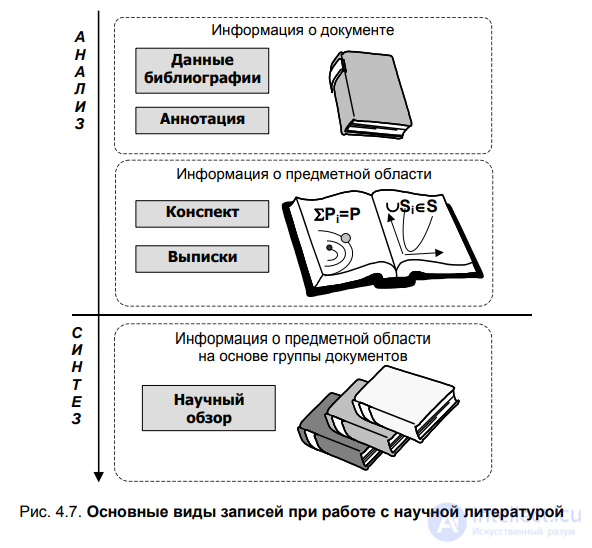
Abstract
An abstract — is a brief description of a document in terms of its content, purpose, form and other features
(see Example 4.1).
The abstract notes the purpose, objective, theoretical and practical value of the document, as well as its target audience. The official version of an abstract for a printed work is compiled by leading
specialists in the relevant field and is usually placed on the back of the title page of a book or brochure.
Example 4.1
Abstract for the monograph «Financial Decision Support Systems at the Micro Level»
The monograph summarizes the experience of creating computer-based financial decision support systems at an enterprise. Considerable
attention is devoted to the methodology of their development and implementation. Economic-mathematical models and methods for making risky financial decisions are described.
It is intended for a wide range of economists, managers, and postgraduate students; anyone interested in the development of computer
systems for financial decision support.
Excerpts
An excerpt – is a small-volume text that conveys the content of individual fragments (sections, chapters, pages) of a document.
The value of excerpts is very high. Their brevity makes it possible, within a small
volume of text, to reflect a large volume of information, avoiding continuous transcription of the material studied.
Specialists give the following recommendations for preparing excerpts:
Notes (conspectus)
A conspectus is a compact presentation of the most essential points in the material under consideration. When taking notes on a text, the author's ideas should be conveyed in one's own words. This approach requires comprehension and analysis
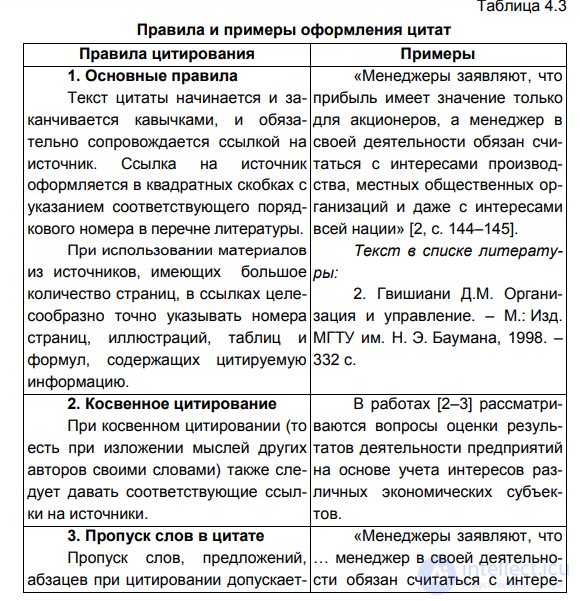
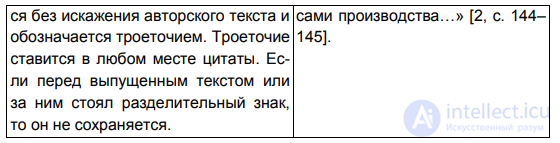
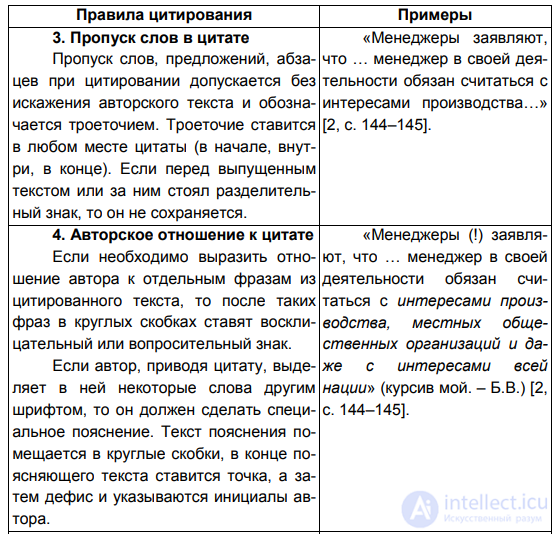
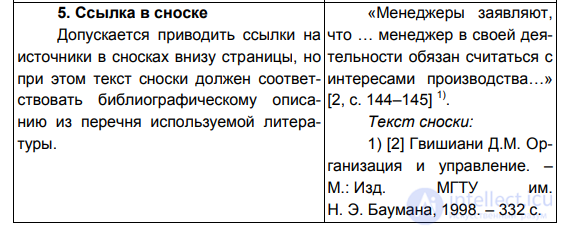
of what has been read, which brings its own benefit. Sometimes one may also use an exact rendering of the author's words, always formatting them as a quotation (Table 4.3).
The main thing in compiling a conspectus — is the ability to identify the rational core relevant to the topic being developed. A conspectus should be, on the one hand, brief, and on the other hand, complete. The completeness of a record is determined not by its volume, but by the degree to which the main ideas important to the topic being developed are conveyed.
To speed up the process of note-taking, it is convenient to use word abbreviations, but in such a way that the meaning of what is recorded is not lost. To highlight the main ideas, it is convenient to use underlining and color highlighting. It is better to keep notes on only one side of the sheet, leave wide margins on each sheet, and mark off paragraphs and numbered items in the text (1.1.1, 1.1.2, ..., 1.2.1). Such formatting of the conspectus will make it easy to supplement it with new material, one's own analysis, proposals, etc. .
Scientific review
A scientific review – is a text containing synthesized summary information on some question or set of questions, extracted from a certain set of primary documents specially selected for this purpose.
The main tasks of a review of literary sources are:
Reviews differ in: the subject of analysis, the purpose of compilation, the types of primary sources used, the breadth of the subject matter, the presence of comparisons and forecasts, the periodicity of preparation, the functional purpose within the documentary system, and also the manner of formatting.
The mandatory structural elements of a review are the following parts:
The introductory part explains the purpose of the review, outlines the thematic boundaries of the topic under consideration, justifies the relevance and significance of the topic, and also gives a general description
of the field of research and its significance for science and production.
The analytical part of the review contains the actual synthesis of the source literary materials. It provides a synthesized
assessment of the state of the question under consideration. The mandatory elements of this part of the review are the following data:
A review should be written not by authors or works, but by
directions of research (tasks, approaches, problems
under consideration) – see Example 4.2.
A review is written correctly when it can be published as a stand-alone article.
Example 4.2 Example of constructing a scientific review
To show how reviews should be written, let us first show how they should not be written. Here is a fragment of a review written «by authors» (that is, incorrectly):
«In the paper, Ivanov I. I. addressed the problem of improving
information support for decision-making processes in management. In the paper, Petrov P. P. investigated the issue of accounting for the psychological characteristics of the decision maker in decision support systems».
Here is how this review should have looked in accordance with
the rules:
«The problems of improving information support for decision-making processes in management were addressed in works [1–5]. The problems of accounting for the psychological characteristics of the decision maker in decision support systems were addressed in works [6 - 8]. These studies left unresolved the question of accounting for gender differences among persons making managerial decisions».
Objectives of the assignment:
Supplementary material
Let us consider an example of structuring a scientific article.
An excerpt from an article with the structural elements explicitly present in its text highlighted is shown in Fig. 4.8.
In addition, we can identify the following elements of the text that are present in the article implicitly:
Assignment
1. Formulate the bibliography parameters and compile a bibliographic list of literary sources on the topic of your research work.
2. Conduct a structural analysis of one of the scientific articles included in the bibliographic list you compiled.
3. Compose the text of an abstract for the article you have studied.
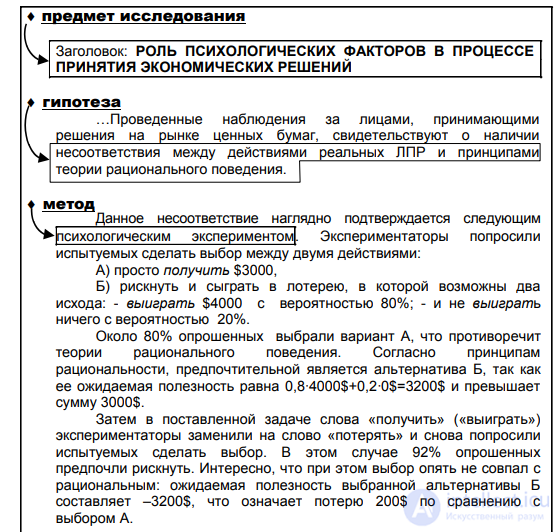
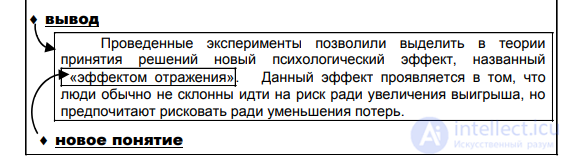
Fig. 4.8. Scientific text with structural elements highlighted
1. List the main stages of working with literary sources within the framework of scientific research.
2. Describe the recommended order for becoming acquainted with different types of literature on the research topic. In your opinion, what is the reason for these particular requirements regarding the sequence of reading?
3. What is the purpose of the «fast» reading method?
4. What is the purpose of structuring the scientific article being studied?
5. What are the main elements of scientific research recommended for identification in the process of structuring a scientific article?
6. List and characterize the main types of notes needed when working with scientific literature.
7. Justify the necessity of compiling a bibliography of literary sources on the topic of the scientific research being conducted.
8. In your opinion, at what stage of the research does work on the bibliography begin, and at what stage does it end?
9. From what main sources can bibliographic information be drawn?
10. What are the specialists' recommendations for compiling a bibliography?
11. How should a card index of literary sources on the topic under study be compiled? What information is it advisable to indicate on the cards in the card index?
12. Define the concept of «abstract». What is the difference between an abstract and a bibliography? What is the purpose of an abstract?
13. What are the specialists' recommendations for preparing excerpts from literary sources?
14. Why is it recommended to make excerpts on one side of the sheet?
15. Define the concept of «conspectus». What is the difference between a conspectus and an abstract?
16. What recommendations for compiling conspectuses do specialists give?
17. Why is it recommended to leave wide margins on each sheet when writing a conspectus?
18. What is a «scientific review»? What are its main tasks?
19. What is the fundamental difference between a scientific review and a conspectus of several literary sources?
20. List the mandatory structural elements of a scientific review. Characterize their content.
21. How do you understand the requirement to compile a review not by authors, but by research directions?
22. List the main rules for formatting quotations.
23. How should references to sources with a large number of pages be formatted?
24. How should an omission of words in a quotation be correctly formatted?
25. How can the author's attitude to the quoted text be expressed using additional symbols?

Comments