
Lecture
Due to the fact that any object can be described in terms of systems, and the most diverse systems can be studied and created using identical
methods, the systems approach is an interdisciplinary direction of the methodology of science.
The systems approach is a direction of the methodology of scientific cognition and social practice, based on considering objects as systems.
The systems approach is contrasted with the "single-aspect" approach, based on the "dissection" of the object under study and the examination of
its individual elements and individual properties - economic, physical, chemical, and so on. In the systems approach, the emphasis is placed on the need for a comprehensive study of the object from different
sides. Great attention is paid to the analysis of its integrative
properties. The study of the elements of an object is necessarily carried out with
regard to their place in the whole, and the analysis of the object itself - with regard to its place
in the suprasystem.
One of the basic ideas of the systems approach: "to know
a part without knowledge of the general whole is just as impossible as
to know the whole without knowledge of its parts" (B. Pascal).
In order to make it intuitively clear what the systems approach is, let us give examples of the non-systemic approach - see Examples 6.1 and 6.2..
E
Example 6.1
A Parable about the Non-Systemic Approach
Three blind men were trying to understand what an elephant was. One felt
the elephant's tail and said, "An elephant is a rope." The second felt its leg and said: "An elephant is a column." The third felt its trunk and said: "An elephant is a
109
109
snake." It is the same in science: a non-systemic approach does not allow one to see
the essence of the object under study in the unity of its diverse properties
and various aspects.
E
Example 6.2
The Non-Systemic Approach in Business
"Recently, managers from a Detroit car plant told me
how, trying to understand the reasons for the extraordinary reliability of cheap
Japanese cars, they took apart the engine of such a car. They found three standard bolts in different places. In an American car, for the same purposes, three different bolts are used, which require
three wrenches, and, accordingly, three kinds of spares must be kept in stock,
which, naturally, slows down and raises the cost of assembly. But why do the Americans use three different bolts? Because three
groups of designers work in the design bureau, and each is responsible "only for its own assembly." Among the Japanese, only one designer is responsible for the entire engine. The irony is that,
all three groups of American designers are satisfied with their work: THEIR assembly works perfectly." Peter Senge. The Fifth Discipline: The Art and Practice of the Learning Organization [44].
The systems approach is based on a set of principles which, on the one hand, reflect the regularities governing the functioning and development of systems, and, on the other hand, determine the rules for studying them:
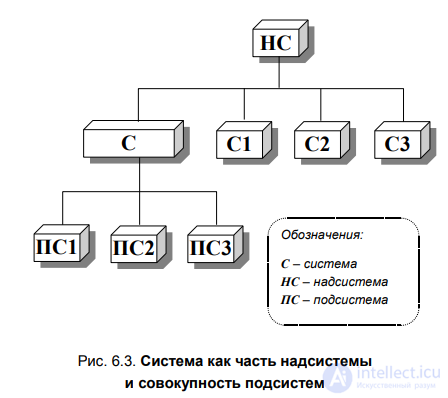
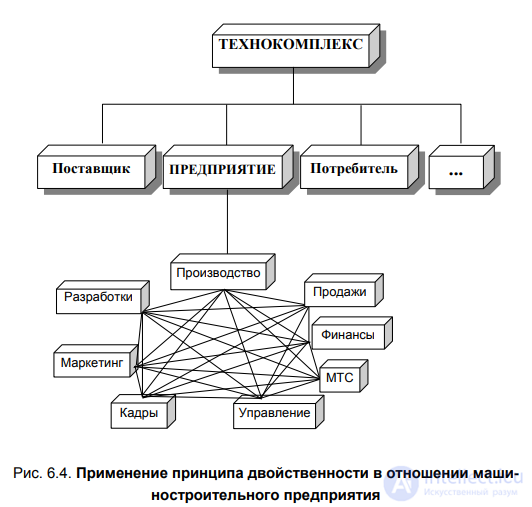
The principle of duality: any object should be considered, on the one hand, as an independent system, and, on the other hand, as part of a system of a higher hierarchical level.
A systemic representation requires that the researcher
mentally view the object in as many as three aspects: as something whole (a system), as part of a more general system (a suprasystem), and as a set
of smaller parts (elements, subsystems).
At the same time, in the suprasystem one must also take into account all of its constituent parts, connected in one way or another with the system being analyzed. This scheme can
be represented graphically in the form of a three-tier structure (Fig. 6.3, 6.4).
The principle of integrity: the object under study must be considered as an integrity possessing the property of emergence.
A system as a whole is not only not unambiguously determined
by the qualities of its elements and is not reducible to them, but, on the contrary, the elements themselves are determined by the whole. And it is only within the framework of this whole that the elements receive their functional explanation.
The principle of comprehensiveness: every object must be studied from
various sides, from different points of view.
The principle of multiplicity: when studying an object, it is necessary to use a multitude of models.
The principle of historicism: every object must be considered in
retrospect, taking into account the history of its emergence and its stages of development.
The principle of dynamism: the properties of an object must be regarded as changing.
The principle of purpose: a necessary stage in the process of studying a system is identifying the goal (purpose) of that system.
The principle of complexity: every element possesses inexhaustible complexity, since it represents a set of elements
that are in diverse relationships with one another and with the environment. In this
connection, when studying an object, it is necessary to carry out its simplification
to the level at which the object retains its essential properties.
The principle of similarity: the most diverse systems function on
the basis of one and the same principles. In this connection, the results of studies of some systems can be used in the study of other objects similar to them.

Comments