
Lecture 50 min.
Scientific research is the process of studying a particular object (an item or a phenomenon) with the aim of establishing the regularities of its emergence, development and transformation for the rational use of that knowledge in people's practical activity.
Scientific research as a process — is the consistent, purposeful and organized activity of a researcher, in the course of which the transition is made from posing a problem to obtaining, verifying, explaining and formalizing new scientific knowledge.
It is important to emphasize that research is precisely a process, and not only its final result. A scientific article, theory, discovery or development are results, whereas research encompasses the entire path to obtaining them.
The purpose of this chapter is to introduce readers to the sphere where science is directly created, where collected facts give rise to ideas, and
vague guesses turn into discoveries. This is the sphere of scientific research. We will show how to properly organize scientific research, what stages a researcher must go through in the course of carrying out scientific work, and what requirements a scientific result must meet.
In this chapter we will answer the following questions: What is scientific research? What kinds of scientific research exist? Where does non-scientific work end and scientific work begin? How should research activity be properly organized? How should the
topic and aim of the research be formulated? How should the subject area of the research be structured? How should a working plan of the research be drawn up? What is a
scientific result and how is it obtained?
Key concepts of this chapter:
Stages of scientific research. Science as a system of knowledge is created and developed in the process of scientific research. What is scientific research? In brief, it is the basic form of scientific activity (alongside supporting, implementation and organizational activity in science). In more detail, scientific research is activity aimed at studying an object with the goal of establishing the regularities of its structure, emergence and development, as well as the further use of the knowledge obtained in people's practical activity.
Scientific research is divided into fundamental and applied.
Fundamental research is theoretical and experimental activity aimed at obtaining knowledge
about the regularities of the development of nature, society and the human being (for example, the study of regularities in human behavior in situations of economic decision-making can be classed as fundamental).
Applied research is activity aimed at obtaining and using knowledge to solve applied
problems arising in the sphere of human practical activity (for example, work on creating a tax accounting procedure can be classed as applied). In addition, theoretical and empirical scientific research are distinguished. They differ both in the nature of the subject of research
and in the methods applied.
Empirical research is factual research, which is aimed predominantly at identifying connections within the object under study and relies on observational and experimental data.
Theoretical research is research aimed at explaining the essence of connections in the objects under study, at
uncovering the internal mechanism of phenomena. The ultimate goal of theoretical research is the development of concepts and theories.
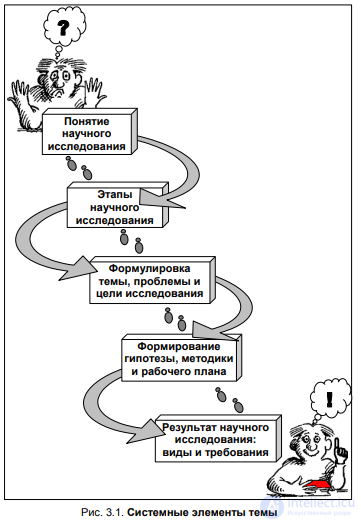
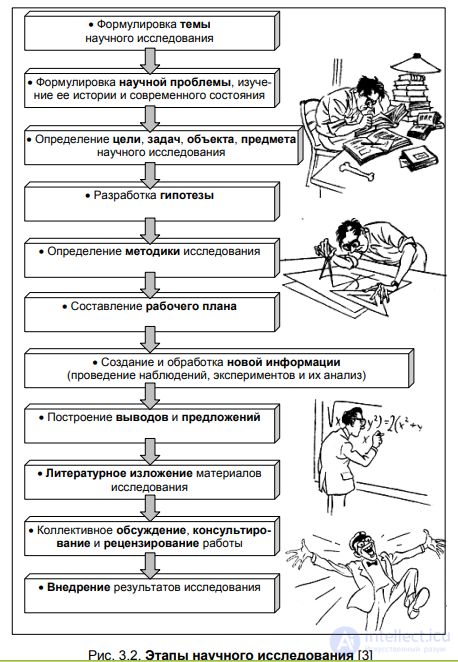
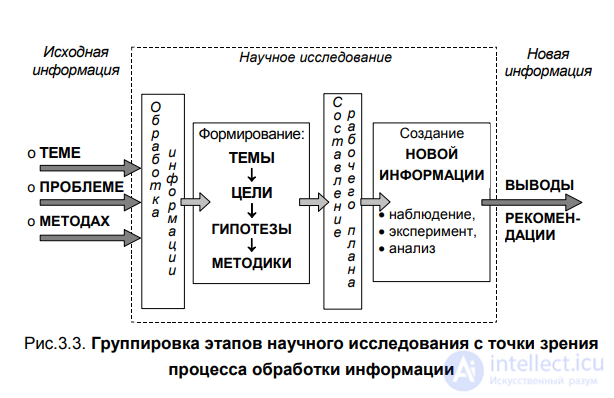
Scientific research requires the researcher to carry out various types of work: studying literary sources, conducting experiments, publishing results, and so on. These types of work form
a certain sequence of stages, which is subject to the rules for forming new scientific knowledge (fig. 3.2 and 3.2). Let us now examine some stages of scientific research in more detail.
The concept of "scientific research" can be examined simultaneously in several interrelated contexts — historical, pragmatic, theoretical and social.
Scientific research did not arise all at once in its modern sense. Its origins lie in ancient civilizations, where systematic knowledge about astronomy, mathematics, medicine and nature accumulated.
Thus, historically, scientific research has traveled the path from individual searching for explanations to an institutionalized system for producing and verifying knowledge.
From a pragmatic point of view, scientific research is purposeful activity aimed at obtaining new, substantiated knowledge for solving a specific problem.
Research answers not only the question "what is happening?", but also the questions:
For example, research into a new material may have a fundamental aim — to understand its physical properties, or it may have an applied aim — to create stronger and lighter structures.
Therefore the pragmatic aspect links science with the needs of society, technology, medicine, economics, education and other spheres of activity.
In the theoretical sense scientific research represents a process of obtaining, substantiating, systematizing and verifying knowledge about reality.
Its main elements are:
problem → question → hypothesis → methods → data collection and analysis → verification → conclusions → new knowledge.
At the same time scientific research differs from ordinary information searching by a number of features:
In this context scientific research can be defined as an organized process of producing new knowledge by means of specially developed methods and procedures for substantiating and verifying it.
Science does not exist in isolation, but within society. Therefore scientific research is also a social activity.
A researcher works within a scientific community, where certain norms exist:
In addition, the direction of research depends on social needs, government funding, economic interests, technological development and cultural values.
Modern science increasingly involves collective work: large-scale studies may bring together specialists from different countries, universities and scientific disciplines.
Thus, scientific research is a historically formed, socially organized and methodically substantiated activity aimed at obtaining, verifying, systematizing and applying new knowledge about reality.
The four contexts complement one another:
| Context | Main question | Meaning |
|---|---|---|
| Historical | How did it arise and develop? | Shows the evolution of scientific cognition |
| Pragmatic | For what purpose is it carried out? | Links research to problem-solving |
| Theoretical | What does it represent? | Reveals the essence, structure and methods |
| Social | Under what conditions does it exist? | Shows the connection between science and society |
Taken together, scientific research is not merely the collection of facts, but a special way of organized cognition of the world, which is formed historically, has a definite purpose, relies on theory and methods, and is carried out within the framework of the scientific community and society as a whole.
Scientific research is a process of study, experimentation, conceptualization and theory verification, connected with obtaining scientific knowledge.
Scientific research is the process of studying a particular object (an item or a phenomenon) with the aim of establishing the regularities of its emergence, development and transformation for the rational use of that knowledge in people's practical activity.
a) Classification of scientific research by the field of use of the results (by intended purpose) — fundamental, applied and development work.
b) Classification of research methods.
c) Classification by source of funding. Budget-funded, contract-funded and unfunded
d) Classification by connection with social production: divided into work aimed at creating new technological processes, machines, structures, increasing production efficiency, improving working conditions, developing the human personality, etc.
e) Classification by duration of research.
j) Classification by stages of research: exploratory, research-and-development and pilot-industrial development work.
k) Classification by the number of scientists working on the research (individual, group).
l) Classification by the number of scientific fields involved (a single field, complex, or big science).
m) Classification by the place where the research is conducted: laboratory-based or production-based.
Scientific research is classified by the types of connection with social production and its degree of importance for the economy; by intended purpose; by sources of funding and by the duration of the research.
Let us examine two of these classifications in more detail.
By type of connection with social production, scientific research is divided into work aimed at creating new technological processes, machines, structures, increasing production efficiency, improving working conditions, developing the human personality, etc.
By intended purpose, three types of scientific research are distinguished: fundamental, applied and development work (fig. 2.1).
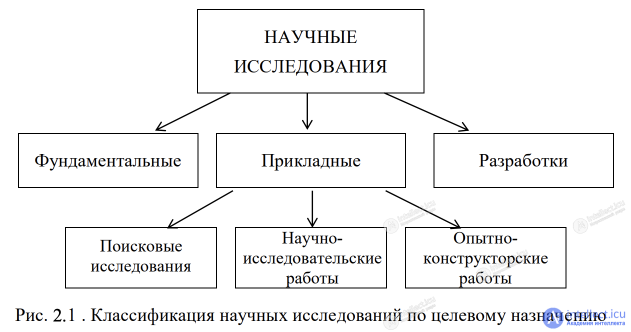
Fig. 2.1. Classification of scientific research by intended purpose
Fundamental research is aimed at discovering and studying new phenomena and laws of nature, and at creating new principles of research. Its purpose is to expand society's scientific knowledge and establish what can be used in human practical activity. Such research is conducted at the boundary between the known and the unknown and has the greatest degree of uncertainty. Fundamental research is often conducted at the intersection with other sciences.
Applied research is aimed at finding ways to use the laws of nature to create new and improve existing means and methods of human activity. The purpose of applied research is to establish how scientific knowledge obtained as a result of fundamental research can be used in human practical activity.
As a result of applied research, technical concepts are created on the basis of scientific concepts. Applied research, in turn, is divided into the following types of work:
As a result of fundamental and applied research, new scientific and scientific-technical information is formed. The purposeful process of converting such information into a form suitable for adoption is usually called development. It is aimed at creating new equipment, materials, technology, or improving existing ones. The ultimate goal of development is to prepare the materials of applied research for implementation.
The concept of "scientific research" is closely connected with a whole series of concepts describing the process of cognition, the obtaining of new knowledge and its practical use. These concepts are not synonyms: each reflects a separate facet of scientific-cognitive activity.
Knowledge is the result of a person's understanding of reality, represented in the form of concepts, judgments, theories, laws, etc.
Scientific research is one of the main ways of obtaining and developing scientific knowledge.
The connection can be represented as follows:
research → obtaining and substantiating knowledge → accumulation of scientific knowledge → development of science.
At the same time, not all knowledge is scientific. Knowledge can be everyday, religious, artistic, practical, etc. Scientific knowledge is distinguished by its systematic character, evidential basis, substantiation and testability.
Information is data, facts and reports about certain objects, phenomena or processes.
A researcher uses information as source material, but information by itself is not yet scientific knowledge.
For example, the results of observations constitute information. When a researcher analyzes them, establishes regularities, tests a hypothesis and substantiates conclusions, the information is transformed into scientifically significant knowledge.
Information is the material of research; knowledge is its meaningful and substantiated result.
Searching is a broader concept. It is activity aimed at finding a needed object, piece of information, solution or answer.
Scientific research includes searching, but is not reducible to it.
For example, searching for literature, data or existing solutions is a stage of research. However, research itself presupposes posing a problem, choosing a method, analyzing material, verifying results and formulating conclusions.
The word "reconnaissance", in its broad cognitive sense, means the preliminary study of an unknown area with the aim of obtaining initial information.
In science, research work can indeed perform a reconnaissance function: determining what is already known, which questions are insufficiently studied, and where the problem lies.
However, unlike reconnaissance, scientific research is oriented not simply toward obtaining information, but toward the systematic and substantiated production of new knowledge.
Discovery is the finding of a previously unknown phenomenon, property, regularity or object.
Scientific research can lead to a discovery, but research and discovery are not one and the same thing.
Research is a process, while discovery is a possible result of that process.
For example:
observation → research → identification of a regularity → scientific discovery.
It is also important to distinguish discovery from the simple detection of a fact: a scientific discovery is a result that has significant importance for the relevant field of knowledge and has received scientific substantiation.
Invention is connected above all with the creation of a new technical or practical solution.
The difference can be expressed very simply:
For example, research into the properties of electricity can lead to a scientific discovery, while using the knowledge obtained to create a new device leads to an invention.
At the same time, research and invention are closely linked: scientific research creates knowledge that can become the basis of new technologies, while technical tasks, in turn, stimulate new research.
Progress is development from a less perfect state to a more perfect one.
Scientific research is one of the most important factors of scientific-technical and social progress.
The chain here may look as follows:
research → new knowledge → discovery → technology/invention → practical application → changes in society.
However, the connection is not automatic. New scientific knowledge may long remain without practical application, and technical progress may have both positive and negative social consequences.
Research usually begins with a problem — a question or contradiction to which existing knowledge does not yet give a satisfactory answer.
This can be represented as:
problem → research question → hypothesis → research → results → solution to the problem / new knowledge.
Therefore a problem is, in a sense, the starting point of research.
Hypothesis is a scientifically substantiated assumption that explains the phenomenon under study and admits of verification.
A hypothesis sets the direction for the research. The researcher does not simply collect facts, but tests a specific assumption.
hypothesis → verification → confirmation, refinement or refutation.
Theory is a systematized system of scientific knowledge that explains a certain range of phenomena and reveals the regularities between them.
Research:
Thus there is a constant interrelation:
theory → determines the direction of research → research → develops or corrects theory.
All these concepts can be combined into a single logical chain:
Problem → searching for information → research → analysis and verification → new knowledge → discovery → application → invention/technology → progress.
At the same time, individual elements may be absent. Not every study ends in a discovery, not every discovery leads to an invention, and not every invention is directly connected with a new scientific discovery.
| Concept | What it characterizes |
|---|---|
| Information | Facts and data |
| Knowledge | Meaningful and substantiated information about reality |
| Searching | Activity aimed at finding a needed object or solution |
| Reconnaissance | Initial study of an unknown area |
| Research | Systematic process of obtaining and substantiating new knowledge |
| Discovery | Finding of something previously unknown in objective reality |
| Invention | Creation of a new technical or practical solution |
| Theory | Systematized system of explanatory knowledge |
| Progress | Development and improvement of a certain system or society |
Thus, scientific research occupies a central place in the system of cognitive activity: it uses information and searching, relies on existing knowledge and theory, is guided by a problem and a hypothesis, and its result may become new knowledge, a discovery, or the basis for an invention and subsequent scientific-technical progress.
Scientific research is a purposeful, systematic and substantiated process of obtaining new knowledge, testing existing conceptions and seeking solutions to theoretical and practical problems. In modern society it is one of the main mechanisms for the development of science, technology and social institutions.
1. Cognitive significance.
Scientific research expands human understanding of nature, society and the human being itself. It allows the transition from individual facts to the identification of regularities and cause-and-effect relationships.
2. Practical significance.
Research results are used to solve specific tasks: developing medicines, technologies, materials, production methods, educational programs, environmental solutions, etc.
3. Predictive significance.
Research allows not only the explanation of the present, but also the forecasting of possible changes: the development of climate, the economy, technology, demographic processes, and so on.
4. Innovative significance.
Scientific knowledge creates the basis for new technologies, products and ways of working. The connection between fundamental science and applied research and development is especially important.
5. Cultural significance.
Science is part of the culture of humankind. It forms a rational picture of the world, develops critical thinking, and the ability to distinguish substantiated statements from unsubstantiated ones.
6. Educational significance.
Scientific research constantly updates the content of education. In addition, research activity itself forms the skills of analysis, argumentation, independent searching and verification of information.
Several of the most important functions can be distinguished:
Thus, scientific research performs not just one function: it simultaneously cognizes, explains, verifies, forecasts and helps to transform reality.
A person obtains information and solves problems not only by means of science. In everyday life, people use practical experience, theoretical reasoning, learning, instinctive actions, intuition, trial-and-error actions, random searching and other methods.
The main distinction of scientific research does not lie in the fact that only science is capable of obtaining correct information. Many other methods can also give a correct result. The distinction lies above all in the nature, systematicity, substantiation and testability of the way knowledge is obtained.
1. Practical experience
Practical experience is formed in the process of direct activity.
For example, a craftsman may know how to work a particular material because he has performed this work many times.
Advantages:
Limitations:
Scientific research strives to go beyond individual experience and establish under what conditions and why a certain result is observed.
A person can solve problems by means of logical thinking, analysis of already-known knowledge, and the construction of theoretical models.
For example, a mathematician can derive a new consequence from already-known axioms and theorems without conducting a physical experiment.
This is a most important part of science, but theoretical reasoning by itself is not always a complete scientific study. Scientific character is determined by the system of posing the problem, argumentation, methods of verification, and connection with the relevant field of knowledge.
Instinctive behavior is based on innate behavioral programs and is especially characteristic of animals, although certain automatic reactions also exist in humans.
For example, a person automatically pulls their hand away from a hot object.
Instinct allows for rapid reaction, but it is not intended for the systematic obtaining of new knowledge.
Instinct answers above all the question "how to react quickly?", while research answers "what is happening, why, and how can this be verified?".
Learning is the acquisition of knowledge and skills already accumulated by other people.
For example, a student studies physics from a textbook and lectures. They obtain scientific knowledge, but this process itself is not necessarily scientific research.
The distinction:
learning predominantly transmits and assimilates existing knowledge; research creates or tests new knowledge.
At the same time, learning and research are closely connected: a researcher must first master the knowledge that already exists, in order to determine exactly what is still unknown.
Sometimes a problem is solved by the random selection of options.
For example, a person tries to turn on a faulty device by pressing various buttons one after another.
This method can lead to success, but the result is usually poorly explainable and difficult to reproduce.
Scientific research, by contrast, strives to:
Trial and error occupies an intermediate position. It is significantly more effective than random action if a person remembers the results of previous attempts and gradually adjusts their actions.
For example:
try → obtain a result → identify the error → change the action → repeat.
Science, too, can use experimental selection of options, but it turns this into a controlled procedure, in which certain conditions are varied and the results are recorded.
Intuition allows a person to quickly arrive at a solution without fully being aware of all the intermediate steps.
It can be very useful in scientific activity as well: a researcher may intuitively suppose the existence of a certain regularity.
But:
intuition can give rise to a hypothesis, but the scientific status of that hypothesis is determined by its subsequent verification.
Therefore intuition is a possible source of a scientific idea, but not sufficient proof.
| Method | Basis | Strength | Limitation |
|---|---|---|---|
| Practical experience | direct activity | concreteness and practicality | limited to personal experience |
| Theoretical reasoning | logic, existing knowledge | the ability to derive new propositions | depends on the initial premises |
| Instinct | innate mechanisms | speed of reaction | not intended for systematic cognition |
| Learning | transmission of experience and knowledge | rapid mastery of accumulated knowledge | does not necessarily create new knowledge |
| Random actions | random choice | sometimes give a quick result | lack of explanation and control |
| Trial and error | sequential testing of options | practical effectiveness | does not always reveal causes |
| Intuition | unconscious or rapid decision | generation of ideas | subjectivity, the need for verification |
| Scientific research | methods, theory, evidence, verification | systematic obtaining and substantiation of knowledge | requires time, resources and special competencies |
It can be formulated as follows:
Other ways of acting can help a person find the correct solution, but scientific research strives to establish why this solution is correct, under what conditions it works, and how the result obtained can be verified by other researchers.
Therefore scientific research is distinguished above all by systematicity, purposefulness, methodical organization, criticality, evidential basis and testability.
In modern society this makes science a special mechanism for producing reliable, reproducible and socially verifiable knowledge, which can then be used for education, decision-making, creating technologies and solving social problems.
Scientific facts are not only described events or a measured "magnitude" of an object, but also many other pieces of information about facts of reality. These should include: when, in what way, and by whom a particular fact of reality was recorded, with what other events and facts of reality it was connected, and what place it occupies in the system of objective reality. It can also be said that scientific facts are fragments of knowledge, certified by science and social practice, that reflect the properties and features of the object under study.
The concept of "scientific fact" is considerably more multifaceted than the concept of "fact of reality". When we speak of scientific facts, they are understood as elements forming the basis of scientific knowledge, reflecting the objective features and properties of the object that currently interests the researcher. On the basis of scientific facts, the regularities of the existence of the object of study are determined, and concepts and theories of its existence and development are formulated. Scientific facts are characterized by the following indicators: novelty, precision, objectivity and reliability.
For beginning researchers it is very important not only to know well the basic propositions that characterize scientific work, but also to have at least the most general idea of the methodology of scientific creativity, because, as the current practice of higher education institutions shows, it is precisely questions of a methodological nature that arise most often for such researchers in their first steps toward mastering the skills of scientific work. Above all, they lack experience in organizing their own work, in using the methods of scientific cognition, and in applying logical laws and rules. It therefore makes sense to examine these questions in more detail.
Every piece of scientific research, from the creative conception to the final formalization of the scientific work, is carried out individually; however, it is also possible to identify certain general methodological approaches to conducting it, which are customarily called study in the scientific sense.
Modern scientific-theoretical thinking strives to penetrate into the essence of the phenomena and processes under study. This is possible given a holistic approach to the object of study, examining this object in its emergence and development, i.e. applying a historical approach to its study.
It is known that new scientific results and previously accumulated knowledge are in dialectical interaction. The best and most progressive elements of the old pass into the new and give it strength and effectiveness. Sometimes the forgotten old is revived again on a new scientific basis and lives, as it were, a second life, but in a different, more perfect form.
To study in the scientific sense means to conduct exploratory research, as if looking into the future. Imagination and fantasy, resting on the real achievements of science and technology, are among the most important factors of scientific research. But at the same time scientific study is the substantiated application of scientific foresight. To study in the scientific sense means to be scientifically objective. One cannot cast facts aside merely because they are difficult to explain or to find a practical application for. The point is that the essence of what is new in science is not always visible to the researcher themselves. New scientific facts, and even discoveries, may for a long time remain in science's reserve and not be used in practice because their significance is poorly disclosed.
In scientific research everything matters. While concentrating attention on the main or key questions of the topic, one cannot fail to take into account so-called indirect facts, which at first glance seem of little significance. It often happens that it is precisely such facts that conceal within themselves the beginnings of important discoveries.
In science it is not enough to establish some new scientific fact; it is important to give it an explanation from the standpoint of modern science, and to show its general cognitive, theoretical or practical significance.
The accumulation of scientific facts in the course of research is a creative process, at the basis of which always lies the scientist's conception, their idea. In the philosophical definition, an idea is a product of human thought, a form of the reflection of reality. Ideas are born from practice, from observations of the surrounding world and from the needs of life. Real facts and events lie at the basis of ideas. Life puts forward specific tasks, but often productive ideas for solving them are not found right away. Then the researcher's ability to propose a new, completely unusual aspect of examining a task — one that could not be solved for a long time by the usual approach, or, as they say, that people tried to solve "head-on" — comes to the rescue.
The development of an idea to the stage of solving a task is usually accomplished as a planned process of scientific research. Although chance discoveries are known in science, only planned scientific research, well equipped with modern means, reliably allows the objective regularities in nature to be uncovered and deeply understood. Thereafter comes the process of continuing the purposeful and overall conceptual elaboration of the original conception, the refinement, alteration, supplementation and development of the outlined research scheme.
Thus scientific study can be represented as the following sequence: Task – idea – implementation – scientific approach.
For the success of scientific research it must be properly organized, planned, and carried out in a definite sequence. The general scheme for carrying out scientific research is presented in fig. 4.1.
These plans and sequences of actions depend on the type, object and goals of the scientific research.
With regard to master's theses, the following successive stages of their completion can be outlined:
1) preparatory;
2) conducting theoretical and empirical research;
3) working on the manuscript and formatting it;
4) implementation of the results of the scientific research.
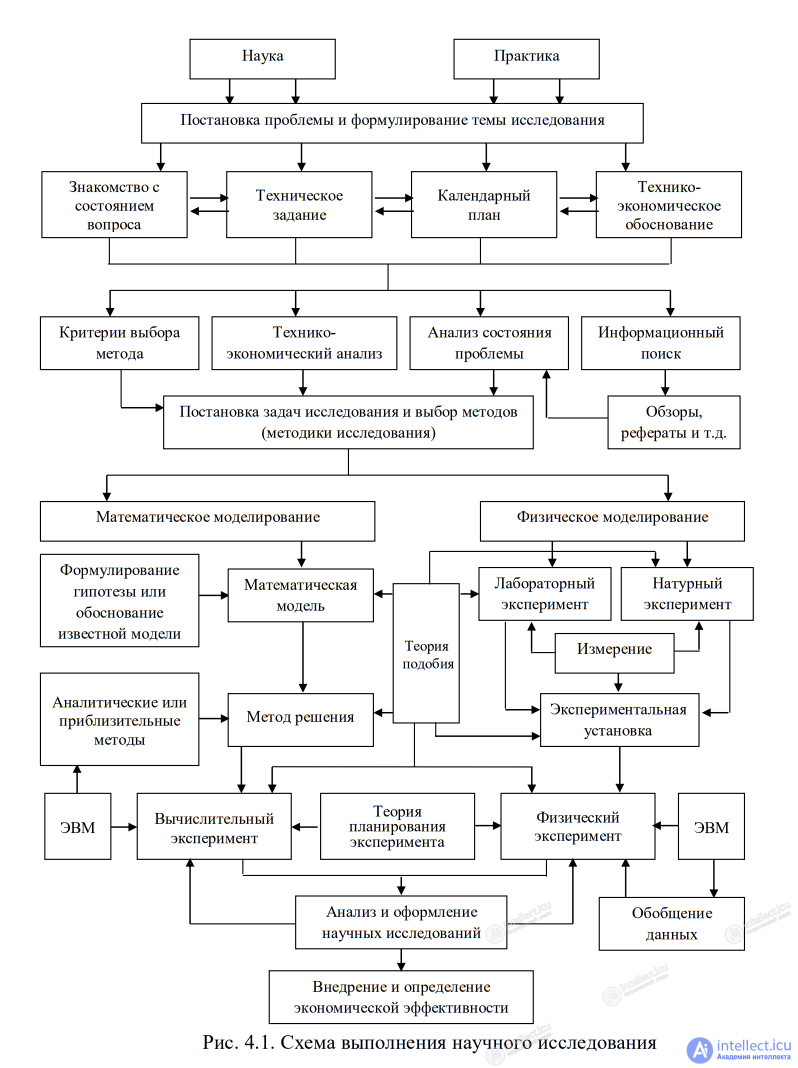
Fig. 4.1. Scheme for carrying out scientific research
It seems necessary first to give a general characterization of each stage of research work, and then to examine in more detail those of them that have great significance for students carrying out scientific research.
The preparatory (first) stage includes:
First the topic of the scientific research is formulated and the reasons for its elaboration are substantiated. By means of a preliminary review of the literature and materials of previously conducted research, it is clarified to what extent the questions of the topic have been studied and what results have been obtained.
A list of normative acts, domestic and foreign literature, and a list of dissertation topics and extended abstracts of dissertations is compiled.
A research procedure is developed. Research tools are prepared in the form of questionnaires, surveys, interview forms, observation programs, etc.
The research (second) stage consists of:
The third stage includes:
The fourth stage consists of implementing the research results in practice and of the author's support of the developments being implemented. Scientific research does not always conclude with this stage, but sometimes students' scientific work and the results of dissertation research are recommended for implementation in the practical activity of management bodies and in the educational process.
The entire course of scientific research can be represented in the form of the following logical scheme:
The explanation of relevance should not be verbose. There is no particular need to begin its description from afar; the main thing is to show the essence of the problem situation.
The formulation of the problem situation is an important part of the introduction. Any scientific research is conducted in order to overcome difficulties in the process of cognizing new phenomena, to explain previously unknown facts, or to reveal the incompleteness of old ways of explaining known facts. A problem arises when old knowledge has already revealed its inadequacy, while new knowledge has not yet taken a developed form. Thus, a problem in science is a contradictory situation that requires resolution. Such a situation most often arises as a result of the discovery of new facts that do not fit within the framework of previous theoretical conceptions.
The correct posing and clear formulation of new problems is of great importance. They determine, if not entirely, then to a very large degree, the strategy of research in general and the direction of scientific inquiry in particular. It is not by chance that it is considered that to formulate a scientific problem means to show the ability to separate the essential from the secondary, and to clarify what is already known and what is still unknown to science about the subject of research.
Beginning researchers often avoid taking narrow topics. This is fundamentally wrong. Work devoted to broad topics is often superficial and lacking in independence. A narrow topic, on the other hand, is worked through more deeply and in more detail. At first it seems that there is nothing to write about. But as one becomes familiar with the material this concern disappears, and aspects of the problem that the researcher had not previously suspected are revealed to them.
 Formulating the aim and objectives.
The aim of research activity is usually formulated briefly, in a single sentence, and is then detailed in the objectives. In formulating the aim, the verbs "prove", "substantiate", "develop" may be used. The last verb should be used if the final product of the research will take material form, for example a video, a working model or mock-up of something, a computer program, etc. The sequential solution of each objective in the course of the research is, in essence, a separate stage of it. In formulating the objectives it is advisable to use the verbs "analyze", "describe", "identify", "define", "establish". There should not be too many research objectives. The optimal number is three to five.
Object and subject of research.Object is a process or phenomenon chosen for study.
Subject is a part of the object that can be transformed in such a way that the object changes. The object and subject of research, as categories of the scientific process, relate to each other as the general and the particular. Within the object, that part is singled out which serves as the subject of research. It is precisely on this that the researcher's main attention is focused.
The object of research is, as a rule, a process, a certain phenomenon that exists independently of the subject of cognition and to which the researcher's attention is directed.
The concept of the subject of research is even more specific in its content: the subject of research fixes that property or relationship within the object which, in the given case, is subject to deep, specialized study.
Choice of research methods.The objectives of the research determine its methods and procedures, that is, the techniques and means that the researcher uses. These include both general methods of scientific cognition, such as analysis, observation, measurement, comparison, experiment, modeling, etc., and special methods, which serve as a tool for obtaining factual material.
Description of the research process is the main part of the work. Here the procedure and technique are also covered.
Discussion of the research results- an essential stage of scientific research, it takes place at meetings of groups and councils, where a preliminary assessment of the theoretical and practical value of the research work and a collective review are given.
Conclusionsare the final stage of scientific research; they contain what is new and essential, constituting the scientific and practical results of the work carried out. Moreover, the results must be in logical connection with the objectives of the research, and the conclusions with the aim. Thus, if the objectives of the research are formulated with the words "analyze", "describe", "identify", "define", "establish", then the results are presented in the following form: "In the course of this research, an analysis was carried out of..., it was identified..., it was defined..., it was established...". The conclusions, in accordance with the aim of the research, are formulated approximately in the following form: "On the basis of the results of this research, it has been proven... (substantiated..., developed...)".
Let us examine the content of the stages of a student's work in the course of research.
At the first, preparatory, stage, which lasts no more than a month, it is necessary to determine the area of research — the phenomenon, epoch, process, etc. Next, a narrowly defined problem should be chosen, and the line (course) of the research and a working formulation of the topic should be outlined.
Next, under the supervision of a teacher, the student determines the structure of the research work: identifies the relevance of the problem, formulates the aim, objectives, object and subject of the research, and chooses the methods and procedures necessary for conducting it. All of this is reflected in the text of the introduction to the research work.
At the second stage it is necessary to begin collecting diverse information on the research problem. For this it is worth visiting libraries, turning to the Internet and other sources. Information can be:
At the same time as collecting information, a database should be created, into which excerpts of texts on the research problem, a bibliography, and illustrative materials should be included.
At the third stage the student conducts a literature review on the research problem and begins describing its stages, which will later form the main part of the research. In doing so, one should rely on the basic methods of scientific cognition:
as well as follow the logical laws and rules:
At the final stage the student or pupil (postgraduate) sums up the results — formulates the findings of the research and draws conclusions. This part is reflected in the text of the conclusion of the research work. In addition, at this stage it is necessary to refine and finally formulate the topic of the research. After which it is necessary to choose a way of presenting the work and to prepare for its defense.

Comments