
Lecture 5 min.
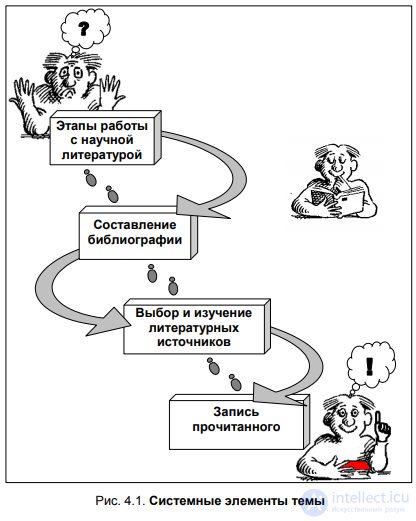
The purpose of this chapter is to teach readers the rules of effective work with scientific literature. Knowledge of these rules is necessary not only for the successful conduct of academic and professional research work, but also for the effective organization of the process of self-education of any specialist. In this chapter we will answer the main questions related to reading scientific literature: what, how and when, and in what order one should read.
The various types of work with literary sources carried out
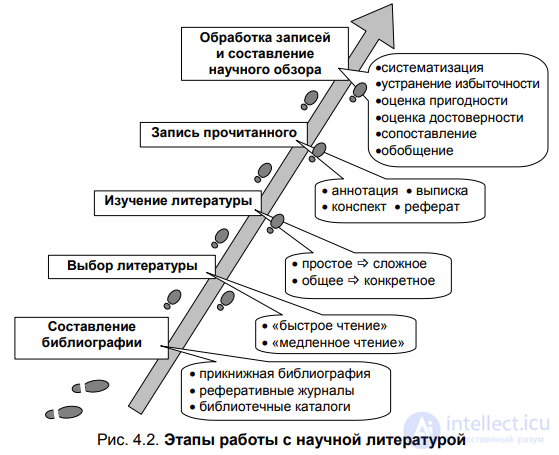
within the framework of scientific research form a strict sequence of stages, which obeys the logical rules of collecting and processing information. The list and key points of the main stages of working with scientific information are shown in Fig. 4.2.
The first stage of working with scientific literature is compiling a bibliography (Fig. 4.3, Table 4.1.).
A bibliography is a list of various informational
documents indicating the following data: the author's surname and initials, the title of the source, the place of publication, the publisher, the year of publication, the length of the source in pages.

Table 4.1. Examples of formatting the bibliographic description of literary sources

It should be kept in mind that a bibliography, although it resembles an ordinary list of references used, in fact performs far more functions. First of all, a bibliography is a list of literature planned for study. It makes it possible to answer the questions: «What should be read?», «What studies have already been carried out within this subject area?», «What questions have already been worked out?», «Which scholars work in this field of knowledge». Thus, a bibliography performs an informational and «accounting and control» function, allowing the researcher's work to be organized properly.
The following sources of information are used to gather bibliographic information:
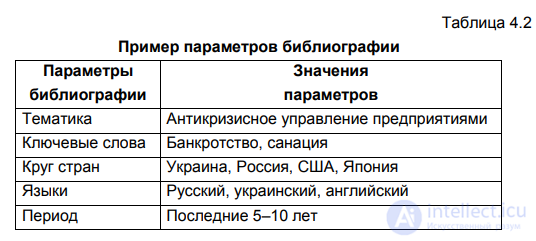
An abstract journal is a periodical publication containing abstracts of scientific publications in some branch of science or technology, as well as other secondary informational materials (bibliographic descriptions, annotations, literature reviews) in conjunction with a reference-retrieval apparatus. Compiling a bibliography should begin with determining its parameters . The most important parameter of a bibliography is its subject matter. The literature being sought may be devoted directly to the topic of the research, to some part of it, to a broader problem, or to related questions. In addition, one must determine the range of countries and languages, the types of literary sources and their chronological scope. For example, technical literature, owing to how quickly it becomes outdated, is usually studied only for the last 5 – 10 years. An example of bibliography parameters is given in Table 4.2
Compiling the bibliography does not stop once the initial information for the scientific research has been collected. In the course of further work on the topic, the researcher constantly refers back to the bibliography, adds references to new publications to it, refines its parameters, and also uses it to keep track of their progress in studying the literary sources.

In addition to a bibliographic list, specialists also recommend compiling a card index of scientific sources on the topic being researched. A card index is a set of information cards on paper or electronic media, containing bibliographic data about literary sources, as well as other additional information at the discretion of the compiler of the card index. In addition to bibliographic data, the compiler of the card index is advised to indicate the following information on the cards: their own assessment of the work or its abstract, the date the book was read, the serial numbers of the extracts or summaries made, a mark showing whether the book has been read or is only planned to be read, as well as other necessary notes. A possible structure for an information card is given in
Fig. 4.4. A specific example of a card is given in Fig. 4.5
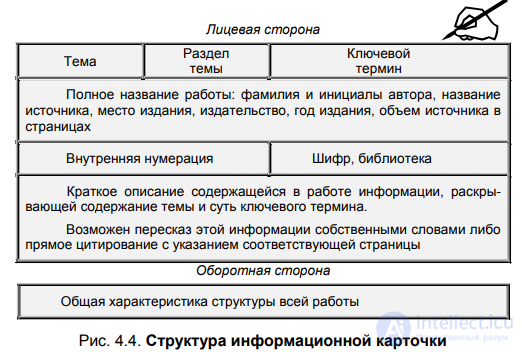
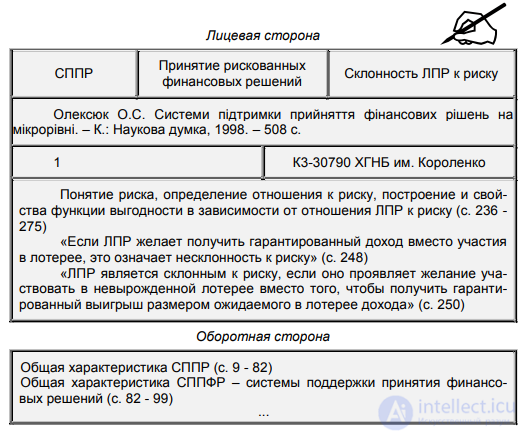
Fig. 4.5. Example of an information card

Comments