
Lecture 4 min.
Any scientific discipline is not a frozen alloy of knowledge but a dynamic system, having its own life cycle and passing through its own stages of development from emergence to maturity. The process of formation of any
particular science, historically speaking, includes the following periods (Fig. 1.8):
1. The pre-scientific period. During this period, in the subject
area where the "edifice of science" will later be erected, ordinary practical human activity is carried out. This is how, for example, factories and plants were managed in the times preceding the emergence of the scientific discipline of management. At the same time, during
the pre-scientific period the methods of practical activity form spontaneously and are not passed on from person to person. Since
there is no accumulation of knowledge, there is also no science. Instead, an art of the corresponding subject area is formed. The essence of this phenomenon is that some people carry out certain
kinds of activity substantially better than others (that is, they are more
"skilled" in this area). Relatively recently, such a state of affairs
was observed in the advertising business: goods were advertised, and masters and
leaders in advertising existed, but their experience was not generalised and systematised, and as a consequence a formal scheme of actions and standard patterns of behaviour in the advertising business was lacking.
2. The empirical level of development of science. During this period an exchange of experience of activity arises. Knowledge is passed from person to person, generalised and accumulated. As a consequence, into that area where
art had previously reigned unchallenged, science intrudes. However,
the art of the subject area does not disappear: it turns into the specialist's
skill in adapting to specific conditions that formalised
scheme of actions which science proposes for the typical situation.
If you have an apple and I have an apple, then
after the exchange you and I will each still have one apple.
But if you have an idea and I have an idea and we exchange them, then each of us will have two ideas.
G.B. Shaw
The main task of a young science during this period – is the accumulation, description and prediction of facts. As a consequence, during this period science is
characterised by the application of empirical research methods, that is,
those methods that make it possible to obtain primary information in
the form of a set of experimental data. At the initial stage of the empirical period, only qualitative descriptions and judgments are used
(for example, recommendations such as "in such-and-such a situation it is advisable to do such-and-such"). Next, statistical data begin to be used (values
of quantitative indicators obtained in the practice of the subject area); then empirical formulas are introduced (relationships linking
the values of statistical data taken as input variables with the values of statistical data taken as output variables).
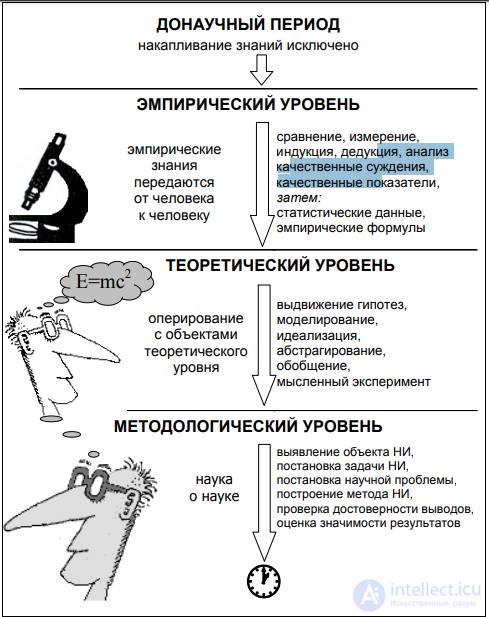
Fig. 1.8. Stages in the Formation of a Science
3. The theoretical (methodical) level of development of science. During this period the main task of science – is to explain the phenomena of the subject area. As a consequence, during this period science is characterised by the application of theoretical research methods, that is, methods such as the formulation of hypotheses, modelling, idealisation, abstraction, generalisation, and the thought experiment.
4. The methodological level of development of science. This is the highest period of development of science, in which science itself becomes the object of research. The name of this period derives from the term "methodology", denoting the doctrine of methods and theories, and of the structure and logical organisation of scientific-research activity.

Comments