Welcome to the test on the topic of scientific research! This test is designed to assess your knowledge and understanding of important aspects related to scientific research. Scientific research plays an important role in expanding our knowledge, opening new horizons and helping us understand the world around us.
Your understanding of scientific research includes such key aspects as the scientific method, the research process, statistical data analysis, the interpretation of results, and much more. In this test you will check your knowledge in these areas and demonstrate your ability to analyze and evaluate scientific research.
Successfully completing this test will allow you to deepen your knowledge of scientific research, as well as develop skills in critical thinking, data analysis, and the interpretation of results. Are you ready to begin this exciting and informative test? If so, let's get started and find out how well you are familiar with scientific research!
Self-check tests without answers
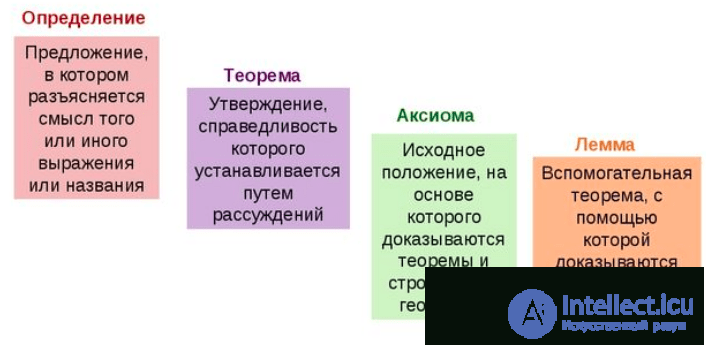
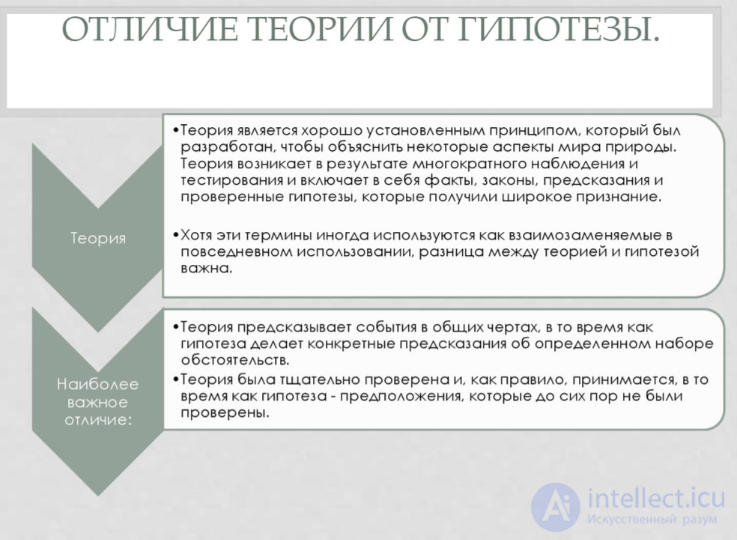
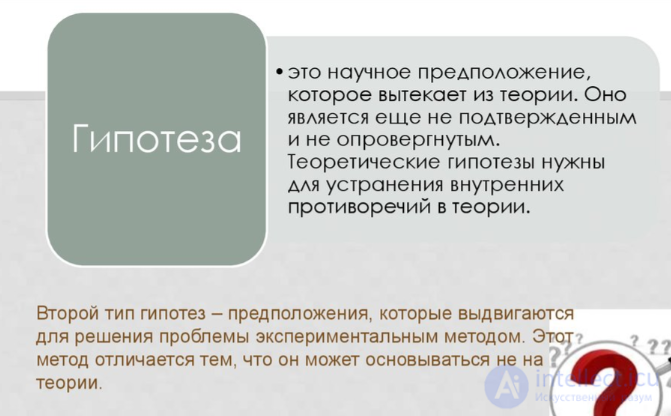
1. A scientific assumption about the connection between phenomena or their causes is called:
- a hypothesis: *
- an axiom;
- a theory.
2. Tasks represent the stages of work
- toward achieving the set goal *
- supplementing the goal
- for further research
3. Scientific research begins
- with the choice of a topic *
- with a literature review
- with the definition of the research methods
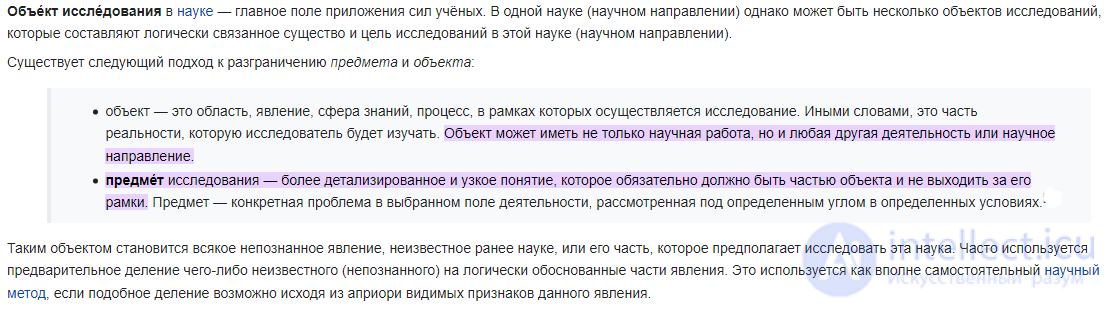
4. How are the object and subject of research related
- not related to each other
- the object contains the subject of research *
- the object is part of the subject
5. The choice of a research topic is determined by
- relevance *
- how well the topic is reflected in the literature
- the researcher's interests *
6. The formulation of the research goal answers the question
- what is being studied?
- why is it being studied? *
- who is studying it?
7. Tasks represent the stages of work
- toward achieving the set goal *
- supplementing the goal
- for further research
8. Research methods are
- theoretical*
- empirical*
- constructive
- financial
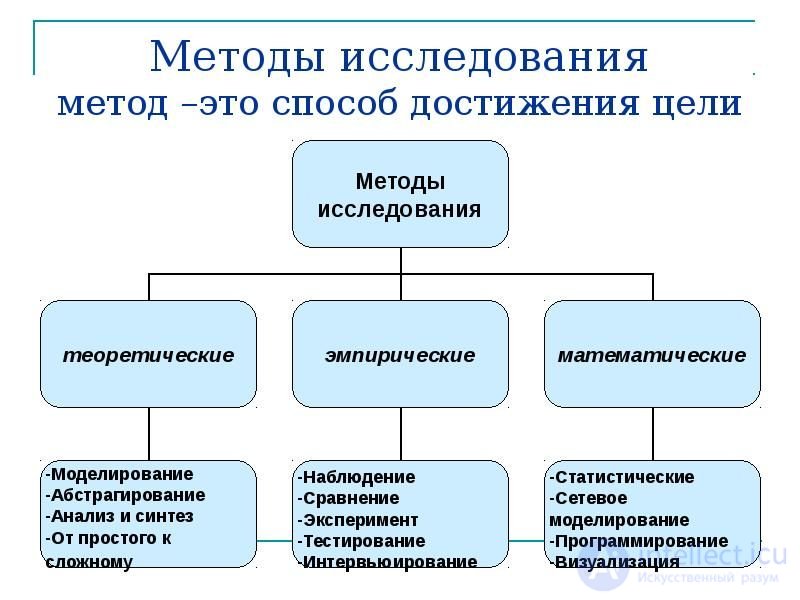
9. Which of the proposed methods are theoretical
- analysis and synthesis *
- abstraction and specification *
- observation
- carrot and stick
10. The methods most frequently found in pedagogical research are
- factor analysis
- surveying *
- the graphical representation method
11. When observation records not the object itself, but the results of its effect on other objects, such observation is called:
- direct;
- mediated; *
- indirect.
12. An experiment differs from observation:
- by the use of special instruments and conditions for observation;
- by having a goal and a plan;
- by the observer's intervention in the course of the processes; *
13. Scientific-pedagogical research is divided into …
- methodological
- applied*
- psychological
- developmental
- fundamental *
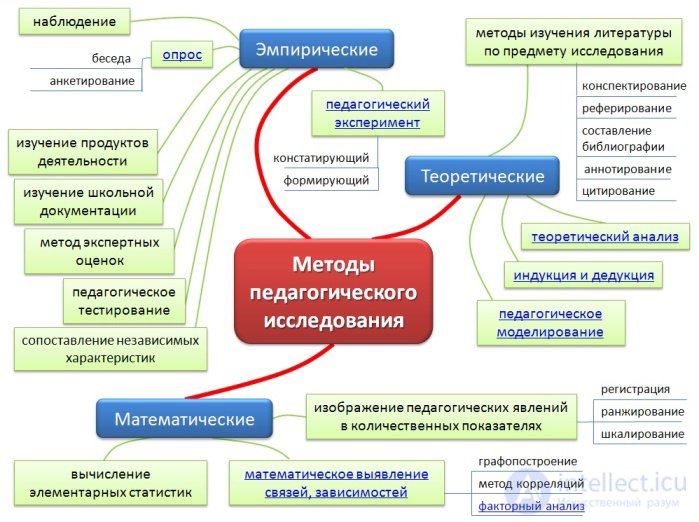
14. Examples of conversation as a method of scientific-pedagogical research could be a teacher's conversation …
- with other teachers about techniques for developing students' interests
- with students about the causes of poor academic performance *
- with students about rules of conduct
- with parents about upbringing in the family
- with students who were late for class
15. The main features of observation are …
- systematicity
- durability
- planned character *
- purposefulness
- comprehensiveness
16. Characteristic features of observation are …
- selection of literature
- developing a scheme *
- defining the tasks and the object *
- preparing questions
- recording and processing the results *
17. The main confirmation of the scientific validity of an experiment is:
- the correspondence of the results to the initial hypothesis; *
- the possibility of obtaining the same results under the same conditions;
- the formal presentation of results as tables and graphs
18.What is the main goal of science:
- obtaining knowledge about reality *
- the development of technology
- the improvement of morality
- increasing income
19. Which of the methods belong to the methods of empirical research?
- comparison, description*
- formalization, the hypothetico – deductive method
- measurement, observation*
20. Which level of methodology includes the general principles of cognition, the categorial structure of science as a whole;
- the philosophical level;*
- the theoretical level;
- specific-scientific methodology;
- technological
21.Which category of the research apparatus corresponds to the definition – a process or a phenomenon?
- hypothesis;
- problem;
- object;*
- subject.
22.Which principle requires a comprehensive accounting of the factors and conditions giving rise to a given phenomenon?
- Objectivity;*
- Essential analysis;
- Genetic;
- Unity of the logical and the historical.
23. Which of the methodological parameters must meet the requirements of conceptuality, novelty, verifiability, and provability:
- subject;
- hypothesis;*
- problem;
- object;
24. Insert into the definition the name of one of the methodological parameters that fits the meaning: In defining the …. of the research, the researcher must answer the question of what he wants to achieve by a certain point in time
25. Which of the methodological parameters are considered as the general and the particular:
- the object and subject of research; *
- the goal and hypothesis of research;
- the relevance and problem of research;
- all of the listed methodological parameters
26. The object of pedagogical research can be:
- a part of pedagogical practice or scientific knowledge; *
- a person;
- the structure of a personality;
- all of the above taken together
27. The methods of studying the real pedagogical process do not include:
- observation;
- annotating;*
- surveying;
- pedagogical experiment
28. The logical structure of analysis consists of the following sequential logical actions:
- Identifying the object and subject of the analysis. *
- Setting the tasks of the analysis. *
- Updating the main requirements for the results of the analysis (Why are we analyzing? What do we plan to obtain?). *
- Choosing the optimal type of analysis. *
- Applying the principles of the personal – activity approach.
29. As with any other method, analysis is subject to certain requirements. Thus the conclusions must contain:
- Information about the real results of the state of the object and the extent to which they correspond to the expected results.*
- A list of the methods applied
- Trends in the changes in the objects analyzed. *
- Information about the achievements, strengths, and competitive advantages of the object.*
30. The research procedure has a certain structure. Its main elements are:
- the theoretical-methodological part, the concept on which the whole procedure is built; *
- the principles of the paradigmatic approach;
- the set of methods applied and their coordination; − the order of applying the methods and methodological techniques;*
- the sequence and technique of processing and generalizing the results of the experimental work*
31.Implementing the research procedure makes it possible to obtain preliminary conclusions. The following requirements are placed on the conclusions:
- they must correspond to the results of the observations;
- comprehensive argumentation summarizing the main results of the research carried out;*
- appropriateness and validity;*
- they must follow from the accumulated material, being a logical consequence of its analysis and generalization;*
- approbation and the possibility of implementation in mass practice.*
32. Identify the one incorrect variant for presenting the content of a scientific work:
- reproducing the main stages and logic of the search carried out;
- reproducing the history of the origin (genesis) of the object;
- the search for absolute truth of knowledge about the subject and object of research*
- the theoretical reconstruction of the subject and object of research.
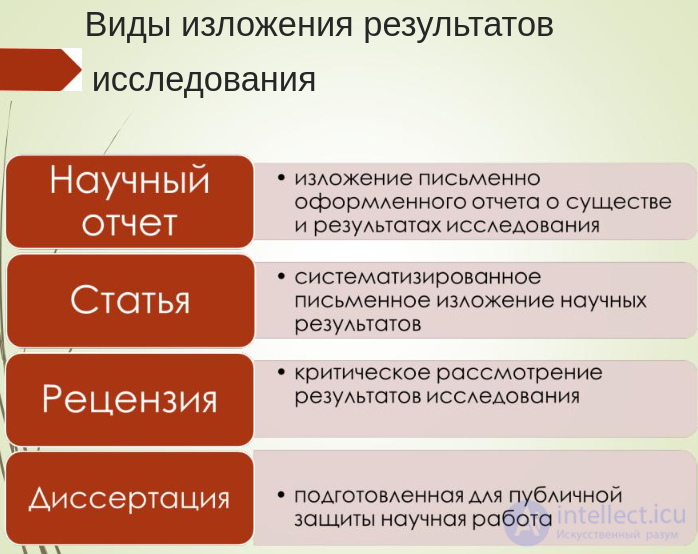
33. A research or scientific report is:
- the official form of presenting the results of the scientific work of a creative team of scientists;*
- carried out as a detailed description of the tasks, procedure, content, course and results of the search work;*
- contains a description of the entire body of knowledge on the subject of research
34. Relevance, novelty, theoretical and practical significance are:
- methodological parameters of pedagogical research;
- quality criteria of pedagogical research;*
- principles of pedagogical research;
- functions of pedagogical research
35. The essence of the research problem lies:
- in the contradiction between established facts and their theoretical interpretation, between different scientific explanations and interpretations of facts;*
- in the researcher's difficulty in answering a question that has arisen;
- in the researcher's turning to a field of scientific knowledge unfamiliar to him;
- in the construction of the logic of the research.
36. Which statement characterizing the object and subject of research is incorrect:
- * only one subject of research can be identified within one and the same object;
- the object of research is a certain set of properties and relations that exists independently of the one who cognizes it, but is reflected by them and serves as a specific field of search;
- in the subject of research, the property or relation in the object that, in this case, is subject to deep special study is fixed;
- the object of research in pedagogy and psychology is a certain process, a certain phenomenon that exists independently of the subject of cognition and to which the researcher's attention is directed.
37. The main groups of research tasks do not include:
- * historical-diagnostic;
- theoretical-modeling;
- practically-transformative;
- explanatory-illustrative.
38. The research hypothesis is:
- the process of goal-setting;
- the initial conceptual propositions on which the research is built;
- a substantiated assumption about how, by what means, and through what the sought result can be obtained;*
- generalizing conclusions made in the course of the step-by-step solution of the research tasks.
39. What is not a method of studying the literature:
- compiling a bibliography;
- writing an annotation;*
- note-taking;
- visiting a library or reading room.
40. Arrange in hierarchical order the structural components of pedagogical research:
- title page,introduction,table of contents, chapters of the main part; conclusion, bibliography; appendix
- title page;table of contents, introduction, chapters of the main part; conclusion, bibliography; appendix *
- title page, introduction, chapters of the main part; conclusion, bibliography,table of contents,appendix
- title page, bibliography, table of contents, introduction, chapters of the main part; conclusion, appendix
41. A test is:
- a type of survey aimed at revealing the experience, assessments, and point of view of the respondent through their answers to a predetermined question or group of questions;
- a standardized task or specially interconnected tasks that allow the researcher to diagnose the degree to which the studied trait is expressed in the subject, the subject's psychological characteristics, and their attitude toward particular objects; *
- the observation and description of the subjects' actions while performing the assigned tasks;
- conducting a conversation with the person or group being studied according to a plan drawn up in advance.
42. A table:
- *may have a title and a number
- *is placed in the text immediately after it is first mentioned
- is given only in the appendix
43. Abbreviations in scientific texts
- *are allowed in the form of compound words and acronyms
- *are allowed down to one letter with a period
- are not allowed
44. The abbreviations «etc.», «and so on» are allowed
- *only at the end of sentences
- only in the middle of a sentence
- anywhere in the sentence
- only if they are in the list of abbreviations
45. Which is not one of the main types of presenting the results of scientific research:
- a report;
- an article;
- a dissertation;
- a seminar. *
46. Which structural component of pedagogical research includes auxiliary or supplementary materials:
- the conclusion;
- the introduction;
- the bibliography;
- the appendix*
47. The testing process can be divided into stages such as …
- administering the test*
- interpreting the results*
- self-analysis
- correction*
- choosing the test *
48. Which structural component of pedagogical research provides a generalized final assessment of the work done and general conclusions:
- the introduction;
- the conclusion; *
- the theoretical chapter;
- the appendix
49. In the __________ of the research, the property or relation in the object that, in this case, is subject to deep special study is fixed.
- agent
- subject*
- object
- topic
50. A type of survey based on the analysis of respondents' written answers is called
- *a questionnaire survey
- testing
51. If the researcher sets the task of identifying the current state and the level of formation of a given property or parameter being studied, they are conducting a(n) ______________________________________________________ experiment.
- Ascertaining experiment
- Formative experiment
- Natural experiment
- comparative experiment
- complex experiment
- thought experiment
52. As a rule, the introduction to a scientific work begins with a justification of
- the chosen research topic.
- the list of abbreviations
- the research goal
53. The features of a scientific text consist in:
- the use of scientific and technical terminology *
- presenting the text in the first person singular
- the use of simple sentences
54. A scientific text must:
- be presented in the form of sections, subsections, and points*
- be given without division, as one continuous text
- be composed so that each new idea begins with a new paragraph
55. The conclusions contain:
- only the final results without proof*
- results with justification and argumentation
- a brief repetition of the entire course of the work
33. Scientific cognition as a special type of social activity arose:
- in ancient Egypt, Assyria
- in ancient Greece *
- in ancient China and Babylon
34. What is scientific measurement?
- the assignment of numbers to the properties of objects
- a measure of length
- a method of theoretical cognition*
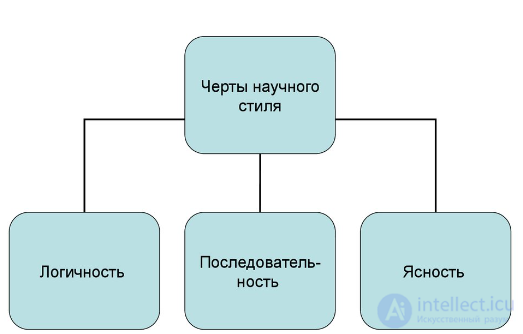
35. A scientific text is characterized by:
- emotional coloring
- logic, reliability, objectivity *
- clarity of the wording
36. The style of a scientific text presupposes:
- direct word order *
- an increase in the informational role of the word toward the end of the sentence
- the expression of personal feelings and the use of figurative means of writing
37. Identify the one incorrect variant for presenting the content of a scientific work:
- reproducing the main stages and logic of the search carried out;
- reproducing the history of the origin (genesis) of the object;
- the search for absolute truth of knowledge about the subject and object of research
- the theoretical reconstruction of the subject and object of research.
write the answer in the comments
38. A research or scientific report is:
- the official form of presenting the results of the scientific work of a creative team of scientists;
- carried out as a detailed description of the tasks, procedure, content, course and results of the search work;
- contains a description of the entire body of knowledge on the subject of research
write the answer in the comments
39. Relevance, novelty, theoretical and practical significance are:
- methodological parameters of pedagogical research;
- quality criteria of pedagogical research;
- principles of pedagogical research;
- functions of pedagogical research
write the answer in the comments
40. The features of a scientific text consist in:
- the use of scientific and technical terminology
- presenting the text in the first person singular
- the use of simple sentences
write the answer in the comments
41. How does the science of the Modern Age differ from the science of Antiquity and the Middle Ages?
- by its philosophical basis
- by its wide use of the experimental method
- by its connection with practice
- by the amount of money invested
write the answer in the comments
42. What is the highest stage in the development of science?
- an explanatory theory that provides not only a description but also an explanation of the phenomena studied
- the sum of accumulated knowledge
- the hadron collider in Zurich
write the answer in the comments
43. A scientific text must:
- be presented in the form of sections, subsections, and points
- be given without division, as one continuous text
- be composed so that each new idea begins with a new paragraph
write the answer in the comments
44. The component parts of a scientific text are designated:
- by Arabic numerals with a period
- without the words «section», «part»
- by Roman numerals
write the answer in the comments
45. The research method of evaluation is carried out in the form of:
- a synthesis of experts' independent characterizations;
- diagnostic situations;
- a psychological-pedagogical council;
- the collection and analysis of the opinions of competent and incompetent persons
write the answer in the comments
46. The conclusions contain:
- only the final results without proof
- results with justification and argumentation
- a brief repetition of the entire course of the work
write the answer in the comments
47. The list of references used:
- is formatted starting on a new page
- has its own independent page numbering
- is compiled so that domestic sources come at the beginning of the list, and foreign ones – at the end
write the answer in the comments
48. Which type of experiment does not exist:
- contact; *
- laboratory;
- natural;
- formative
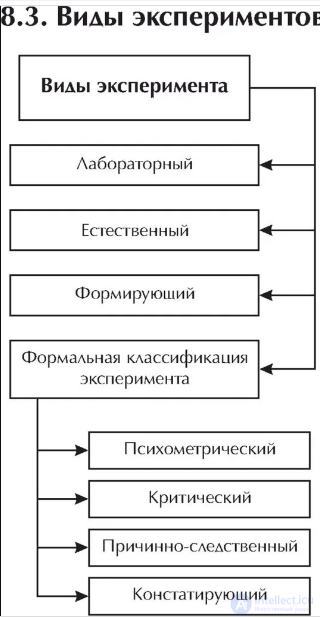
49. In appendices:
- page numbering is continuous *
- the word «Appendix» is printed at the top right of the sheet
- the word «APPENDIX» is printed at the right of the sheet
50. Indicate a research method of the theoretical level:
- studying the products of activity;
- modeling;*
- surveying;
- formative experiment.
51. Methodological approaches to the study of social objects are diverse. Among them, two extreme positions can be distinguished:
- induction - deduction; *
- regularity - randomness;
- sociality - asociality;
- objectivity - destructiveness;
- naturalistic approach - humanities approach
52. The research method and mode of reasoning in which a general conclusion is built on the basis of particular premises is:
- intuition;
- analysis;
- deduction;
- induction *;
- invention
53. A synonym for scientific research, and the method of research by decomposing a whole subject into its component parts, is:
- synthesis;
- defragmentation;
- abstraction;
- formalization;
- detailing;
- analysis *.
54. The fundamental, initial position of some theory, doctrine, science, or worldview is:
- synthesis;
- analysis;
- principle; *
- aspect;
- hypothesis;
- problem
55. The word «theory» comes from the Greek «theoria» - investigation. The criterion of truth and the basis for the development of a theory is:
- objectivity;
- proof;
- practice; *
- intuition;
- experience;
- axiom.
See also
- [[b8135]]
- [[b8974]]
- [[b8953]]
- [[b1909]]
- [[b8966]]
- [[b8968]]
See also
- The Concept of Science and Its Sociocultural Status
- 2.4. Levels (theoretical, empirical) and methods of scientific cognition (observation, experiment, comparison, modeling, abstraction, analysis, measurement)
- INTRODUCTION to scientific research
- Chinese room
- 2.2. The concept of hypothesis: types, functions, stages of development, the concept of a version
- CHAPTER 3. 3.1. Scientific research - concept, classification, features, technology and stages



Comments