
Lecture
The apogee of the work on a dissertation is its public
defence, which takes place at a meeting of the specialised academic
council and is conducted in the form of a scholarly discussion.
278
278
"The most important component of the dissertation defence procedure is the public nature of this process. From time immemorial
the paradigm of the transparency of the process of conferring academic
degrees, and the necessity of public disputation ... on the materials submitted for defence, has arisen and been carefully preserved by the world scholarly community. Extensive, centuries-old experience,
both foreign and domestic, firmly attests
to the undoubted necessity and great usefulness
of holding a public disputation in the defence of dissertations. The dissertation candidate must be able to "take a hit". Only the dissertation
is worth anything whose author is able to defend it staunchly."
[17].
A meeting of the council for the defence of a dissertation is conducted in accordance with the following procedure, defined by the "Regulations on Specialised Academic Councils" [35]:
1. Before the opening of the meeting of the specialised council, the members of the council are given a draft opinion, prepared in advance by the previously formed commission.
2. When the meeting of the specialised council is opened, the chairperson, on the basis of the registration card data, informs
the council of the meeting's validity. The meeting is considered valid if it was attended by not less than two-thirds
of the members of the specialised council, and also on condition of the mandatory
participation of at least three Doctors of Science in the specialty of the Candidate's dissertation and at least four Doctors of Science in the specialty of the Doctoral dissertation.
3. After the meeting is opened, the chairperson informs the members of the council of the language of the dissertation defence agreed with the candidate, announces the agenda, the title of the dissertation, and information on the
official opponents and the leading institution.
4. The floor is then given to the academic secretary, who
briefly reports on the documents submitted by the dissertation candidate and on
their compliance with the established requirements.
279
279
5. The candidate delivers a presentation setting out the main points of the dissertation. From the text of the presentation it should
become clear to the audience that the candidate "stands on the shoulders of giants" and that their dissertation is a full-fledged building block in the edifice of the relevant science [1].
6. The members of the specialised council then put
questions to the candidate in order to clarify the essence of the problems considered in the dissertation
and the scientific results obtained, and also to determine
the level of the candidate's preparedness.
7. After the candidate's answers, the floor is given to their supervisor
or advisor for a review of the candidate's work during the
period of conducting the dissertation research.
8. The academic secretary reads out the opinion of the organisation where the dissertation work was carried out, as well as the review of the leading organisation and other reviews of the dissertation and the extended abstract received by the council.
9. After the reviews are read out, the candidate is given the opportunity to respond to the comments contained in them.
10. The official opponents then speak.
11. After each opponent's statement, the candidate is given the floor to respond to the comments.
12. After the statements of the opponents and the candidate's answers, a public discussion of the dissertation is opened, in which everyone present at the meeting may take part. The members of the council who are Doctors of Science in
the specialty in which the dissertation was prepared must, in the course of the discussion, assess the level of the candidate's theoretical training and
their personal contribution to the solution of the scientific problem.
13. At the end of the discussion, the candidate is given a closing statement to respond to the comments made during the
discussion, and a general conclusion.
14. After the candidate's closing statement, the council conducts a secret ballot on the question of conferring the academic degree. The results of the secret ballot are announced to those present: the decision of the dissertation council is considered positive if it receives the votes of not less than three-quarters
280
280
of the number of
council members present at the meeting.
15. After the approval of the minutes of the counting commission,
a discussion and adoption of the council's draft opinion is held. At this point the meeting of the council is considered concluded.
Within one month after the defence of the dissertation work, the first copy of the
Doctoral (Candidate's) dissertation is submitted to the VAK, together with
the candidate's attestation file and two copies of the dissertation's
registration card, in the established form. The second copy
of the defended Doctoral (Candidate's) dissertation is sent to the
Ukrainian Institute of Scientific, Technical and Economic Information
(UkrINTEI).
As part of the candidate's attestation file, the following documents are sent to the
VAK [33]:
1) a covering letter to the VAK, signed by the chairperson of the
specialised academic council;
2) the candidate's registration card;
3) a personal personnel record sheet with information about the candidate,
current as of the time the dissertation was accepted for defence (1 copy);
4) the extended abstract of the dissertation (5 copies), signed by the author on the cover;
5) the registration card (2 copies);
6) a copy of the certificate of Candidate's examinations passed;
7. the transcript of the meeting of the specialised academic council;
8) the reviews of the official opponents;
9) information about the official opponents;
10) the review of the leading institution;
11) the opinion of the organisation where the dissertation was prepared;
12) the opinion of the commission of the specialised academic council regarding the dissertation's compliance with the stated specialty and the council's profile, as well as regarding the completeness of the presentation of the dissertation's main results in published works and the candidate's personal contribution;
281
281
13) copies, certified in the established manner, of diplomas of
completed higher education;
14) one floppy disk containing the following files:
- a file with the data of the candidate's registration card;
- a file with the text of the extended abstract;
- a file with the registration card;
- a file with the comments contained in the reviews of the opponents
and the leading institution, in the reviews of the dissertation and the extended abstract, and
also those voiced by the members of the specialised academic council and
other specialists during the defence.
After the presidium of the VAK adopts a positive attestation conclusion on awarding the candidate the academic degree of Doctor (Candidate) of
Sciences, a copy of their dissertation is transferred for storage to the V. I. Vernadsky National Library of Ukraine.
PRACTICAL COMPONENT
PLANNING WORK FOR PREPARING FOR THE DISSERTATION DEFENCE
Purpose of the assignment: to learn to plan activities
for preparing for the defence of a Candidate's dissertation.
Supporting material
One of the techniques for effectively organising a candidate's work during the
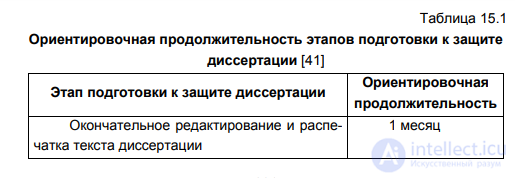
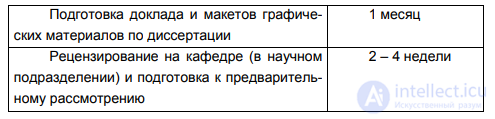
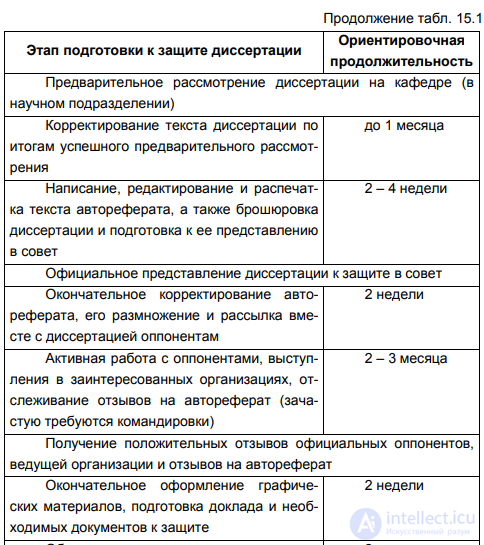
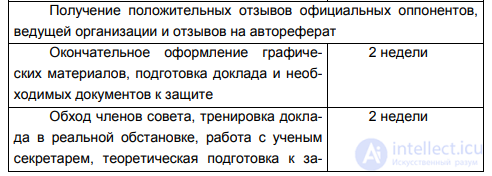
period of preparing for the dissertation defence is drawing up a detailed plan of the necessary work. The initial information for constructing
such a plan can be the approximate duration of the various stages of preparing to undergo the defence, presented in
Table 15.1

A convenient way of planning the work for preparing for the
defence of a dissertation is to construct a network diagram.
A network diagram is a plan for carrying out a set of work, given in the form of a graph (Fig. 15.5). The main elements of a network diagram
are activities and events (events are understood as the moments of the start
and completion of activities). Events on the graph are depicted as circles, activities as directed arcs. Among the events, one distinguishes the initial event (having no
preceding activities) and the final event (it has no subsequent activities).
Important elements of a network diagram also include such elements as a path, a complete path and the critical path. A path is any sequence of activities in which the final event of each activity
coincides with the initial event of the subsequent activity. A complete path
is a path whose beginning coincides with the initial event and whose end coincides with the final event. The complete path of maximum duration
is called the critical path.
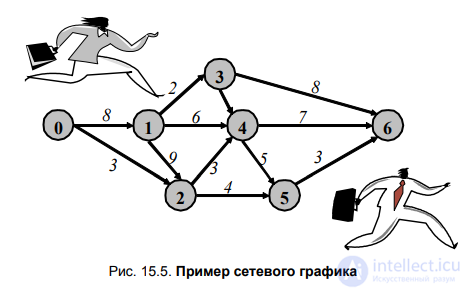
The general procedure for constructing a network diagram is as follows:
1. The process is broken down into separate activities. The duration of the activities and their logical interrelation are determined.
2. A network diagram is drawn up. The diagram is ordered so
that all arcs are directed from left to right: from the event with the smaller
number to the event with the larger number.
3. The time parameters of the diagram are calculated:
- the earliest possible time of occurrence of each event,
- the latest possible time of occurrence of each event,
- the time reserve of each event.
The earliest possible time of occurrence of the i-th event (tE) is determined by the maximum duration of the path preceding that event:
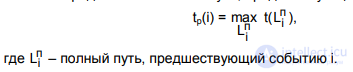
The latest possible time of occurrence of the i-th event (tL) is determined by the formula:

The time reserve of an event is the time margin that does not lead to a delay of the remaining events or to an increase of the critical path. The time reserve of an event is equal to the difference between the latest and earliest time of occurrence of the given event:

Assignment
Based on the data in Fig. 15.2-15.4, Table 15.1, and the "Regulations on Specialised Academic Councils" [35], construct a network diagram of the work
for preparing for the dissertation defence.
REVIEW QUESTIONS
285
285
1. Where are Candidate's and Doctoral dissertations defended?
2. Where is the preliminary assessment of dissertation
works carried out?
3. What stages precede the defence of a dissertation in the specialised academic council?
4. What is the procedure for conducting a dissertation defence?
5. What documents are sent to the VAK after the dissertation defence?
6. Describe the procedure for planning the work for preparing for the
dissertation defence by constructing a network diagram.
CONCLUSIONS
Let us sum up what was set out in Chapter 15:
All the actions of a candidate connected with the defence of a dissertation
can be divided into three stages: 1) preparation for the defence, 2) the actual conduct of the defence in the specialised academic council; 3)
the drawing up of documents based on the results of the defence.
The public defence of a dissertation takes place at a meeting of the specialised academic council and is conducted in the form of a scholarly discussion.
The defence procedure is defined by the "Regulations on Specialised
Academic Councils", approved by order of the VAK of Ukraine of 29.08.2000
No. 429.
The defence of a dissertation in the specialised academic council
is preceded by its preliminary assessment, carried out, first, at the place where the work was performed, and second, in the specialised academic council.
After the defence of a dissertation, the candidate prepares a whole
series of documents for submission to the VAK. A description of the documents intended for submission to the VAK can be found in the "Lists and Forms of Documents Used in the Attestation of Scientific and Scientific-Pedagogical Workers", approved by order of the VAK of Ukraine of
21.03.97 No. 121.
An important condition for a successful dissertation defence is the correct organisation of the candidate's work. One of the convenient techniques for organising work at the stage of preparing for the defence is drawing up a network
diagram of the work that the candidate needs to carry out.

Comments