
Lecture
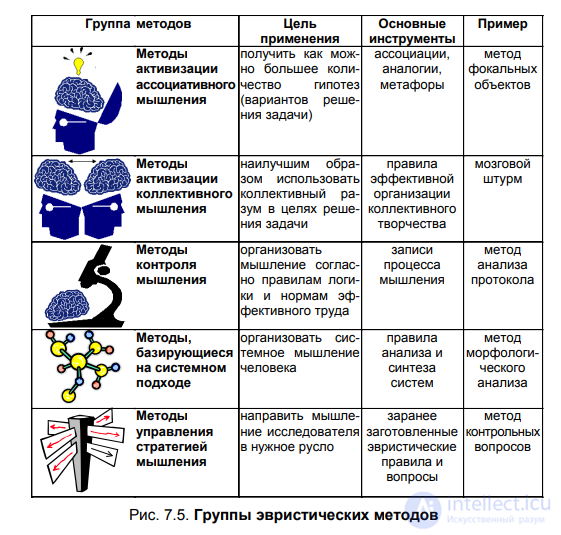
Heuristic methods are methods aimed at organising a person's creative thinking (fig. 7.5). The basic idea of heuristic methods is to combine, on the one hand, organised human thinking, which gives a guaranteed result, and, on the other hand, intuitive, spontaneous considerations, which give an unconventional solution to the problem
Structure of methods for activating creative thinking
One of the tools for implementing simulation-game methods is the procedure for activating the creative thinking of participants in group interaction during problem-solving.
The structure of methods for obtaining problem solutions is shown in fig. 12.1, from which it follows that heuristic[59] methods occupy an important place alongside methods of analysis and synthesis, and are based on the insight of the process participants and the realisation of the law of synergy of systems.
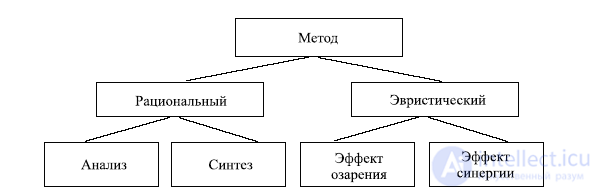
Fig. 12.1. Structure of methods for obtaining new knowledge
As G. M. Andreeva, Doctor of Economic Sciences, professor at the Department of Social Psychology of Moscow State University, notes, numerous experiments have established the most typical conditions for the application of heuristics:
The creation of something new is a creative process. Creative abilities – creativity – can be assessed using eight identified criteria.
The general thought processes common to all forms of creativity are combination and analogising, together with such techniques as identifying new connections and transferring the function of one object to another. Psychologists have established that unconstrained imagination[60] governs the generation of countless more or less random associations.
The root cause and basis of creative thinking is the work of our brain,[61] the uniqueness of which lies in the fact that it develops only through being used.
The list of the main methods for influencing a client's creativity is as follows.[62]
1. Emotionality – a method of uniting the left- and right-side brain processes for those in whom left-sided thinking predominates. Emotions assist the registration of information in the right hemisphere. Information processed by both hemispheres of the brain is remembered more reliably. An orientation towards the learner's feelings assists right-brain processing of information. Professional or behavioural competence plays an increasingly important role in a manager's career and in their work with people. Psychologists also count other methods of hemisphere interaction among the successful tools for developing creative brain processes.
2. Visualisation – imagining, envisioning, for example, a future product, the end result of creative work, or a problem and the ways to overcome it. Those who visually picture the desired result are more likely to achieve the goal they have set. Developmental situations help foster vivid imagination. Vision is a right-brain function and at the same time a method for developing strategic competence. Graphs, diagrams, schemes, drawings and pictures encourage creative processes by developing visual thinking.
3. Analogies – these are comparisons drawn from different disciplines. This method motivates intuition and synthesises thinking, developing systemic analytics.
4. Metaphor – this method of motivating creativity is based on connecting two different things or matters by a common principle, for example electricity is linked to the directed movement of charged particles, or, more simply, to water flowing through pipes; time is ascribed human qualities – harsh years, happy days, troubled times. Metaphors assist in playing with concepts. Metaphorical thinking is a creative process that proceeds on the basis of comparisons between problems in different fields of science and practice, in order to assist the search for a solution. Comparing the problems of business and biology leads to concepts such as survival, adaptation to the external environment, and rehabilitation.
5. Humour – actively unites the rational processes of the left hemisphere and the creativity of the right. During laughter the brain produces the natural hormone endorphin, which has analgesic and tranquilising properties and helps develop a feeling of wellbeing.
The structural diagram of expert methods for working out decisions is shown in fig. 12.2.
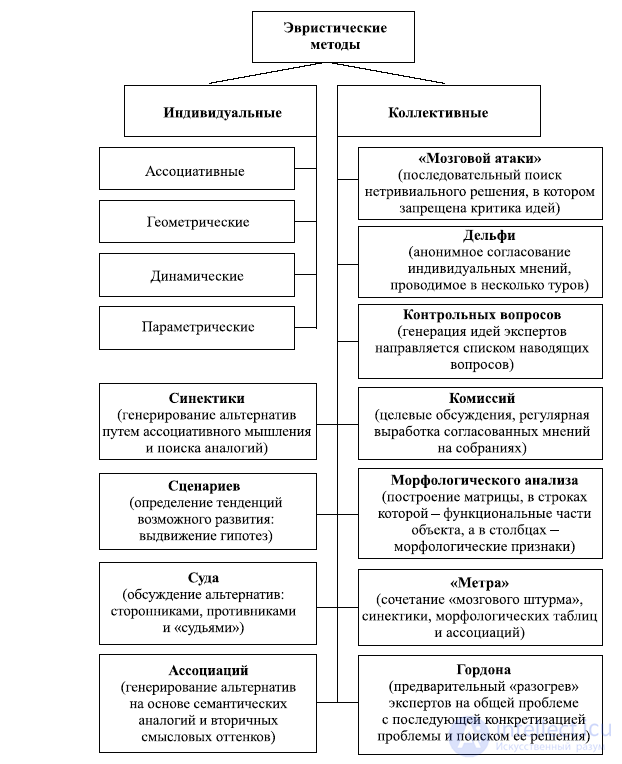
Fig. 12.2. Structure of expert methods for working out decisions
Individual methods can conventionally be divided into four groups:[63]
a) associative methods, which in one way or another use the concept of "associativity"; these include the methods of analogy and stimulation by chance;
b) "geometric" methods:
c) dynamic methods:
d) parametric methods:
Among the collective methods, let us consider the following set:
The distinctive features of heuristic methods are clearly seen in comparison with other classes of methods used in problem-solving – analytical methods and the trial-and-error method (fig. 7.6).
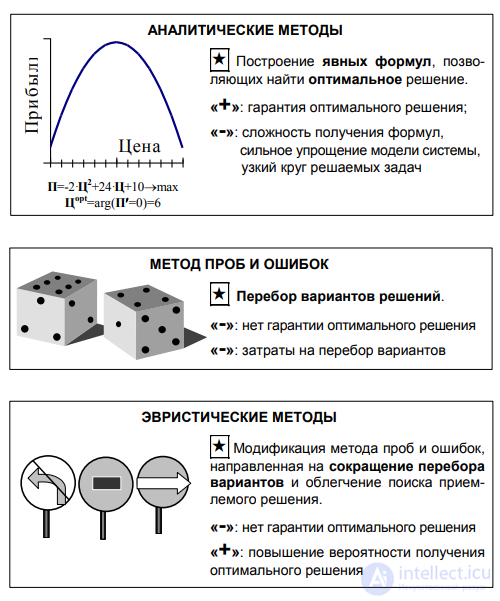
Fig. 7.6. Comparison of three classes of problem-solving methods
Example 7.2. What kinds of problems require the use of heuristic methods? The distinctive features of the scope of application of heuristic methods can easily be seen in the example of the following problems:
Problem 1. Denis said that he has twice as many sisters as brothers. His little sister Tanya explained that she has as many sisters as brothers. It is necessary to determine how many boys and girls there are in Denis's family.
Problem 2. It is required to develop measures to stimulate the birth rate in region N.
The first problem can be solved by two methods: the analytical method and the trial-and-error method. The analytical method involves constructing the mathematical equation 2(X-1)-1=X (where X is the number of boys in Andrei's family), while the trial-and-error method is implemented as a simple enumeration of variants.
The situation is different with problem No. 2. To solve this problem, analytical methods alone are not enough. There is no model
into which one could substitute the values of the socio-economic characteristics of region N and obtain a description of the optimal strategy for stimulating the birth rate. And the trial-and-error method could lead to destructive consequences, but, fortunately, such experiments on people are prohibited by law. Problem No. 2 is a typical object for the application of heuristic methods.
Let us consider several examples of heuristic methods.
The "brainstorming" method was proposed in 1938 by the American specialist A. Osborn; it is based on the psychological and pedagogical regularities of collective activity and rests on the fact that the creative activity of every person is often held back for one reason or another, among which various barriers occupy a significant place: psychological and communicative, social and pedagogical.
The main function of "brainstorming" is to ensure the process of generating ideas without their analysis and discussion by the participants, and the success of the session depends on observing two main principles:
The essence of the method: every member of the group is given the right to voice the most varied ideas about possible solutions to the problem, regardless of their soundness, feasibility or logic. The more varied the proposals, the better. The session is directed by a facilitator. The participants of the group work are briefed in advance on the nature of the problem. All proposals are heard without criticism or evaluation (the facilitator sees to this), and their analysis is carried out centrally after the idea-generation process is complete, on the basis of records kept by the secretariat. As a result, a list is formed in which all the proposals submitted are structured according to certain parameters (criteria), as well as according to their effectiveness in solving the problem under discussion.
A graphical model of the content of the stages of "brainstorming" is shown in fig. 12.3.
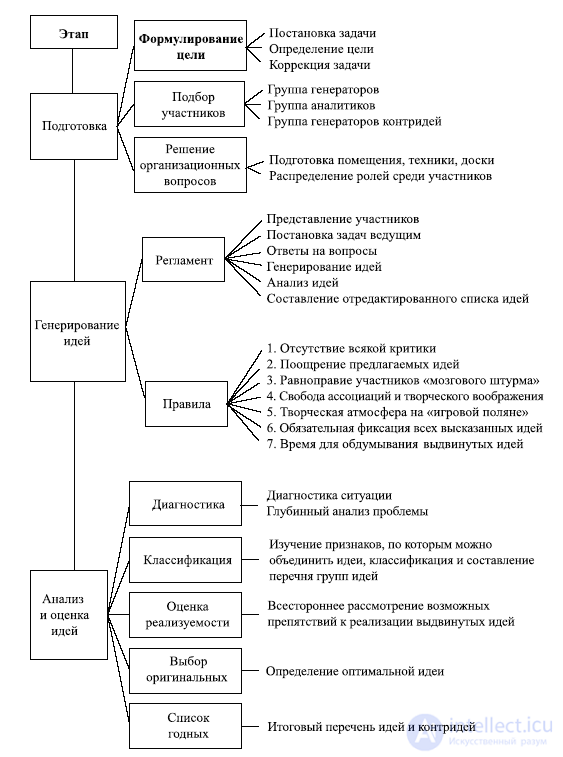
Fig. 12.3. Graphical model of the content of the stages of the "brainstorming" method
When preparing to hold a "brainstorming" session, it is necessary to determine the venue and the participants. The best venue is a "round table", at which all participants could feel like equal colleagues. A session can be held with any number of participants, but the most successful group size is from 4 to 12 people. At the same time, both specialists and non-specialists should be invited to solve a given problem: practice shows that the most valuable ideas most often belong to people who are not specialists in the given field but are indirectly connected with the problem being solved.
"Brainstorming" in reverse, or "abbreviated brainstorming", as a method largely resembles ordinary "brainstorming", but here the participants are not only permitted but even invited to voice critical remarks about the ideas that have been formulated. The main difficulties here are connected with the need for participants to treat one another correctly during the discussion. Usually, in the course of implementing this method, participants must try not only to find as many weak points as possible in each idea, but also to propose ways of eliminating them. Analysis of the essence of the "brainstorming" method leads to two contradictions.
On the one hand, in order to develop an idea at the generation stage, it must be criticised, yet criticism is forbidden by the rules of the session. On the other hand, in order to steer the course of the solution in one direction, it must be managed, yet the essence of the method lies in the chaotic generation of ideas.
This method is usually used when time allotted for solving the problem is short. In essence, it is an accelerated or "abbreviated brainstorm".
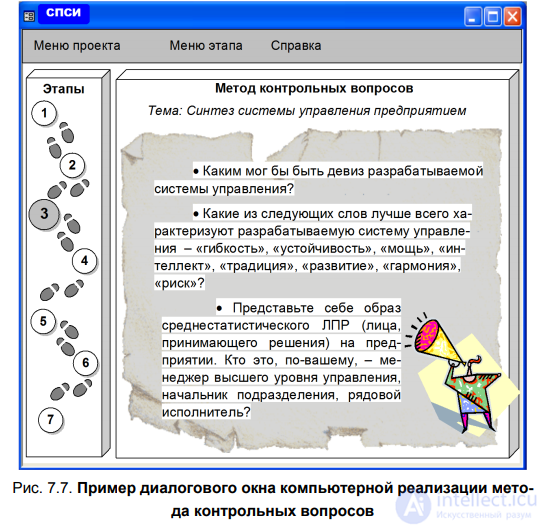
The method of control questions is one of the methods of psychologically activating the creative process, consisting in leading a person to the solution of a problem by means of guiding questions.
The essence of the method is that the generation of solution options is, as it were, "directed" by lists of control (guiding) questions, which are compiled by various participants or experts. These are usually questions of a general kind: "What if everything were done the other way round? What if the statement of the problem were changed? What if a different material were used or the shape of the object were changed?" The participants in the discussion answer these questions in writing (very briefly) and pass them around to one another in a circle. In this way, each person becomes familiar with everyone else's proposed solutions and gives their own thoughts on the matter. In doing so, the solutions are, as it were, "accumulated" on a single sheet belonging to each participant in the discussion. There is no need to repeat oneself.
The main tool of this method is lists of control questions, which are drawn up by specialists in the relevant subject area and then serve as guiding heuristics in the process of solving problems.
Implementation of the control-questions method includes the following stages:
1) Formulating the problem.
2) Choosing a list of control questions on the relevant topic (fig. 7.7, Example 7.3).
3) Studying the lists of control questions and formulating answers to them. Answering the questions clarifies the situation and solves the tasks that have been set.
The advantages of the control-questions method are that it is simple, universal and effective (if the analysis is carried out by professionals).
Moreover, one hardly needs to learn how to use this method at all. But there is also a drawback: this method can lead one away from a creative solution by orienting thinking toward an analogous situation.
Originally, the control-questions method was intended to activate inventive activity. In the USA the most widely used list of questions is A. Osborn's list, which includes questions
of the type "What can be reduced in the technical object?", "What can be replaced in the technical object?". An interesting list of questions was published in the American journal "Product Engineering" in 1965. This list included the following questions: How would this problem have been solved in the past? In the era of prehistoric technology? In the future? Has anything analogous been created in the past in any field
of technology?
Example 7.3. A list of control questions on the topic "Analysis of the implementation of the firm's goals" [48]
1. At what stage of development is the Firm?
2. Does society need the Firm?
3. Does the director know what needs to be done for the Firm to prosper?
4. Does he have a flexible, ideal strategy for the Firm's development? Is he looking for work to fit the people he already has, or is he ready to change the Firm's structure in line with new tasks? Does he command a systemic and functional approach.
5. Is the Firm ready for collapse? What would have to happen for the Firm to fall apart? Does the Firm have a reliable rearguard and a GHQ reserve? (GHQ reserve – the reserve
of the general headquarters). Can the Firm quickly switch to another line of work? Is the Firm ready for the collapse of its suppliers?
6. The Firm's strengths and weaknesses. What tasks have gone unsolved for many years? Which of the Firm's subsystems lag behind in development?
7. Is the market well studied? Is the marketing director talented? Are the brokers active, is the merchandiser professional?
8. Minimax analysis: What are the Firm's limiting possibilities for development in this region? How much could be bought from the Firm (if there were no competitors)? Why do they buy so little? At what turnover and what minimum profit can the Firm still exist? Are the Firm's costs high?
9. What will happen if the Firm stops operating? What will happen to the people, the director, the property?
10. What additional functions can the Firm perform?
11. Perhaps it is necessary to sell not only goods but also services (including information and intermediary services...)? For example, sell medicines and provide certain kinds of therapy: physio-, animal-, water-,
psycho-, etc.
12. Can "waste" be reduced or put to use?
13. Where are excess reserves tied up, and can they be reduced?
14. Which element (division) of the Firm is the weakest, the one that "drags down" the whole Firm? How can it be strengthened?
15. Which factors in the Firm's operation are the most harmful to the Firm?
16. Who are the competitors? What do you know about them? How can they be beaten?
17. How do the Japanese solve similar problems?
18. How to "win" permanent customers?
The method of focal objects is a method that consists in transferring the attributes of several randomly selected objects onto the object being improved. The object being improved lies, as it were, at the focus of the transfer, which is why it is called focal.
The method of focal objects is used in cases where the researcher faces the task of improving some object (a product, a management system, a way of rewarding employees, etc.).
This method makes it possible to activate the imagination, broaden the range of possible solutions to the problem, and find unusual combinations of the properties of objects.
Stages of the method of focal objects:
1) Formulating the problem and choosing the focal object.
2) Choosing one or several objects at random (one can name whichever objects the eye happens to fall on, or those that come to mind).
3) Compiling a list of the attributes of the randomly chosen objects.
4) Transferring the chosen attributes onto the focal object.
5) Developing ideas based on the combinations obtained at step No. 4.
Interpretation of the results (Example 7.4).
Example 7.4.
Solving a problem of economic content using the method of focal objects
The problem being solved is the formation of a new classification of enterprises – taxpayers. A simplified algorithm for applying the method of focal objects to solve this problem will include
the following steps.
Step No. 1. Description of focal object A.
In our example, the focal object is "the new classification
of enterprises – taxpayers".
Step No. 2. Random selection of object B.
Suppose, for example, that the researcher working on the problem we are describing is a student or a teacher. Then it is not surprising that the randomly chosen object turned out to be "the long desk
in the classroom".
Step No. 3. Choosing some attribute of object B.
In our example, the attribute "long" is chosen.
Step No. 4. Transferring the chosen attribute onto the focal object and interpreting the result.
In our example, the result is the idea of classifying
enterprises according to the duration ("length") of the period of evasion
of tax payment.
Synectics is a method of activating a person's creative thinking, in which special conditions are created that stimulate the advancing of unexpected and non-stereotyped analogies and
associations to the problem that has been set.
The term "synectics" is a neologism meaning the joining together of heterogeneous elements. Synectics uses elements both of brainstorming and of the techniques of analogy and association. Unlike ordinary
brainstorming, synectics involves permanent groups made up of specialists from different professions. The main principle of synectics is "to make the unfamiliar familiar, and the familiar – strange". This
principle makes it possible to go beyond the traditional way of thinking, to abandon stereotypes, and to broaden the range of the search for new ideas. The main technique is analogy as a means of reorienting from the level of conscious thought to the level of spontaneous thinking. Analogies are applied: a) at the stage of understanding the problem (turning the unusual into the familiar, i.e. expressing
the situation being analysed in familiar terms); b) at the stage of generating solution options.
Synectics uses the following types of analogy:
The contradictions noted are partly eliminated in the method of "synectics", where the session is conducted by a permanent group with a specially selected composition. The factors involved in implementing the synectics method are shown in fig. 12.4.
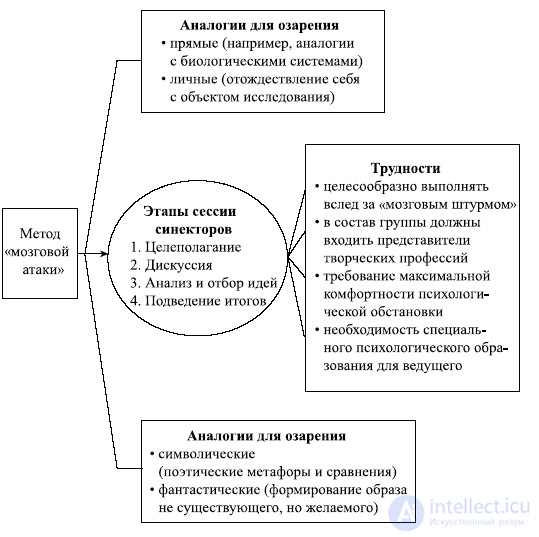
Fig. 12.4. Factors in implementing the "synectics" method
The author of "synectics", W. Gordon, in 1960 introduced the conscious search for analogies within the framework of a definite procedure, in an effort to turn the productive process, which takes place in the sphere of the subconscious when solving a problem, from implicit into explicit, from spontaneous into consciously managed. The purpose of analogies is to change the habitual perception of well-known things, to take a fresh look at the "legacy of frozen words" and ways of understanding. To activate thinking and manage it, Gordon applied four types of analogy:
The synectics method is intended for generating alternatives through associative thinking and the search for analogies to the problem set, and consists in the following.
1. A group of five to seven people is formed, possessing flexible thinking, experience, psychological compatibility, sociability and mental agility.
2. Skills of joint group work are developed.
3. Not only known similar solutions are considered, but all possible and impossible (fantastic) solutions as well.
4. It is forbidden to discuss the merits and shortcomings of the group members.
5. Everyone is allowed to stop working at any moment without explaining the reasons.
6. The role of facilitator periodically passes to other members of the group.
Unlike "brainstorming", this requires special and lengthy preparation of the group. The group's work proceeds in two stages. The task of the first stage is to make the unfamiliar familiar. To this end, by generalising various situations, the unfamiliar problem or object is placed, by means of the method of analogies, into a familiar context, and its unfamiliarity disappears. After this the second stage begins, whose task is to make the familiar unfamiliar (returning to the original problem).
The sequence for solving the problem is as follows:[64]
1) the problem as given – formulation of the problem;
2) clearing away obvious solutions – a discussion in the course of which the group members clarify their views on the obvious solutions, which are unlikely to yield anything more than a combination of existing solutions (this stage resembles "brainstorming");
3) turning the unusual into the familiar – the search for analogies that make it possible to express the "given problem" in terms well familiar to the group members from their work experience (in an attempt to get to the heart of the problem and untangle the knot of proposals, ignoring physical laws and conventions is permitted);
4) the problem as understood – the main difficulties and contradictions hindering the solution of the problem are identified;
5) guiding questions – the chairperson suggests giving a solution using one of the types of analogy. Each member of the group freely plays out the guiding question. If the analogies become too abstract, the discussion is redirected towards "the problem as understood". When a promising idea appears, it is developed verbally up to the point where the group members can produce and test rough prototypes of the device.
Among the widely used heuristic techniques are the techniques of the Theory of Inventive Problem Solving.
The Theory of Inventive Problem Solving (TRIZ) is a methodology for finding solutions to problems of scientific and technical creativity, developed by the well-known inventor G. S. Altshuller. The theoretical foundation of TRIZ is formed by
the regularities of the development of technical systems, identified as a result of processing large arrays of patent information. Within TRIZ, the process of solving an inventive problem is viewed as a sequence of operations for identifying, clarifying and overcoming a number of contradictions. As a consequence, an important tool of creative activity formed within TRIZ is
a system of principles and techniques for resolving contradictions. Such principles are used as guiding heuristics in
the process of solving poorly structured problems involving the creation and modification of various kinds of systems.
The technology for using techniques for resolving contradictions
in TRIZ includes the following stages:
1. A scientific or applied problem is formulated.
2. The researcher studies a range of TRIZ techniques and uses them to generate solution options for the problem set: each
technique makes it possible to formulate one or several alternatives.
4. Among the many alternatives formulated, the best one
is identified.
The system of TRIZ techniques includes the following techniques [25]:
1. The "Combining" technique. This technique involves carrying out the following actions to resolve the identified problem:
The "Combining" technique is used by some domestic manufacturers, who, with the aim of improving the results of their activity, join forces with foreign firms, creating joint
ventures.
2. The "Splitting" technique. Among other things, this technique involves the following actions:
The "Splitting" technique is used by some insurance companies, which offer their clients insurance for individual body parts: arms, legs, eyes, lips, etc.
3. The "In Advance" technique. This technique is based on the following
heuristic rule: "If it is impossible to perform an action on an object at the required time, then the necessary action is carried out in advance". The "In Advance" technique involves the following:
For example, the company "Lego", which manufactures children's plastic
construction sets, at some point began adding a substance to their composition
that is clearly visible under X-rays. What do you think this is for?
4. The "Increasing Dynamism" technique. This technique offers the following options for solving problems:
- make the characteristics of the object change in accordance with changing environmental conditions;
- divide the object into parts capable of changing and moving relative to one another;
- if the object is immobile, make it mobile.
5. The "Changing Scale" technique. This technique involves the following actions:
6. The "Reverse" technique. The "Reverse" technique offers the following:
- instead of the usual action, perform the reverse (opposite) action;
- turn the object "upside down", turn it inside out.
7. The "Copying" technique. This technique is based on the following heuristic rule: "If it is difficult or impossible
to carry out the necessary actions with the object, it is advisable to use a copy of it". The "Copying" technique offers the following alternatives for resolving problems:
Objectives of the assignment:
- acquire skills in applying heuristic methods of problem-solving;
- study the techniques for resolving contradictions developed within the Theory of Inventive Problem Solving.
Supplementary material
Let us consider the possibilities of applying TRIZ techniques to solve
economic problems, using the following example.
Example. The problem of the green mixers
The company KhPRT ran into a problem: not a single item
from the new batch of poisonous-green mixers had been sold. It was found that consumers disliked the design of the mixer and its colour.
The head of the marketing department was tasked with organising a campaign
to sell the problematic mixer, in order to save the company from
losses. The head of the marketing department thought long and hard about the problem and, in order to activate his thinking, decided to use the TRIZ
techniques for resolving contradictions. As a result of applying this set of
techniques he managed to come up with a number of measures for selling the ill-fated mixer. Thus, the "Combining" technique prompted the following
idea: sell the mixer as a set together with another, "fast-moving", product (that
is, the mixer as a bundled extra). The "Splitting" technique made it possible to come up with
the following alternative: take the mixer apart into spare parts and use them
to repair other mixers. Applying other TRIZ techniques led to the formulation of several more measures for selling the mixer:
Assignment
Using the techniques of the Theory of Inventive Problem Solving,
formulate options for resolving contradictions in some economic system on the topic of your own research work.
This method is often used in cases where it is not possible to assemble a group. According to the procedure, group members are not allowed to meet and exchange opinions about the problem being solved; independence of opinion is ensured. The procedure is as follows.
1. Group members are asked to answer an entire list of questions formulated in detail on the problem under consideration.
2. Each participant answers the questions anonymously.
3. The results of the answers are collected centrally, and after processing them an integrated document is drawn up, containing all the proposed solution options.
5. Familiarisation with this document (analysis of the proposals of other group members) may change the opinion of some group members regarding possible solution options.
6. Stages 3 through 5 are repeated as many times as necessary to reach an agreed solution.
This method is applicable when there are no time constraints on developing a solution, and the decisions are made by experts. When developing solutions for a specific organisation with a view to subsequent implementation, it is advisable to use other methods of group work that make it possible to find consensus, and in the process of searching for solutions a team of like-minded people may be formed from the group members (the organisation's management).
As can be seen from the example, it is advisable to use various metaphors to generate associations and ideas. For example, binary metaphor-analogies ("a little bell sings beneath the arc", "brow horseshoes"); metaphor-catachreses containing a contradiction ("a landlubber sailor", "a round square"); metaphor-riddles ("a room full of people" – a cucumber). The technology of free association is based on such principles as free association, anti-conformism, and deferred critical analysis.
The rules for implementing the method have their own specifics for both the organisers and the participants (fig. 12.5).
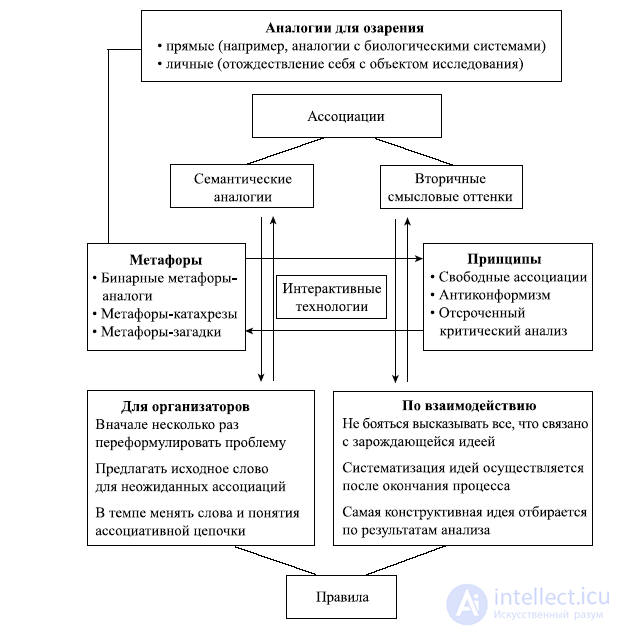
Fig. 12.5. Parameters of the method of associations
The method is based on combining selected elements or their attributes in the process of searching for a solution to a problem. Within this method, all the possible elements on which the solution of the problem may depend are identified, the possible values of these elements are listed, and then the process begins of generating alternatives by enumerating all possible combinations of these values.
The term "morphology" (the study of form, Gr. morphe – form and logos – study) was introduced in 1796 by Goethe – the founder of the morphology of organisms, the study of the form and structure of plants and animals. Later, the morphology of humans, of soils, etc. appeared.
Morphological analysis was first used to solve technical problems in 1942, when the Swiss astronomer F. Zwicky began developing rocket engines at the firm "Aerojet Engineering Corporation".
Constructing morphological matrices makes it possible to navigate the diversity of concepts and factors more quickly and accurately. Classification is one of the most important elements of creative activity.
When using this method, a technical object must be broken down into functional parts (functional-morphological attributes), namely those without which the object will not perform its functions. Then the morphological attributes should be written out separately, and information about them (variants of implementation) recorded without reference to the object (product), i.e. the morphological attributes should be applied to other, analogous products.
Analysis of the resulting variants reveals combinations of them that might be missed in an ordinary enumeration.
Scenarios are what hypothetical alternative descriptions of what may happen in the future are called. Scenarios are not simply a product of the imagination, but logically substantiated models of the future, a kind of narrative about "what will happen if…" Usually several scenarios are developed: an optimistic one, a pessimistic one, and an intermediate one. Before developing a scenario, lists are compiled of the factors influencing the course of events and of the resources available.
The search for non-standard solutions to a newly arisen problem is carried out using methods of generating alternatives. The relative preferability of the various alternatives is assessed using a method of determining ratings or methods of forming evaluation systems, which include evaluation criteria, scales for measuring the criteria, and rules for choosing the most preferable alternative. This method is applied in cases where the goal is unclear and only the initial state of the system is known.
Events at the lowest level of decomposition are ranked by preferability and probability of occurrence. The most preferable variant is precisely the goal of the system.
The method assumes that the participants in the group work do not know in advance exactly which problem will be discussed, so they are not constrained by habitual patterns. The facilitator sets out, in the most general terms, some concept connected with the problem under consideration. The participants voice their ideas as a "warm-up", after which, under the facilitator's guidance, the original concept is refined. Only then is the actual problem, for the sake of which the discussion was started, revealed. As a result, the participants, already "warmed up", begin to voice entirely concrete proposals and think about how to implement them.
The essence of the method lies in holding a meeting directed by a facilitator, so as to involve all participants in an open and engaged discussion and prevent the meeting from turning into a series of passive answers to questions. The difference from the "brainstorming" method and the Gordon method is that the participants prepare their point of view on the problem being solved in advance. This is both good and bad at the same time.
It is good because everyone can prepare seriously for the discussion, unhurriedly weigh all the "pros" and "cons", and, if necessary, apply individual heuristic methods of generating ideas. It is bad because a participant who has arrived at some solution will later find it hard to abandon it.
This method combines the techniques of "brainstorming", "synectics", morphological tables and the method of analogies (the "Metra" analogue technique – Boulwin, 1972). The "Metra" analogue technique consists of six phases.
Phase 1. The problem is stated in the sought formulation, and the facilitator invites the participants to a free discussion of the problem (the main goal is to familiarise the participants with the essence of the problem).
Phase 2. The initial conception of the problem is "broken down" from the most varied angles: the object, the subject matter, the subject, the connections (the problem is "chewed over").
Phase 3. Reconsideration of the original formulation of the problem and an attempt at a new statement of the problem, to which "brainstorming" is applied (the task is broadened and its statement is simplified).
Phase 4. Development of analogies within the new statement of the problem, making it possible to divide it into a number of sub-problems (application of associative methods to solving the broadened task, previously broken down into a number of sub-problems).
Phase 5. Free search for analogies and associations, as fantastic and unconstrained as possible (the "free flight" phase).
Phase 6. Return to the original problem, "translating" the analogies put forward into the language of business terms.
The flowchart of the "Metra" method consists of three stages.
Stage 1. Formulation of the problem and its analysis. Statement of the problem, generation of initial solution ideas.
Stage 2. "Selection". It branches into three simultaneous procedures: "breaking down" the problem by means of analogies and associations, the combinatorial construction of morphological tables, and correlating goals with the means of satisfying them.
Stage 3. Analysis of the first results, formulation of the "new" problem and the search for its solution using the "brainstorming" method. The various solution methods are compared against the original criteria of the problem set, and the original and obtained results are compared. A decision is made on whether to continue or stop the work, and a return is made to the original problem. A repeat analysis of the resulting solution is carried out and it is compared with the goal of the original problem, after which one of the solution options is approved.
It is developed on the basis of systems analysis of problem situations and involves the use of a hierarchical structure obtained by dividing the overall goal into sub-goals. A goal tree is created to analyse a problem situation and to give a visual representation of the results of such an analysis.
The idea of developing a goal tree belongs to the American researcher C. Churchman, who applied this approach to studying the problems of industrial development. In this case the goal tree is a connected graph without cycles, so the following definition can be given. A goal tree is a graph expressing the subordination and interrelations of elements, which are goals and resources.
When constructing a goal tree, the trends of the expected development of events are assessed by expert forecasts. The identification of the main factors influencing the development of the situation is carried out by the method of developing scenarios.
Having studied this article, you have learned that:

Comments