
Lecture 30 min.
A hypothesis — is a regular form of the development of knowledge, representing a substantiated assumption put forward with the aim of clarifying the properties and causes of the phenomena under study.
Hypothesis (Anc. Gr. ὑπόθεσις — «assumption; supposition», from ὑπό — «under; by reason of; because of» and θέσις — «place; position; thesis») — an assumption or guess, a statement which, unlike axioms, requires proof
(1) A hypothesis — is a universal form of the development of knowledge, necessary for any cognitive process. Wherever there is a search for new ideas or facts, regular connections or causal dependencies, a hypothesis is always present. It acts as a connecting link between previously attained knowledge and new truths, and at the same time as a cognitive means regulating the logical transition from earlier incomplete and inexact knowledge to new, more complete and more precise knowledge.
(2) The construction of a hypothesis is always accompanied by the advancing of an assumption about the nature of the phenomena under study, which is the logical core of the hypothesis and is formulated as a separate judgment or a system of interrelated judgments. It always has a weakened epistemic modality: it is a problematic judgment in which inexact knowledge is expressed.
A hypothesis always contains within itself probable knowledge that needs to be verified. A proposition proven on its basis is already, properly speaking, a hypothesis, for it contains verified and, in some cases, still doubtful true knowledge.
(3) The assumption arising in the construction of a hypothesis is produced as a result of analyzing factual material, on the basis of generalizing numerous observations. Intuition, the researcher's creative abilities and imagination play an important role in the emergence of a fruitful hypothesis. However, a scientific hypothesis — is not simply a guess, a fancy or an assumption, but a rationally substantiated, accepted assumption resting on concrete material.
The final stage of cognition — is the verification of the hypothesis, which turns the assumption into reliable knowledge or refutes it.
A scientific hypothesis constitutes the core, the methodological basis of a research study (see Example 2.1). It is no accident that, by its etymological meaning, hypothesis denotes that which is conditionally taken as a foundation (Greek hypothesis – foundation).
A hypothesis sets the direction and scope of the work, determines which facts should be collected, which literary sources should be studied, which experiments should be conducted.
Example 2.1.
Galileo's experiment On April 20, 1590, Galileo Galilei dropped from the Leaning Tower of Pisa a heavy cannonball and a lead musket ball (according to another version
- balls of different weights). The cannonball and the bullet touched the ground simultaneously. As a result of this experiment, Galileo showed that, in the absence of air resistance, the speed of falling bodies does not depend on their mass.
In the 16th century, views formed back in antiquity still prevailed in Europe. At that time no one doubted
the propositions of Aristotle's mechanics. In particular, Aristotle asserted that the speed of falling bodies is proportional to their weight. To test this
proposition it was enough to climb onto a roof and simultaneously drop down two objects of different weight, but heavy enough for
them to easily overcome air resistance. Anyone could climb onto a roof, but it occurred to no one to do so for several centuries. But Galileo carried out his experiment because he had a HYPOTHESIS that Aristotle's assertion needed correction. The stages of developing a hypothesis in the course of a research study are shown in Fig. 2.3. First a working hypothesis is formed, which is considered a temporary assumption. Then the working hypothesis is corrected, refined, supplemented, and sometimes completely replaced. As a result of all these procedures, a scientific hypothesis is formed on the basis of the working hypothesis, representing the most general assumption capable of fully and deeply explaining the phenomena under study.
One should not think that only a single scientific hypothesis is always formulated in the course of a research study. Quite the opposite. Specialists recommend developing not one but at least two hypotheses:
a main one and an alternative one (a counter-hypothesis). Otherwise there is a danger that the hypothesis may become a goal to be achieved at any
cost. Developing several hypotheses takes more time, but it increases the reliability of the research results.
A formulated scientific hypothesis requires substantiation and verification.
- To substantiate a hypothesis – means to show that its basic assumption was not put forward by chance, but rests on a number of theoretical and other considerations.
- To verify a hypothesis – means to establish its truth or falsity, its correspondence or non-correspondence to reality.
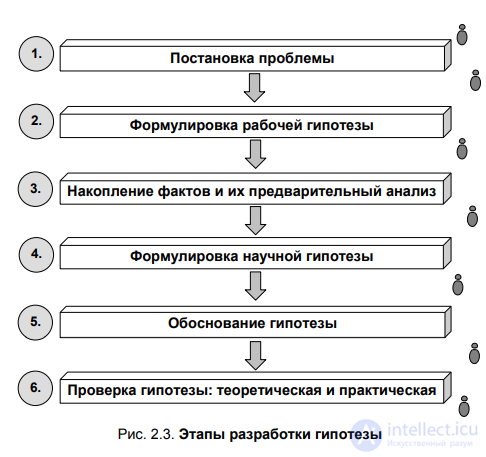
Hypotheses come in different kinds.
Poincaré, for example, divided hypotheses into 3 groups depending on the degree of their non-triviality. According to Poincaré's classification, hypotheses of the first kind play the role of axioms (such, for example, is the assumption that the effect of an earthquake in Turkey on the labor productivity of Kharkiv machine builders is negligible). Poincaré calls hypotheses of the second kind indifferent:
they are formulated with the aim of casting ideas into a concrete form. And only hypotheses of the third kind represent bold
assumptions requiring proof.
Depending on the degree of generality and completeness of coverage of phenomena, hypotheses are divided into general, particular and single (Fig. 2.4)
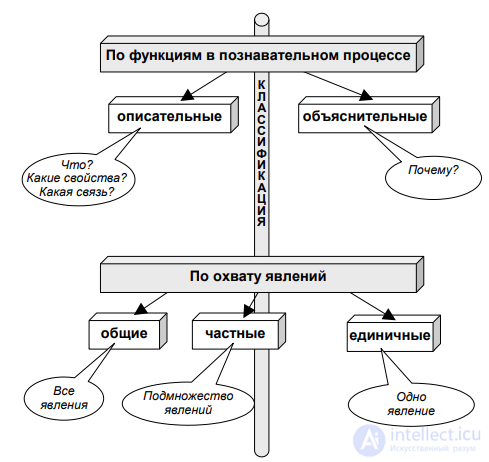
Fig. 2.4. Types of hypotheses [52]
In order to distinguish far-fetched, unfounded assumptions from a scientific hypothesis, one needs to take into account the following basic
requirements for a hypothesis as a form of cognition:
1) the fundamental testability of the assumption that is declared to be a hypothesis;
2) the maximum generality of the hypothesis (the hypothesis should cover as wide a range of phenomena of the subject area under study as possible);
3) the presence of predictive power (the hypothesis should make it possible to predict the existence of phenomena, properties and interrelations not previously known to science);
4) fundamental simplicity;
5) continuity (the hypothesis should be based on prior knowledge - although this requirement should not be absolutized).
In the process of the development of knowledge, hypotheses differ in their cognitive functions and in their object of research.
1. By function in the cognitive process, hypotheses are distinguished: (1) descriptive and (2) explanatory.
(1) A descriptive hypothesis — is an assumption about properties inherent in the object under study. It usually answers the questions «What is this object?» or «What properties does this object possess?»
Descriptive hypotheses may be put forward with the aim of identifying the composition or structure of an object, revealing the mechanism or procedural features of its functioning, determining the functional characteristics of an object.
A special place among descriptive hypotheses is occupied by hypotheses about the existence of some object, which are called existential hypotheses.
(2) An explanatory hypothesis — is an assumption about the causes of the emergence of the object of research. Such hypotheses usually clarify: «Why did this event occur?» or «What are the causes of the appearance of this object?»
The history of science shows that in the process of the development of knowledge, existential hypotheses arise first, clarifying the fact of the existence of specific objects. Then descriptive hypotheses arise, clarifying the properties of these objects. The final stage — is the construction of explanatory hypotheses, revealing the mechanism and causes of the emergence of the objects under study. The successive complication of hypotheses in the process of cognition — about existence, about properties, about causes — is a reflection of the dialectic inherent in the process of cognition: from the simple — to the complex, from the external — to the internal, from the phenomenon — to the essence.
2. By object of research, hypotheses are distinguished: (1) general and (2) particular.
(1) A general hypothesis is the name given to a substantiated assumption about regular connections and about empirical regularities.
General hypotheses perform the role of scaffolding in the development of scientific knowledge. Once proven, they become scientific theories and are a valuable contribution to the development of scientific knowledge.
(2) A particular hypothesis — is a substantiated assumption about the origin and properties of individual facts, specific events and phenomena. If a single circumstance served as the cause of the emergence of other facts and if it is not accessible to direct perception, then its cognition takes the form of hypotheses about the existence or about the properties of this circumstance.
A working hypothesis — is an assumption put forward in the early stages of research, which serves as a conditional assumption and makes it possible to group the results of observations and give them a preliminary explanation.
The specificity of a working hypothesis — lies in its conditional and hence temporary acceptance. It is extremely important for the researcher to systematize the available factual data at the very beginning of the investigation, to process it rationally and to outline directions for further searches. It is precisely the working hypothesis that performs the function of the first systematizer of facts in the course of research.
Version
In historical, sociological or political-science research, as well as in judicial-investigative practice, when explaining individual facts or a set of circumstances, a number of hypotheses differently explaining these facts are often put forward. Such hypotheses are called versions.
(1) A general version — is an assumption explaining all the crimes as a whole, as a single system of specific circumstances. It answers not one but many interrelated questions, clarifying the entire set of legally significant circumstances of the case.
(2) A particular version — is an assumption explaining individual circumstances of the crime under consideration. Being unknown or little known, each of the circumstances may be the subject of an independent investigation; for each of them, too, versions are created explaining the features and origin of these circumstances.
Purpose of the assignment: - to acquire skills in forming and substantiating scientific assumptions.
Supporting material
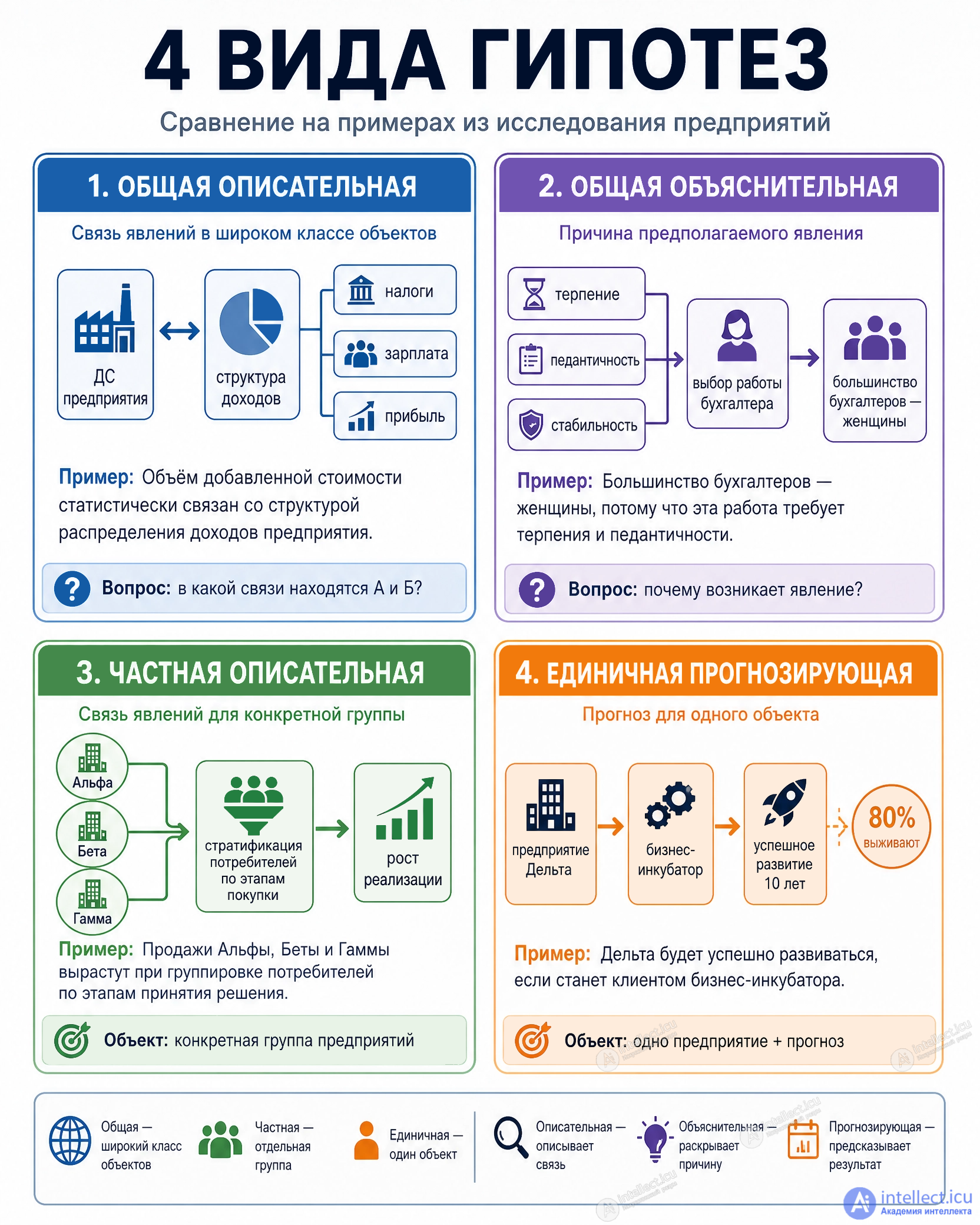
Let us consider the previously described types of hypotheses using examples.
Topic of the research within which the hypothesis is formulated. Modeling the management of enterprise development.
Hypothesis. The volume of value added (VA) generated at enterprises is in a statistical dependence on the structure of the enterprise's income distribution, and conversely – the income structure depends on the volume of VA.
Substantiation. Given a fixed volume of income from the sale of products, the parameters of its distribution among taxes, wages and profit
determine the amount of resources directed toward the development of the enterprise, and consequently the amount of value added of the future period. On the other hand, the parameters of income distribution depend on
the volume of VA generated: starting from a certain point, an increase in VA
leads to an increase in the share of profit in the enterprise's income.
Characteristics of the hypothesis. This hypothesis is general and
descriptive. It answers the question: «What connection are phenomena A and B in?», where A – is the volume of value added of the enterprise, B –
is the structure of the enterprise's income distribution among taxes, wages and
profit. The hypothesis presented can be used in organizing the management of enterprise development with the aim of regulating
the pace of development by adjusting the parameters of the income distribution structure. Verification of the hypothesis can be carried out using methods of mathematical statistics.
Topic of the research within which the hypothesis is formulated. The organization of accounting in Ukraine.
Hypothesis. Most accountants at domestic enterprises are women, owing to the fact that women are more patient and meticulous, and also not inclined to change jobs.
Substantiation. Such qualities of women as patience and meticulousness, as well as a lack of inclination to change jobs, lead
to the fact that, on the one hand, women themselves are satisfied with the painstaking work of an accountant, and on the other hand, this state of affairs suits management. A man prefers to keep «growing» all the time; he is more inclined to change jobs, whereas a woman, having attained
the position of chief accountant, can become a mainstay for management for a long period. Constant turnover of chief accountants will not benefit
any organization.
Characteristics of the hypothesis. This hypothesis is general and explanatory. It can be used in the process of managing
enterprise personnel, in organizing the training of accountants, and also in developing an automated workstation for an accountant. Verification of the formulated hypothesis can be carried out using questionnaire methods and mathematical statistics.
Topic of the research within which the hypothesis is formulated. Accounting for the interaction of the enterprises «Alpha», «Beta» and «Gamma» with
consumers of the product. Hypothesis. The volume of product sales at the enterprises «Alpha», «Beta» and «Gamma» will increase if one carries out stratification (that
is, grouping) of consumers according to the stages of decision-making regarding a purchase.
Substantiation. The volume of product sales depends on the effectiveness of methods for stimulating buyers to purchase. Since the products of the enterprises «Alpha», «Beta» and «Gamma» are expensive, technically complex and have an industrial purpose, the
decision to purchase is made by the consumer not immediately, but over several stages of considerable duration in time.
At the same time, for consumers at different stages of decision-making, different stimulation methods are effective. As a
result, accounting for consumers by stage of decision-making will lead to an increase in the effectiveness of stimulation methods, which in
turn will lead to an increase in the volume of product sales.
Characteristics of the hypothesis. The hypothesis under consideration is descriptive, since it answers the question: «What connection are phenomena A and B in?», where A – is the volume of product sales of the enterprises «Alpha», «Beta» and «Gamma», B – is the type of consumer stratification.
According to another classification, this hypothesis is particular, since
it concerns the group of enterprises «Alpha», «Beta» and «Gamma». At the
same time this hypothesis can be expanded to the level of a general one, if
one notes that it is suitable for all enterprises selling products for industrial and technical purposes (PITP). The general hypothesis would read as follows: the volume of product sales at enterprises
producing PITP will increase if one carries out stratification of consumers according to the stages of decision-making regarding a purchase.
Topic of the research within which the hypothesis is formulated. Formation of a development strategy for the enterprise «Delta».
Hypothesis. The successful development of the enterprise «Delta» over the following 10 years will be guaranteed if this enterprise becomes a client of a business incubator.
Substantiation. The enterprise «Delta» belongs to small enterprises, and according to statistics, out of the total number of newly created
small enterprises, only 20% remain after 2–3 years. At the same time, among enterprises that go through a business incubator, the proportion
is the reverse: 80 percent survive and become well-developing firms, and only 20% close down. Since the personnel of the enterprise
«Delta» possess strong intellectual potential, one can assume that after leaving the business incubator this enterprise will develop successfully on its own.
Characteristics of the hypothesis. The hypothesis under consideration is single and descriptive-predictive, since it establishes
a connection between the participation of the enterprise «Delta» in a business incubator and the results of the development of this economic entity.
The main points of the chapter are as follows:
Science is a system of knowledge in which three subsystems are distinguished, corresponding to different levels of cognition of phenomena: the empirical foundations, the theoretical foundations and the methodological foundations of science. The methodological foundations of science (methodology) are the doctrine of the forms and methods of scientific cognition, of the organization of
research activity, of scientific methods and theories.
In short, the methodology of science – is the science of science.
The empirical foundations of science are formed by scientific facts, and
the theoretical ones - by hypotheses, theories, concepts, laws, regularities, principles, etc.
Theory – is the highest form of organization of scientific knowledge, giving a holistic picture of a certain area of reality.
Theories are formed, changed and replaced as a result of the emergence of new facts that do not correspond to the old propositions of the theory.
For science, not just any experiential data is of interest, but
scientific facts, which are the result of generalizing the class of phenomena under consideration. Scientific hypotheses are formulated on the basis of an analysis of scientific facts.
A hypothesis – is a scientific assumption satisfying such requirements as the presence of elements of novelty and originality,
fundamental testability and maximum generality.
A hypothesis is the core of a research study: it sets
the direction and scope of the work, determines which facts should be collected, which experiments should be conducted, which literary sources
need to be studied
1. Choose a topic for a research study and formulate 2 - 3 working hypotheses about the properties, interrelations and causes of phenomena belonging to the corresponding subject area.
2. Propose a substantiation for the formulated hypotheses.
3. Determine the type of each hypothesis.
4. Describe the purpose of the hypotheses (in which spheres of science and practice can information about the assumed regularities be used).
5. Describe how the reliability of each formulated hypothesis can be verified.
1. What is the role of facts and hypothesis in the process of scientific cognition?
2. Why is theory considered the highest form of organization of scientific knowledge?
3. List the stages of developing a hypothesis in the course of a research work.
4. List the types of hypotheses known to you.
5. What is the difference between regularities and laws?
6. What are the methodological foundations of science?
1. What is understood by a hypothesis in a research study?
Hint: a hypothesis is an assumption that requires verification and confirmation.
2. Which of the listed requirements is important for a scientific hypothesis?
Hint: a scientific hypothesis must be testable and must admit the possibility of being confirmed or refuted.
3. What is the main function of a hypothesis in a research study?
Hint: a hypothesis determines the direction of the search and connects the available facts with the proposed explanation.
4. Which function of a hypothesis consists in explaining unknown connections and causes of the phenomenon under study?
Hint: the explanatory function makes it possible to propose a possible explanation of facts, causes and regularities.
5. Which stage in the development of a hypothesis is associated with putting forward an assumption on the basis of observations and existing knowledge?
Hint: initially the researcher formulates an assumption, which is then subjected to verification.
6. What happens to a hypothesis after it is put forward?
Hint: the assumption put forward must undergo a verification procedure.
7. What outcome is possible after testing a scientific hypothesis?
Hint: the results of the research may confirm the hypothesis partially or completely, or show its untenability.
8. What is called a working hypothesis?
Hint: a working hypothesis is used as a guideline at a certain stage of the research and can be refined.
9. What characterizes a particular hypothesis?
Hint: a particular hypothesis has a narrower field of application compared to a general hypothesis.
10. What is a general hypothesis?
Hint: a general hypothesis covers a wider range of phenomena and can serve as a basis for forming a system of particular hypotheses.
11. What is understood by a version in a research study?
Hint: a version is a kind of hypothesis proposing a possible explanation of a specific fact or event.
12. What is the relationship between the concepts of «hypothesis» and «version»?
Hint: a version is regarded as a kind of hypothesis, usually connected with explaining a specific fact or event.
13. What usually characterizes a version as a kind of hypothesis?
Hint: when several possible explanations exist, different versions may be put forward, which are then compared against the facts.
14. What principle is important when testing several versions?
Hint: objective testing makes it possible to determine which version better agrees with the established facts.
15. Which stage is the final one in the development and testing of a hypothesis?
Hint: after testing, the researcher evaluates the results obtained and establishes whether the hypothesis is confirmed, whether it requires refinement, or whether it must be rejected.

Comments