
Lecture
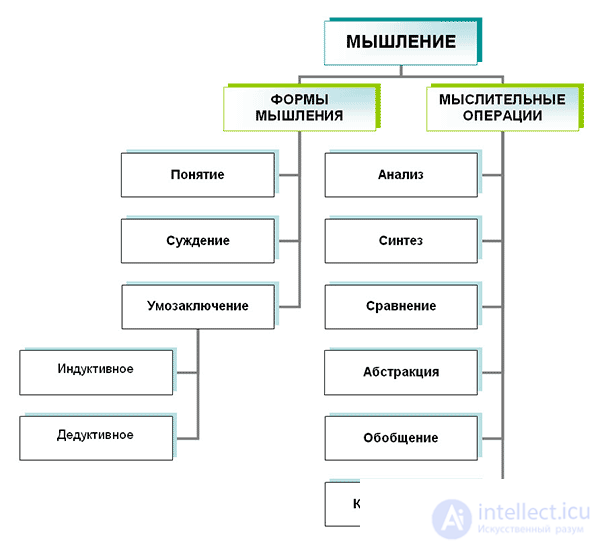
We have already said that scientific results that constitute a contribution to science are characterised by a high degree of generalisation and abstractness. Now it is time to clarify what the terms «generalisation» and «abstraction» mean. These are operations of thinking that are studied in detail in psychology and philosophy.
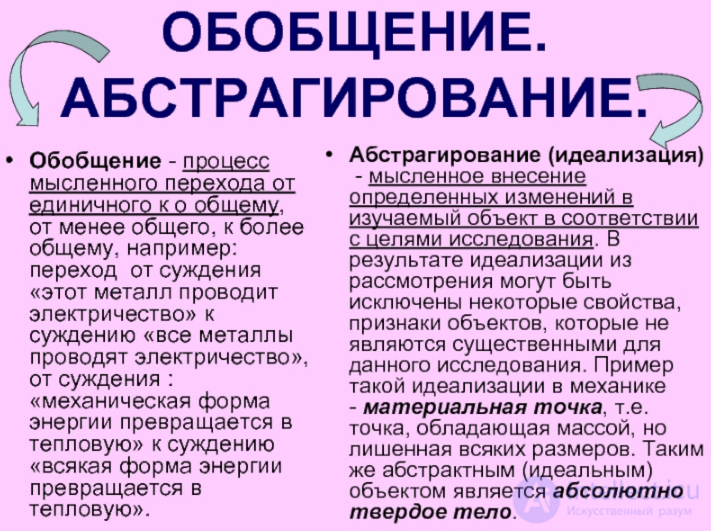
Abstraction – is a cognitive technique consisting in the mental disregard of properties (aspects, relations) of an object that are inessential within the framework of the current study, and in the identification of those aspects of it that correspond to the goal and content of the research. Mental disregard of properties and connections of the objects under study that are inessential in a certain respect, together with the simultaneous identification and fixing of
one or several aspects of these objects that are of interest to the researcher.
Generalisation – is a technique of thinking by which the common properties and features of objects are revealed. GENERALISATION is the mental identification of certain properties of objects of a given class, the disregard of singular, dissimilar properties, and the consideration of general properties common to all objects of the given class. Generalisation – is the movement of thought from the particular to the general, from the less general to the more general
Thus: Abstraction - is an emphasis on the idea, qualities and properties rather than on details (suppression of details).
Generalisation - is the extension of application to cover a wider range of objects of one or different types.
Parameter is a quantity whose value depends on the conditions of its application.
Substitution --- putting something in place of something else.
Encapsulate --- to enclose completely.
An example of generalisation and abstraction can be seen in the process of forming economic concepts. Thus, for example, the concept of a «small
enterprise» was formed by identifying the specific features of small enterprises (the number of employees not exceeding 50
people, and the annual income not exceeding 300,000 euros) and abstracting from their individual characteristics.
Isolating abstraction- The identification of properties and relations inseparably connected with objects, and their designation by specific «names», which gives such abstractions the status of independent objects (for example: «whiteness», «stability», etc.)
Abstraction of identification- The formation of concepts by combining objects into a special class, by identifying objects connected by relations of the equality type
Abstraction of constructivisation- Disregard of the indefinability, the «fluidity» of the boundaries of real objects, a «coarsening» of reality.
This makes it possible to formulate certain laws with respect to this coarsened reality, to understand it «as a first approximation» so as to
move further, deeper, in cognition
Abstraction of actual infinity- Disregard of the incompleteness of the process of forming an infinite set, of the impossibility of specifying it by a complete list of all its elements. Such a set is simply regarded as given, as existing
Abstraction of potential feasibility- Disregard of the real limits of human capabilities, conditioned by the finiteness of human life in space and time.
The type of a person's thinking can be judged by the structure of the meanings functioning in his speech. The stages of the development of meanings (both in sociogenesis and in ontogenesis) then give their names to forms of thinking: syncretic, complex and conceptual thinking. Types of generalisation differ from one another:
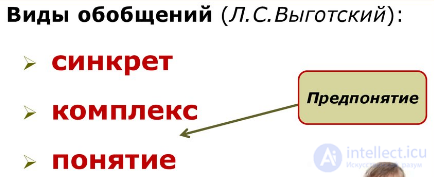
1. The most primitive generalisation – a syncrete (syncretic association) – consists in grouping objects on the basis of a random feature (objective or subjective). Thus, the coincidence of objects in time and/or space can become grounds (especially for a child) for applying a single name. "Yucky thing" – that is what a child calls the most varied objects that have nothing in common except that they all cause him displeasure. "Passengers of bus No. 5" – we say this about those who are riding on that bus right now, and who generally ride it to work every day, and who may perhaps ride it again someday. A syncrete is always egocentric, i.e. it fixes not the objective state of affairs but their relation to the bearer of meaning.
2. A more complex (and genetically later) formation is the complex (complex generalisation). In children's speech (and thinking) the word "quack" can mean a duck ("it quacks"), other species of swimming birds ("they swim like a duck"), any liquids (resemblance to the surface of water on which a duck swims), and a large shiny button (resembling the lake where the duck swam – round and shiny), and so on. The main principle by which objects and phenomena are generalised into a complex is the inconstancy of the basis (criterion), its instability and inessentiality. L. S. Vygotsky identified chain, nuclear, diffuse and collection complexes. Each member of a complex always has a resemblance to at least one feature with another member, but if several members are excluded from this series, then, without knowing the history of the complex's formation, it is impossible to understand why all these objects are called the same (in our example: why is a button called "quack"?). Complexes are based on the subject's empirical experience, and we often use such generalisations when solving everyday problems at the "level of common sense". For example, in calling our acquaintance Vasya a "skinflint", we base ourselves on a number of observations of his behaviour, ignoring the motives behind why he acted this way rather than another.
Aim of the assignment:
- to become familiar with the possibilities of applying the method of analogy in the field of economics and business.
Supplementary material
An interesting example of the application of the method of analogy in economics is sporting. Sporting is a view of economics and business through the eyes
of sport. It is the logic of sport in business. It is the use of the experience of sport in economics.
Let us analyse the viability of such an analogy in accordance with the rules we have studied. To do this, let us first identify the similar features of the objects being compared – sport and business:
The following can be cited as fundamental differences between sport and business:
As follows from the list of similarities and differences given above, some elements of sporting ideology, principles, techniques and methods
used in sport can be brought into the sphere of business. Coaching can be cited as an example of borrowing that has already taken place. Coaching (from the English coach – trainer, instructor, tutor) is personal support for the professional activity
of employees in the field of management, marketing and corporate business. A coach in business is the analogue of a trainer in sport.
Assignment
1. Give examples of the application of the method of analogy in the field of economics and business.
2. Analyse the appropriateness of a conclusion by analogy in the following situation. Enterprise A has raised the price of its products, and Enterprise B is planning to act by analogy. Enterprises A and B are similar in their period of operation, number of employees, and age of their directors. It remains to add that Enterprise A is a bread factory, and Enterprise B – a toy factory.
1. What are the procedures of analysis and synthesis?
2. What types of analysis-synthesis are distinguished?
3. What is an inference?
4. Make a comparative analysis of deductive and inductive inferences.
5. Give examples of deductive and inductive inferences.
6. What types of induction do you know? What is the difference between them?
7. Why is analogy classified as an inductive inference?
8. Give an example of an inference by analogy.
9. What procedures make it possible to increase the probability that a conclusion by analogy is true?
10. What are the techniques of abstraction and generalisation?

Comments