
Lecture
A concept is a thought that reflects the general, and moreover essential, properties of objects and phenomena.
A concept — is the unity, reflected in thought, of the essential properties and relations of objects; a thought that singles out and generalises objects of a certain class according to features that are common to them and, taken together, specific to them . In a more precise formulation: a concept is a thought that, by pointing to a certain feature, singles out from the universe and gathers (generalises) objects possessing that feature .
A concept, in its abstractness, stands opposed to the concreteness of perception. A concept is likewise opposed to a word, which can be treated as the sign of a concept .
Words and phrases that denote concepts are called terms .
For example, economic theory has formed such concepts as "commodity", "capital", "added value", "efficiency".
Note: while a person can picture some specific commodity as a mental image, they cannot picture added value or efficiency in the same way. The same goes for kindness, beauty, speed, and so on. A person can understand these, but not picture them. Why? Because concepts reflect not specific objects and phenomena but their general properties. More precisely, their general essential features (Fig. 8.2).
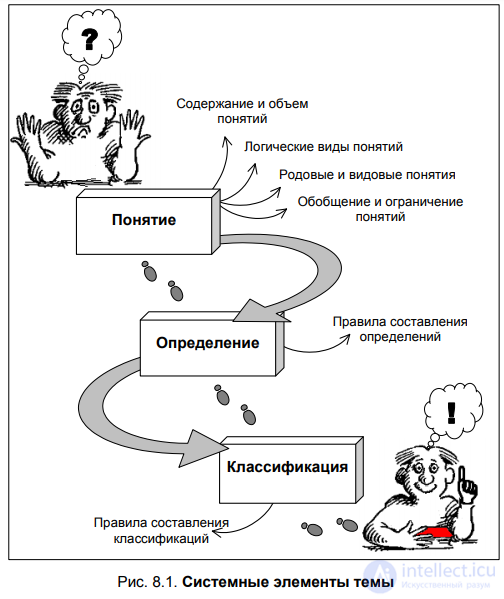
Working with concepts and forming definitions and classifications is an integral part of the research process (see Example 8.1). To reveal the essence of the phenomenon under study, it is necessary to identify its essential features and record the knowledge obtained in the form of a definition. Further study of the phenomenon under investigation requires analysis of its various forms, accompanied by the formation of a classification. A clear formulation of definitions and classifications makes it possible to avoid ambiguity, both at the stage of conducting scientific research and at the stages of approbation and implementation of results.
The purpose of this chapter is to explain to readers the rules for working with concepts and, above all, the rules for forming definitions and classifications. In order to correctly compose definitions and classifications, one needs to know what the essential features of an object are, which concepts are generic and which are specific, and what the limitation and generalisation of a concept are. We shall examine these questions in this chapter.
Example 8.1
Illustration of the application of operations with concepts in scientific research. Suppose, for example, that you are conducting a research study on the topic «The influence of national and personal holidays on the labour productivity of machine-building industry workers». First you will need to clarify the concept of «holiday». For instance, what does «national holiday» mean? What is the scope of this concept? Does the celebration of a national team's victory at the FIFA World Cup fall under this concept? Or is it each person's personal holiday? And what are the essential features of this concept? Can eating «olivier» salad be counted among them? Next, in order to convey an understanding of these nuances to others, you need to formulate definitions of the key concepts. You will then notice that the influence of holidays on labour productivity depends on the number of people celebrating, the duration of the celebration, established traditions, and so on. As a result, you will divide national holidays into formal and informal
(for example), and personal holidays into small-scale and large-scale. This means that you have already begun forming classifications.
The two most important characteristics of any concept are its content (intension) and scope (extension).
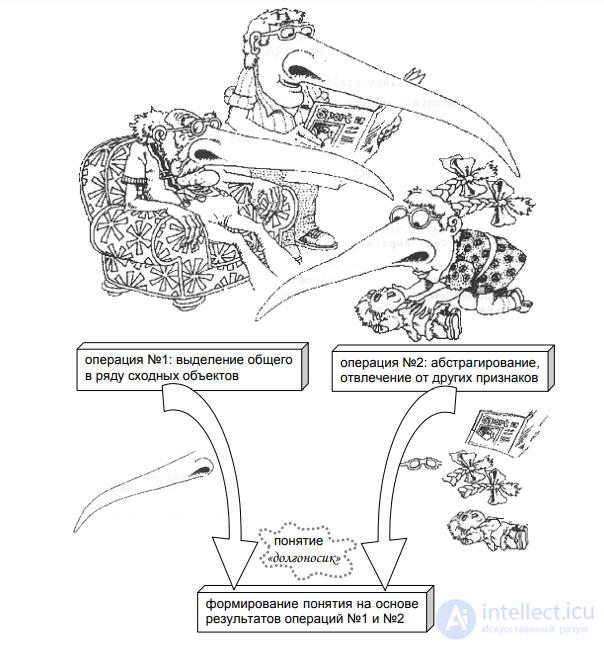
Fig. 8.2. A concept as the result of the operations of generalisation and abstraction
The content of a concept makes it possible to determine which objects fall under the given concept and which do not. That is, the content of a concept determines its scope. The relationship between the content and scope of a concept is expressed in the logical law of inverse relation (Fig. 8.3).
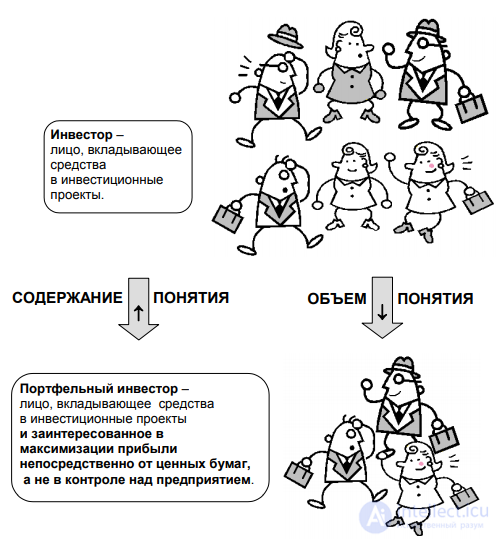
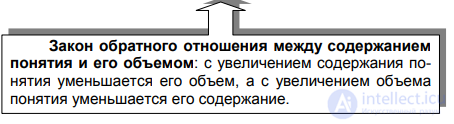
Fig. 8.3. The law of inverse relation between the content and scope of a concept
Consider, for example, two concepts: «investor» and «portfolio investor». The concept «investor» has a larger scope, since it extends to all persons investing funds in investment projects, whereas the concept «portfolio investor» covers only investors interested in maximising profit directly from securities. The content is greater for the concept «portfolio investor», since besides the features inherent in any investor, it also includes a specific feature – the absence of a drive to control the enterprise.
The characteristics of content and scope serve as grounds for the classification of concepts.
By scope, concepts are divided into general, singular and empty.
By content, concepts are subdivided into concrete and abstract, non-relative and relative [52].
As one ancient Greek put it, «I see a horse, but I do not see horseness», meaning the concreteness of the concept «horse» and the abstractness of the concept «horseness» [14].
Key concepts of this topic: concept, essential features of an object, content and scope of a concept, generic concept, specific concept, generalisation and limitation of concepts, definition, classification.
In Russian philosophical dictionaries of the 18th century (see Antiokh Kantemir and Grigory Teplov), the term «concept» was brought close to «idea».
By a concept Kant meant any general representation, insofar as the latter is fixed by a term. Hence his definition: «A concept… is a general representation, or a representation of that which is common to many objects, hence — a representation that has the possibility of being contained in various objects».
For Hegel, a concept — «is first of all a synonym for genuine understanding of the essence of the matter, and not merely an expression of any generality, any sameness of the objects of contemplation. In the concept, the true nature of a thing is revealed, not its resemblance to other things, and it must therefore find expression not only for abstract generality (this is only one moment of the concept, akin to representation), but also for the particularity of its object. This is why the form of the concept turns out to be a dialectical unity of universality and particularity, which is revealed through the various forms of judgement and inference, and comes to the surface in judgement. It is no wonder that any judgement breaks the form of abstract identity, being its most self-evident negation. Its form — A is B (that is, not-A)» .
The universal concept expresses not a simple abstract generality, the sameness of the individual representatives of a given class, but «the actual law of the emergence, development and disappearance of individual things» .
Concepts are «abbreviations in which we grasp, according to their common properties, a multitude of different sensuously perceived things» (F. Engels) .
The content and scope of a concept are distinguished. The content of a concept is the set of essential features of the class of objects falling under this concept. For example, the content of the concept «rhombus» is formed by the following two features: the generic one — «being a parallelogram» and the specific (species) one — «having equal sides». The scope of a concept is the set of the objects themselves (or classes of objects) falling under this concept. For example, the scope of the concept «tree» comprises the set of all trees (that have existed, exist, or will exist; real and imaginary), or the set of all varieties of trees.
There is an inverse relationship between the content and scope of a concept: the greater the content of a concept, the smaller its scope. In other words, the more features a concept includes, the fewer objects this concept covers (and vice versa). For example, the concept «deciduous tree» is greater in content, that is, it contains more features than the concept «tree», and accordingly the scope of the first concept turns out to be smaller (narrower) than the scope of the second, since deciduous trees are a part (or subclass) of all trees (trees in general)
By scope, concepts can be divided into singular, general and empty. The scope of a singular concept includes one single object (a one-element class) — for example, «the Russian writer Anton Pavlovich Chekhov», «the capital of Denmark». The scope of a general concept includes more than one object (for example, «tree», «chemical element»). The scope of an empty concept is an empty set (for example, «perpetual motion machine», «round square»). The scope of a general concept can be finite or infinite. Thus, the concept «prime number» has an infinite scope, while «prime number less than 20» has a finite scope (2, 3, 5, 7, 11, 13, 17, 19). Moreover, by reducing the scope of a general concept, we can arrive at a singular concept (x is a prime number, 36<x<38; we get the singular concept – the number 37).
By content, concepts are divided into positive and negative; relative and non-relative; collective and non-collective (divisive); concrete and abstract; empirical and theoretical.
1. Positive concepts record the presence of some feature in an object (for example, «a tidy person»), while negative concepts indicate the absence of this feature in an object («an untidy person»). If the negation «not» or «without» («un-») has become part of the word and the word is not used without it («to feel unwell»), such a concept is also considered positive.
2. Relative concept denotes an object whose existence presupposes the existence of some other object («pupil» — «teacher»). Non-relative concept denotes an object existing outside such a dependency («person», «tree»).
3. Collective is the name given to a concept denoting a set of homogeneous objects that is thought of as a single whole («flock», «fleet»). What is asserted in a collective concept applies to the whole collection of objects denoted by this concept, but cannot be applied to the individual objects making up this whole. Collective concepts can be general («forest») or singular («the constellation Boötes»). Unlike the collective, a non-collective (divisive) concept refers not to a group but to an individual object («tree», «star»).
4. A concept is called concrete if it relates to an object or class of objects (for example, «house»), and abstract if it reflects properties, features of an object taken separately from the object itself (for example, «whiteness», «kindness»), or relations between objects (for example, «equality»).
5. Empirical concepts are concepts about observable objects and their properties, while theoretical concepts are about unobservable objects. If empirical concepts are worked out on the basis of a direct comparison of the general properties of a certain class of existing (available for study) objects or phenomena, then theoretical ones are worked out on the basis of an indirect analysis of a certain class of objects or phenomena with the help of previously developed concepts, conceptions and formalisms.
The name of any material object is a concrete empirical concept, while its directly observable properties are expressed by abstract empirical concepts. Concrete theoretical concepts include, in particular, a number of concepts of theoretical physics, for example «electron»; an abstract theoretical concept is, for example, «spin».
In addition, different concepts can be comparable or incomparable. Concepts are considered comparable when their content contains common features. Concepts are usually called incomparable when they are significantly far apart from each other in content. Two concepts are comparable when they differ in content but coincide fully or partially in scope. Concepts whose scopes coincide are called identical (equivalent). As an example we can consider a square and a regular quadrilateral, or a cube and a regular hexahedron; even numbers and numbers divisible by two. Overlapping concepts are those whose scopes coincide only partially, or intersect. For example, a rectangle and a rhombus, or a number divisible by 2 and a number divisible by 3; the months of the third quarter of the year and the summer months. One concept may be subordinate to another. For example: real and rational numbers; a regular polygon and a square; identical transformations and reduction of a fraction; a linear function and a constant.
Concepts whose scopes intersect in the empty set, or equal zero, are called incompatible concepts. Such concepts are characterised by having a common genus[10].
In formalised representation, in the most general form, any concept is expressed by the following linguistic construction :
 ,
,
where  - is an integer,
  - is an (ordered) tuple of objects of length
  from the Cartesian product
  such that for the objects
  the relation
  holds. This construction is called a universal. In the case where
  the concept is expressed by a universal of the form:
 ,
,
where the objects α belong to the universe  and possess the feature
  .
.
Psychology makes it possible to approach the study of concepts empirically, investigating the relations between concepts that exist in consciousness (semantic clusters, groups, networks), including with the help of mathematical methods (cluster and factor analysis); the processes of concept formation, including by means of the method of forming artificial concepts; the age-related development of concepts, and so on.
Psychology has developed many methods for studying concepts, such as the associative experiment, the classification method, the method of subjective scaling, the semantic differential, and the method of forming artificial concepts.
In some cases, as, for example, in the method of the semantic radical, physiological measurements are also used.
Psychological research has established that concepts are not entities that are unchanging by nature, independent of the age of the subject operating with them. Mastery of concepts occurs gradually, and the concepts used by a child differ from the concepts of an adult. Various types of concepts have been identified, corresponding to changes in the understanding of space with the transition from one age stage to another.
J. Piaget found that at the preoperational stage of cognitive development (2—7 years), a child's concepts are not yet true concepts, but preconcepts. Preconcepts are figurative and concrete, relate neither to individual objects nor to classes of things, and are linked to one another by means of transductive reasoning, which consists in a transition from the particular to the particular.
L. S. Vygotsky and L. S. Sakharov, in their classic study[11], using their own procedure, which was a modification of N. Ach's procedure, established the types (which are also the age-related developmental stages) of concepts.
According to L. S. Vygotsky, a concept is the result of the development of a category of objects, which proceeds in four stages in accordance with an increasing level of complexity, generality and specificity of functioning[12].
L. S. Vygotsky, studying the development of concepts in childhood, wrote about everyday (spontaneous) and scientific concepts. Everyday concepts are words acquired and used in daily life, in everyday communication, such as «table», «cat», «house». Scientific concepts are words that a child learns at school, terms embedded in a system of knowledge, connected with other terms.
When using everyday concepts, for a long time the child (up to age 11-12) is aware only of the object to which they point, but not of the concepts themselves, not their meaning. Only gradually does the child master the meaning of concepts. According to Vygotsky's views, the development of spontaneous and scientific concepts proceeds in opposite directions: for spontaneous concepts — towards a gradual awareness of their meaning, for scientific concepts — in the reverse direction.
The awareness of meanings that comes with age is connected with the nascent systematicity of concepts, that is, with the establishment of logical relations between them. And since scientific concepts, which the child assimilates in the process of learning, differ fundamentally from everyday concepts precisely in that by their very nature they must be organised into a system, it is their meanings — Vygotsky believes — that are the first to become conscious. The awareness of the meanings of scientific concepts then gradually spreads to everyday concepts as well.
Problem-solving theory — a theoretical branch of artificial intelligence research — offers a fairly mathematically rigorous and at the same time intuitive interpretation of the term «concept». A complete mathematically rigorous description can be found in Banerji's monograph[14].
A less rigorous but more concise description can be given as follows:
In this interpretation, the law of inverse relation does indeed turn out to be a trivial consequence of the definition and one of the absorption laws A&B->A. It is worth noting that the law of inverse relation does not hold for an arbitrary property.
Banerji considers a model of problems in which a certain set of situations and a set of transformations (operations) of one situation into another are given. A subset of situations that constitute the goal of the solution is also singled out. «In doing so, we seek to translate a given situation into another admissible situation, applying a sequence of transformations, in order eventually to arrive at the target situation» . Concepts in Banerji's model are used to describe both the target subset and the strategy for choosing transformations.
It would be logical to call Banerji's concepts «proto-concepts», since in the general scientific sense concepts are singled out and fixed by means of a term in the course of solving a broad class of homogeneous problems in which their application has proved useful.

Comments